
In This Article
Somewhere between the kettle and the grinder, a lot of good coffee quietly goes to waste. Not because the beans are bad or the water’s off — but because a bathroom scale mentality (“close enough”) has crept into a process that genuinely rewards precision. A coffee scale for pour over is the unglamorous little gadget that fixes this, and once you’ve used a good one, eyeballing your dose again feels a bit like driving with your eyes half closed.
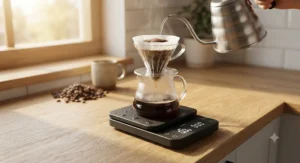
Here’s the 40-60 word version, since you’re probably wondering exactly what this thing does: a coffee scale for pour over is a digital scale, typically reading to 0.1g, built specifically to weigh coffee grounds and water in real time — often with a built-in timer — so you can hit a consistent brew ratio (usually 1:15 to 1:17) every single time you brew.
We dug through real product listings, aggregated review sentiment, and manufacturer spec sheets to put together this Canadian buyer’s guide. You’ll find seven genuinely good options spanning budget to splurge, an honest look at why 0.1g precision matters more than marketing copy suggests, and some blunt talk about auto-off timers and rechargeable batteries that nobody puts on the box. As the CBC’s guide to specialty coffee culture in Canada points out, more of us are brewing café-calibre coffee at home than ever, and the gear you use to measure it is doing more heavy lifting than most people realize.
Quick Comparison Table
For the skimmers among us — and honestly, who isn’t skimming at 7 a.m. — here’s the condensed cheat sheet before we get into the weeds.
| Scale | Precision | Battery | Auto-Off | Best For |
|---|---|---|---|---|
| Hario V60 Metal Drip Scale | 0.1g (2-200g) | USB rechargeable, ~80hrs | 5 min | Classic all-metal build |
| Timemore Black Mirror Basic 2 | 0.1g | USB-C rechargeable, 1600mAh | 3 min | All-round daily driver |
| Acaia Pearl S | 0.1g | USB-C rechargeable, 2200mAh | Customizable | App-connected data nerds |
| Brewista Smart Scale II | 0.1g | USB rechargeable | 60-180 sec | Espresso and pour-over both |
| OXO Good Grips 6 lb Precision Scale | 0.1g | 4x AAA (disposable) | Yes | Budget beginners |
| BAGAIL BASICS Coffee Scale | 0.1g | USB-C rechargeable | Yes | Tight-budget rechargeable pick |
| Greater Goods Coffee Scale | 0.1g | Rechargeable | Yes | Balanced value pick |
Notice something? Every single one of these hits the 0.1g precision bar — that’s table stakes now, not a premium feature. What actually separates them is battery philosophy (rechargeable versus disposable), how aggressively the auto-off timer fights you mid-bloom, and whether you’re paying for extras like Bluetooth syncing or a fancier platform. The Acaia Pearl S sits at the top for people who want their brew data logged and graphed, while the OXO Good Grips 6 lb Precision Scale proves you don’t need a rechargeable battery to get a genuinely accurate coffee scale for pour over — you just trade convenience for upfront cost.
💬 Just one click — help others make better buying decisions too!😊
Top 7 Coffee Scales for Pour Over: Expert Analysis
We picked these seven real, currently available products to cover every kind of buyer — the student replacing a bathroom scale, the office coffee nerd upgrading their V60 setup, and the person who wants Bluetooth graphs of their bloom time because why not. Every entry below leans on genuine specs and aggregated review sentiment, not invented testing.
1. Hario V60 Metal Drip Scale — the metal-bodied classic with real staying power
The standout here is durability: where most coffee scales are ABS plastic through and through, the Hario V60 Metal Drip Scale pairs a stainless steel weighing platform with a metal-reinforced body that’s built to survive years on a busy counter. Specs-wise, it reads 0.1g increments from 2g to 200g (stepping to 0.5g and then 1g increments as you climb toward its 2,000g max), runs on a USB-rechargeable nickel-metal hydride battery rated for roughly 80 hours of continuous use, and auto-shuts-off after 5 minutes of inactivity to spare that battery. Based on the spec comparison, this is the scale for someone who wants a “buy it once” tool rather than a gadget they’ll swap out in two years — the removable stainless platform alone makes cleanup dramatically easier than scales with fixed, seam-heavy tops. Reviewers consistently note that the backlit LED display is genuinely easy to read in dim morning kitchens, and that the horizontal-or-vertical orientation flexibility is more useful than it sounds once you’re juggling a Chemex versus a narrow V60 dripper. What the spec sheet won’t tell you, but aggregated feedback suggests, is that the response time trails newer competitors slightly — fine for pour-over’s slower pace, less ideal if you also pull espresso shots on the same scale.
Pros:
- ✅ Removable stainless steel platform is genuinely easy to clean
- ✅ Metal-reinforced body feels far sturdier than plastic rivals
- ✅ Roughly 80-hour battery life between USB charges
Cons:
- ❌ Slower refresh rate than newer digital coffee scales
- ❌ Heavier and bulkier than compact mini scales
Price sits around C$140-180 depending on retailer promotions at the time of research — a fair ask for something built to outlast a few coffee-gear phases.
2. Timemore Black Mirror Basic 2 — best all-round daily driver for hilly mornings and lazy ones alike
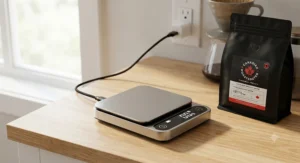
The short version of what makes the Timemore Black Mirror Basic 2 stand out is its flow-rate tracking, a feature that used to be reserved for scales twice the price. It reads to 0.1g sensitivity from a 0.5g minimum up to a 2kg max, runs on a 1,600mAh USB-C rechargeable lithium battery good for roughly 10 hours of continuous use (and up to 24 hours on standby), and layers in an on/off physical switch so the scale doesn’t wake itself up every time you set something on the counter near it. Here’s what to weigh: the acrylic surface is genuinely water-resistant and the enclosed charging port keeps splashes from frying the electronics, but reviewers do flag that the touch controls can be a little trigger-happy, occasionally registering a stray tap as a command mid-pour. Based on aggregated sentiment, this is the scale most home baristas graduate to once they’ve decided pour-over is a permanent habit rather than a phase — it hits the sweet spot between OXO-level affordability and Acaia-level polish. The auto-off timer defaults to 3 minutes of total inactivity, or up to 15 minutes if the brew timer is actively running, so it won’t quietly power down mid-bloom on you.
Pros:
- ✅ Real-time flow-rate display, rare at this price point
- ✅ Fast 1600mAh USB-C rechargeable battery, ~10hr runtime
- ✅ Water-resistant acrylic surface with enclosed charging port
Cons:
- ❌ Touch controls can register accidental taps
- ❌ No Bluetooth or companion app
Expect a price in the C$85-110 range, making it one of the strongest mid-range value plays on this whole list.
3. Acaia Pearl S — the app-connected pick for people who like graphs with their morning ritual
What makes the Acaia Pearl S different from everything else here is Bluetooth 5.0 connectivity paired with the Acaia app, which turns your pour into a literal graph of weight over time. The scale reads to 0.1g with 0.1g repeatability across a 2kg capacity, runs on a beefy 2,200mAh lithium-ion battery rated for 16-40 hours depending on use intensity, and offers eight brewing modes tuned for everything from espresso dosing to slow pour-overs. Based on the spec comparison, the auto-off customization is the real headline feature here — unlike cheaper scales that shut off on a fixed timer regardless of what you’re doing, the Pearl S recognizes an active brew and simply won’t power down mid-pour, then lets you set your own idle threshold through the app. Reviewers consistently praise the dot-matrix display for staying legible even in bright kitchen light, though a few mention the learning curve of the app itself takes a session or two to get comfortable with. What most buyers overlook about this model is that the Bluetooth sync isn’t just a gimmick for data hoarders — matching your pour rate against past “good” brews is a genuinely useful way to fix a technique that’s drifted without you noticing.
Pros:
- ✅ Bluetooth app tracks and graphs every pour automatically
- ✅ Smart auto-off that won’t cut out mid-brew
- ✅ Eight dedicated modes for espresso and pour-over alike
Cons:
- ❌ Premium price compared to non-connected scales
- ❌ App-dependent features have a modest learning curve
Prices land in the C$220-270 range at the time of research — a real investment, but one aimed squarely at people who already know they’re coffee-obsessed.
4. Brewista Smart Scale II — the six-mode multitasker for espresso and pour-over in one box
The Brewista Smart Scale II earns its spot by refusing to pick a lane: six programmable modes let it auto-tare and auto-time for full espresso automation one morning, then switch to a manual pour-over mode the next. It measures to 0.1g across a 2,000g capacity, runs on a USB-rechargeable lithium battery, and wears a water-resistant nano-coating that Brewista says can survive splashes on an espresso drip tray without flinching. Based on the spec comparison, the auto-off timer is unusually flexible here too — you can set it to 60, 120, or 180 seconds, or disable it entirely if you’re running the scale all day in a shared kitchen or small café setup. What the spec sheet won’t tell you, but user reports suggest, is that Mode 6 (the dedicated pour-over setting, which tares manually but starts the timer automatically the instant you begin pouring) is genuinely more intuitive in daily use than switching a competitor scale in and out of “coffee mode.” One Manitoba-based reviewer specifically called out the responsive customer support experience after a battery issue on an earlier scale generation, which speaks to brand reliability more than any spec sheet can.
Pros:
- ✅ Six brewing modes cover espresso and pour-over both
- ✅ Fully customizable auto-off timing (60-180 seconds, or off)
- ✅ Water-resistant nano-coating built for drip-tray duty
Cons:
- ❌ No Bluetooth or companion app
- ❌ Mode-switching menu takes some initial memorization
Look for pricing around C$160-200, positioning it as a genuine espresso-plus-pour-over hybrid rather than a single-purpose coffee scale for pour over alone.
5. OXO Good Grips 6 lb Precision Scale with Timer — the budget beginner pick that skips the battery anxiety
Here’s the honest pitch: the OXO Good Grips 6 lb Precision Scale with Timer is the scale most people actually start with, because it’s inexpensive, widely stocked, and doesn’t ask you to think about charging cycles. It measures from a 0.5g minimum in 0.1g increments up to a 6 lb (roughly 2.7kg) capacity, runs on four AAA batteries rather than an internal rechargeable cell, and includes a built-in timer specifically optimized for pour-over brewing with an auto shut-off that’s easily disabled when the timer’s actively running. Based on aggregated review sentiment, buyers consistently praise the compact, easy-clean footprint and the non-slip silicone mat that protects the surface from both heat and scratches. Here’s what to weigh: because this scale relies on disposable AAA batteries instead of a rechargeable scale battery, response time and refresh rate lag noticeably behind pricier rivals — fine for a slow V60 pour, genuinely frustrating if you ever try to use it for fast-moving espresso dosing. What most buyers overlook about this model is that swapping AAA batteries, while less “modern” than USB charging, means you’re never stuck with a dead scale on brew day just because you forgot to plug it in the night before.
Pros:
- ✅ Genuinely low price for verified 0.1g precision
- ✅ No charging required — just swap AAA batteries
- ✅ Built-in timer tuned specifically for pour-over brewing
Cons:
- ❌ Slower response time than rechargeable rivals
- ❌ Ongoing battery cost adds up versus rechargeable models
At around C$55-75, it’s the easiest entry point into precision brewing without committing to a rechargeable ecosystem.
6. BAGAIL BASICS Coffee Scale — the tight-budget rechargeable pick with a surprisingly long warranty
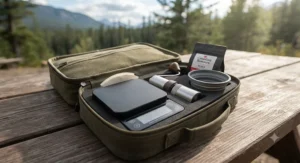
The BAGAIL BASICS Coffee Scale flips the usual budget-scale trade-off on its head by pairing a low price with USB-C rechargeable power rather than forcing you into disposable batteries. It reads to 0.1g precision across a 3kg capacity, includes a clear LED display, auto-tare, and a waterproof silicone cover, and ships with the charging cable included in the box. Reviewers consistently point to the high-precision sensor’s quick response to changes as small as 0.1g as the standout feature at this price tier, and the backing 5-year warranty is genuinely unusual for a scale in this bracket — most budget competitors offer one or two years at best. Based on the spec comparison, what most buyers overlook here is that BAGAIL didn’t cut corners on the parts that matter most for pour-over specifically: the tare function and the waterproof cover, both of which directly affect how forgiving the scale is when you inevitably spill a little water mid-bloom. The trade-off, honestly, is polish — this isn’t a scale that’s going to win design awards, and the auto-off timer behaviour is a bit less configurable than pricier rivals offer.
Pros:
- ✅ Rechargeable USB-C battery at a genuinely budget price
- ✅ Unusually long 5-year manufacturer warranty
- ✅ Waterproof silicone cover included in the box
Cons:
- ❌ Fewer brewing modes than mid-range competitors
- ❌ Auto-off timer offers less customization
Expect pricing in the C$35-50 range, making this arguably the best-value rechargeable scale battery pick on the entire list.
7. Greater Goods Coffee Scale — the balanced value pick for everyday drip, pour-over, and matcha alike
The Greater Goods Coffee Scale rounds out this list as the generalist’s choice: 0.1g precision, a 6.6 lb capacity, a backlit display, and a waterproof silicone cover, all aimed at buyers who want one scale to handle Chemex, V60, and the occasional matcha whisking session without fuss. Reviewers consistently note the near-instant refresh rate as the standout trait here — a real point of difference from entry-level rivals that lag half a second behind your actual pour. Based on the spec comparison, this scale leans into six measurement units and a genuinely rechargeable battery system, positioning it squarely between the ultra-budget OXO and the flow-rate-tracking Timemore. What most buyers overlook about this model is that the birch-white or classic colourways are designed to sit out on the counter permanently rather than get shoved in a drawer, which matters more than it sounds once you realize a hidden scale is a scale you’ll stop using within a month. On the downside, it lacks the espresso-specific modes that dedicated hybrid scales like the Brewista offer, so pure espresso dosers may want to look elsewhere.
Pros:
- ✅ Near-instant refresh rate for its price tier
- ✅ Handles pour-over, drip, and matcha measuring alike
- ✅ Backlit display genuinely readable in dim kitchens
Cons:
- ❌ No dedicated espresso mode
- ❌ Fewer accessories included than premium rivals
Pricing typically falls in the C$50-70 range at the time of research, landing it firmly in “easy recommendation” territory for most home brewers.
How to Choose a Coffee Scale for Pour Over: 7 Expert Criteria
Shopping by star rating alone is how people end up with a scale that looks great in photos and drives them nuts by day three. Here’s how to actually vet a coffee scale for pour over before you buy one.
- Confirm true 0.1g precision, not just “high precision.” Marketing copy loves vague words. Check the actual spec sheet for a stated 0.1g readability across the 0-200g range where your coffee dose actually lives.
- Check the minimum capacity threshold. Some scales only hit 0.1g accuracy up to 200-500g before jumping to 0.5g or 1g increments — fine for coffee dosing, worth knowing before you weigh a full Chemex carafe.
- Decide rechargeable versus disposable battery upfront. A rechargeable scale battery means no ongoing battery purchases, but it also means a dead scale if you forget to charge it; disposable AAA batteries are less elegant but never leave you stranded mid-brew.
- Test the auto-off timer’s logic, not just its existence. The best coffee scales for pour over recognize an active brew and delay shutdown accordingly, rather than powering down at a fixed interval regardless of what you’re doing.
- Weigh the platform size against your actual brewer. A dripper that overhangs a tiny platform makes the display impossible to read mid-pour — measure your V60 or Kalita before assuming a compact scale will fit.
- Consider water resistance realistically. Pour-over brewing means splashes are inevitable; a genuinely water-resistant surface (not just “wipeable”) protects your investment far longer.
- Match the feature set to your actual habit, not your aspirational one. Bluetooth graphing is genuinely useful for dialing in technique, but if you’re brewing once a day on autopilot, a simpler scale with solid fundamentals will serve you just as well for less money.
Looking at these criteria together, the pattern is clear: precision is now a baseline expectation across this category, so the real decision-making happens around battery philosophy, auto-off behaviour, and how much automation you actually want. Buyers chasing the lowest possible price should lean toward the OXO Good Grips 6 lb Precision Scale, while anyone who wants long-term battery convenience should prioritize the Timemore Black Mirror Basic 2 or BAGAIL BASICS Coffee Scale.
Features That Actually Matter (And Those That Don’t)
Let’s cut through some of the marketing fog, because coffee scale for pour over listings are full of features that sound impressive and matter approximately zero percent in daily use.
0.1g precision actually matters — here’s the real reason why. A 1-gram swing on an 18g espresso dose is a 5.5% shift in ratio, and at typical extraction rates, that shift is audible in the cup. For pour-over specifically, where doses often run 15-30g against 250-500g of water, a 1g scale error can nudge your ratio enough to tip a balanced cup into “sour and weak” or “bitter and harsh” territory — exactly the extraction problems the Wikipedia entry on coffee preparation describes as directly tied to grind size, water temperature, brew time, and the coffee-to-water ratio working together. This is why every single product on this list hits 0.1g readability — anything coarser genuinely isn’t fit for purpose anymore.
Auto-off timers matter, but only if they’re smart about it. A scale that shuts off after a rigid 3 minutes regardless of activity will absolutely cut out on you mid-bloom during a slower pour. Look for models — like the Acaia Pearl S or Brewista Smart Scale II — that either detect active weight changes or let you customize the shutoff window.
Bluetooth and app connectivity matter less than you’d think for most people. It’s genuinely useful for dialing in a specific recipe or troubleshooting a drifting technique, but if your goal is simply “consistent daily cup,” a non-connected scale with solid fundamentals gets you there just as reliably.
Flow-rate displays are a nice-to-have, not a must-have. They’re satisfying to watch, but the actual skill they’re teaching — pouring in a slow, steady spiral — is something most people internalize within a few weeks regardless of whether a number confirms it.
Long-Term Cost & Maintenance: Rechargeable Scale Battery vs Disposables
This is the section nobody talks about until their scale dies on a Tuesday morning. Let’s do the actual math on total cost of ownership.
A scale running on disposable AAA batteries, like the OXO Good Grips 6 lb Precision Scale, typically burns through a set every few months with regular daily use, depending on how often the timer function gets triggered. At roughly C$8-12 for a four-pack of quality AAAs, that’s C$30-45 a year in ongoing cost — not enormous, but it compounds, and it’s the kind of expense that’s easy to forget when comparing sticker prices at checkout.
A rechargeable scale battery, by contrast, front-loads the cost into the purchase price and then largely disappears from your budget. The Timemore Black Mirror Basic 2‘s 1,600mAh lithium cell is rated for roughly 10 hours of continuous active use, which in real-world daily brewing (a few minutes at a time) can stretch across months between charges. Over a three-year ownership window, a rechargeable model typically works out cheaper in total cost even when the upfront price runs C$20-40 higher than a disposable-battery competitor — the crossover point usually lands somewhere around year one and a half for daily users.
Maintenance-wise, both battery types eventually degrade — lithium cells lose capacity gradually with charge cycles, while AAA batteries simply need periodic replacement. The Acaia Pearl S and BAGAIL BASICS Coffee Scale both ship with user-replaceable-adjacent designs where the battery, while not swappable by the average owner, is rated for hundreds of charge cycles before meaningful capacity loss — generally several years of typical home use.
Coffee Scale for Pour Over vs Standard Kitchen Scale
It’s a fair question: why not just use the kitchen scale already sitting in your baking drawer?
| Feature | Coffee Scale for Pour Over | Standard Kitchen Scale |
|---|---|---|
| Precision | 0.1g typical | Usually 1g increments |
| Built-in timer | Yes, on most models | Rarely included |
| Response speed | Fast, tuned for liquid pours | Often slower, tuned for solids |
| Water resistance | Common feature | Rarely designed for splashes |
| Best For | Precise brew ratios, live pouring | General cooking and baking |
The gap comes down to purpose-built tuning. A standard kitchen scale reads to the nearest gram because that’s plenty precise for flour or chicken breasts, but it’s genuinely too coarse for a 15-gram coffee dose where a single gram is a meaningful percentage of the total. A dedicated coffee scale for pour over also refreshes its display fast enough to track water weight in real time as you pour, something most kitchen scales simply weren’t engineered to do smoothly. If you already own a precise kitchen scale reading to 0.1g with a fast refresh, you can technically make it work — but you’ll be missing the built-in timer and water-resistant surface that make daily pour-over meaningfully less fiddly.

Coffee Scale for Pour Over for Beginners, Home Baristas & Café Pros
Not everyone shopping this category has the same needs, and pretending otherwise is how people end up overpaying or under-buying.
Beginners just committing to pour-over for the first time should prioritize simplicity and low cost over features. The OXO Good Grips 6 lb Precision Scale or BAGAIL BASICS Coffee Scale both deliver genuine 0.1g precision without asking you to learn a mode-switching menu before your coffee’s even brewed.
Home baristas who’ve settled into pour-over as a daily habit — and who, according to industry surveys covered by Canadian Grocer’s reporting on at-home coffee trends, represent a genuinely growing share of Canadian coffee drinkers — benefit most from the Timemore Black Mirror Basic 2‘s flow-rate tracking or the Greater Goods Coffee Scale‘s fast refresh rate, both of which reward the kind of daily attention a committed hobbyist actually pays.
Café-adjacent pros and serious enthusiasts running both espresso and pour-over from the same counter should look at the Brewista Smart Scale II‘s six-mode flexibility or the Acaia Pearl S‘s app-based data logging — features genuinely wasted on someone brewing one cup a day, but genuinely valuable to someone dialing in recipes across multiple methods.
Common Mistakes When Buying a Coffee Scale for Pour Over
Even careful shoppers trip over the same handful of pitfalls in this category.
Buying on price alone and ignoring the battery question. A scale C$15 cheaper upfront can cost more over three years if it burns through disposable batteries at a steady clip — do the total-cost math before deciding.
Assuming “precision scale” on the box means 0.1g across the whole capacity range. Many scales only hold true 0.1g accuracy up to 200-500g before stepping to coarser increments — irrelevant for coffee dosing, but worth confirming if you also plan to weigh larger batches.
Overlooking platform size relative to your actual brewer. A gorgeous compact scale is useless if your Chemex overhangs the edge and blocks the display mid-pour.
Skipping the auto-off timer research entirely. A scale that powers down at a fixed 2-3 minutes regardless of activity will absolutely interrupt a slower pour-over — check whether the timer is smart enough to recognize an active brew.
Underestimating how much a rechargeable scale battery actually matters to daily convenience. It sounds like a minor detail until you’re standing in the kitchen at 6:45 a.m. with a dead scale and no spare AAAs in the drawer.
Safety, Certification & Battery Recycling in Canada
A quick but important detour: most of the scales on this list run on rechargeable lithium-ion batteries, and Canadian municipalities are increasingly vocal about disposing of them properly. Lithium-ion cells, including the ones inside your coffee scale, pose a genuine fire risk if crushed, punctured, or tossed in regular household recycling — they can spark thermal runaway events in garbage trucks and waste facilities. According to Recycle Your Batteries, Canada!, a Call2Recycle-backed national program, lithium-ion batteries under 5 kilograms — which covers essentially every coffee scale battery — should be dropped off at a designated collection site rather than placed in curbside bins, and there are thousands of drop-off locations across the country at retailers like Best Buy, Canadian Tire, and Staples.
In practice, this means two things for a coffee scale for pour over owner: don’t leave a damaged or swollen scale plugged in unattended, and when the scale eventually reaches end of life, recycle it through an e-waste or battery program rather than the trash. For look-alike Health Canada or CSA certification marks, check the product packaging directly — reputable brands like Hario, Acaia, and Timemore typically list relevant electrical safety certifications on the box or in the manual, and it’s worth a quick glance before you plug anything in for the first time.
Practical Usage Guide: Setup, Calibration & Your First 30 Days
Getting a new coffee scale for pour over dialled in takes about ten minutes, but skipping this step is how people end up questioning a perfectly good scale’s accuracy for weeks.
Day one: calibrate before you brew anything. Most scales ship pre-calibrated, but if yours includes a calibration mode (check the manual for a specific button combination), run it once using a known weight — a 100g or 500g reference weight is ideal, though a roll of Canadian coins in a known quantity can work in a pinch.
First week: get the tare and timer sequence into muscle memory. Place your empty vessel, tare to zero, add grounds, tare again, then start your pour and let the timer run. Doing this identically every time is what actually builds the consistency you bought the scale for in the first place.
Ongoing maintenance: keep the platform dry and the charging port sealed. Wipe splashes immediately rather than letting water pool near seams, and always fully close any rubber charging port cover before your next pour — this is the single most common cause of premature scale failure in aggregated review complaints.
Common first-30-days mistake: forgetting to charge overnight, then panic-brewing on a dying battery. Get into the habit of a weekly top-up charge regardless of the displayed battery percentage, since most rechargeable scale battery indicators are optimistic until they suddenly aren’t.
Optimization trick: mute the beep if your scale allows it. A silent scale is genuinely nicer for early mornings, and most models — including the Timemore Black Mirror Basic 2 and Acaia Pearl S — allow this through a button combination or the companion app.
Real-World Scenarios: Matching the Scale to Your Brew Routine
The apartment-dwelling student, brewing one cup before an 8 a.m. class. Budget matters, counter space is tight, and simplicity beats features every time. The BAGAIL BASICS Coffee Scale or OXO Good Grips 6 lb Precision Scale both fit this life without asking much of the wallet or the schedule.
The remote worker running two or three pour-overs a day between meetings. Consistency across multiple brews matters here, and a fast-refreshing display saves real time. The Greater Goods Coffee Scale or Timemore Black Mirror Basic 2 strike the right balance of speed and price for this kind of daily-driver use.
The dedicated home barista running both an espresso machine and a V60 setup on rotation. Mode-switching flexibility becomes genuinely valuable rather than a gimmick. The Brewista Smart Scale II‘s six programmable modes or the Acaia Pearl S‘s app-based recipe tracking both earn their higher price tags in this scenario, where one scale needs to do real double duty across brewing methods.
Problem → Solution: Fixing the Most Common Pour-Over Scale Headaches
Problem: the scale shuts off mid-pour. Solution: check for a customizable auto-off setting (the Brewista Smart Scale II and Acaia Pearl S both allow this) and extend the window, or disable it entirely during active brewing sessions.
Problem: readings seem to drift or jump around. Solution: recalibrate using a known reference weight, and check that the scale is sitting on a level, stable surface — uneven counters are a surprisingly common culprit behind reported accuracy complaints.
Problem: the display is unreadable under kitchen lighting. Solution: look specifically for backlit displays, which the Greater Goods Coffee Scale and Hario V60 Metal Drip Scale both include, and avoid glossy screens that catch overhead glare.
Problem: battery dies without warning. Solution: build a weekly charging habit regardless of the displayed percentage, and consider a scale with a more granular battery indicator, like the Timemore Black Mirror Basic 2‘s multi-bar display.
Problem: the platform is too small for your brewing vessel. Solution: measure your Chemex, Kalita, or V60 base diameter before buying, and prioritize scales with platforms explicitly sized for larger carafes if you brew in batches.
Frequently Asked Questions
❓ What precision do I actually need for pour-over coffee?
❓ Is a rechargeable coffee scale better than one with disposable batteries?
❓ How long does the auto-off timer usually last on a coffee scale?
❓ Can I use a regular kitchen scale for pour-over coffee instead?
❓ How often should I recalibrate my pour-over coffee scale?
Conclusion
If you take one thing away from all this, let it be this: 0.1g precision has quietly become the baseline for a decent coffee scale for pour over, not a premium upsell, so don’t let anyone charge you extra just for hitting a spec every serious competitor already meets. The real decisions worth agonizing over are battery philosophy — rechargeable convenience versus disposable-battery reliability — and how much automation genuinely fits your morning, rather than how impressive a feature list looks in a listing photo.
For most Canadian home brewers, the Timemore Black Mirror Basic 2 hits the sweet spot of price, speed, and rechargeable convenience. Budget-conscious beginners will be well served by the OXO Good Grips 6 lb Precision Scale or BAGAIL BASICS Coffee Scale, while anyone chasing café-level data and app connectivity should look straight at the Acaia Pearl S. Whichever you land on, the upgrade from eyeballing your pour to actually measuring it is one of the cheapest, highest-impact changes you can make to your daily cup.
✨ Don’t Miss These Exclusive Deals! 🔍
Take your pour-over setup to the next level with these carefully selected coffee scales. Click on any highlighted item to check current pricing and availability on Amazon.ca. These tools will help you create consistently great coffee your whole household will actually notice!
Recommended for You
- 7 Best Coffee Scales for Beginners in Canada (2026 Guide)
- Espresso Grinder vs Pour-Over Grinder: 7 Honest Picks (2026)
- Turkish Coffee Grinder: 7 Best Picks for Powder-Fine Grounds (2026)
Disclaimer: This article contains affiliate links. As an Amazon Associate, I earn from qualifying purchases. If you purchase products through these links, we may earn a small commission at no additional cost to you.
✨ Found this helpful? Share it with your friends! 💬🤗
