
In This Article
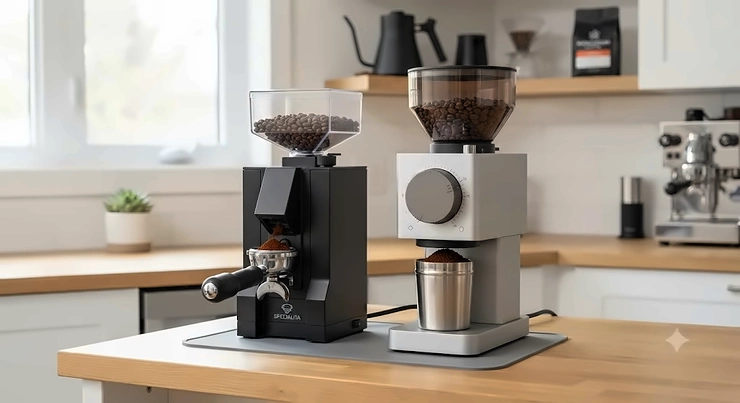
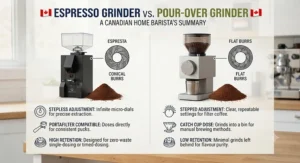
An espresso grinder vs pour-over grinder debate boils down to one number: grind range. Espresso needs a narrow, ultra-fine 180-380 micron window to survive nine bars of pressure, while pour-over wants a coarser, more forgiving 410-930 micron spread for gravity-fed brewing. Everything else — burr type, dosing, price — follows from that gap.
If you’ve ever stood in your kitchen wondering whether the grinder you already own is quietly ruining your espresso, or your pour-over, or both, you’re asking exactly the right question. Canadians have gotten noticeably more particular about their coffee in the last few years — seven in ten of us drink at least one cup daily, and a growing share of that group has moved past pre-ground bags and into the world of home burr grinders, dialled shots, and Sunday-morning Chemex rituals. That shift raises a genuinely practical question: does an espresso grinder vs pour-over grinder choice actually matter, or is a grinder just a grinder?
It matters more than most marketing copy admits, and less than some coffee snobs insist. The honest answer sits somewhere in the middle, and it depends entirely on your grind-size needs, your budget, and how much you value one machine doing everything reasonably well versus two machines each doing one thing brilliantly. Below, we’ve pulled seven real, currently available grinders — from a C$280 budget starter to a premium C$900 single-dose machine — and broken down exactly where each one lands on the espresso-to-pour-over spectrum, with honest pros, cons, and price ranges in Canadian dollars throughout.
Quick Comparison Table
| Factor | Espresso Grinder | Pour-Over Grinder |
|---|---|---|
| Grind range | Fine, roughly 180-380 microns | Coarser, roughly 410-930 microns |
| Common burr type | Flat burrs (55-64mm) or precision conical | Conical or stepped brew burrs |
| Adjustment style | Stepless preferred for shot-to-shot precision | Stepped or stepless; less critical here |
| Typical price in Canada | C$450-C$950+ | C$260-C$550 |
| Best for | Daily shot-pullers | Chemex, Kalita Wave, drip, French press |
The gap in the table above is the whole story: espresso’s narrow window rewards a grinder engineered specifically for it, while pour-over’s wider tolerance means even a budget machine like the Baratza Encore ESP can produce a genuinely good cup. Price tends to track precision, not versatility — a stepless espresso grinder like the Eureka Mignon Specialita costs more because that narrow band has to be hit reliably shot after shot, not because it’s inherently “better” than a filter specialist like the Fellow Ode Gen 2.
💬 Just one click — help others make better buying decisions too!😊
Top 7 Espresso and Pour-Over Grinders: Expert Analysis
All seven grinders below are real, currently available models — no filler placeholders. Quick primer: a burr grinder crushes beans between two revolving surfaces rather than chopping them with a spinning blade, and the distance between those surfaces is what sets your grind size. We’ve spread these picks across budget, mid-range, and premium price points, and deliberately mixed single-method specialists with true multi-method all-rounders so you can see the trade-off in real products instead of in the abstract.
1. Baratza Encore ESP — best budget grinder that covers both brew styles
The name gives away the standout feature: this is Baratza’s classic Encore reworked with an ESP steel burr set so first-time buyers no longer have to choose between an espresso grinder and a pour-over grinder outright. The 40mm conical steel burrs spin across 40 click-stop settings covering everything from coarse French press to fine moka pot, and the motor is built to run cool through back-to-back grinds without overheating. In practice, that range means one machine can grind for a Chemex Saturday morning and a stovetop moka the same afternoon, though the jumps between the finest settings are noticeably bigger than on true single-dose espresso grinders. Based on the spec comparison with dedicated espresso machines, the Encore ESP reads best as an excellent pour-over and drip grinder that can technically reach espresso-adjacent territory, not a grinder built for microscopic espresso adjustments. Reviewers who’ve run it for a year or more consistently praise its user-serviceable design — every burr, gear, and hopper part is replaceable — and its reliability under daily use, though several also flag it as one of the louder grinders in its price bracket.
Pros:
- ✅ Grinds everything from French press to moka pot
- ✅ Fully user-serviceable with swappable burrs and parts
- ✅ Proven reliability after years of daily grinding
Cons:
- ❌ Loud operation, especially on longer grind cycles
- ❌ Coarse steps between fine settings limit true espresso precision
At the time of research, the Baratza Encore ESP sits in the C$260-C$300 range in Canada, making it one of the few genuinely dual-purpose grinders under C$300 — solid value if espresso is occasional rather than daily.
2. Baratza Virtuoso+ — best single-method pick for pour-over purists
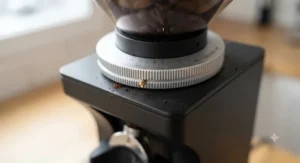
What stands out here is focus: Baratza built the Virtuoso+ to do one job — filter coffee — extremely well, rather than compromise across every brew method. Its 40mm stainless steel conical burrs span 40 settings from roughly 200 to 1,200 microns, powered by a 70-watt DC motor with a digital timer for repeatable dosing down to the second. That range comfortably covers pour-over, drip, and French press, but based on the spec comparison it stops short of the tight adjustment window espresso demands — Baratza itself positions this as a brew grinder, not an espresso grinder. What most buyers overlook is that the trade-off is deliberate: fewer, better-optimized settings for filter coffee instead of a compromise range trying to do everything. Reviewers consistently report exceptional grind consistency and a motor that feels noticeably more powerful than budget competitors, alongside a minor complaint about a hopper that wobbles slightly during grinding.
Pros:
- ✅ Exceptional grind consistency across pour-over and drip settings
- ✅ Powerful DC motor with digital timer for repeatable dosing
- ✅ Durable build designed for years of daily service
Cons:
- ❌ Not built to dial in true espresso
- ❌ Bean hopper feels slightly wobbly during operation
At the time of research, the Baratza Virtuoso+ runs in the C$340-C$380 range — a fair premium over the Encore ESP for meaningfully better filter-coffee consistency.
3. Eureka Mignon Specialita — quietest espresso-first grinder that still handles filter
The standout here is silence: independent testing has clocked the Specialita around 55 decibels, which reviewers call the quietest grinder they’ve measured across more than a decade of testing home espresso gear. Underneath that quiet motor sit 55mm hardened steel flat burrs on a stepless micrometric collar, tuned primarily for fine-to-medium-fine espresso with a medium-coarse range that stretches into filter territory, though it isn’t optimized specifically for pour-over the way a dedicated brew grinder is. Based on the spec comparison, the all-metal Italian build and hands-free portafilter cradle are what separate this from budget flat-burr grinders — load the portafilter, tap a button, and walk away. Here’s what to weigh: the stepless collar has no printed numbers, so reviewers note it takes two to three weeks of practice, usually with a strip of tape as a reference marker, before dial-in becomes second nature. Aggregated review sentiment is strongly positive on particle uniformity, with testers comparing it favourably to grinders costing hundreds more.
Pros:
- ✅ Genuinely quiet operation even during long grinding sessions
- ✅ Hands-free portafilter cradle speeds up the daily shot routine
- ✅ All-metal Italian build engineered for a decade-plus of use
Cons:
- ❌ Unmarked stepless collar takes weeks to fully master
- ❌ Less optimized for filter coffee than dedicated pour-over grinders
At the time of research, the Eureka Mignon Specialita lands in the C$780-C$820 range, a fair ask for commercial-grade Italian engineering at home.
4. Fellow Ode Gen 2 — best dedicated pour-over grinder, no espresso pretending
Fellow’s standout decision with the Ode Gen 2 was refusing to chase espresso at all — the company’s own support documentation states plainly that grinding espresso on this machine voids the warranty, and recommends its sibling grinder, the Opus, for anyone who needs both. That single-method focus lets the Gen 2’s 31-step conical brew burrs, larger 100-gram hopper, and built-in ionizer concentrate entirely on filter coffee, and the ionizer has largely solved the static-cling mess that dogged the original Ode. Based on the spec comparison with the first-generation model, Gen 2 also grinds noticeably finer, giving it more range for AeroPress-style immersion brewing without ever crossing into espresso territory. What most buyers overlook is that this narrower focus is a feature, not a limitation, if pour-over and drip are genuinely all you need. Reviewers consistently describe the redesigned burrs as delivering better sweetness and balance than the original, and call the mess reduction the single biggest upgrade in Gen 2.
Pros:
- ✅ Built-in ionizer virtually eliminates static and grounds mess
- ✅ Larger hopper and catch cup than the original Ode
- ✅ Redesigned burrs sharpen sweetness and balance in filter coffee
Cons:
- ❌ Not approved for espresso; doing so voids the warranty
- ❌ Single-purpose design means a second grinder for shot-pulling days
At the time of research, the Fellow Ode Gen 2 sits around C$480-C$520, positioning it as a premium single-method purchase rather than a do-it-all machine.
5. DF64 Gen 2 — best upgradeable single-dose grinder for espresso first, filter later
The standout feature is upgrade potential: the DF64 Gen 2 ships with 64mm stainless steel flat burrs from ItalMill — one of the most common burr sizes on the market — meaning owners can later swap in third-party SSP burrs without replacing the whole grinder. Out of the box, its 250-watt motor spinning at a fixed 1,400 RPM grinds a typical espresso dose in 7 to 11 seconds and is, by the manufacturer’s own framing, optimized for espresso rather than filter coffee. Based on the spec comparison, this is where the single-method-versus-multi-method question gets interesting: the DF64 Gen 2 starts life as a single-method espresso grinder, but its popular burr size turns it into a genuine multi-method option once you invest in an SSP burr upgrade for pour-over. Reviewers who tested the Gen 2 against the original DF64 report a marked improvement — the declumping and static issues that plagued the first version are largely resolved — and call it exceptional value for a single-dose grinder in this range.
Pros:
- ✅ Common 64mm burr size opens an easy path to upgrades
- ✅ Fixes the popcorning and static problems of the original
- ✅ Strong value against pricier single-dose espresso grinders
Cons:
- ❌ Fixed RPM offers no speed adjustment
- ❌ Needs an SSP burr swap to truly excel at pour-over
At the time of research, the DF64 Gen 2 runs roughly C$540-C$570 before any burr upgrade, competitive for a single-dose machine with this much aftermarket flexibility.
6. Niche Zero — best premium do-it-all conical grinder
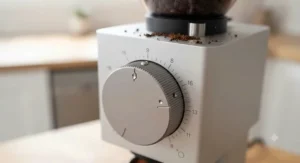
What stands out about the Niche Zero is that it was designed from day one as a true multi-method grinder rather than a specialist with a workaround: its 63mm conical burrs, from the same Mazzer Kony lineage used in commercial grinders, sit on a fully stepless dial with no click-stops at all. That range is wide enough to run comfortably from fine espresso through medium pour-over settings to coarse French press, all on a single-dose hopper holding about 55 grams — enough for either three double shots or roughly four cups of filter coffee. Based on the spec comparison, the real headline is retention: independent testing puts leftover grounds low enough that testers describe it as “well below what a human can taste,” a genuine rarity among grinders that switch between multiple grind sizes throughout the week. Here’s what to weigh: conical burrs are generally regarded as slightly less ideal for ultra-clean filter coffee than a dedicated flat-burr pour-over grinder, though most reviewers say the difference is marginal in daily use.
Pros:
- ✅ Stepless dial spans espresso through French press in one grinder
- ✅ Exceptionally low retention keeps single-dose switching clean
- ✅ Quiet 72-decibel operation for a conical burr grinder
Cons:
- ❌ No included portafilter holder for espresso setups
- ❌ Conical burrs aren’t every filter-coffee purist’s first choice
At the time of research, importing a Niche Zero into Canada typically lands in the C$850-C$950 range once shipping and duty are factored in — still compelling for genuine multi-method versatility.
7. Comandante C40 MK4 — best hand grinder for travel and multi-method versatility
The standout feature is portability without sacrificing quality: at just 740 grams and 3.4 inches wide, the C40 MK4 packs Comandante’s trademarked Nitro Blade burrs — 39mm heptagonal conical burrs cut from high-nitrogen stainless steel — into a hand-crank body that fits in a backpack. Those burrs handle pour-over and French press comfortably out of the box, but the standard range is comparatively narrow for espresso, and Comandante sells an optional Red Clix upgrade specifically to widen the fine end for anyone who wants to pull shots by hand. Based on the spec comparison, that makes the stock C40 a genuinely strong single-method-leaning multi-method grinder: excellent for pour-over and immersion brewing, capable of espresso only with the add-on. Reviewers consistently rate the build quality and grind consistency at the top of the manual-grinder category, while also flagging the price as high relative to competitors.
Pros:
- ✅ Exceptional grind consistency by hand across brew methods
- ✅ Compact and travel-friendly compared with any electric grinder
- ✅ Strong resale value and an active owner community
Cons:
- ❌ Needs the Red Clix upgrade to widen its espresso range
- ❌ Premium price for a manual grinder
At the time of research, the Comandante C40 MK4 runs in the C$440-C$470 range before the Red Clix upgrade, which adds roughly C$50-C$70 more — a premium price for a manual grinder, backed by a genuinely loyal ownership community.
Top 7 Grinders at a Glance: Full Spec and Price Comparison
| # | Grinder | Burr Type | Method | Price Range (CAD) | Best For |
|---|---|---|---|---|---|
| 1 | Baratza Encore ESP | 40mm conical steel | Multi-method | C$260-C$300 | Budget dual-purpose starter |
| 2 | Baratza Virtuoso+ | 40mm conical steel | Single-method (filter) | C$340-C$380 | Pour-over and drip purists |
| 3 | Eureka Mignon Specialita | 55mm flat steel | Multi-method, espresso-first | C$780-C$820 | Daily espresso, occasional filter |
| 4 | Fellow Ode Gen 2 | 31-step conical brew burrs | Single-method (filter) | C$480-C$520 | Dedicated pour-over households |
| 5 | DF64 Gen 2 | 64mm flat steel | Single-method, upgradeable | C$540-C$570 | Espresso-first with an upgrade path |
| 6 | Niche Zero | 63mm conical | Multi-method | C$850-C$950 | Premium all-in-one single dose |
| 7 | Comandante C40 MK4 | 39mm conical (Nitro Blade) | Multi-method (manual) | C$440-C$470 | Travel and hand-grinding versatility |
Lined up side by side, the split between single-method and multi-method grinders becomes obvious: the Baratza Virtuoso+ and Fellow Ode Gen 2 deliberately narrow their focus to filter coffee, while the Niche Zero and Comandante C40 MK4 are built to flex across brewing methods without a burr swap. Price doesn’t map neatly to “better” here — the Eureka Mignon Specialita costs more than the manual Comandante C40 MK4 despite doing less overall range, simply because commercial-grade Italian engineering for daily espresso carries its own premium.
Espresso Grinder vs Pour-Over Grinder: The Questions Every Canadian Buyer Asks
Before comparing model numbers, it helps to settle the questions that come up in nearly every coffee forum thread on this topic. Here’s the honest, spec-backed answer to each.
Do I Need Different Grinders for Espresso and Pour-Over?
The short answer: usually yes, if you want both to be genuinely good — but not always. Espresso and pour-over sit at opposite ends of the same burr’s adjustment range, and a grinder tuned to nail one end tends to compromise on the other. The Fellow Ode Gen 2 is the clearest example: Fellow’s own engineers decided the trade-offs of chasing espresso weren’t worth it, so they built a filter-only grinder and pointed espresso buyers toward a different model entirely. On the other hand, grinders like the Niche Zero and Eureka Mignon Specialita prove that one machine can do both competently if the burr set and adjustment mechanism are engineered for the full range from the start, not bolted on as an afterthought. What most buyers overlook is that “needing” two grinders is really about how much you value each brew method performing at its absolute ceiling versus how much convenience and shelf space are worth to you. If you pull three espresso shots a day and pour a Chemex once a month, a dedicated espresso grinder plus a hand grinder like the Comandante C40 MK4 for occasional filter cups often beats a single compromise machine.
Grind Range Differences by Brewing Method
Grind range is where the espresso grinder vs pour-over grinder question actually gets decided, and the numbers are more specific than most buying guides let on. Espresso needs roughly 180 to 380 microns — fine enough that water under 9 bars of pressure takes 25 to 30 seconds to push through the puck. Pour-over sits at 410 to 930 microns, coarse enough for gravity alone to pull water through in 2 to 4 minutes without over-extracting. A 2021 modelling study published in the Journal of Food Process Engineering found that grind size interacts with brew temperature and time in ways that aren’t perfectly linear, which is part of why a grinder with wide, evenly spaced steps across the whole spectrum — like the Niche Zero‘s stepless dial — tends to outperform a narrow-range grinder pushed outside its comfort zone. French press stretches further still, up to roughly 1,300 microns. The practical takeaway: check a grinder’s published micron range before buying, not just its click-stop count, because 40 settings crammed into a narrow 300-micron window behave very differently from 40 settings spread across 1,000 microns.
Single-Method vs Multi-Method Grinders: Which Should You Buy?
Single-method grinders like the Baratza Virtuoso+ and Fellow Ode Gen 2 win on execution: because engineers only had to optimize one narrow job, the burrs, motor, and adjustment mechanism can all be tuned specifically for that range. Multi-method grinders like the Niche Zero, and with an upgrade the DF64 Gen 2, win on flexibility — one machine, one countertop footprint, one grinder to maintain. Based on the spec comparison across all seven grinders here, the honest pattern is that true multi-method performance tends to live at either the very top of the price range or the very bottom with real compromises, while the middle tier is dominated by grinders that pick a lane. If you’re not yet sure which brew method will dominate your routine, a multi-method grinder is the lower-risk purchase; if you already know you’ll pull espresso daily, a single-method espresso grinder will almost always out-perform a generalist at the same price.
Brewing Method Compatibility Beyond Espresso and Pour-Over
Espresso and pour-over aren’t the only methods a grinder needs to think about. AeroPress sits in a flexible middle ground — roughly 300 to 700 microns depending on immersion time — which is why grinders like the Fellow Ode Gen 2 and Baratza Virtuoso+ handle it comfortably even though neither is built for espresso. Moka pot brewing needs a grind finer than drip but coarser than true espresso, close to what the Baratza Encore ESP‘s finest settings produce — exactly the gap that grinder was designed to fill. Cold brew wants a coarse, French-press-adjacent grind, well within reach of every grinder on this list. The one method that genuinely separates the field is Turkish coffee, which needs a near-powder consistency around 40 to 220 microns that only a handful of specialty grinders can reach — none of the seven featured here are built for it. Before buying, match a grinder’s published range against every method you actually use, not just the two headline ones.
Benefits of Dedicated Grinders vs a Single All-Purpose Machine
Beyond raw grind range, there are real day-to-day differences between running one dedicated grinder per brew method and asking a single machine to do it all.
| Consideration | Dedicated Single-Method Grinder | Multi-Method Grinder |
|---|---|---|
| Peak performance | Higher ceiling for its one method | Slightly lower ceiling, wider floor |
| Countertop space | Two machines needed for two methods | One machine, one footprint |
| Switching time | None — always set for its job | 10-30 seconds to redial between methods |
| Upfront cost | Often lower per machine | Often higher per machine |
| Best for | Fellow Ode Gen 2, Baratza Virtuoso+ households | Niche Zero, Comandante C40 MK4 households |
The table makes the trade-off concrete: choosing a dedicated grinder like the Baratza Virtuoso+ for filter coffee means never redialling, but it also means paying for a second motor and burr set if espresso ever enters the picture. A single multi-method grinder like the Niche Zero costs more upfront, but over three to five years it’s frequently cheaper than buying and eventually replacing two separate machines, especially since most home users don’t grind enough volume to wear out either burr set quickly anyway.
How to Choose Between an Espresso Grinder and a Pour-Over Grinder
Espresso grinder vs pour-over grinder decisions get easier once you work through them in order rather than starting with brand names.
- Identify your primary brew method first. If more than 70% of your cups come from one method, buy for that method specifically rather than splitting the difference.
- Check the published micron range, not just the number of settings. It needs to comfortably cover 180-380 microns for espresso or 410-930 for pour-over.
- Decide between a hopper and single-dose design. Hoppers like the one on the Baratza Encore ESP suit grab-and-go mornings; single-dose grinders like the Niche Zero suit anyone weighing every dose.
- Match burr type to your priority. Flat burrs, as on the Eureka Mignon Specialita, tend to favour clarity in espresso; conical burrs, as on the Niche Zero and Comandante C40 MK4, tend to favour sweetness and forgive a wider range.
- Budget for noise and where the grinder will live. A grinder rated near 80 decibels is a poor fit for a studio apartment with a 6 a.m. alarm.
- Confirm parts and service availability in Canada before buying an imported single-dose grinder, since warranty support varies by importer.
- Leave room in the budget for accessories — a scale, a distribution tool, and a spray bottle for static control add real value regardless of which grinder you choose.
✨ Don’t Miss These Exclusive Deals! 🔍
Take your coffee setup to the next level with the grinders covered above — from the budget-friendly Baratza Encore ESP to the premium Niche Zero. Tap any highlighted name to check current pricing and availability, and start pulling better shots or pouring better filter coffee this week!
Common Mistakes When Buying a Coffee Grinder
The single biggest mistake buyers make is picking a price point before picking a brew method — spending C$800 on the Eureka Mignon Specialita makes little sense if pour-over is genuinely all you drink, and the Fellow Ode Gen 2 would serve you better for less. A close second is ignoring retention, the coffee left behind in the chute and burr chamber after each grind; a grinder that retains several grams might not sound like much until you realize that’s a meaningfully different, staler blend hitting your next cup. Buyers also assume a higher price automatically means a wider grind range, when price often reflects build quality, noise reduction, or brand reputation rather than range — the C$455 Comandante C40 MK4 covers pour-over beautifully despite costing less than the C$550 DF64 Gen 2. Noise gets overlooked until the grinder is already on the counter; anything above roughly 75 decibels is genuinely disruptive in a shared apartment before 7 a.m. Finally, buyers rarely check whether replacement burrs are even sold in Canada before committing to a niche import, which can turn a great grinder into an expensive paperweight the day the burrs wear out.
Dialling In Your Grinder: A Practical Setup and Calibration Guide
Getting a new grinder to actually taste good starts before the first bean goes in the hopper. First, run a handful of old or cheap beans through every setting once, coarse to fine, to season the burrs and clear manufacturing residue — most manufacturers, including Baratza, explicitly recommend this. Second, start calibration at the manufacturer’s suggested middle setting rather than guessing; for espresso grinders like the DF64 Gen 2, that usually means beginning near the factory-marked line and adjusting one click at a time. Third, weigh everything for the first two weeks. A cheap kitchen scale removes the single biggest variable in dialling in either espresso or pour-over, since “close enough by eye” is exactly how channeling and sour shots happen. Fourth, adopt the Ross Droplet Technique — a light mist of water on the beans before grinding — if static and mess are a problem, which reviewers of the Baratza Encore ESP and similar grinders mention often. On the maintenance side, brush the burr chamber weekly, run a grinder-cleaning tablet through flat-burr machines monthly, and check the hopper seal every few months for buildup. The most common first-30-days mistake is over-adjusting: buyers change grind size, dose, and brew time all at once and can’t tell which variable fixed or broke the cup. Change one thing, taste, then change the next.
Real-World Scenarios: Matching Grinders to Your Coffee Routine
Consider three genuinely different households. First, a university student in a shared Toronto apartment, brewing one cup a day on a budget under C$300, who wants flexibility because their brew method keeps changing as they experiment: the Baratza Encore ESP fits, since it covers French press through moka pot on a student budget and its parts are easy to source locally as it ages. Second, a home barista in Vancouver who pulls two espresso shots every morning before work and treats pour-over as a weekend hobby, with roughly C$700-900 to spend: the Eureka Mignon Specialita or, at a lower price, the DF64 Gen 2 with an eventual SSP burr upgrade both make sense, since daily espresso consistency is the priority and filter coffee is a bonus. Third, a retired couple in a quiet Halifax condo who brew a large Chemex most mornings and never touch espresso, with noise a genuine concern given thin walls: the Fellow Ode Gen 2 is close to ideal, since its ionizer keeps mess down and its single-method focus means no wasted range from an espresso-capable motor they’ll never use. None of these is the “best” grinder in the abstract — each is the right grinder for a specific frequency of use, budget, and living environment.
Common Grinding Problems and How to Fix Them
Sour, weak pour-over usually means the grind is too coarse for the brew time — tighten it one or two clicks on a grinder like the Baratza Virtuoso+ before changing anything else. Bitter, over-extracted espresso shots that run too fast are almost always a grind-too-coarse problem too, but the fix on a flat-burr espresso grinder like the Eureka Mignon Specialita is a much smaller adjustment than on a stepped grinder, since flat burrs tend to have a narrower usable espresso window per click. Channeling — where water blasts through one weak spot in the espresso puck instead of the whole bed evenly — is more often a distribution problem than a grind problem, but an inconsistent grinder makes it worse; grinders with tighter particle distribution, like the Niche Zero, reduce channeling risk simply by producing fewer oversized or undersized particles. Static and mess during grinding, especially with fresh, oily beans, responds well to the Ross Droplet Technique or a built-in ionizer like the one on the Fellow Ode Gen 2. Stale-tasting coffee despite fresh beans is frequently a retention problem — old grounds mixing with the new dose — which single-dose grinders like the DF64 Gen 2 and Niche Zero are specifically designed to minimize.
Long-Term Cost & Maintenance: Total Cost of Ownership
The sticker price is only part of the real cost of owning a grinder for espresso, pour-over, or both. Flat burrs, like those in the Eureka Mignon Specialita and DF64 Gen 2, generally need replacing after 500-1,000kg of coffee — for a household grinding 250 grams a week, that’s a 10-to-20-year runway. Conical burrs, like those in the Niche Zero and Comandante C40 MK4, often last even longer under the same use, though replacement sets can cost more when the time finally comes. Electricity use across any electric grinder here is negligible, typically a few cents a month even with daily use.
| Grinder | Price Range (CAD) | Estimated Burr Life | Ongoing Cost Note |
|---|---|---|---|
| Baratza Encore ESP | C$260-C$300 | 5-8 years typical home use | Replacement burrs widely available |
| Baratza Virtuoso+ | C$340-C$380 | 8-10 years typical home use | Backed by Baratza’s repair network |
| Eureka Mignon Specialita | C$780-C$820 | 8-12 years typical home use | Higher upfront, low ongoing maintenance |
| DF64 Gen 2 | C$540-C$570 | Varies with burr choice | SSP upgrade is an added future cost |
| Fellow Ode Gen 2 | C$480-C$520 | 8-10 years typical home use | Single-purpose design, predictable wear |
| Niche Zero | C$850-C$950 | 10+ years typical home use | Highest upfront, strong resale value |
| Comandante C40 MK4 | C$440-C$470 | Effectively decades (manual) | No motor to eventually replace |
Looking at total cost of ownership rather than sticker price, the manual Comandante C40 MK4 and single-dose Niche Zero both age unusually well because neither depends on a motor that can eventually fail. The budget Baratza Encore ESP remains the cheapest path in either dimension as long as you don’t need true espresso precision, while the Eureka Mignon Specialita justifies its higher price mainly through low day-to-day maintenance rather than cheaper long-term ownership.
Safety, Certification, and Buying Electric Grinders in Canada
Every electric grinder plugged into a Canadian outlet needs a recognized safety certification mark, and this matters more than it sounds like it should when importing a single-dose grinder like the DF64 Gen 2 or Niche Zero from an overseas retailer rather than a Canadian distributor. Health Canada is explicit on this point: look for a CSA, cUL, or cETL mark before buying, and avoid electrical products that plug into an outlet without one, since unmarked products haven’t been verified against Canadian national safety standards. This is a genuinely practical concern for grinders like the Eureka Mignon Specialita and DF64 Gen 2, which draw household current and should carry a visible mark on the unit or manual, though it’s a non-issue for the fully manual Comandante C40 MK4. Beyond certification, basic electrical safety applies to any grinder: don’t run it on an extension cord rated below its wattage, unplug it before clearing a jam rather than reaching in while it’s powered, and keep the motor housing away from steam or splashes near an espresso machine. None of the seven grinders featured here have documented safety recalls at the time of research, but it’s worth checking Health Canada’s recall listings periodically, since a good grinder is built to last well over a decade.
FAQ
❓ What's the actual difference between an espresso grinder and a pour-over grinder?
❓ Can I use a pour-over grinder like the Fellow Ode Gen 2 for espresso?
❓ What's the best grinder for both espresso and pour-over in Canada?
❓ How much should I budget for a grinder that handles espresso and pour-over?
❓ Do manual hand grinders like the Comandante C40 work for espresso?
Conclusion
So, espresso grinder vs pour-over grinder — after seven real products and a dozen angles, the honest verdict is that the question itself is the wrong starting point. The right question is what you actually drink most mornings, because grind range, not brand reputation or price tag, is what separates a grinder that nails one brew method from one that compromises across several. If your routine is genuinely espresso-first, the Eureka Mignon Specialita or DF64 Gen 2 will out-perform any generalist at the same price. If pour-over and drip dominate your week, the Baratza Virtuoso+ and Fellow Ode Gen 2 were built specifically to make that coffee better, not to also half-heartedly grind for shots you’ll rarely pull. And if you genuinely can’t predict which way your coffee habit will go, or you actively want both done well from one machine, the Niche Zero earns its premium price, while the budget-conscious Baratza Encore ESP and travel-ready Comandante C40 MK4 prove that multi-method flexibility doesn’t have to break the bank. Canadian coffee culture keeps growing more particular about how the cup gets made, and the grinder, more than the brewer or the beans, is where that precision actually starts. Match the grinder to the brew method you’ll use most, budget honestly for the one you’ll actually use daily, and the rest of the setup gets a lot easier to get right.
✨ Ready to Grind Better Coffee Starting Tomorrow?
🔍 Check current pricing and availability on any of the bolded picks above, and start your next cup with the grinder that actually matches how you brew.
Recommended for You
- Turkish Coffee Grinder: 7 Best Picks for Powder-Fine Grounds (2026)
- Cold Brew Coffee Grinder: 7 Best Picks for Bold Batches (2026)
- 7 Best French Press Coffee Grinders in Canada (2026 Guide)
Disclaimer: This article contains affiliate links. As an Amazon Associate, I earn from qualifying purchases. If you purchase products through these links, we may earn a small commission at no additional cost to you.
✨ Found this helpful? Share it with your friends! 💬🤗
