
In This Article
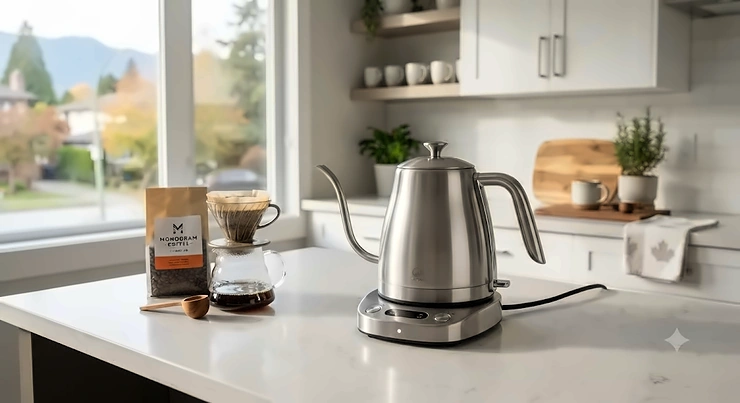
An electric gooseneck kettle is a cordless, plug-in kettle with a long, narrow, S-curved spout that lets you pour hot water in a slow, controllable stream — ideal for pour-over coffee and delicate teas. Many models add variable temperature control, keep-warm modes, and built-in brew timers.

That’s the dictionary version. Here’s the real one: a regular kettle pours like a fire hose, and a gooseneck pours like a paintbrush. If you’ve ever tried to bloom coffee grounds in a V60 with a standard spout, you know the feeling — one wobble and you’ve blasted a crater in the coffee bed, drowned half the grounds, and left the other half bone-dry. Uneven extraction. Sour cup. Sad morning.
The humble kettle has been around for centuries, but the electric gooseneck kettle is a relatively recent crossover from specialty cafés to Canadian home counters. And the category has split in three directions. At the bottom, you’ll find the budget gooseneck kettle for beginners — simple, boil-only, one-touch operation, often under C$60. In the middle sit preset-temperature models that nail green tea and light-roast coffee without fuss. At the top, you’ll find PID-controlled precision tools with 1°C adjustments and hour-long holds.
So which one deserves your counter space? That depends on three things most buyers underestimate: fast boil time (wattage matters more than marketing admits), kettle capacity (0.6 L and 1.0 L are wildly different lifestyles), and whether you actually need variable temperature at all.
Below, I’ve compared seven real kettles available to Canadian shoppers, synthesizing published specs, independent lab measurements, and aggregated reviewer sentiment. No invented test anecdotes — just honest analysis of what each spec means when you’re half-awake at 6:45 a.m. with a filter full of freshly ground beans.
Quick Comparison Table: 7 Electric Gooseneck Kettles at a Glance
| Kettle | Kettle Capacity | Power | Temperature Control | Keep-Warm | Price Range (CAD) | Best For |
|---|---|---|---|---|---|---|
| Fellow Stagg EKG | 0.9 L | 1200W | 57–100°C, 1° steps | Up to 60 min | C$210–C$260 | Fellow Stagg EKG: design-minded pour-over purists |
| OXO Brew Adjustable Temperature Pour-Over Kettle | 1.0 L | 1500W | Variable, to 100°C | Yes | C$130–C$180 | OXO Brew: speed plus precision |
| Cosori CO108-NK Gooseneck Kettle | 0.8 L | 1200W | 5 presets (77–100°C) | Up to 60 min | C$70–C$100 | Cosori CO108-NK: best value with presets |
| Brewista Artisan 1.0L Gooseneck Variable Kettle | 1.0 L | 1100W | ~40–98°C + flash boil | Yes | C$200–C$230 | Brewista Artisan: tea lovers and low-temp brewing |
| Bodum Melior Gooseneck Electric Kettle | 0.8 L | ~1000W | Boil only | No | C$55–C$80 | Bodum Melior: stylish one-touch simplicity |
| Chefman Fast-Boil 0.8L Gooseneck Kettle | 0.8 L | 1000W | Boil only | No | C$35–C$55 | Chefman Fast-Boil: tightest budgets |
| Hario V60 Buono Electric Drip Kettle | 0.8 L | 1000W | Boil only | No | C$100–C$140 | Hario V60 Buono Electric: classic pour shape, no frills |
Prices are approximate ranges at the time of research — check current price on amazon.ca, as prices may vary.
Reading the table, the clearest dividing line isn’t price — it’s temperature control. The Cosori CO108-NK is the cheapest way into temperature presets, while the Bodum Melior and Chefman Fast-Boil trade that feature for dead-simple one-touch operation at a lower price. At the premium end, the OXO Brew wins on raw wattage (and therefore fast boil time), whereas the Fellow Stagg EKG and Brewista Artisan justify their price through finer control and longer holds.
💬 Just one click — help others make better buying decisions too!😊
Top 7 Electric Gooseneck Kettles: Expert Analysis
1. Fellow Stagg EKG — the precision benchmark for pour-over
The Fellow Stagg EKG is the kettle other kettles get measured against, largely because its temperature control is so tight. It holds 0.9 L (roughly 0.8 L usable), runs on 1200W, and lets you dial anywhere from about 57°C to 100°C (135–212°F) in single-degree steps, then holds that temperature for up to 60 minutes. In practice, that one-hour hold is the underrated feature: brew a second cup 40 minutes later and the water is still exactly where you left it, no re-boil required.
Based on the spec comparison, this is the kettle for the person who already owns a burr grinder and a scale and wants to eliminate water temperature as a variable. The counterbalanced handle and narrow spout give you a slow, steady trickle — exactly what a bloom pour needs. If you only make one mug of drip coffee a day, however, you’re paying for precision you may never notice.
Reviewers consistently praise the pour control and display, and one independent comparison of 13 kettles named it the most accurate of the group. A recurring complaint in user reviews is sensor or display drift appearing after roughly 18–24 months of daily use, so keep your receipt and check warranty terms.
Pros:
- ✅ Single-degree temperature control with 60-minute hold
- ✅ Superb flow control for bloom and spiral pours
- ✅ Built-in brew timer on the display
Cons:
- ❌ Premium price for a 0.9 L kettle capacity
- ❌ Some reports of sensor issues after two years
Expect to pay in the C$210–C$260 range — a strong buy if pour-over is a daily ritual rather than a weekend hobby.
2. OXO Brew Adjustable Temperature Pour-Over Kettle — fastest boil in the lineup
The OXO Brew Adjustable Temperature Pour-Over Kettle wins on one spec above all: a 1500W heating element, the highest here. Independent lab testing measured it boiling 500 mL in under three minutes, and Coffee Review found it heated 600 mL to brewing temperature more than a minute faster than comparable kettles. That’s the practical meaning of fast boil time — your coffee is brewing before your toast pops.
Beyond speed, the 1.0 L kettle capacity is generous enough for a full Chemex, and the single-dial interface is refreshingly intuitive, with a built-in timer and keep-warm mode. What most buyers overlook: that 1500W draw is significant. Run it at the same time as a toaster or microwave on one kitchen circuit and you may trip a breaker — plan your morning plug layout accordingly.
Reviewers consistently rave about the handle ergonomics and pour feel. The common critiques are that it runs a few degrees warm at lower settings, and that while holding or reheating, the display shows your target temperature rather than the water’s actual temperature.
Pros:
- ✅ 1500W element delivers the quickest boil tested
- ✅ Comfortable, balanced handle for steady pours
- ✅ 1.0 L capacity suits two-person households
Cons:
- ❌ Runs slightly hot at green-tea temperatures
- ❌ Display hides real-time temperature during hold
Typically in the C$130–C$180 range — arguably the best all-rounder for people who value speed and capacity over boutique styling.
3. Cosori CO108-NK Gooseneck Kettle — most affordable path to temperature presets
The Cosori CO108-NK Gooseneck Kettle packs five temperature presets into a price that undercuts most variable-temperature rivals by half. Those presets — roughly 77°C, 82°C, 90°C, 96°C and 100°C (170, 180, 195, 205, 212°F) — cover green tea, white tea, oolong, most coffees, and black tea. With 1200W and a 0.8 L kettle capacity, it also keeps a one-hour hold, and Cosori highlights that water doesn’t touch plastic inside the kettle.
Here’s what to weigh. Presets aren’t the same as 1°C control; if you’re dialling a light-roast Ethiopian to exactly 93°C, you’ll need to accept 90°C or 96°C. For most drinkers, though, five sensible presets beat a hundred choices you’ll never use. That’s why this is often the first recommendation for anyone hunting a budget gooseneck kettle for beginners that still grows with them.
In aggregated reviews, buyers repeatedly highlight value and ease of use. Lab testers, however, note it’s less balanced in the hand than premium kettles, took close to five minutes to boil four cups, and runs louder than the Fellow Stagg EKG.
Pros:
- ✅ Five useful presets at an entry-level price
- ✅ Stainless interior with no plastic water contact
- ✅ One-hour keep-warm function
Cons:
- ❌ No single-degree temperature adjustment
- ❌ Pour balance trails premium models
Usually found around C$70–C$100 — outstanding value per feature, and the smartest middle ground in this list.
4. Brewista Artisan 1.0L Gooseneck Variable Kettle — widest temperature range for tea
The Brewista Artisan 1.0L Gooseneck Variable Kettle reaches lower than anything else here — down to about 40°C (104°F) — which matters more for tea than coffee. Delicate Japanese greens like gyokuro prefer water around 50–60°C, a zone most kettles simply can’t hold. It runs 1100W, holds 1.0 L, and offers both a precise-temperature mode and a “flash boil” mode for when you just need boiling water fast.
Brewista has deep roots in the competition-barista world, and the Artisan reflects it: a touch panel, °C/°F switching, a hold timer, and a stainless body on a tempered-glass base. Based on the spec sheet, this is the kettle for the household where one person brews pour-over and another steeps sencha — it covers both extremes without compromise.
Reviewers appreciate the modern look and the flexibility of the presets. The common criticisms are a slightly slower boil than 1200W rivals and a handle that isn’t solid wood despite the wood-look accents. Some Canadian specialty coffee retailers stock it alongside amazon.ca, so compare sellers.
Pros:
- ✅ Low 40°C floor handles delicate teas
- ✅ Flash-boil mode for everyday hot water
- ✅ Generous 1.0 L kettle capacity
Cons:
- ❌ Slower heating than higher-wattage competitors
- ❌ Priced near the premium tier
Expect roughly C$200–C$230 — best value for tea-first households who also brew coffee.
5. Bodum Melior Gooseneck Electric Kettle — one-touch simplicity with a cork handle
The Bodum Melior Gooseneck Electric Kettle proves that a gooseneck doesn’t need a screen to be useful. It’s a boil-only, one-touch operation kettle: press the switch, wait, pour. It holds 0.8 L (enough for two large mugs or one full pour-over plus a rinse) and is widely listed at around 1000W, with automatic shut-off and a cordless base.
The standout design detail is the natural cork handle and lid knob. Cork stays cool and grippy, which matters more than it sounds when you’re pouring a thin stream for three minutes straight. Here’s what the spec sheet won’t tell you: without temperature control, you’ll be using the “boil, then wait 30–45 seconds” trick to land in the 90–96°C coffee range. For medium and dark roasts, that’s perfectly fine.
The Bodum Melior has one of the largest review pools among budget goosenecks, and aggregated sentiment is strongly positive. One tester at The Kitchn wrote that you “could hit the head of a pin with the pour.” The typical complaints are the short cord and, naturally, the lack of any temperature setting.
Pros:
- ✅ Very precise, pencil-thin pour for the price
- ✅ Cool-touch cork handle feels premium
- ✅ Nothing to program — true one-touch use
Cons:
- ❌ No variable temperature or keep-warm mode
- ❌ Short power cord limits base placement
Usually around C$55–C$80 — an excellent budget gooseneck kettle for beginners who mostly drink medium or dark roasts.
6. Chefman Fast-Boil 0.8L Gooseneck Kettle — the lowest-cost way into gooseneck pouring
The Chefman Fast-Boil 0.8L Gooseneck Kettle exists for one purpose: getting a gooseneck spout onto your counter for the least money possible. It’s 1000W, 0.8 L, matte-black stainless steel, with one-touch operation, blue LED heating indicators, boil-dry protection and auto shut-off. Importantly for Canadian buyers, Chefman lists it as cETL approved — a recognized Canadian safety mark (more on that later).
Chefman markets its fast boil time, and roughly three minutes is a fair expectation for a partial fill. On paper, 1000W is modest; the speed advantage comes mostly from its small kettle capacity. Heating 500 mL simply takes less energy than heating a litre, which is why smaller goosenecks often feel quicker than the numbers suggest.
Who’s it for? Students, first apartments, office desks, and curious people who aren’t sure pour-over will stick. Aggregated reviewer sentiment highlights speed and light weight; the tradeoffs are a less refined pour than the Bodum Melior and no temperature control whatsoever. Chefman backs it with a one-year warranty.
Pros:
- ✅ Lowest price in this comparison
- ✅ Lightweight and quick for small batches
- ✅ cETL mark and boil-dry protection
Cons:
- ❌ Boil-only — no presets or hold
- ❌ Flow control less refined than pricier goosenecks
Typically C$35–C$55 — the no-regret experiment for anyone curious about pour-over.
7. Hario V60 Buono Electric Drip Kettle — the café classic, electrified
The Hario V60 Buono Electric Drip Kettle takes the famously shaped Buono stovetop kettle — a fixture on café bars for years — and adds a 1000W cordless base. Capacity is 800 mL maximum with a 150 mL minimum, a detail worth noting: you can safely heat a single small cup without running the element nearly dry.
The spout is the reason to buy it. Hario’s slim gooseneck produces a fine, consistent stream that pairs naturally with its own V60 dripper. Stainless steel forms the body and lid, while polypropylene is used on the handle, knob, and base. The trade-off is that it’s boil-only, and its price lands above feature-rich preset kettles like the Cosori CO108-NK.
So who should choose it? Someone who values pour shape above digital features and trusts a proven design. Reviewer sentiment is positive but modest — typically framed as a great basic pouring kettle, with a few users wishing for a slightly faster flow rate when brewing larger batches. Availability on amazon.ca varies by seller, so verify it’s the 120V North American model before ordering.
Pros:
- ✅ Iconic, highly controllable Buono spout
- ✅ 150 mL minimum fill for single cups
- ✅ Durable stainless body
Cons:
- ❌ Boil-only at a mid-range price
- ❌ Flow can feel slow for big batches
Generally C$100–C$140 — best for V60 loyalists who want the café pour without the café gadgets.
✨ Don’t Miss These Exclusive Deals!
🔍 Take your morning coffee and afternoon tea to the next level with these carefully selected kettles. Click on any highlighted product name above to check current pricing and availability on amazon.ca. The right electric gooseneck kettle will help you brew café-quality cups your whole household will love!
Practical Usage Guide: Your First 30 Days With an Electric Gooseneck Kettle
Unboxing is the easy part. The first month is where good habits (or bad ones) form, so here’s a short playbook.
Day 1: Clean before you brew
Fill the kettle to its max line, boil, and discard the water — twice. This flushes manufacturing residue and any “new appliance” smell. Wipe the exterior and dry the base contacts.
Week 1: Learn your pour
Practise with plain water over an empty mug. Tilt slowly until the stream is about pencil-thin, then hold that angle. With the Fellow Stagg EKG or Hario V60 Buono Electric, you’ll find the “sweet spot” quickly; with lighter kettles like the Chefman Fast-Boil, fill no higher than about three-quarters so the weight doesn’t fight your wrist.
Temperature cheat sheet
- ☕ Light-roast coffee: 94–96°C
- ☕ Medium/dark roast: 90–93°C
- 🍵 Green tea: 70–80°C
- 🍵 Oolong: 85–90°C
- 🫖 Black and herbal tea: 95–100°C
On boil-only kettles like the Bodum Melior, wait about 30 seconds after the click for coffee, and a few minutes with the lid open for green tea.
Weeks 2–4: Build a maintenance rhythm
Empty leftover water after each session — standing water accelerates scale. Descale every 2–4 weeks if you live in a hard-water city. Oil wooden handles (like the one on the Fellow Stagg EKG) monthly with food-safe mineral oil.
Common first-month mistakes
- ❌ Filling above the max line (it spits from the spout)
- ❌ Running it nearly empty repeatedly
- ❌ Ignoring early scale spots on the base
Real-World Scenarios: Matching the Right Kettle to Your Life
Specs mean more when you attach them to a real routine. Here are three common Canadian profiles and the reasoning behind each match.
Profile 1: The student in a Montreal walk-up
Budget under C$60, a tiny counter, one cup a day, and a roommate who “borrows” everything. The Chefman Fast-Boil makes the most sense here: low cost, light weight, and one-touch operation mean there’s nothing to break or misconfigure. If the budget stretches a little, the Bodum Melior buys a noticeably finer pour. Either is a smart budget gooseneck kettle for beginners because the lesson learned — pour control — transfers to any future upgrade.
Profile 2: The two-coffee couple in suburban Calgary
Two people, two mugs, sometimes a 6-cup Chemex on weekends, and famously hard municipal water. Kettle capacity and fast boil time both matter, so the OXO Brew is the logical match: its 1.0 L body and 1500W element handle a full batch quickly. Plan on regular descaling — Prairie water is unforgiving.
Profile 3: The tea-first household in Vancouver
One person drinks gyokuro and sencha; the other brews light-roast pour-over. Soft coastal water means scale is less of a worry, but the temperature spread is huge. The Brewista Artisan reaches down to about 40°C and up to near-boil, covering both drinkers. If the budget is tighter, the Cosori CO108-NK presets cover most greens and coffees at under half the price.

Problem → Solution: Fixing the Most Common Gooseneck Headaches
Even great kettles cause friction. Here are the problems buyers most often report, and what actually fixes them.
Problem 1: The pour “glugs” or sputters. ✅ Solution: You’ve probably overfilled. Goosenecks pour smoothest at 60–80% full. On the Cosori CO108-NK, staying below the max line also improves balance.
Problem 2: White, chalky flakes in the water. ✅ Solution: That’s mineral scale (calcium carbonate) from hard water. Fill halfway with equal parts white vinegar and water (or use a citric-acid descaler), let it sit 30–60 minutes, then rinse and boil fresh water twice. Descale more often if you live in a hard-water region.
Problem 3: Coffee tastes sour even with good beans. ✅ Solution: Your water may be too cool. On a boil-only kettle, shorten your post-boil wait. On a variable kettle, bump the target to 94–96°C.
Problem 4: The breaker trips during breakfast. ✅ Solution: High-wattage models like the OXO Brew (1500W) share circuits poorly with toasters and microwaves. Move the kettle to a different counter outlet.
Problem 5: The display reads wrong after a couple of years. ✅ Solution: This is a known complaint on some premium models, including the Fellow Stagg EKG. Register your product, keep your receipt, and contact support early — warranty service is usually smoother than troubleshooting yourself.
How to Choose an Electric Gooseneck Kettle
Use these seven steps, in order, to narrow the field fast.
- Decide what you brew most. Coffee-only drinkers can live with boil-only models; tea drinkers benefit from temperature control because greens scorch above 80°C.
- Pick your temperature style. Presets (like the Cosori CO108-NK) suit most people; 1°C control (like the Fellow Stagg EKG) suits dial-in obsessives.
- Match kettle capacity to your household. 0.8 L covers one or two cups; 1.0 L handles a full Chemex or two drinkers.
- Check wattage for speed. 1500W boils noticeably faster than 1000W, but draws more current on shared kitchen circuits.
- Test the handle and balance. Read reviews for comments on wrist fatigue — a poorly balanced kettle ruins precise pours.
- Look for a Canadian certification mark. CSA, cUL, cETL and similar marks signal the product was evaluated for Canadian standards.
- Weigh long-term support. Warranty length and reported sensor reliability matter more than a flashy display in year three.
The short version: start with what you drink, then let kettle capacity and budget settle the rest. Most people end up happier with a simpler kettle they use daily than a complex one they tolerate.
Fast Boil Time: What Wattage Really Buys You
Every listing promises a fast boil time, so let’s translate. Heating water is simple physics: the energy needed depends on the volume and the temperature rise, and wattage is how quickly the kettle delivers that energy. Doubling the wattage roughly halves the heating time, all else equal.
In practical terms, the OXO Brew at 1500W sits at the top of this list; lab testing clocked it under three minutes for 500 mL. The Fellow Stagg EKG and Cosori CO108-NK at 1200W land in the middle, with testers reporting close to five minutes for a four-cup fill on the Cosori. The 1000W group — the Bodum Melior, Chefman Fast-Boil and Hario V60 Buono Electric — are slowest per litre.
But here’s the nuance that marketing skips: you rarely boil a full kettle for pour-over. For a single 350 mL cup, the difference between 1000W and 1500W might be under a minute. Cold Canadian tap water in January (often well below 10°C) adds time across the board.
So chase a fast boil time only if you regularly heat a full litre. Otherwise, fill only what you need — it’s the cheapest speed upgrade available, and it saves energy too.
Kettle Capacity: How Much Water Do You Actually Need?
Kettle capacity looks like a minor spec until you try to brew a 6-cup Chemex from a 0.6 L kettle and have to reboil halfway through. Here’s how to think about it.
A typical single pour-over uses 250–400 mL of brew water, plus roughly 150–200 mL to rinse the paper filter and preheat the mug. That’s why 0.8 L (the Cosori CO108-NK, Bodum Melior, Chefman Fast-Boil and Hario V60 Buono Electric) is the sweet spot for one or two people. The Fellow Stagg EKG sits at 0.9 L nominal, though closer to 0.8 L is practical for a clean pour.
At 1.0 L, the OXO Brew and Brewista Artisan comfortably handle a larger batch brewer or two back-to-back cups without a refill.
Bigger isn’t automatically better, though. A full litre in a gooseneck is heavy to hold at arm’s length for three minutes, and it takes longer to heat. There’s also a minimum: the Hario V60 Buono Electric specifies 150 mL, and running any kettle below its minimum line risks triggering boil-dry protection. Buy the kettle capacity your daily routine needs, not the biggest number on the shelf.
One-Touch Operation vs Variable Temperature: Which Do You Need?
This is the most important fork in the road, and the honest answer is: fewer people need variable temperature than think they do.
One-touch operation means one switch, one job: boil, then click off. The Bodum Melior, Chefman Fast-Boil and Hario V60 Buono Electric all work this way. Advantages: fewer electronics to fail, lower price, and nothing to program when you’re half-asleep. For medium and dark roasts, and for black or herbal tea, boiling water (or boiling plus a short pause) is exactly right.
Variable temperature earns its keep in three situations: you brew light-roast specialty coffee that tastes better at a precise 93–96°C; you drink green, white, or oolong teas that turn bitter with boiling water; or you want water held warm for a second cup. That’s where the Cosori CO108-NK presets, OXO Brew dial, and Fellow Stagg EKG fine control pay off.
A useful rule: if you’ve never tasted the difference between 90°C and 96°C coffee, start with one-touch operation. You can always upgrade later — and your pouring technique will transfer perfectly.
Budget Gooseneck Kettle for Beginners: Where to Draw the Line
Beginners face a tricky question: how cheap is too cheap? Based on the spec comparison and reviewer themes, here’s a practical framework.
Under about C$55: The Chefman Fast-Boil is the standout budget gooseneck kettle for beginners in this price zone. You get the spout, one-touch operation, and safety cutoffs. You don’t get refined balance or temperature control. It’s ideal for testing whether pour-over fits your life.
C$55–C$100: This is the real sweet spot. The Bodum Melior buys a noticeably more precise pour and nicer materials. The Cosori CO108-NK adds five presets and a keep-warm function, which makes it the most future-proof budget gooseneck kettle for beginners — you won’t outgrow it quickly.
Above C$100: Now you’re paying for speed (OXO Brew), precision (Fellow Stagg EKG), tea range (Brewista Artisan), or a heritage spout (Hario V60 Buono Electric).
Where would I draw the line? If you drink tea at all, spend the extra for presets. If you’re coffee-only and unsure, start cheap. Either way, prioritize a certification mark and boil-dry protection over cosmetic features.
Gooseneck Kettle vs Standard Electric Kettle
A standard electric kettle is built for volume and speed; a gooseneck kettle is built for control. The difference shows up the moment you pour.
| Feature | Electric Gooseneck Kettle | Standard Electric Kettle | Stovetop Gooseneck |
|---|---|---|---|
| Pour control | Slow, precise stream | Fast, wide stream | Slow, precise stream |
| Typical capacity | 0.6–1.0 L | 1.5–1.8 L | 0.6–1.2 L |
| Temperature control | Often (presets or 1° steps) | Sometimes | None — needs thermometer |
| Auto shut-off | Yes | Yes | No |
| Best For | Pour-over, specialty tea — e.g. Fellow Stagg EKG, Cosori CO108-NK | Big batches, pasta water, French press | Minimalists, induction or gas users |
The table makes the trade-off plain: a standard kettle wins on volume, but its wide spout makes even extraction in a pour-over nearly impossible. Stovetop goosenecks pour beautifully but lack auto shut-off and temperature feedback, which is why most home brewers now prefer the electric version. If you also cook with lots of hot water, owning both a standard kettle and a compact model like the Bodum Melior isn’t excessive — it’s specialization.
Long-Term Cost & Maintenance
Sticker price is only part of the story. Energy use is tiny: a 1000–1500W kettle running four minutes uses roughly 0.07–0.1 kWh, typically around a cent or two per boil at Canadian residential electricity rates. The real long-term cost is the kettle itself divided by how many good years it lasts.
| Kettle | Price Range (CAD) | Approx. Cost per Use* | Maintenance Notes | Best For |
|---|---|---|---|---|
| Chefman Fast-Boil | C$35–C$55 | ~2¢ | Descale regularly | Chefman Fast-Boil: trial run |
| Cosori CO108-NK | C$70–C$100 | ~4¢ | Descale; wipe display | Cosori CO108-NK: best overall value |
| OXO Brew | C$130–C$180 | ~7¢ | Descale; watch circuit load | OXO Brew: busy households |
| Fellow Stagg EKG | C$210–C$260 | ~11¢ | Oil wood handle monthly | Fellow Stagg EKG: daily enthusiasts |
*Estimate assumes two boils a day for three years (about 2,190 uses), excluding electricity.
The analysis is revealing: over three years, even the premium Fellow Stagg EKG costs about a dime per cup — less than a single café pour-over by a wide margin. The Cosori CO108-NK delivers the lowest cost for a feature-rich kettle, while the Chefman Fast-Boil only wins if it survives its full life. Descaling every few weeks in hard-water areas is the single best way to extend any kettle’s lifespan.
Safety, Certification & Canadian Buying Guide
Electrical products sold in Canada must meet Canadian safety requirements, and that’s worth checking before you add to cart — especially from third-party marketplace sellers. Health Canada’s guidance on buying electrical products online recommends looking for a recognized certification mark on the product and packaging.
Which marks count? The Standards Council of Canada publishes a list of recognized Canadian electrical product approval marks, including CSA, cUL, and cETL (the “c” indicates Canadian evaluation). For example, Chefman lists its Chefman Fast-Boil as cETL approved.
Practical safety checklist:
- ✅ Confirm a Canadian certification mark before buying
- ✅ Choose 120V North American models (imports may be 220V)
- ✅ Look for auto shut-off and boil-dry protection
- ✅ Keep the base dry and away from the sink edge
- ✅ Avoid extension cords for 1500W models
Finally, check the Government of Canada’s recalls database periodically for your model — a two-minute habit that’s easy to skip.
FAQ: Electric Gooseneck Kettle Buying Questions
❓ Is an electric gooseneck kettle worth it for tea only?
❓ What is the best cheap gooseneck kettle in Canada?
❓ Can I use an electric gooseneck kettle for French press?
❓ How often should I descale my gooseneck kettle?
❓ Does a gooseneck kettle make coffee taste better?
Conclusion: Pour With Purpose
Choosing an electric gooseneck kettle comes down to honesty about your routine. If you’re curious but cautious, the Chefman Fast-Boil or Bodum Melior delivers the essential skill — pour control — for very little money. If you want one kettle that grows with you, the Cosori CO108-NK hits the sweet spot of presets, hold, and price.
Need speed and capacity for two? The OXO Brew and its 1500W element give you the fastest boil time here. Tea-first households will appreciate the Brewista Artisan‘s low-temperature range, V60 loyalists will love the Hario V60 Buono Electric‘s classic spout, and daily pour-over devotees will find the Fellow Stagg EKG worth every cent over its lifetime.
Whatever you choose, remember the basics: fill only what you need, descale regularly, and confirm a Canadian certification mark. Your morning cup deserves that much.
🚀 Ready to upgrade your brew?
Click any highlighted kettle above to check current price and availability on amazon.ca — and start pouring like a barista tomorrow morning! ☕
Recommended for You
- Bluetooth Coffee Scale vs Digital Coffee: 7 Picks (2026)
- Pour Over Scale With Timer: 7 Best Picks For Flawless Brews 2026
- Espresso Dosing Scale For Home Baristas: 7 Best Picks (2026)
Disclaimer: This article contains affiliate links. As an Amazon Associate, I earn from qualifying purchases. If you purchase products through these links, we may earn a small commission at no additional cost to you.
✨ Found this helpful? Share it with your friends! 💬🤗
