
In This Article
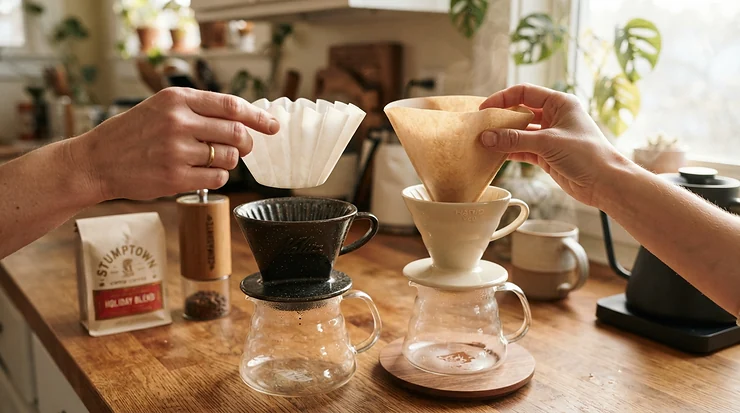
A coffee filter is the porous barrier between your grounds and your cup. Paper traps fine particles and most coffee oils for a light, clean brew. Metal lets oils and some sediment through for a heavier, richer cup. That single difference drives almost every other trade-off in paper coffee filters vs metal coffee filters.
You’ve bought decent beans, maybe even a burr grinder. Then you drop in a ten-cent disc of paper (or a stainless cone that cost more than your lunch) and quietly decide how the whole cup will taste. It’s the least glamorous gear in your kitchen, and it may be the most influential.
In this guide to paper coffee filters vs metal coffee filters, I compare seven real, widely sold options, from budget paper to premium stainless. For each one I explain what the spec actually means in your kitchen. Canadian specifics get their own space: C$ price ranges, metric measurements, cholesterol context, and what a long winter does to your stockpile of disposable filters. As background, Wikipedia’s overview of the coffee filter is a handy primer on how paper, cloth and metal designs evolved.
A quick note on method: I’m drawing on product specifications and published reviews, not claiming I’ve brewed with every item. Where review evidence is thin, I’ll say so. Let’s get to it.
Quick Comparison: Paper Coffee Filters vs Metal Coffee Filters at a Glance
Here’s the cheat sheet. Prices are approximate Canadian ranges at the time of research and shift often, so check current price before you buy.
| Product | Filter Type | Approx. Price Range | Cup Character | Best For |
|---|---|---|---|---|
| Melitta Super Premium Natural Brown #4 | Unbleached paper cone | C$5–C$9 | Clean, mellow | Everyday drip on a budget |
| Hario V60 02 White Paper Filters | Bleached paper cone | C$12–C$20 | Bright, lively | Pour-over tinkerers |
| Kalita Wave 185 Filters | Paper, wave-shaped | C$14–C$25 | Balanced, forgiving | Beginners wanting consistency |
| Chemex Bonded Filters FP-2 | Thick bonded paper | C$15–C$25 | Ultra-clean, lighter body | Delicate light roasts |
| AeroPress Original Microfilters | Paper discs | C$8–C$14 | Clean, crisp | Travel and office brewing |
| Able Brewing Kone | Stainless steel cone | C$40–C$65 | Full body, rich | Chemex fans craving texture |
| Fellow Prismo | Stainless mesh cap | C$30–C$50 | Concentrated, bold | AeroPress espresso-style shots |
Read across the table and a pattern shows up. The cheaper, disposable options skew toward clarity. The pricier, reusable ones skew toward body. Melitta Super Premium Natural Brown #4 wins on running cost, while Able Brewing Kone and Fellow Prismo only start paying off after months of daily use. If you want the cleanest possible cup, Chemex Bonded Filters FP-2 is the clear outlier, with a thickness that does real work.
💬 Just one click — help others make better buying decisions too!😊
Top 7 Filters: Expert Analysis of Paper Coffee Filters vs Metal Coffee Filters
1. Melitta Super Premium Natural Brown #4 Cone Filters — budget workhorse for everyday drip
The Melitta #4 is the brown-paper default for a reason: it’s cheap, it’s everywhere, and it fits the classic 8–12 cup cone brewers and many automatic drip machines in Canadian kitchens. That’s the standout, simple compatibility at a price that makes you forget filters are a recurring cost.
Its natural (unbleached) paper has a slightly coarser feel than premium specialty papers. On paper this means a bit more flow variance, but also a forgiving, mellow cup for medium roasts. The spec sheet won’t tell you this, but reviewers in general roundups note that unbleached papers sometimes want a quick rinse to dial back any papery edge.
I couldn’t verify a large, current review sample for this exact listing. The broader consensus on budget cone papers is that they’re dependable and occasionally prone to tearing if you overfill. Treat that as a general trend, not a promise.
Pros:
- ✅ Very low cost per brew
- ✅ Fits common 8–12 cup cone brewers
- ✅ Mellow, balanced flavour profile
Cons:
- ❌ Can taste papery without a rinse
- ❌ Thinner paper than specialty brands
Expect roughly C$5–C$9 depending on count. Verdict: unbeatable value if you brew a full pot most mornings.
2. Hario V60 02 White Paper Filters — fast-flow filters for bright, lively cups
The Hario V60 02 is a thin, bleached paper cone made for the V60 02 dripper, the one that holds roughly one to four cups. Its standout is flow: the V60 drains quickly, which rewards a careful pour and punishes a sloppy one.
Thin paper plus a big central opening means your technique (grind size, pour speed, agitation) shapes the cup more than the brewer does. That’s wonderful if you enjoy tinkering and mildly maddening if you want push-button predictability. One review-style comparison puts the V60 firmly in the “clean, bright, experimentation-friendly” camp, and my reading of the specs agrees.
Because it’s a bleached paper, the filter generally imparts less noticeable paper taste than natural brown, though a pre-wet is still smart. Per Tom’s Guide, a box of 100 works out to around 9.5 US cents per filter, which is a useful yardstick. Verdict: fair mid-range value.
Pros:
- ✅ Bright, high-clarity cup
- ✅ Wide availability and sizing options
- ✅ Gives you real control over extraction
Cons:
- ❌ Less forgiving of poor technique
- ❌ Costs more per filter than Melitta
Typical range: C$12–C$20 for 100.
3. Kalita Wave 185 Filters — forgiving flat-bed consistency every morning
The Kalita Wave 185 filters are crimped, wave-shaped papers designed for the Wave 185 dripper. The flat bed of coffee and three small drain holes slow and even out flow, which is why the brewer has a reputation as beginner-friendly. Cafés like it for consistency during rush hours.
What does that mean for you? Fewer sour or bitter swings when your pour isn’t perfect. Barista Magazine’s comparison of popular pour-over brewers frames the Wave as the more forgiving option versus the V60, and the geometry supports that.
The catch: these papers are proprietary and not as universally stocked as V60 or Melitta cones. Reviewers repeatedly flag availability as the main irritation, so buy a few boxes before winter shipping delays kick in.
Pros:
- ✅ Even extraction with minimal technique
- ✅ Balanced sweetness and body
- ✅ Crimped edges resist collapsing
Cons:
- ❌ Proprietary shape limits where you can buy
- ❌ Pricier per filter than basic cones
Expect C$14–C$25 per 100. Verdict: a smart pick if your mornings are chaotic.
4. Chemex Bonded Filters FP-2 — thickest paper for the cleanest cup
The Chemex FP-2 is the heavyweight. These pre-folded bonded squares are reportedly 20–30% thicker than typical pour-over papers, and they fit 6-, 8- and 10-cup Chemex brewers (check your model first).
Thickness slows drainage and strips out nearly all oils and fines, so you get a luminous, tea-like cup that flatters floral light roasts. It also means a lighter body than V60 or Kalita Wave. If you love a thick, syrupy mouthfeel, that’s a cost, not a feature.
Tom’s Guide pegs Chemex filters at roughly 11 US cents each versus about 9.5 for Hario, which stacks up over a year. They’re also compostable, with the usual provincial composting caveats. Reviewers praise the aromatic clarity, and complaints centre on price and the occasional paper-flavour note if you skip the rinse.
Pros:
- ✅ Exceptionally clean, aromatic cup
- ✅ Thick paper resists tearing
- ✅ Great for light roasts
Cons:
- ❌ Highest per-filter cost among paper options
- ❌ Lighter body than many drinkers want
Typical range: C$15–C$25 per 100. Verdict: premium paper, justified for delicate beans.
5. AeroPress Original Microfilters — travel-friendly paper for pressed coffee
The AeroPress Microfilters are small paper discs, sold in big multi-packs, built for the AeroPress Original and compatible models. Their standout is sheer convenience: tiny, light, and absurdly cheap per brew, which suits a commuter’s desk drawer or a camping kit.
Because the AeroPress presses water through the coffee, paper here keeps the cup crisp and sediment-free, which is part of why the brewer is known for clean results. One AeroPress comparison notes that paper can often be reused a few times if rinsed and fully dried, so the true cost per cup can drop even lower.
I wasn’t able to verify a robust review set for this specific listing. General AeroPress user sentiment is consistently positive about price and tidy cleanup, with the main complaint being that paper mutes the oils some drinkers miss.
Pros:
- ✅ Extremely low cost per brew
- ✅ Easy cleanup, packable for travel
- ✅ Clean, sediment-free cup
Cons:
- ❌ Mutes body and oils
- ❌ Easy to run out mid-trip
Typical range: C$8–C$14 per multi-pack. Verdict: best-value paper per cup.
6. Able Brewing Kone — body-rich reusable steel for Chemex fans
The Able Kone is a laser-etched stainless cone with a food-safe plastic support ring, made for 6-, 8- and 10-cup Chemex brewers. It also reportedly fits Ratio Eight, Technivorm Moccamaster and Bonavita machines. The listing describes a footprint of about 13 cm across and 10 cm tall (5⅛” by 4″).
The standout is texture. By letting oils through while filtering sediment better than cheap mesh, the Kone aims for something between paper’s clarity and a French press’s weight. Roundups describe a fuller, more complex cup, and one retailer reports the stainless can last years with care.
Reviewers on retail listings talk up long-run savings for heavy brewers, and several stress that grind size matters (go slightly coarser to avoid sluggish flow). One buyer noted a loose fit on an 8-cup Chemex, so check your model.
Pros:
- ✅ Rich, full-bodied cup
- ✅ No filter paper to restock
- ✅ Dishwasher safe
Cons:
- ❌ Higher upfront cost
- ❌ Oils and sediment still reach your cup
Expect about C$40–C$65. Verdict: strong value if you brew daily for a year or more.
7. Fellow Prismo — metal-filter AeroPress cap for concentrated shots
The Fellow Prismo replaces the standard AeroPress cap with a stainless mesh filter and a pressure-actuated valve. It’s designed for espresso-style concentrated brews without the inverted method, and one roundup calls it the best option for AeroPress fans.
Metal here means more oils and a bolder texture, ideal for milk drinks or a stronger cup, but the cup won’t have the polished clarity of paper. Fine particles may also slip through, so a medium-fine grind and a patient press help.
Compatibility matters: confirm it fits your AeroPress model before you buy. Evidence from reviews is limited in what I retrieved, so treat my comments as spec-based analysis, not consensus.
Pros:
- ✅ Bold, concentrated, espresso-style cup
- ✅ Reusable, so no paper to restock
- ✅ Valve helps avoid drips during steeping
Cons:
- ❌ Needs thorough cleaning after each use
- ❌ Some sediment compared to paper
Typical range: C$30–C$50. Verdict: fair value for latte lovers.
How to Choose Between Paper Coffee Filters vs Metal Coffee Filters
When you’re weighing paper coffee filters vs metal coffee filters, decide in this order. Each step narrows the field fast.
- Start with your brewer. Match the shape first (cone, flat-bottom, bonded square, disc). A perfect filter that doesn’t fit is a paperweight.
- Decide what you want in the cup. Clarity and brightness point to paper; body and richness point to metal.
- Weigh health context. If you drink a lot of coffee daily and watch your LDL cholesterol, paper has a documented edge (see the cholesterol section below).
- Do the cost math. Paper is cheap upfront; metal wins only if you brew often for a long time.
- Factor in effort. Paper is a toss-and-go; metal needs rinsing and periodic deep cleaning.
- Think about waste. Reusable steel cuts landfill, though compostable paper narrows the gap where municipal composting allows it.
- Match your roast. Light roasts typically shine through paper, dark roasts often handle metal’s extra oils.

Taste Clarity: What Paper and Metal Actually Do to Your Cup
Taste clarity is the headline difference in paper coffee filters vs metal coffee filters. Paper absorbs oils and catches fines, so flavours read as separate, crisp notes: citrus, jasmine, stone fruit. Metal passes oils through, so flavours blend into a heavier, rounder impression.
Neither is “better.” A common summary is that paper delivers clarity while metal and cloth deliver body, and it’s hard to argue with. The surprise is how much taste clarity depends on paper thickness: Chemex FP-2 gives you more of it than Hario V60 02 or Kalita Wave 185, and Melitta #4 sits in a friendly middle.
Metal filters vary too. An etched cone like Able Kone can reduce fines versus cheap mesh, so the cup tastes less muddy. By contrast, a basic mesh basket may feel gritty. If your cup tastes dull or muddy, taste clarity is usually the missing piece, and swapping filter material is cheaper than replacing your grinder. Dark roasts, with their heavier oils, often taste better with paper if you find them harsh.
Bleached vs Unbleached Filters: Does It Really Matter?
Short answer: less than the internet argues. Bleached vs unbleached filters mostly come down to paper aroma and your comfort level. One source puts it plainly: bleached vs unbleached makes little difference to taste or safety, and filter quality matters more.
Unbleached (brown) papers can carry a slight cardboard note if you skip the rinse. Bleached (white) papers tend to taste more neutral, and one Canadian roaster’s guide to the Kalita Wave notes the bleached version has a less noticeable paper taste when pre-wetted. Both are fine once you rinse with hot water.
Here’s how I’d frame bleached vs unbleached filters in practice:
- Choose bleached (like Hario V60 02) if you’re sensitive to papery flavours or brew light roasts.
- Choose unbleached (like Melitta #4) if you prefer minimally processed paper and don’t mind a rinse.
In short, bleached vs unbleached filters is a preference call. Don’t let it outrank fit and thickness.
Filter Cone Sizing: Matching Paper to Your Brewer
Filter cone sizing causes more silent brewing failures than anything else. A filter that’s too small collapses into the grounds. One that’s too big folds over and leaks.
Rules of thumb for filter cone sizing:
- Hario V60: sizes 01, 02 and 03 correspond to small, medium and larger drippers. The Hario V60 02 suits the common 02 dripper (roughly one to four cups).
- Kalita Wave: 155 and 185 sizes are separate. Kalita Wave 185 fits only the 185 dripper.
- Chemex: Chemex FP-2 squares serve the larger 6-, 8- and 10-cup sizes; smaller Chemex models use different papers.
- Cone drip machines: Melitta-style numbering matters, and the Melitta #4 matches larger 8–12 cup cones.
- AeroPress: AeroPress Microfilters are sized specifically to the cap.
For metal filters, filter cone sizing is about fit, not folding. Able Kone is built for particular Chemex sizes and listed machines, so verify before ordering. When in doubt, check your brewer’s manual and compare diameters in centimetres.
Cholesterol and Cafestol: What the Science Says About Paper vs Metal
This is the one place where paper coffee filters vs metal coffee filters has a health angle. Coffee naturally contains oily diterpenes, notably cafestol, which can raise LDL (“bad”) cholesterol. Paper traps most of it; metal doesn’t.
A Swedish study of 14 workplace machines found median cafestol of 176 mg/L from machines with metal filters, versus about 12 mg/L in paper-filtered coffee. Espresso reached 2,447 mg/L and boiled coffee 939 mg/L in the same report. Another summary suggests moving from metal mesh or French press to paper can cut cafestol by over 90%.
What this means practically:
- If you drink several cups daily or monitor cholesterol, paper is the safer default.
- If you love metal, you can drop a paper filter inside it some days.
- Occasional metal-filtered cups are a very different question than daily heavy use.
This isn’t medical advice. If cholesterol is a concern, ask your doctor or pharmacist about coffee habits. Also remember that caffeine totals count toward Health Canada’s guidance, covered in the conclusion.
Long-Term Cost & Maintenance: Paper vs Metal vs Cloth
Cheap per brew isn’t always cheap per year. Here’s the comparison:
| Factor | Paper | Metal | Cloth |
|---|---|---|---|
| Upfront cost | Very low | Moderate to high | Low to moderate |
| Ongoing cost | Recurring | Near zero | Occasional replacement |
| Cup character | Clean, light | Full, oily | In-between |
| Cleanup | Toss | Rinse and deep clean | Rinse and dry carefully |
| Cafestol removal | Yes | No | No |
| Best examples | Melitta #4, Chemex FP-2 | Able Kone, Fellow Prismo | N/A in this roundup |
The table makes the trade-off obvious: paper charges you every cup, metal charges you once and then asks for care. A heavy user brewing a few times daily can recoup Able Kone in a year or two, while an occasional brewer never will. If you brew twice a week, AeroPress Microfilters or Melitta #4 is easier to justify. Cloth sits in the middle on body but, like metal, doesn’t remove cafestol.

Common Mistakes When Buying Filters
Most buying errors are avoidable:
- Ignoring sizing. Skipping the check on filter cone sizing is the top cause of leaks and collapsed filters.
- Buying the cheapest paper for a delicate coffee. Thin papers can tear and flatten flavour.
- Expecting metal to taste like paper. It won’t. Choose it for body, not clarity.
- Skipping the rinse. Both paper and metal benefit from hot water first.
- Over-grinding for metal. Too-fine grounds clog etched cones and slip through mesh, so go slightly coarser.
- Buying a proprietary shape you can’t restock. The Kalita Wave problem again.
- Letting metal sit wet. Store it dry to avoid musty smells.
Fix those seven and your coffee improves before you spend more on beans.
Practical Usage Guide: Your First 30 Days With a New Filter
A few habits make any filter perform better.
Paper setup: Fold seams (if needed), seat the filter fully, and rinse with hot water to remove paper taste and preheat the brewer. Discard the rinse water. Use fresh, evenly ground coffee and avoid overfilling.
Metal setup: Rinse before first use, brew, then rinse immediately after. Once a week, soak in hot water with mild soap for 15–20 minutes, and never use steel wool. Always store it completely dry.
30-day checkpoints:
- Week 1: Dial grind size. Paper likes medium; metal often prefers slightly coarser.
- Week 2: Compare unrinsed vs rinsed paper side by side.
- Week 3: Try both Hario V60 02 and Kalita Wave 185 if you own both brewers.
- Week 4: Decide whether to keep a metal cone or paper for weekdays.
Problem → Solution Guide: Fixing Common Filter Headaches
Problem: Coffee tastes papery. Rinse longer with hot water, or switch from unbleached to bleached paper. Hario V60 02 is a common remedy.
Problem: Muddy, gritty cup. You’re likely using metal with too fine a grind. Coarsen the grind or step up to etched steel like Able Kone. Or move back to paper.
Problem: Slow, stalled drawdown. Fine particles are clogging. Chemex FP-2 is naturally slower, so coarsen your grind.
Problem: Filter collapses or leaks. Recheck filter cone sizing against your brewer.
Problem: Metal smells stale. Deep clean weekly and store dry.
Problem: Running out of filters mid-trip. Pack a bulk sleeve of AeroPress Microfilters. They weigh almost nothing.
Buyer’s Decision Framework: If You Are X, Choose Y
Use this quick tree:
- If you brew a full pot every morning on a budget, choose Melitta #4. It’s cheap and fits common machines.
- If you want clarity and enjoy tweaking, choose Hario V60 02.
- If you want consistency with minimal technique, choose Kalita Wave 185.
- If you love delicate light roasts, choose Chemex FP-2.
- If you travel or brew at the office, choose AeroPress Microfilters.
- If you brew daily and crave body, choose Able Kone.
- If you want strong, espresso-style AeroPress shots, choose Fellow Prismo.
Priority checklist: (1) fit, (2) taste clarity vs body, (3) cholesterol concern, (4) cost horizon, (5) cleanup tolerance. If cholesterol is a top concern, put paper first, no exceptions.
Scenario example: a Saskatoon commuter brewing one cup at work could pair AeroPress Microfilters with a small kit on a modest budget, while a household going through three pots a day might run the numbers on Able Kone over a year.
FAQ
❓ Are metal filters worth it if I only brew a few times a week?
❓ Can I put a paper filter inside a metal filter?
❓ Do I need to rinse paper coffee filters before brewing?
❓ How long does a stainless steel coffee filter last?
❓ Are paper coffee filters compostable in Canada?
Conclusion
After weighing paper coffee filters vs metal coffee filters, here’s the honest takeaway. Paper is the safer, cleaner, cheaper-to-start choice, and it’s the better pick if you care about cholesterol or taste clarity. Metal offers richer body, less waste, and long-term savings for dedicated daily brewers.
My straightforward picks: Melitta #4 for budget drip, Hario V60 02 for bright pour-overs, Kalita Wave 185 for consistency, Chemex FP-2 for the cleanest cups, AeroPress Microfilters for travel, Able Kone for Chemex body, and Fellow Prismo for bold AeroPress shots. Remember filter cone sizing, because fit decides more brews than brand.
One last practical note: Health Canada recommends no more than 400 mg of caffeine daily for healthy adults, which is roughly three 237 mL cups of brewed coffee. Pick the filter that fits your habits, then enjoy the cup.
🚀 Ready to upgrade your brew?
Check current prices on your favourite pick and start tasting the difference today! ☕
Recommended for You
- Reusable K-Cup Filter: 7 Best Picks For Canadians In 2026
- Pour Over Kettle Set: 7 Best Picks For Canada In 2026
- Stovetop Gooseneck Kettle For Pour Over: 7 Best Picks (2026)
Disclaimer: This article contains affiliate links. As an Amazon Associate, I earn from qualifying purchases. If you purchase products through these links, we may earn a small commission at no additional cost to you.
✨ Found this helpful? Share it with your friends! 💬🤗
