
In This Article
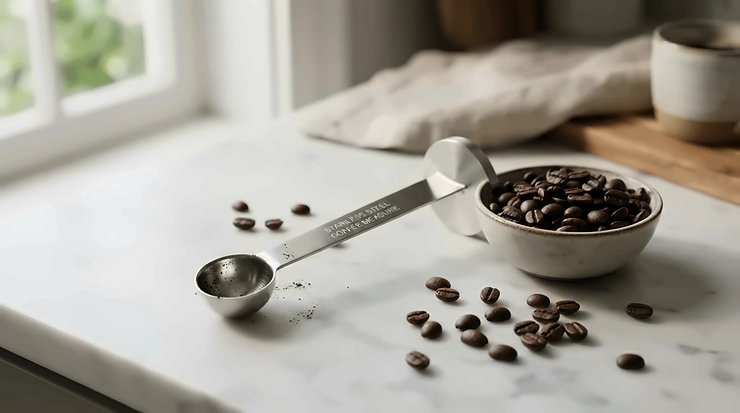
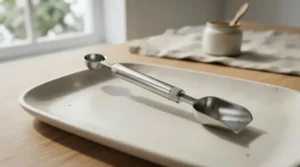
A dual-sided coffee scoop is a single long-handled measuring tool with a different-sized bowl at each end, typically 1 tablespoon (15 mL) on one side and 2 tablespoons (30 mL) on the other, so you can portion a single cup or a bigger brew without swapping spoons or digging out a scale.

Simple, right? Almost suspiciously so. Yet the humble dual-sided coffee scoop solves a daily annoyance: the mug that’s too weak on Monday and too punchy on Tuesday because you “eyeballed it” half-asleep.
Canadian kitchens have a quiet advantage here. Our recipes and mugs run on the metric tablespoon of 15 mL, which lines up neatly with the 15 mL and 30 mL bowls on most stainless scoops. No awkward US-versus-metric rounding.
This guide covers seven real dual-sided coffee scoop options (plus one two-piece alternative) that you can find on amazon.ca. Every pick sits in the coffee scoop under $20 CAD territory, so we’re talking pocket change next to your grinder. We’ll look at single-serve scoop sizing, dishwasher-safe materials and compact storage, then finish with scenarios and an FAQ.
One honesty note up front. Product specs below come from listings and retailer pages gathered at the time of research. Review comments are summarized from public customer feedback, and I flag it plainly when I couldn’t verify something. Prices shift daily, so every figure is a range. Check current pricing before you buy.
Quick Comparison: Dual-Sided Coffee Scoop Types at a Glance
Four designs cover nearly everything on the market. Here’s how they stack up.
| Type | Typical Sizes | Material | Best For |
|---|---|---|---|
| Long-handle stainless, 1 Tbsp / 2 Tbsp (Fox Run 5909, Tablecraft 403) | 15 mL / 30 mL | 18/10 or 18/8 stainless | Everyday drip and French press |
| Long-handle stainless, 1 tsp / 1 Tbsp (CoaGu, Honbay) | 5 mL / 15 mL | 304 stainless | Single-serve mugs, tea, spices |
| Plastic dual-sided (BE-TOOL) | Large and small bowls | Food-grade plastic | Light, budget coffee bars |
| Scoop plus tamper (Jadeshay) | One scoop end, one tamping end | Stainless | Moka pot and espresso fans |
Looking at the table, the 1 Tbsp / 2 Tbsp stainless pair covers the widest range of brewing habits, from a small mug to a half-carafe. The 1 tsp / 1 Tbsp versions suit smaller doses but run short for a big drip pot. BE-TOOL trades durability for a lower price, while Jadeshay is a specialist pick rather than a general-purpose one.
💬 Just one click helps others make better buying decisions too! 😊
Top 7 Dual-Sided Coffee Scoop Picks: Expert Analysis
Ratings and specs below are snapshots from the research period. Availability on amazon.ca varies, so confirm stock before you commit.
1. Fox Run 5909 Double Coffee Measure Scoop — the 1 or 2 tablespoon classic
This one is the benchmark: a plain, no-nonsense dual-sided coffee scoop that does exactly what the label says.
It’s built from 18/10 stainless steel and measures roughly 19.7 cm (7.75 in) long, with a 1 Tbsp bowl at one end and 2 Tbsp at the other. That length matters. It reaches the bottom of a deep canister or a tall retail bag without your knuckles brushing the grounds.
Based on the spec comparison, this is the safest all-rounder for households that brew both single mugs and larger pots. The 2 Tbsp end handles a standard drip dose, while the 1 Tbsp end covers a small mug or a top-up.
Reviewers on the amazon.ca listing rate it around 4.6 out of 5 across roughly 750 ratings at the time of research. A smaller sample on another retailer’s page praised the length for scooping from big cans and even flour jars. I couldn’t verify a dishwasher claim from the maker, so check the listing.
Pros:
- ✅ Solid 18/10 stainless construction
- ✅ Long reach into deep bags and cans
- ✅ Two useful sizes in one tool
Cons:
- ❌ Dishwasher suitability not confirmed from maker
- ❌ Plain look, no tick marks or clip
Expect a price around C$10–C$13. Verdict: the best baseline value in this lineup.
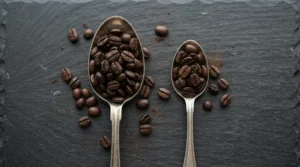
2. Tablecraft 403 Stainless Steel Measuring Scoop — café-grade 1 and 2 tablespoon combo
Born in the restaurant world, this scoop treats a coffee bar like a production line.
The retailer page describes 18/8 stainless with a mirror finish, a 1 Tbsp and 2 Tbsp pairing, and dishwasher-safe care. That mirror finish isn’t just pretty. A polished surface releases fine grounds and oily residue more easily than a brushed one.
For anyone who wants dishwasher-safe materials without worrying about warping, this is the strongest candidate on paper. It’s built for repeated commercial cleaning.
Customer feedback on the related Tablecraft scoops consistently highlights durability, sturdiness and versatility. One reviewer liked using the larger bowl for coffee and the smaller one for sweetener and cream. I couldn’t confirm amazon.ca stock for this exact model, so verify availability first.
Pros:
- ✅ Dishwasher-safe stainless per retailer page
- ✅ Mirror finish wipes clean easily
- ✅ Café-tested build for daily use
Cons:
- ❌ Amazon.ca availability not verified
- ❌ Plain handle, no measurement markings
Expect roughly C$8–C$16, based on the category band. Verdict: top pick if cleaning convenience is your priority.
3. CoaGu Dual-Measure Coffee Scoop — tick-marked 1 teaspoon and 1 tablespoon
Small bowl, big precision: this is the pick for people who measure in teaspoons.
The listing describes 304 stainless steel with a 5 mL end and a 15 mL end, plus a tick mark on the handle. That tick mark acts as a quick visual reference when you’re scooping from a bag at 6:45 a.m.
On paper, this suits single-serve brewers, tea, cocoa and spices better than a full carafe. A 15 mL maximum means two or three trips for a big pot, which is fine for a French press and tedious for a 12-cup drip.
One caution from the research: the listing text mentions both a 1 tsp / 1 Tbsp pairing and a 1 Tbsp / 2 Tbsp dosing description. That’s inconsistent, so confirm the sizes before ordering. I couldn’t verify aggregated review themes for this model.
Pros:
- ✅ Handle tick mark aids quick dosing
- ✅ 304 stainless resists corrosion
- ✅ Versatile for tea, cocoa and spices
Cons:
- ❌ Listing copy contradicts itself on sizes
- ❌ Small bowl slows large batches
Expect around C$8–C$15. Verdict: great for mug drinkers, mediocre for pot brewers.
4. Honbay Double Head Coffee Measuring Scoop — budget twin of the tsp/Tbsp format
Think of it as a close cousin to the CoaGu, usually at a gentler price.
The listing describes a stainless double-head scoop at 1 tsp (5 mL) and 1 Tbsp (15 mL), with a long handle and a tick mark. The long handle is the real feature: short-handled spoons make you tilt the bag and spill.
Here’s what to weigh. If you already own a 2 Tbsp scoop, this smaller-sized tool is a clever supplement for sweeteners, creamers and half-doses. If it’s your only scoop, you’ll be scooping twice for most drip pots.
I couldn’t verify review sentiment for this specific listing, so I won’t pretend otherwise. Treat it as a spec-driven pick and read recent buyer comments for fit and finish.
Pros:
- ✅ Long handle reaches deep bags
- ✅ Teaspoon end suits tea and spices
- ✅ Typically a low-cost option
Cons:
- ❌ Max 15 mL per scoop
- ❌ Review sentiment unverified
Expect roughly C$7–C$14. Verdict: smart secondary scoop, so-so primary.
5. BE-TOOL Dual-Sided Coffee Scoop — lightweight plastic for a tidy coffee bar
If stainless feels like overkill, this plastic option keeps things light.
The listing calls it a food-grade plastic dual-sided scoop with a large side for fractions of a carafe and a small side for single-serve sizes. It also pitches the tool for tea, cocoa, protein and baking spices.
Plastic changes the equation. It’s lighter and won’t clang against a mug, but it can scratch, stain or hold odours over time. Dishwasher suitability wasn’t clear from the listing, so assume top rack at best and hand wash if unsure.
On review sentiment: I couldn’t verify enough genuine feedback to summarize responsibly. If this is your pick, read the latest buyer comments about colour retention and handle stiffness.
Pros:
- ✅ Very light, easy on delicate countertops
- ✅ Two sizes for single-serve and larger brews
- ✅ Budget-friendly entry point
Cons:
- ❌ Plastic may stain or retain odours
- ❌ Dishwasher guidance unclear
Expect under about C$15. Verdict: fine for light use, a downgrade for heavy use.
6. Jadeshay 2 in 1 Coffee Scoop and Tamper — scoop one end, tamp the other
Not every dual-sided coffee scoop pairs two sizes. This one pairs a measure with a press.
The amazon.ca listing describes a stainless steel tool, 14.5 cm (5.7 in) long, built for holding, pressing and grinding. One end scoops, the other tamps. That makes it handy for moka pots, where lightly leveling grounds improves consistency.
The shorter length is the trade-off. It’s fine for a countertop canister but won’t reach the bottom of a tall bag. It also has one scoop size, so it isn’t a substitute for a true two-size tool.
The listing shows about 4.5 out of 5 at the time of research. I couldn’t verify detailed review themes, so read recent comments for tamper diameter fit.
Pros:
- ✅ Scoop and tamper in one tool
- ✅ Stainless construction
- ✅ Compact 14.5 cm length
Cons:
- ❌ Only one scoop size
- ❌ Too short for deep bags
Expect around C$12–C$16. Verdict: a niche winner for moka and small-espresso setups.
7. Orblue Premium Coffee Scoop Set — two single-ended scoops, 1 Tbsp and 2 Tbsp
Technically a pair, not a single dual-sided coffee scoop, but it solves the same problem.
It includes a 1 Tbsp (15 mL) and a 2 Tbsp (30 mL) scoop in stainless steel with long handles, sold in gold. Two tools means you can dedicate one to coffee and one to creamer or sweetener, and neither gets contaminated.
The analytical angle: separate scoops cost a bit more and take more drawer space, yet they avoid the “wrong end touches wet cup” problem that dual-ended designs can have.
Reviewers on a retailer listing gave it about 4.9 out of 5 across roughly 110 ratings. One buyer noted the scoop doesn’t spill grounds across the counter, and another used the 1 Tbsp for creamer and the 2 Tbsp for coffee.
Pros:
- ✅ Two sizes sold as a pair
- ✅ Long handles for bag access
- ✅ Strong early buyer sentiment
Cons:
- ❌ Two pieces to store, not one
- ❌ Gold finish may need gentle care
Expect roughly C$12–C$20 for the pair. Verdict: ideal if you share scoops between coffee and creamer.
Top 7 Comparison: Specs, Price Ranges and Ratings
| Product | Sizes | Material | Price Range (CAD) | Rating Snapshot | Best For |
|---|---|---|---|---|---|
| Fox Run 5909 | 15 mL / 30 mL | 18/10 stainless | C$10–C$13 | ~4.6 (≈750 ratings) | All-round daily brewing |
| Tablecraft 403 | 15 mL / 30 mL | 18/8 stainless | C$8–C$16 | Positive durability themes | Dishwasher cleaning |
| CoaGu | 5 mL / 15 mL | 304 stainless | C$8–C$15 | Not verified | Single-serve mugs |
| Honbay | 5 mL / 15 mL | Stainless | C$7–C$14 | Not verified | Supplementary scoop |
| BE-TOOL | Large / small | Food-grade plastic | Under C$15 | Not verified | Light-duty budgets |
| Jadeshay | One scoop plus tamper | Stainless | C$12–C$16 | ~4.5 | Moka and espresso |
| Orblue | 15 mL and 30 mL, separate | Stainless | C$12–C$20 | ~4.9 (≈110 ratings) | Coffee plus creamer |
Across the table, Fox Run 5909 offers the cleanest value for a true 1 Tbsp / 2 Tbsp dual-sided coffee scoop. Tablecraft 403 is the cleaning-first choice, while Orblue earns attention for buyer sentiment. For anyone prioritising a coffee scoop under $20 CAD, every product here fits, but Orblue sits closest to the ceiling.
How to Choose a Dual-Sided Coffee Scoop
Short on time? Work through these steps in order.
- Match the sizes to your brewer. A 1 Tbsp / 2 Tbsp pair suits drip and French press. A 1 tsp / 1 Tbsp pair suits mugs, tea and spices.
- Pick the handle length by your storage. Deep bags need 18 cm or more. Countertop canisters are fine with 14–15 cm.
- Choose the material for your cleaning habits. Stainless is the safest bet for the dishwasher. Plastic is lighter but fussier.
- Look for markings. A handle tick mark or etched volume helps you confirm the right end in half-light.
- Confirm the dimensions yourself. Listings sometimes contradict themselves, as the CoaGu page does.
- Think about secondary jobs. If you also scoop protein, cocoa or spices, a second, smaller scoop helps.
- Set a ceiling. For nearly everyone, a coffee scoop under $20 CAD covers every genuine need.
What most buyers overlook is the bowl depth. A shallow, wide bowl spills grounds when you lift it from a bag. A deeper, narrower bowl holds a mounded dose steadier, which matters more than any marketing language.
Single-Serve Scoop Sizing: Matching Each End to Your Mug
Single-serve scoop sizing sounds fussy until your mug tastes like dishwater two mornings out of five.
Start with the numbers. One level tablespoon of ground coffee is typically 5 to 7 grams, so a 2 Tbsp scoop lands around 10 to 14 grams. The Specialty Coffee Association’s Gold Cup guideline sits near 55 grams per litre, but CoffeeGeek’s beginner guide notes that standard was designed for large-batch brewing. For smaller brews, it suggests about 7 grams per 100 mL.
Now apply it to a typical 250 mL mug:
- At the SCA ratio, you need about 13.75 grams, roughly one 2 Tbsp scoop.
- At the stronger 7 g per 100 mL, you need about 17.5 grams, roughly 2 Tbsp plus a rounded 1 Tbsp.
For a 350 mL travel mug, scale up by 40 percent. That’s the real superpower of a dual-sided coffee scoop: one 2 Tbsp end plus one 1 Tbsp end gives you a quick, repeatable 3 Tbsp dose without hunting for another tool.
Grind and roast shift the weight, though. Darker, lighter-density beans pack less mass per scoop than dense light roasts. My advice: weigh one scoop on a kitchen scale once, write down the grams, and you’ll know exactly what each end delivers.
Dishwasher-Safe Materials: Stainless Steel vs Plastic
Dishwasher-safe materials decide whether your scoop becomes a chore or a non-event.
Stainless steel is the benchmark. An explainer in The Globe and Mail featuring Health Canada experts describes stainless as generally safe for cooking and storing food, and it says plastic food containers raise no concern when used as directed. That’s reassuring for both materials, but cleaning behaviour differs.
| Material | Dishwasher Behaviour | Watch Out For |
|---|---|---|
| 18/10 or 18/8 stainless | Typically fine, often top or bottom rack | Hard-water spotting, dry before storing |
| 304 stainless | Typically fine | Check the listing for care notes |
| Plastic (food-grade) | Top rack at best | Warping, staining, odour retention |
| Gold or coloured finishes | Varies by coating | Some third-party roundups list hand wash only |
Tablecraft 403 is described as dishwasher safe on the retailer page, which makes it the cleanest-cut example here. For BE-TOOL, the listing didn’t state dishwasher suitability, so top rack or hand washing is the cautious route. Always check the specific product care notes.
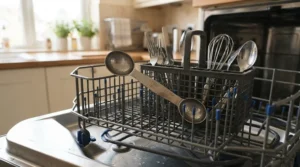
One practical rule: put the scoop in the silverware basket, handle down if the bowl is deep, so water can drain. A scoop that goes back into a coffee bag damp can clump your grounds, which is a bigger problem than the cleaning itself.
Compact Storage: Where a Long-Handled Scoop Should Live
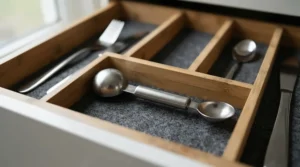
Compact storage is the unglamorous half of buying a dual-sided coffee scoop. A 20 cm utensil is an awkward drawer guest.
Here are four layouts that work:
- In the canister. If your container is wide enough, leave the scoop inside. Mind the handle length so the lid still closes.
- In a small mug beside the grinder. Stand it upright. Visible, quick, and no rummaging.
- Clipped or tucked at the bag. Some scoops come with clips. They add convenience but also a place for grounds to hide, so rinse thoroughly.
- In a drawer organizer. A 14.5 cm tool like the Jadeshay fits more easily than the nearly 20 cm Fox Run 5909.
A small trap: don’t count on a magnetic strip. Common stainless grades like 18/10 and 18/8 are typically non-magnetic or only weakly magnetic, so a strip may not hold them reliably. If you want to hang a scoop, look for one with a hang hole.
For anyone short on space, Orblue‘s two-piece set takes more room than a single dual-ended tool, while CoaGu and Honbay fit comfortably into most drawers. Compact storage often tips the choice between near-identical products.
Coffee Scoop Under $20 CAD: Price Range and Value Analysis
Here’s the pleasant surprise: the whole category lives under C$20, and most options sit in the C$8–C$16 band. A consumer roundup of coffee scoops puts typical pricing at roughly US$4–$20 for a quality scoop or set, which lines up with what’s listed on amazon.ca.
Let’s do some quick ROI maths. Suppose you pay around C$12 and use the scoop daily for five years. That’s about 1,825 uses, which works out to less than one cent per brew. Even if you replace it twice, the cost-per-use stays trivial.
Where does the money actually go? Material and finish. A longer, thicker stainless scoop like Fox Run 5909 costs a few dollars more than a basic spoon, and you’re paying for a handle that doesn’t bend and a bowl that won’t rust. Plastic like BE-TOOL saves money up front but may need replacing sooner if it stains or warps.
Total cost of ownership beats sticker price. A coffee scoop under $20 CAD that survives dishwasher cycles and daily abuse is cheaper than a C$6 plastic one you rebuy every year. When comparing prices, note that listings change, so use “check current price” rather than trusting a number from last month.
Dual-Sided Coffee Scoop vs Single Scoop vs Kitchen Scale
Which tool actually makes better coffee? Let’s compare honestly.
| Method | Accuracy | Speed | Cost | Best For |
|---|---|---|---|---|
| Dual-sided coffee scoop | Good (volume-based) | Fast | Low | Fox Run 5909 or Tablecraft 403 for daily drip |
| Single-size scoop | Good, one dose only | Fast | Low | One-mug households |
| Kitchen scale | Excellent (weight-based) | Slower | Higher | Pour-over and espresso fans |
| Eyeballing a spoon | Poor | Fast | Free | Emergencies only |
A scale wins on precision because it ignores density differences. But a scoop wins on speed and consistency for typical drip and French press, especially when you’ve calibrated it against a scale once.
The honest middle path is to use both. Weigh a scoop’s output once, then rely on the scoop day to day. A dual-sided coffee scoop gives you two repeatable doses, and a scale handles the experimental brews. If you choose just one tool, a scoop covers more households.
Features That Actually Matter (And Those That Don’t)
Matters:
- Handle length. It decides whether you can reach the bottom of a bag.
- Bowl depth. Deeper bowls hold their dose when lifted.
- Material. Stainless survives years. Plastic survives seasons.
- Clear sizes. You should never wonder which end is which.
Doesn’t matter (much):
- Gold or rose-gold finishes. They look nice, though some roundups mention hand-wash care for coloured scoops.
- Bag clips. Handy, but they add crevices for grounds.
- Fancy packaging. It ends up in the recycling.
Most buyers overlook a simple point: the “best” scoop is the one that matches your brewing habit. A mug drinker gains little from a 2 Tbsp maximum, and a drip-pot brewer gains little from 1 tsp precision.
Common Mistakes When Buying a Dual-Sided Coffee Scoop
Avoid these pitfalls:
- Trusting contradictory listings. If sizes aren’t consistent in the description, verify before buying.
- Ignoring dishwasher notes. A scoop that warps in week three wasn’t a bargain.
- Buying too small. A 1 tsp / 1 Tbsp scoop for a big pot means multiple scoops per brew.
- Skipping the food-contact question. In Canada, SGS’s overview of food-contact rules explains that the Canada Consumer Product Safety Act prohibits consumer products that are a danger to human health or safety, including food-contact articles. Stick with reputable materials and clear product descriptions.
- Packing grounds. A heaped, tamped scoop isn’t a standard dose.
✨ Ready to Upgrade Your Morning Routine?
☕ Click on any highlighted product to check current pricing and availability. Small tools make a big difference to your daily cup!
Practical Usage Guide: Setup, Calibration and the First 30 Days
You’ve bought the scoop. Now let’s make it useful.
Day 1: Calibrate. Weigh a level 2 Tbsp scoop of your usual beans or grounds on a kitchen scale. Write the gram figure on a sticky note. Repeat for the 1 Tbsp end. You’ve just built your personal dosing chart.
Week 1: Scoop consistently. Dip, lift, level with a butter knife, and stop. Don’t tap, press or heap. Consistency beats perfection.
Week 2: Adjust by taste. Too bitter? Reduce by half a scoop. Too weak? Add a 1 Tbsp end. Change one variable at a time.
Week 4: Clean on schedule. Wash stainless in the dishwasher or by hand weekly. Wipe plastic scoops dry after every use to reduce staining.
Optimization tricks Amazon listings skip:
- Keep the scoop out of the grounds bag between uses if the handle makes the bag hard to seal.
- Use the small end for creamers and sweeteners, but wipe it before returning to the coffee bag.
- In dry Canadian winters, plastic can cling to fine grounds through static, so give it a quick wipe.
Common first-month mistakes: scooping from a damp scoop, mixing up the ends, and assuming grams stay constant when you switch roasts. Re-calibrate when you change beans.
Real-World Scenarios: Which Dual-Sided Coffee Scoop Fits Your Life?
Scenario 1: The condo dweller with a French press. Small kitchen, one or two mugs a day, drawers already crammed. A compact scoop with 1 tsp / 1 Tbsp sizing like CoaGu or Honbay saves space and doses a mug cleanly. Budget: around C$8–C$15. The trade-off is making a second scoop for a 4-cup press.
Scenario 2: The family drip-pot household. Six cups every morning, plus weekend guests. The Fox Run 5909 or Tablecraft 403 makes sense: the 2 Tbsp end handles the bulk of the dose, and the 1 Tbsp end tunes strength. Budget: around C$10–C$16. The dishwasher compatibility of Tablecraft 403 helps with the Saturday-morning pile-up.
Scenario 3: The moka-pot enthusiast. Small batches, tight grounds, daily ritual. Jadeshay pairs scooping with light tamping in one tool. Budget: around C$12–C$16. If you also want a creamer scoop, add Orblue for the extra size.
Scenario 4: The shared-office coffee corner. Several people, frequent washing, fixed station. A durable stainless Tablecraft 403 stands up to repeat washing better than BE-TOOL‘s plastic.
Quick decision framework:
- If you brew pots, choose a 1 Tbsp / 2 Tbsp pair.
- If you brew mugs, choose a 1 tsp / 1 Tbsp pair.
- If you use a moka pot, choose a scoop-and-tamper.
- If you hate hand washing, choose stainless with dishwasher notes.
FAQ
❓ How many grams of coffee does a dual-sided coffee scoop hold?
❓ Is a stainless steel coffee scoop dishwasher safe?
❓ What size scoop do I need for a 350 mL travel mug?
❓ Can a dual-sided coffee scoop measure protein powder or flour?
❓ Does a stainless steel coffee scoop rust?
Conclusion
A dual-sided coffee scoop is the cheapest upgrade in your coffee routine. For most Canadians, a long-handled stainless 1 Tbsp / 2 Tbsp design like Fox Run 5909 covers daily drip and French press at a friendly price. If cleaning convenience leads your list, Tablecraft 403 is built for it. For mug-sized doses and spice duty, CoaGu and Honbay make smart, compact choices.
Prefer plastic and a lighter feel? BE-TOOL is the budget route, with the caveat that care notes matter. Moka and espresso fans will appreciate Jadeshay, while Orblue suits anyone who wants dedicated coffee and creamer scoops.
Whichever you pick, calibrate it once, store it where you can find it, and keep the whole purchase in the coffee scoop under $20 CAD range. Check current prices on amazon.ca, since they move often.
Recommended for You
- Coffee Scoop And Measuring Spoon Set: 7 Smart Buys 2026
- Cloth Coffee Filter For Drip Coffee: 7 Best Picks In 2026
- Metal Coffee Filter For Pour Over: 7 Best Picks 2026
Disclaimer: This article contains affiliate links. As an Amazon Associate, I earn from qualifying purchases. If you purchase products through these links, we may earn a small commission at no additional cost to you.
✨ Found this helpful? Share it with your friends! 💬🤗
