
In This Article
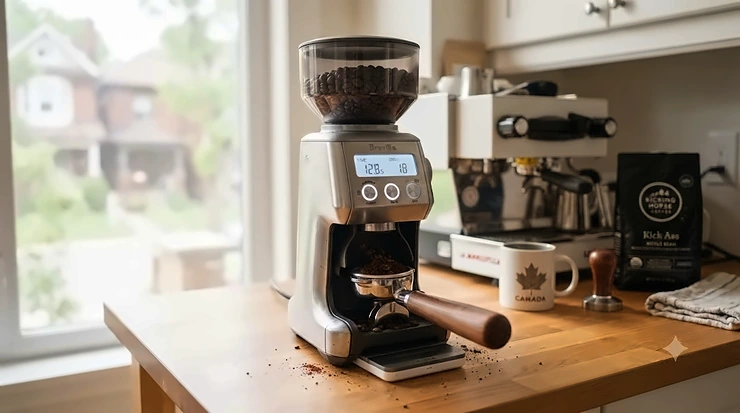
Somewhere between the third snooze alarm and the moment the kettle starts groaning, most of us make a coffee decision on autopilot. That’s precisely the problem an electric coffee grinder with timer is built to solve — it takes the guesswork of “how long do I hold this button” out of a groggy 6:15 a.m. brain and replaces it with a repeatable, programmed grind cycle. Instead of eyeballing your dose every single morning, you set a time, a cup count, or a shot target once, and the machine does the counting for you.
This matters more than it sounds. Grind consistency is arguably the single biggest lever on flavour that home coffee drinkers ignore, and a timer is the mechanism that keeps that consistency from morning to morning. Whether you’re brewing a single mug before a commute or dosing a portafilter for a home espresso setup, the right electric coffee grinder with timer turns a fiddly manual task into a two-second ritual. That ritual carries a little more weight in Canada than you might expect, too — most adults here lean on a few cups a day to get through the morning, right around the range covered in Health Canada’s guidance on daily caffeine intake, which makes consistent, predictable grinding more than just a flavour preference. Below, we’ve researched seven real, currently available models — from entry-level dial grinders to programmable conical-burr units — with honest analysis of specs, aggregated review themes, and where each one actually earns its keep. No exact prices (they shift too often to be reliable), but clear CAD ranges so you know roughly what you’re signing up for. Let’s get into it.
Quick Comparison Table
| Grinder | Timer Type | Grind Settings | Price Range (CAD) | Best For |
|---|---|---|---|---|
| Breville Smart Grinder Pro | Digital, 0.2-second increments | 60 | C$260–C$320 | Precision espresso dosing |
| Secura Conical Burr Grinder | Cup selector (2–10 cups), auto-stop | 18 | C$40–C$65 | Tight budgets, first burr grinder |
| Cuisinart DBM-8 | Electric cup-count timer, auto shut-off | 18 | C$90–C$125 | Simple drip routines |
| Capresso Infinity Plus 575 | 5–60 second dial timer, auto shut-off | 16 | C$140–C$185 | Quiet, low-heat grinding |
| Hamilton Beach 80385 | 2–14 cup dial, auto shutoff | 18 | C$55–C$80 | Value-driven households |
| KRUPS GX5000 | 2–12 cup selector, auto-stop | 9 (45 micro-steps) | C$85–C$115 | Compact kitchens |
| SHARDOR Digital Timer Grinder | LCD precision timer | 31 | C$70–C$100 | Tech-forward budget buyers |
Look at that spread for a second: the price gap between the Secura and the Breville is roughly five-to-one, yet both technically qualify as “an electric coffee grinder with timer.” The difference isn’t really about whether they have a timer — every entry here does — it’s about how granular and repeatable that timer is. Breville’s 0.2-second dosing increments are built for people who care about shot-to-shot consistency down to fractions of a gram, while the Secura’s cup dial is aimed at someone who just wants the same reliable mug every weekday. Both jobs are legitimate; they’re just different jobs.
💬 Just one click — help others make better buying decisions too! 😊
Top 7 Electric Coffee Grinders with Timer: Expert Analysis
1. Breville Smart Grinder Pro — precision time-based dosing for espresso
The Breville Smart Grinder Pro is built around what Breville calls Dosing IQ: a digital timer that adjusts grind duration in 0.2-second increments, which is a genuinely different category of precision than a mechanical dial. With 60 individual grind settings spanning ultra-fine espresso to coarse French press, and an LCD that displays your selected setting, grind time, and shot or cup count simultaneously, this is less a kitchen gadget and more a small dosing instrument that happens to live on your counter.
Here’s what that precision buys you in practice: because the timer measures duration rather than a fixed number of beans, switching between a lighter, less-dense roast and a darker, oilier one won’t silently throw off your dose the way a purely mechanical cup-count grinder can. Based on the spec comparison against the rest of this list, the Breville Smart Grinder Pro is the only model here offering true sub-second dose repeatability, which is why it shows up so often in home-espresso circles specifically. It’s best suited for anyone who has already committed to a real espresso setup, or a pour-over enthusiast who’s tired of “close enough” doses. Reviewers consistently point to the portafilter cradles (included for both 50–54mm and 58mm baskets) as a meaningful convenience for hands-free dosing, though the recurring caveat in owner feedback is that burr sharpness — like on any grinder — degrades gradually over years of daily use, so budget for eventual burr replacement rather than treating it as a lifetime part.
Pros:
- ✅ 0.2-second dosing increments for genuinely repeatable shots
- ✅ 60 grind settings cover espresso through French press
- ✅ Grinds directly into portafilter, container, or paper filter
Cons:
- ❌ Highest price point on this list by a wide margin
- ❌ Bulkier footprint than dial-based competitors
At around C$260–C$320, the Breville Smart Grinder Pro isn’t an impulse buy, but for anyone dosing shots daily, the math on wasted, inconsistent grinds over a year makes it a reasonable long-term investment rather than a luxury.
2. Secura Conical Burr Grinder — best budget entry into timed dosing
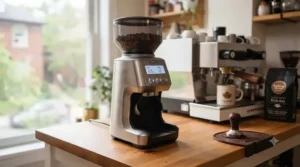
The Secura Conical Burr Grinder proves you don’t need a four-figure price tag to get an actual timer-based dosing system. It uses a cup-quantity dial from 2 to 10 cups, and once you press start, the grinder runs for the duration calibrated to that setting and then shuts off on its own — no standing over it, no guessing when to let go of a button. Paired with 18 grind settings, it covers everything from espresso-fine to French-press-coarse, which is a wider spread than you’d expect at this price tier.
What most buyers overlook about entry-level conical burr grinders like this one is that the burr geometry itself — not just the electronics — is doing a lot of the flavour work. A conical burr grinds more slowly and with less friction heat than the blade grinders often sold at a similar price, so even without Breville-level dosing precision, you’re starting from a better mechanical foundation. This is the grinder for someone who wants to graduate from pre-ground coffee or a blade grinder without committing serious money to the hobby. Aggregated feedback for budget conical burr grinders in this category tends to cluster around solid short-term performance with more mixed long-term durability reports — a pattern worth knowing going in, since it’s common across the entire budget tier, not unique to this model.
Pros:
- ✅ Genuine auto-stop timer, not just a hold-button design
- ✅ 18 grind settings at a genuinely low price
- ✅ Removable hopper and container simplify cleanup
Cons:
- ❌ Plastic-heavy housing feels less premium than metal competitors
- ❌ Long-term durability reports are more mixed than pricier models
Priced around C$40–C$65, the Secura Conical Burr Grinder is the rare budget pick that doesn’t ask you to sacrifice the actual timer functionality — just the build materials and the settings ceiling.
3. Cuisinart DBM-8 — simplest path to a consistent drip routine
The Cuisinart DBM-8, also sold as the Supreme Grind Automatic Burr Mill, takes a refreshingly unfussy approach: pick your grind fineness from 18 positions, slide the cup dial anywhere from 4 to 18 cups, press the power bar, and an integrated electric timer shuts the unit off automatically once that batch is ground. There’s no LCD screen and no app to pair — just a mechanical dial doing the timing math for you based on cup count.
Here’s what most spec sheets won’t spell out clearly: the DBM-8’s timer is genuinely calibrated to grind duration, meaning a 12-cup setting takes roughly 40 seconds while an 18-cup setting runs closer to 55 seconds, according to the manufacturer’s own documentation. That’s a real time-based auto shut-off, not a rough approximation, which is exactly why this model is such a fixture in drip-coffee households — you fill the hopper the night before, set your dial, and the coffee maker timer and the grinder timer effectively hand off to each other for a hands-free morning. Owner reviews collected across major retailers repeat two consistent themes: the grinder is louder in operation than buyers expect, and it performs best with medium roasts, since very dark, oily beans are more prone to clogging the flat-burr mechanism over time.
Pros:
- ✅ True electric timer shuts off automatically by cup count
- ✅ 18 grind settings from ultra-fine to extra-coarse
- ✅ Large 32-cup grind chamber holds extra ground coffee
Cons:
- ❌ Noticeably louder than several competitors in this list
- ❌ Struggles with very dark, oily roast beans over time
In the C$90–C$125 range, the Cuisinart DBM-8 is best for buyers who want automation without needing to think about grind time in seconds — cups is a far more intuitive unit for daily drip brewing.
4. Capresso Infinity Plus 575 — the quiet, low-heat workhorse
The Capresso Infinity Plus 575 takes a hybrid approach to timing: a 5-to-60-second adjustable timer combined with a 1-to-12 cup selector, running through commercial-grade solid steel conical burrs that Capresso states are hand-matched in Switzerland for tight tolerances. The motor spins at under 450 RPM, which is meaningfully slower than most competitors — and slower generally means cooler, since less friction heat is being generated against the beans during the grind cycle.
What that lower RPM means in practice is less aroma loss from heat-driven off-gassing, particularly noticeable if you’re grinding for pour-over or French press where subtle aromatics matter more than they do in a milk-forward espresso drink. Reviewers researching this model consistently flag it as one of the quieter grinders in its price class, a detail that matters if your kitchen is anywhere near a bedroom door at 6 a.m. The auto shut-off here is also a genuine safety feature, not just a convenience one: the unit will not run at all unless the bean hopper is properly locked into place, which prevents the classic “beans everywhere” mishap that comes from grinding with a loose container. If you’ve already tried a bargain grinder and found it too loud or too hot-running for your taste, this is the logical step up.
Pros:
- ✅ Sub-450 RPM motor reduces heat and preserves aroma
- ✅ Genuinely quiet operation versus similarly priced rivals
- ✅ Hand-matched conical steel burrs for tight tolerances
Cons:
- ❌ 16 settings is fewer than several less expensive rivals
- ❌ Larger footprint due to the taller bean hopper
At roughly C$140–C$185, the Capresso Infinity Plus 575 sits in an interesting middle tier — pricier than basic dial grinders, but built with a mechanical philosophy closer to premium models.
5. Hamilton Beach 80385 — best all-around value pick
The Hamilton Beach 80385 covers a wide 18-setting grind range from extra-fine espresso through coarse French press, paired with a 2-to-14-cup dial and genuine auto shutoff — you press once, and one-touch grinding with auto shutoff handles the rest hands-free. It’s a stainless-steel-bodied unit with dishwasher-safe containers and lids, which sounds minor until you’ve hand-scrubbed a static-clingy grind chamber at 6:45 a.m. on a Tuesday.
The real story here is value density: for a price point that’s often lower than several of its 18-setting competitors, you’re still getting a bean hopper that holds up to 2 cups of whole beans (a lid included to preserve freshness), a compact footprint with under-base cord storage, and a burr system rather than a blade — the latter being the more meaningful upgrade for grind consistency than most marketing copy gives it credit for. Reviewers and multi-retailer feedback for this model consistently highlight easy cleanup and quiet-for-the-price operation as the standout strengths, with the most common critique being that the bean hopper’s 2-cup capacity feels a touch small if you’re grinding for a larger household in one go.
Pros:
- ✅ 18 grind settings and 2–14 cup range in one unit
- ✅ Dishwasher-safe containers speed up cleanup
- ✅ Auto shutoff with one-touch, hands-free operation
Cons:
- ❌ 2-cup bean hopper capacity is modest for big households
- ❌ Plastic components throughout keep it feeling budget-tier
At around C$55–C$80, the Hamilton Beach 80385 is arguably the strongest dollar-for-dollar pick on this entire list if your priority is straightforward, no-fuss consistency.
6. KRUPS GX5000 — the compact, countertop-friendly option
The KRUPS GX5000 compresses 9 main grind settings (each with 5 intermediate micro-steps, for 45 total fineness positions) and a 2-to-12 cup selector into one of the smaller footprints in this category. Once you’ve dialed in your fineness and cup count, the unit runs its calibrated cycle and stops automatically — a genuine auto-stop function, and one that KRUPS also ties into a safety interlock: the grinder simply won’t operate unless the hopper lid and coffee container are both properly seated.
What most buyers overlook about micro-step grind systems like this one is that the “9 settings” number undersells the actual flexibility — the 5 intermediate steps per level mean you’re really choosing from 45 discrete fineness points, which rivals grinders advertising much higher headline numbers. The anti-static coffee container is a genuinely useful add for anyone who’s fought clingy grounds on a cheaper unit. Reviewers researching this model report a fairly consistent pair of trade-offs: the compact size and auto-stop safety features are well liked, while a subset of owners note the motor runs fast enough that coffee dust can accumulate around the chute faster than on slower-turning conical burr designs.
Pros:
- ✅ 45 effective fineness positions from 9 settings with micro-steps
- ✅ Genuine auto-stop tied to a hopper/container safety interlock
- ✅ Compact frame fits tight counter spaces easily
Cons:
- ❌ Faster motor speed can mean more coffee dust buildup
- ❌ Fewer headline settings than several digital competitors
In the C$85–C$115 range, the KRUPS GX5000 earns its spot for apartment kitchens and anyone who wants micro-adjustability without a large-footprint machine.
7. SHARDOR Digital Timer Grinder — best tech-forward budget pick
The SHARDOR Digital Timer Grinder brings a genuine LCD precision timer to a price bracket usually reserved for basic mechanical dials. With 31 grind settings and an anti-static coffee chamber, plus a memory function that retains your last-used timer setting even after a power interruption, this is a grinder clearly designed by people who’ve actually been annoyed by the alternatives.
Here’s what the spec sheet won’t tell you outright: a digital timer display, as opposed to a physical dial, means you can dial in and repeat exact grind durations down to the tenth of a second rather than approximating a dial position by eye each morning — a small thing that compounds into real consistency over months of daily use. That’s a meaningfully more precise dosing mechanism than most grinders at this price point offer, and it’s why this model tends to appeal to buyers who’ve outgrown a basic blade grinder but aren’t ready to spend Breville money. The removable upper burr and built-in cleaning brush keep maintenance approachable. Aggregated owner feedback for digital timer grinders in this bracket consistently praises the precision-versus-price ratio, while the most repeated critique is that the touchscreen interface, though intuitive once learned, has a mild learning curve compared to a simple twist dial.
Pros:
- ✅ Genuine digital LCD timer with sub-second adjustability
- ✅ 31 grind settings at a distinctly non-premium price
- ✅ Remembers your last setting after a power cut
Cons:
- ❌ Touchscreen interface has a brief learning curve
- ❌ Anti-static tech reduces, but doesn’t eliminate, static cling
At roughly C$70–C$100, the SHARDOR Digital Timer Grinder is proof that digital dosing precision has trickled down well below the premium tier.
Building a Timed Dose Coffee Grinder Into Your Daily Brew Routine
Owning a timed dose coffee grinder and actually using it well are two different things, and the gap between them is almost always about routine, not equipment. Here’s the setup sequence that gets the most consistent cup out of any of the seven models above.
First, weigh (or measure by volume, if your grinder doesn’t include a scale-friendly design) your beans once per bag and note which timer or cup setting produces your preferred strength — write it down, literally, because “I’ll remember” rarely survives a Monday morning. Second, run a quick dial-in the first time you switch roasts: darker, oilier beans grind faster than light-roast beans of the same weight because they’re more brittle, so the same timer setting can occasionally over- or under-shoot your target dose across different bags. Third, build cleaning into the routine rather than treating it as an emergency task — most of these grinders include a brush specifically because coffee oil residue accumulates gradually and starts dulling flavour clarity well before it becomes visibly obvious.
The most common mistake in the first 30 days of ownership isn’t a hardware problem at all: it’s skipping the hopper-lock or lid-seating step, which on models like the KRUPS GX5000 and Capresso Infinity Plus 575 will simply prevent the grinder from starting, leaving a confused owner assuming the unit is broken. Optimizing your timed dose coffee grinder is less about tweaking settings constantly and more about locking in a repeatable process once, then trusting the timer to hold you to it every single morning after.
Real-World Scenarios: Who Actually Needs an Electric Grinder with Auto Shut-Off Timer
Picture three different mornings. The first belongs to a grad student in a shared apartment, brewing one mug before an 8 a.m. seminar, budget tight, counter space tighter. For her, an electric grinder with auto shut-off timer like the Secura Conical Burr Grinder or Hamilton Beach 80385 solves the actual problem: she needs consistency and safety (no standing over a blade grinder half-asleep), not 60 programmable settings she’ll never touch.
The second morning belongs to a home-espresso enthusiast in Mississauga who upgraded from a pod machine last year and now dials in shots before work. Dose consistency isn’t a nice-to-have for him — under-dosed shots pull thin and sour, over-dosed ones choke the portafilter — so the Breville Smart Grinder Pro‘s 0.2-second dosing increments are directly solving his specific pain point, and the price premium is justified by daily use. Circling back to the grad student for a second: pairing a consistent grind with mindful overall intake — the kind of practical breakdown covered in the University of Guelph’s student wellness caffeine primer — matters just as much for someone pulling late study nights as it does for the retirees below.
The third belongs to a retired couple in Halifax who brew a full pot of drip coffee every morning for themselves and rotating grandkids on weekends. Their priority is a wider cup range and dead-simple operation over espresso-grade micro-adjustability, which makes the Cuisinart DBM-8‘s 4-to-18-cup dial and Capresso’s quiet, low-heat grind a better match than anything built primarily for single-shot dosing. None of these three buyers is wrong about what they need — they’re just solving different problems with the same core feature: an auto shut-off timer that removes guesswork from the process.
How to Choose an Electric Coffee Grinder with Timer
Choosing an electric coffee grinder with timer comes down to matching the timer’s granularity to how precisely you actually need to dose. Here’s the shortlist of criteria that matters most:
- Timer type: digital versus dial. Digital timers (like Breville’s or SHARDOR’s) offer sub-second repeatability; dial or cup-count timers (like Cuisinart’s or Secura’s) are less precise but far more intuitive for casual brewing.
- Grind setting range. If you brew multiple methods — espresso one day, French press the next — you need a wide range (16+ settings); single-method brewers can get away with fewer.
- Burr type over blade type. Burr grinders (conical or flat) produce a far more uniform particle size than blade grinders, which directly affects extraction evenness.
- Hopper and chamber capacity. Match this to your household size; a 2-cup hopper is fine solo, cramped for a family of four brewing simultaneously.
- Safety interlocks. Look for auto-stop tied to hopper/lid placement — it’s a genuine injury-prevention feature, not just marketing language.
- Noise tolerance. If your kitchen is near a sleeping household member, prioritize slower-RPM conical burr designs like the Capresso over faster motors.
- Cleaning access. A removable upper burr and dishwasher-safe chamber save real time over months of daily grinding.
Working through these seven points in order — starting with how precisely you need to dose, ending with how much maintenance friction you’ll tolerate — narrows the field fast, usually to two or three realistic candidates rather than seven.
Timed Dose Coffee Grinder vs Weight-Based Dosing
A timed dose coffee grinder measures how long the burrs spin; a weight-based (scale-integrated) grinder measures how many grams have actually landed in the container, stopping the motor the instant it hits target. On paper, weight-based dosing sounds strictly superior — and for pure gram-for-gram accuracy, it generally is, since a timer can drift slightly when bean density changes between roasts or bags.
In practice, though, the gap matters less than it seems for most home brewers. None of the seven grinders in this guide include integrated scales, and that’s not a flaw — it reflects where the price-to-precision curve actually sits for home use. A well-calibrated timer, recalibrated briefly whenever you switch bean types, gets you within a gram or two of target consistently, which is well inside the margin most palates can detect in a finished cup. Weight-based grinders also tend to cost meaningfully more and add complexity (batteries, scale calibration, moisture sensitivity) that can introduce its own failure points. Unless you’re chasing competition-level espresso consistency, a quality timer-based model like the Breville Smart Grinder Pro delivers the vast majority of the benefit without the added cost or fuss of scale integration.
Common Mistakes When Buying a Timer-Based Coffee Grinder
The single most common mistake is buying based on the number of grind settings alone. A grinder advertising 60 settings isn’t automatically better than one with 18 if the burrs themselves are lower quality — settings count measures granularity, not accuracy, and a cheap burr set can produce inconsistent particle sizes at any setting.
The second mistake is ignoring noise ratings entirely, then being surprised every morning by how loud the unit actually is next to a still-sleeping partner or roommate — this is exactly why we flagged RPM and reviewer noise commentary throughout our product breakdowns above. Third, buyers frequently underestimate hopper capacity needs, assuming “bigger household, bigger grinder” isn’t worth thinking about until they’re refilling a 2-cup hopper three times to brew a full pot. Fourth — and this one’s sneaky — some shoppers assume “timer” and “auto shut-off” are interchangeable marketing terms describing the same feature, when in reality a genuine safety-interlocked auto shut-off (like on the KRUPS or Capresso) is a distinct, more robust feature than a basic countdown timer alone. Finally, skipping burr-type research is a recurring regret: blade grinders marketed with digital timers still produce inconsistent chop-style grounds, timer or no timer, so the burr mechanism matters more than the timer display ever will.
Dose Consistency: What the Spec Sheet Won’t Tell You
Dose consistency is the metric that actually determines whether your coffee tastes the same on Tuesday as it did on Monday, and it’s shaped by more than just the timer. Bean density shifts with roast level and even with humidity — a bag that’s been open two weeks absorbs ambient moisture and can grind slightly differently than the same beans fresh from a sealed package. What most buyers overlook here is that a perfectly calibrated timer setting from week one can drift by the time you’re partway through a bag, simply because the beans themselves have changed, not the machine.
The practical fix is unglamorous but effective: recheck your dose by weight (a basic kitchen scale works fine) every time you open a new bag or switch roasters, then adjust your timer setting if needed rather than assuming last month’s number still holds. Grinders with finer setting granularity — the Breville‘s 60 positions or the SHARDOR‘s 31 — give you more room to make small corrective adjustments without overshooting into “too coarse” or “too fine” territory. Grinders with fewer, wider-spaced settings, like the Capresso‘s 16, require more careful timer tweaking to compensate since each setting jump is a bigger fineness change. Either approach works; the key insight the spec sheet skips is that dose consistency is an ongoing small-maintenance habit, not a one-time setup task.
Auto Shut-Off: Why It Matters for Safety and Grind Quality
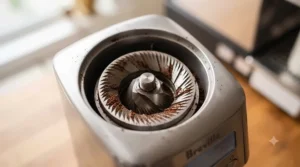
Auto shut-off gets marketed as a convenience feature, but its more important role is safety. A grinder that only stops when you release a button leaves room for distraction — answering the door, grabbing a phone call — while a motor keeps spinning unattended near small hands or curious pets. Models like the KRUPS GX5000 and Capresso Infinity Plus 575 go a step further with safety interlocks that prevent the motor from starting at all unless the hopper and container are correctly seated, which closes off an entirely different failure mode: beans scattering across the counter because a container wasn’t locked in before the grind cycle began.
There’s a grind-quality angle too, and it’s easy to miss. Over-grinding — running the motor past your intended dose because you got distracted — doesn’t just waste beans, it can push your grind size finer than intended as beans continue passing through the burrs, throwing off extraction on your next brew. A reliable auto shut-off timer removes that risk entirely by capping the cycle automatically, which is precisely why every grinder on this list, from the budget-tier Secura to the premium Breville, includes some form of it. If a grinder you’re considering doesn’t have genuine auto shut-off — some ultra-basic blade grinders rely purely on manual button-holding — treat that as a real mark against it, not a minor omission. Interlock and shutoff mechanisms like these fall squarely under the kind of small-appliance electrical safety evaluation performed by CSA Group, Canada’s product safety certification body, so a grinder carrying that certification mark has already had its safety features independently checked.
Long-Term Cost & Maintenance
The sticker price is only part of the real cost of owning an electric coffee grinder with timer. Burrs wear down gradually — typically over several years of daily home use — and replacement burr sets for models like the Breville Smart Grinder Pro or Capresso Infinity Plus 575 are available but represent an added cost most buyers don’t budget for upfront. Cheaper blade-adjacent units often don’t offer replaceable burrs at all, meaning the whole unit gets replaced once grind quality degrades, which can actually work out costlier over a five-year span than paying more upfront for a burr grinder with serviceable parts.
Maintenance time is the other hidden cost, though it’s measured in minutes rather than dollars. Grinders with dishwasher-safe chambers, like the Hamilton Beach 80385, cut weekly cleanup time compared to units requiring hand-washing of oily, static-clingy parts. Removable upper burrs, standard on most models here, let you brush out accumulated coffee oil and fines every few weeks — skipping this step is the single most common reason a perfectly good grinder starts tasting “off” long before the burrs are actually worn out. Total cost of ownership, then, isn’t just purchase price; it’s purchase price plus eventual burr replacement plus the ten minutes a month a clean burr chamber actually takes.
What to Expect: Real-World Performance
On paper, the difference between an 18-setting grinder and a 60-setting one looks dramatic. In daily use, the gap narrows considerably for most brewing methods. If you’re making drip coffee every morning, the practical difference between the Cuisinart DBM-8‘s 18 settings and the Breville‘s 60 is genuinely small — you’ll likely settle on one or two go-to positions and rarely touch the rest, the same way most cars never use their top gear on a daily commute.
Where the gap becomes real is at the extremes: pulling a genuinely fine espresso shot, or grinding coarse enough for cold brew without producing sludge, is where finer-grained settings and slower, cooler-running motors like the Capresso‘s actually earn their keep. Expect any burr grinder on this list to be audibly louder than you’d guess from a product video — kitchens amplify sound in ways showroom demos don’t capture — and expect the first week of ownership to involve some minor trial-and-error dialing in your preferred timer setting for your specific beans. After that initial calibration period, though, every grinder here should settle into a predictable, low-effort daily routine, which is really the entire point of buying a timer-based model in the first place.
Frequently Asked Questions
❓ What is an electric coffee grinder with timer?
❓ Is a burr grinder with a timer better than a blade grinder?
❓ How much should I pay for a good electric coffee grinder with timer in Canada?
❓ Does auto shut-off drain more electricity than manual grinders?
❓ Can I use a timed dose coffee grinder for espresso?
Conclusion
An electric coffee grinder with timer isn’t a luxury upgrade so much as a quiet fix for a problem most coffee drinkers don’t realize they have: inconsistent dosing that makes every cup a little bit of a gamble. Across the seven models covered here, the common thread isn’t the price tag or the settings count — it’s that each one replaces manual guesswork with a repeatable, automated cycle, whether that’s a simple cup dial or a digital timer accurate to a fraction of a second.
If you’re brewing one mug on a tight budget, the Secura Conical Burr Grinder or Hamilton Beach 80385 solve the real problem without overspending. If your mornings revolve around a home espresso setup, the Breville Smart Grinder Pro‘s dosing precision earns its higher price. And if quiet, low-heat grinding for pour-over or French press is the priority, the Capresso Infinity Plus 575 is built specifically for that. Match the timer’s precision to how demanding your actual daily brew routine is, not to the most impressive spec sheet, and you’ll end up with a grinder that quietly does its job every single morning without asking you to think about it.
✨ Don’t Miss These Exclusive Deals!
🔍 Take your morning coffee routine to the next level with these carefully researched picks. Click on any highlighted grinder above to check current pricing and availability on Amazon.ca. The right timer-based grinder means one less decision before your first sip — every single day.
Recommended for You
- 7 Best Programmable Coffee Grinders 2026: Precision Without the Guesswork
- Compact Electric Coffee Grinder for Small Kitchens: 7 Picks (2026)
- Electric Coffee Grinder vs Manual Grinder: The Ultimate 2026 Guide
Disclaimer: This article contains affiliate links. As an Amazon Associate, I earn from qualifying purchases. If you purchase products through these links, we may earn a small commission at no additional cost to you.
✨ Found this helpful? Share it with your friends! 💬🤗
