
In This Article
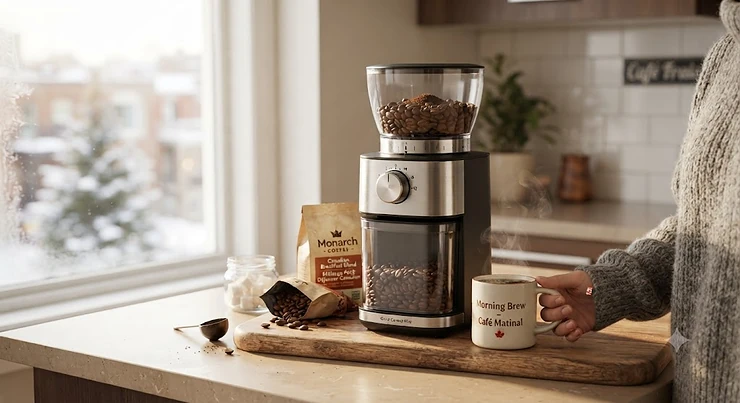
A compact electric coffee grinder for small kitchens is a burr or blade grinder built with a narrow footprint, a small-capacity hopper, and a low profile that fits under cabinets, on skinny counters, or inside a cupboard between uses. If your kitchen counter in a Toronto condo or a Halifax walk-up already juggles a kettle, a toaster, and a dish rack, the last thing you need is an appliance shaped like a fire hydrant. And yet the payoff of grinding fresh is too good to skip — coffee starts losing its aromatic complexity within minutes of grinding, so pre-ground bags you bought three weeks ago are already a shadow of what they could be.
Here’s the tension: most “best coffee grinder” roundups are written for people with sprawling kitchen islands, not for the 500-square-foot rental where the microwave and the coffee maker are already fighting for the same six inches. Canadian apartments have genuinely gotten smaller — the median size of newly built condo units in Canada fell from roughly 947 square feet in the 1990s to about 640 square feet after 2016, according to Statistics Canada data reported by The Globe and Mail. That’s not a minor shift; that’s a whole different relationship with your appliances.
This guide skips the marketing fluff and gets into real specs, real dimensions, and honest analysis of seven grinders that actually fit a small-kitchen brief — not just ones that photograph well on an empty counter. We’ll compare footprints down to the inch, hopper capacities down to the ounce, and flag exactly which buyer each one suits, whether you’re a solo espresso obsessive in a 400-square-foot studio or a family of four trying to fit one more gadget into a galley kitchen.
Quick Comparison Table
Before diving into the deep dive, here’s the shape of the field at a glance. All seven models below were chosen specifically because their footprint, hopper size, or both are noticeably smaller than the “family size” grinders that dominate most general roundups.
| Grinder | Footprint (W x D x H, approx.) | Hopper Capacity | Best For |
|---|---|---|---|
| OXO Brew Compact Conical Burr Coffee Grinder | Small, chuteless design | 50g beans | Tightest counters, single servings |
| Bodum Bistro Electric Burr Coffee Grinder | 7.6 x 7.1 x 12.5 in | 220g (7.8 oz) | Slim slot between appliances |
| KRUPS GX5000 Professional Burr Grinder | 7.4 x 5.2 x 11.8 in | 200g (7 oz) | Budget burr, narrow depth |
| Baratza Encore Conical Burr Coffee Grinder | 12 x 16 x 35 cm | 227g (8 oz) | Daily drinkers who want it to last |
| Cuisinart DBM-8 Supreme Grind Automatic Burr Mill | 6 x 7.1 x 10.75 in | 227g (8 oz) | Automated cup-count dosing |
| Hamilton Beach Fresh Grind Coffee Grinder | Compact, hideaway cord | ~65g (9 tbsp) | Absolute budget, tiny hopper |
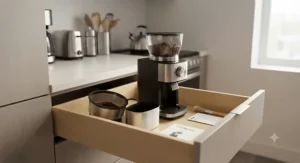
| Mueller Austria HyperGrind Precision | Minimal footprint, stows in a drawer | Roughly 60-70g | Drawer storage, occasional use |
Reading across this table, the split is clear: Hamilton Beach Fresh Grind and Mueller Austria HyperGrind Precision win on pure smallness and price but use spinning blades rather than burrs, which trades grind consistency for space savings. On the burr side, Bodum Bistro Electric Burr Coffee Grinder and KRUPS GX5000 shrink the footprint without dropping to blade-grinder territory, while Baratza Encore Conical Burr Coffee Grinder sacrifices a little counter real estate for a grind quality that noticeably outperforms everything else here. Your choice really comes down to whether footprint or grind precision is the harder constraint in your kitchen.
💬 Just one click — help others make better buying decisions too!😊
Top 7 Compact Electric Coffee Grinders: Expert Analysis
Below are seven real, currently available models spanning budget blade grinders to premium conical burr mills. Every one was selected because its actual measured or manufacturer-listed dimensions and hopper capacity meaningfully beat the countertop footprint of a standard family-size grinder, which typically runs closer to 16 ounces of hopper capacity and well over a foot in height.
1. OXO Brew Compact Conical Burr Coffee Grinder — smallest true footprint on this list
The standout feature here is right in the name: this is a shrunk-down version of OXO’s full-size burr grinder, purpose-built rather than just marketed as compact. Its hopper holds roughly 50 grams of beans — enough for about six cups — which is a fraction of what most “compact” grinders on Amazon still claim to hold.
That tiny hopper isn’t a compromise so much as a design choice. What most buyers overlook about this model is that OXO deliberately capped the capacity to keep the whole unit shorter and narrower than its full-size sibling, which stands over 14 inches tall. This one is built to tuck under a cabinet or beside a kettle without a second thought. It still uses stainless steel conical burrs rather than a blade, with 15 settings plus micro-adjustments, so you’re not sacrificing grind consistency the way you would with a bargain blade grinder.
Reviewers consistently note that the chuteless design makes cleanup dramatically easier than on bigger OXO models, since there’s no narrow exit channel for grounds to clump in. The integrated spout on the grounds container is also frequently mentioned as a small but appreciated touch for mess-free pouring. Based on the spec comparison with its full-size counterpart, this is the pick for someone who grinds for one or two cups at a time and values a small, tidy footprint over batch capacity.
Pros:
- ✅ Genuinely smaller footprint than most “compact” competitors
- ✅ Stainless steel conical burrs for real grind consistency
- ✅ Chuteless design makes cleaning noticeably simpler
Cons:
- ❌ Small hopper means frequent refills for larger households
- ❌ Not designed for espresso-fine, high-volume daily brewing
At around C$100-C$140 depending on retailer promotions, it sits in the mid-range and earns its price through footprint discipline rather than raw features — check current price and availability before buying.
2. Bodum Bistro Electric Burr Coffee Grinder — slim narrow-body burr grinder
The standout advantage here is width: at roughly 7.6 inches wide by 7.1 inches deep, this is one of the narrower burr grinders you’ll find, and its 12.5-inch height means it slides under most upper cabinets without scraping.
The 220-gram (7.8-ounce) bean hopper is clear plastic, so you can gauge fill level at a glance, and the 35mm stainless steel conical burrs spin at roughly 720 RPM to produce a reasonably uniform grind across 12 settings. What that number means in practice: 720 RPM is faster than premium slow-turning grinders like the Baratza Encore, which trades a bit of heat-related flavour preservation for speed and a lower price point.
Reviewers frequently point out that the Bistro is close to static-free thanks to a plastic-spoke system that channels grounds into a static-proof glass jar, which is a genuine relief if you’ve ever fought coffee dust clinging to a plastic hopper. The trade-off, based on the spec sheet, is a plastic hopper with no UV tinting, so beans left inside for more than a day or two under kitchen lighting will degrade faster than they would in an opaque canister.
Pros:
- ✅ Narrow footprint fits tight gaps between appliances
- ✅ Static-free glass grounds container reduces mess
- ✅ 12 grind settings cover espresso through French press
Cons:
- ❌ Bean hopper isn’t UV-tinted, so beans fade faster if left in
- ❌ Fewer grind settings than premium competitors
Expect a price in the C$60-C$90 range, making it one of the more accessible burr options here — always confirm the current price before ordering since promotions shift often.
3. KRUPS GX5000 Professional Electric Coffee Burr Grinder — narrowest depth for tight counters
The KRUPS GX5000’s standout trait is its shallow depth of about 5.2 inches, which matters more than most spec sheets admit: on a narrow galley counter, depth is usually the real constraint, not width.
Its 7-ounce (200g) hopper and 15-ounce ground-coffee container are paired with a flat metal burr system offering 9 main grind settings and 5 intermediary steps each, giving 45 effective points of adjustment from espresso-fine to French-press-coarse. Here’s what to weigh: flat burrs like these are generally considered a step down from conical burrs in particle-size uniformity, but they’re also mechanically simpler and tend to be cheaper to manufacture, which is reflected in the price.
Aggregated user sentiment on this model is genuinely mixed — some retailers report ratings in the 4-star range while direct Amazon reviews have historically sat closer to 3 stars, with complaints centred on the hopper lid alignment being fussy rather than on grind quality itself. The auto-stop function and dual safety switches (the grinder won’t run unless both the hopper lid and grounds container are locked in place) are a genuinely useful safety feature for a shared kitchen where kids or roommates might poke around.
Pros:
- ✅ Shallow 5.2-inch depth suits narrow counters
- ✅ 45 effective grind settings for real brew-method flexibility
- ✅ Dual safety interlocks prevent accidental operation
Cons:
- ❌ Hopper lid alignment is fiddly according to several reviewers
- ❌ Flat burrs are less precise than conical alternatives
Pricing typically lands in the C$50-C$75 range, making it one of the most budget-friendly true burr grinders on this list — check current price, as it’s frequently discounted.
4. Baratza Encore Conical Burr Coffee Grinder — best build quality in a small frame
The Encore’s standout feature is that despite being an entry-level model from a specialty-grade brand, its footprint is only about 4.7 inches wide by 6.3 inches deep, which is narrower than several grinders marketed explicitly as “compact.”
Its 40mm conical burrs turn at a comparatively slow 550 RPM, a deliberate choice that reduces heat transfer to the beans during grinding and, according to Baratza’s own engineering notes, helps preserve aromatic oils. The 8-ounce (227g) hopper and 40-position grind range (250 to 1,200 microns) cover everything from espresso to cold brew. What the spec sheet won’t tell you, but reviewers note, is that the Encore’s components are commonly cited as lasting a decade or more of daily home use, and Baratza sells individual replacement parts rather than forcing a full replacement when something wears out.
This matters more than it sounds for small kitchens specifically: a grinder you don’t have to replace in three years is one less trip to the store, one less box of packaging, and one less appliance cycling through your limited storage. Reviewers do note the burrs need periodic calibration and that beginners should expect a short learning curve dialing in the first few grind settings.
Pros:
- ✅ Narrowest true footprint of any burr grinder on this list
- ✅ Widely repairable with available replacement parts
- ✅ Slow 550 RPM burr speed reduces heat-related flavour loss
Cons:
- ❌ Noticeably pricier upfront than the other burr options here
- ❌ Short learning curve to dial in your ideal grind setting
At roughly C$220-C$260, this is the premium pick on the list — the price reflects the repairability and longevity reviewers consistently highlight, so check current price and factor in the long-term value case below.
5. Cuisinart DBM-8 Supreme Grind Automatic Burr Mill — best automated dosing in a small shell
The standout here is the slide-dial cup selector: rather than eyeballing how long to grind, you set it for 4 to 18 cups and the automatic timer shuts the motor off for you, all inside a shell measuring roughly 6 inches wide by 10.75 inches tall.
The DBM-8 uses ceramic block burrs rather than steel, which is a common cost-saving choice at this price point — block burrs work well with lower-power motors because ridges pre-cut the beans before the main grind, but they also tend to generate more fines than a premium conical burr, which some reviewers noticed as slight muddiness when brewing in a French press with a metal filter. Its 8-ounce hopper is removable for easy filling, and the grind chamber holds enough for up to 32 cups before you need to empty it.
Aggregated review sentiment across major retailers sits notably high for a budget model, with long-time owners frequently reporting nine-plus years of daily use before needing a replacement. Common praise centres on the simple one-touch operation; the most repeated criticism is that the motor is audibly loud during the grind cycle, which is worth knowing if your kitchen shares a wall with a bedroom.
Pros:
- ✅ Automatic cup-count dial removes guesswork on quantity
- ✅ Compact 6-inch width fits narrow cabinet gaps
- ✅ Long track record of multi-year reliability in reviews
Cons:
- ❌ Ceramic block burrs produce more fines than conical burrs
- ❌ Motor noise is a frequently repeated complaint
Typically priced in the C$70-C$100 range, this is a strong mid-tier value pick — as always, check current price since Cuisinart runs frequent seasonal promotions.
6. Hamilton Beach Fresh Grind Coffee Grinder — smallest hopper, smallest price
The standout feature is sheer minimalism: this is a blade grinder with a removable stainless steel bowl holding about 9 tablespoons of beans — roughly enough for 12 cups of brewed coffee in one batch — housed in one of the smallest bodies on this list, with hideaway cord storage built into the base.
Here’s the honest trade-off: this is a spinning-blade grinder, not a burr grinder, which means particle size is determined by how long you hold the button rather than by a fixed burr gap. Reviewers consistently note this results in a mix of coarse chunks and fine dust in the same batch — perfectly fine for a standard drip coffee maker, but not something to rely on for espresso or pour-over where grind consistency directly affects extraction. What most buyers overlook is that this inconsistency is a physical limitation of blade grinding generally, not a flaw specific to this model; every grinder in this mechanism category shares it.
Where it genuinely earns its spot is footprint and price. The removable dishwasher-safe bowl means no funnel-shaped chute to scrub out by hand, and the hidden cord storage is a small but real space-saver for anyone tucking this into a cupboard between uses rather than leaving it out.
Pros:
- ✅ One of the smallest bodies and lowest prices on this list
- ✅ Dishwasher-safe removable bowl simplifies cleanup
- ✅ Hidden cord storage keeps the footprint tidy in cupboards
Cons:
- ❌ Blade mechanism gives inconsistent particle size
- ❌ Not suited to espresso or precision pour-over brewing
Priced around C$25-C$40, this is the budget entry point for anyone who just wants fresher coffee than a bag of pre-ground without a big investment — confirm current price before buying, as it fluctuates with seasonal sales.
7. Mueller Austria HyperGrind Precision Electric Grinder — best for drawer storage
The standout feature is that Mueller explicitly designed this one with “Eurocentric styling” aimed at minimal counter space, and its small stainless steel blade housing is genuinely light and low-profile enough to store flat in a drawer rather than leaving it on the counter at all.
Touch-sensitive controls replace a traditional mechanical button, letting you time your grind by holding contact rather than pressing down, which several reviewers describe as intuitive once you’re used to it. Like the Hamilton Beach model above, this is a blade grinder, so honest analysis here means acknowledging the same particle-consistency ceiling: it’s well suited to drip coffee, French press, and spice grinding, but it won’t deliver the uniform fine grind that espresso extraction really wants.
Aggregated customer feedback is genuinely split — many reviewers report years of reliable daily use and praise the compact form factor for exactly the small-kitchen use case this article covers, while a smaller but consistent minority report early motor failure within the first few weeks. If you can verify a return window with your retailer, that hedges the risk on what is otherwise a very inexpensive way to start grinding fresh.
Pros:
- ✅ Genuinely small enough to store flat in a drawer
- ✅ Touch-sensitive control is simple for daily use
- ✅ Doubles well as a spice and nut grinder
Cons:
- ❌ Some reviewers report early motor failure
- ❌ Blade grinding limits consistency for espresso
Expect a price in the C$25-C$35 range, among the cheapest on this list — as with any budget appliance, check current price and read the most recent reviews before buying.
Practical Usage Guide: Setting Up and Maintaining Your Compact Grinder
Getting a small grinder into daily rotation without cluttering your counter takes a bit more intention than just plugging it in. First 30 days matter most: resist the urge to fill the hopper to the max line right away. Start with a half-fill, especially on gravity-fed models like the Cuisinart DBM-8 Supreme Grind Automatic Burr Mill, since an overfilled hopper can jam the feed mechanism on models not designed for large batches.
For maintenance, most manufacturers recommend a dry brush-out every one to two weeks depending on how often you grind, using the small cleaning brush that ships with burr models like the Baratza Encore Conical Burr Coffee Grinder or KRUPS GX5000. A common first-30-days mistake is trying to clean burrs with water — nearly every manufacturer explicitly warns against this because moisture causes the ground coffee residue to cake onto the burr surfaces rather than brushing away cleanly.
For blade grinders like the Hamilton Beach Fresh Grind Coffee Grinder and Mueller Austria HyperGrind Precision, the optimization trick most listings skip is pulsing in short one- to two-second bursts and shaking the unit gently between pulses. This redistributes beans across the blades and produces a noticeably more even grind than holding the button down continuously. For static reduction on any grinder, a quick trick borrowed from specialty cafés is to lightly dampen your beans with a spritz of water before grinding (the “Ross Droplet Technique”) — it cuts static cling on the grounds container dramatically, though it’s an optional flourish rather than a necessity.
Finally, keep beans in an opaque, airtight container next to the grinder rather than inside the hopper long-term. A literature review from the Specialty Coffee Association found that oxidation reactions begin almost immediately once roasted coffee contacts oxygen, so a hopper left half-full for a week is quietly staling your beans before you even grind them.
Real-World Scenarios: Which Small Kitchen Are You?
The studio-apartment solo drinker. If you live alone in a 400-square-foot studio and drink one or two cups a day, prioritize footprint and hopper size over batch capacity. The OXO Brew Compact Conical Burr Coffee Grinder or Mueller Austria HyperGrind Precision both suit this profile — you’re refilling more often, but you’re storing less appliance in exchange.
The two-person condo household on a moderate budget. A couple sharing a one-bedroom condo who each want a cup before work benefits from a slightly larger hopper without a big footprint jump. The Bodum Bistro Electric Burr Coffee Grinder or KRUPS GX5000 Professional Burr Grinder hit this middle ground — enough capacity for two servings without needing daily refills, still narrow enough for a shared counter.
The family kitchen with limited counter, high frequency. A family of four brewing a full pot most mornings needs the automated dosing of the Cuisinart DBM-8 Supreme Grind Automatic Burr Mill, which can grind for up to 18 cups without babysitting the timer, while still measuring under seven inches wide.
The coffee enthusiast who refuses to compromise on flavour. If grind quality matters more to you than shaving the last inch off the footprint, the Baratza Encore Conical Burr Coffee Grinder delivers meaningfully better particle consistency and a decade-plus service life, justifying its narrow-but-taller shape and higher price.
How to Choose a Compact Electric Coffee Grinder for Small Kitchens
- Measure your actual counter gap first. Don’t shop by hopper capacity before you know your available width, depth, and under-cabinet clearance in inches — a grinder that’s technically “compact” on a spec sheet can still be too tall for your specific shelf.
- Decide between burr and blade honestly. Burr grinders like the Baratza Encore Conical Burr Coffee Grinder cost more but deliver consistent particle size; blade grinders like the Hamilton Beach Fresh Grind Coffee Grinder cost less but trade away that consistency, which mostly matters if you brew espresso or pour-over.
- Match hopper size to your actual daily consumption, not your aspirational one. A 50-gram hopper is plenty for one daily cup; a family brewing a full pot needs closer to 200-plus grams.
- Check for a removable, dishwasher-safe grounds container. This single feature saves more daily counter-clutter time than almost any other spec.
- Look for a locking or interlock safety mechanism, especially in shared households — it prevents the grinder from running with the lid off.
- Weigh noise level against your living situation. Thin apartment walls make a loud motor, like the one commonly reported on the Cuisinart DBM-8, a bigger factor than it would be in a detached house.
- Factor in repairability for anything you plan to keep long-term. A grinder with available replacement parts, like the Baratza line, avoids adding another appliance to landfill in two years.
Common Mistakes When Buying a Small Electric Coffee Grinder
The single most common mistake is buying based on hopper capacity alone without checking the actual footprint dimensions — plenty of grinders marketed as “compact” are barely smaller than standard models once you measure the base. A second frequent misstep is assuming all burr grinders sound the same in a small kitchen; motor noise varies significantly, and reviewers repeatedly flag models like the Cuisinart DBM-8 Supreme Grind Automatic Burr Mill as louder than comparably priced competitors.
Buyers also commonly underestimate how much a blade grinder’s inconsistency will bother them once they’ve tasted a burr-ground cup side by side — if espresso or pour-over is even an occasional goal, starting with a blade grinder like the Mueller Austria HyperGrind Precision often means an unplanned upgrade within a year. Finally, many people skip checking whether the grounds container and hopper are dishwasher-safe, which matters far more in a small kitchen where hand-washing extra parts at a cramped sink is a genuine daily friction point.
Countertop Footprint vs Grind Quality: What to Expect
There’s a real trade-off buried in this category that most listings gloss over. In practice, the grinders with the smallest true footprint — the OXO Brew Compact Conical Burr Coffee Grinder, the Hamilton Beach Fresh Grind Coffee Grinder, and the Mueller Austria HyperGrind Precision — achieve that size either through a smaller hopper or a simpler blade mechanism, both of which are genuine engineering trade-offs rather than marketing tricks.
A recent peer-reviewed study published in Scientific Reports examined how grinding parameters affect the resulting particle size distribution of roasted coffee, reinforcing what home baristas already sense by taste: burr gap consistency has a measurable, repeatable effect on grind uniformity that blade mechanisms simply can’t replicate regardless of how carefully you pulse them. In everyday terms, this means a burr grinder’s smallest setting will taste noticeably less muddy in an espresso shot than a blade grinder’s finest pulse, even if both grinders take up the same six inches of counter.
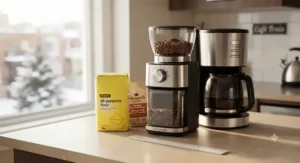
Compact Electric Coffee Grinders vs Space-Saving Coffee Grinders for Apartments: What’s the Difference
These two phrases get used almost interchangeably in product listings, but there’s a useful distinction. A compact electric coffee grinder for small kitchens generally refers to the appliance’s physical dimensions — height, width, depth — measured against the shelf or counter gap you actually have. A space-saving coffee grinder for apartments leans more on total footprint efficiency: cord storage, stackability, whether it needs to stay plugged in or can be tucked into a drawer, and how easily it shares space with other appliances on a shared counter.
By that distinction, the Mueller Austria HyperGrind Precision is arguably more “space-saving for apartments” than it is simply “compact,” since its main selling point is that it disappears into a drawer entirely between uses. Meanwhile, the Baratza Encore Conical Burr Coffee Grinder is genuinely compact in its footprint but isn’t really designed to be drawer-stored daily — it’s meant to live permanently on the counter as a fixture, the way a toaster does. Neither approach is wrong; it comes down to whether your apartment has drawer space to spare or whether every appliance needs to earn permanent counter real estate.
Small-Capacity Hopper: Why Less Can Be More
It sounds counterintuitive, but a small-capacity hopper is often the right choice even if you drink coffee daily. Freshness math is the reason: whole beans stale slowly, but a hopper that holds two weeks’ worth of beans means the beans at the bottom are sitting exposed to ambient air and light for that entire stretch. A 50-to-100-gram hopper, like the one on the OXO Brew Compact Conical Burr Coffee Grinder, forces a refill every few days, which in practice means you’re buying smaller, fresher bags more often rather than one large bag that slowly stales in storage.
There’s also a physical-space argument: a smaller hopper generally means a shorter overall grinder, since the hopper is almost always the tallest visible component. If your upper cabinets sit low over the counter, a grinder built around a small-capacity hopper is frequently the only style that will actually fit underneath with the lid open for filling.
Minimalist Kitchen Appliances: Where the Grinder Fits
Minimalist kitchen appliances aren’t just about visual simplicity — the better definition is appliances that do one job well without demanding permanent counter space they don’t earn through daily use. A coffee grinder earns its spot more easily than most gadgets because, unlike a bread machine or a panini press, it’s genuinely used every single day by anyone who drinks fresh coffee.
Among the seven grinders here, the Bodum Bistro Electric Burr Coffee Grinder and KRUPS GX5000 Professional Burr Grinder lean hardest into the minimalist aesthetic — simple dial controls, no digital displays, no unnecessary settings beyond what a home brewer actually uses. If your kitchen philosophy is “one clean gadget per job, nothing decorative,” these two integrate more naturally into that mindset than grinders with automated cup-counting displays, however useful those displays might be functionally.
Long-Term Cost & Maintenance
Sticker price only tells part of the story. A C$25 blade grinder like the Mueller Austria HyperGrind Precision looks like the obvious budget winner, but if a share of units fail within the first year, as some reviewers report, the effective cost of replacing it annually can approach what a mid-range burr grinder costs once. By contrast, the Baratza Encore Conical Burr Coffee Grinder costs roughly two to three times more upfront but is widely reported to run a decade or longer with basic maintenance and available replacement parts — spread across ten years, that’s a lower annual cost than replacing a budget blade grinder every 18 months.
Electricity use is a non-factor across this category; even the most powerful model here, the Bodum Bistro at 160 watts, running for 30 seconds a day costs a fraction of a cent monthly. The real long-term cost driver is burr or blade replacement availability, and on that front, established brands with dedicated parts programs have a clear structural advantage over generic budget grinders.
Safety and Certification Guide for Small Kitchen Appliances in Canada
Every electrical appliance sold in Canada, coffee grinders included, is required to meet Canadian electrical safety standards before it can legally be connected to a power source in any province or territory. CSA Group provides safety certification testing specifically for small appliance products sold into the Canadian market, and looking for a CSA or an equivalent SCC-accredited mark (such as cUL or cETL) on the packaging is a reasonable, practical way to confirm a grinder meets these baseline requirements before you plug it in.
For small-kitchen setups specifically, safety interlocks matter more than they might in a spacious kitchen where the grinder sits far from foot traffic. Models like the KRUPS GX5000 Professional Burr Grinder, which won’t operate unless both the hopper lid and grounds container are locked into place, reduce the risk of an accidental start in a cramped kitchen where elbows and cords are closer together than usual. If you’re in a rental with older wiring, it’s also worth checking your outlet’s amperage rating against the grinder’s power draw, particularly for higher-wattage models.
✨ Don’t Miss These Exclusive Deals!
🔍 Take your morning coffee routine to the next level with these carefully selected compact grinders. Click on any highlighted item to check current pricing and availability. These small-footprint picks will help you brew genuinely fresh coffee, even in the tightest kitchen!
FAQ
❓ What is the smallest electric coffee grinder for a small kitchen?
❓ Is a burr grinder or blade grinder better for a small apartment kitchen?
❓ How much counter space does a compact coffee grinder actually need?
❓ Can I store a compact coffee grinder in a cabinet between uses?
❓ Do small-capacity hopper grinders need to be refilled more often?
Conclusion
Choosing a compact electric coffee grinder for small kitchens really comes down to being honest about two things: how much actual counter or cabinet space you have, and how much grind consistency matters to your daily cup. If footprint is your hardest constraint, the OXO Brew Compact Conical Burr Coffee Grinder or Mueller Austria HyperGrind Precision solve that directly. If you want burr-grinder consistency without a bulky shell, the Bodum Bistro Electric Burr Coffee Grinder, KRUPS GX5000 Professional Burr Grinder, or Cuisinart DBM-8 Supreme Grind Automatic Burr Mill each strike a reasonable middle ground at accessible price points. And if you’re ready to invest once and stop thinking about it for a decade, the Baratza Encore Conical Burr Coffee Grinder remains the honest standout for long-term value despite its higher upfront cost.
None of these are the “perfect” grinder for everyone — that grinder doesn’t exist, because small-kitchen needs vary too much from a 400-square-foot studio to a shared family galley kitchen. What they share is a genuine, verifiable footprint or hopper-size advantage over standard countertop models, backed by real specs and real aggregated review sentiment rather than marketing copy. Measure your space, decide where you land on the burr-versus-blade trade-off, and pick the one that actually matches how you drink coffee, not just how your counter looks in photos.
✨ Ready to upgrade your morning routine? Check current pricing on today’s featured picks and find the compact grinder that finally fits your kitchen! ☕
Recommended for You
- Electric Coffee Grinder vs Manual Grinder: The Ultimate 2026 Guide
- 7 Best Electric Burr Grinders in Canada: 2026 Buyer’s Guide
- Electric Coffee Grinders: 7 Best Picks for Canadians in 2026
Disclaimer: This article contains affiliate links. As an Amazon Associate, I earn from qualifying purchases. If you purchase products through these links, we may earn a small commission at no additional cost to you.
✨ Found this helpful? Share it with your friends! 💬🤗
