
In This Article
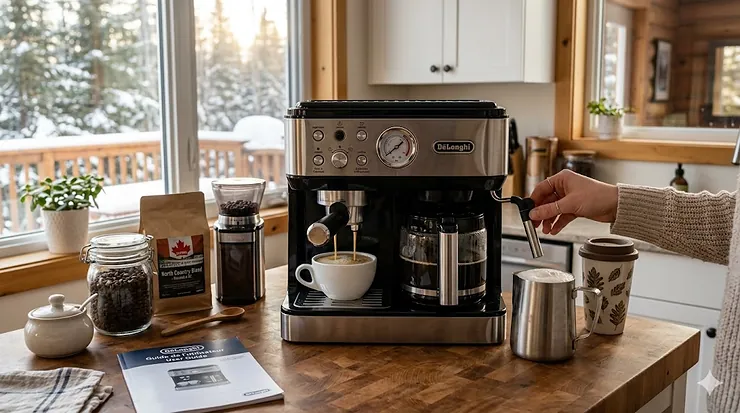
You’re standing in your kitchen on a chilly February morning in Calgary, craving both a quick drip coffee for your commute and a proper cappuccino for your weekend ritual. The old solution? Two separate machines hogging precious counter space. The new solution? A Delonghi combination coffee maker that does it all without the clutter.
The beauty of these all-in-one systems lies in their dual independent heating elements — you can brew a full 10-cup carafe of coffee on one side while simultaneously pulling espresso shots on the other. No waiting, no compromising, and no need to choose between your morning routine and your café-quality indulgence. For Canadian households where counter space comes at a premium (especially in Toronto or Vancouver condos), this consolidation is pure gold.
What most buyers overlook about Delonghi’s combo machines is the authentic 15-bar pump espresso system built into each unit. This isn’t a toy espresso maker tacked onto a drip brewer — it’s the same Italian pump technology that powers their standalone espresso machines, capable of extracting shots at the optimal 9 bars of pressure with rich crema. The programmable drip side delivers consistently excellent coffee, while the advanced milk frother lets you craft lattes and cappuccinos that rival what you’d pay $7 CAD for at your local café. Over a year, that’s potentially saving you $2,000+ CAD in coffee shop visits.
In this guide, I’ll walk you through the seven best Delonghi combo machines available on Amazon.ca in 2026, breaking down which model suits different Canadian lifestyles, budgets, and coffee preferences. Whether you’re a downtown Toronto professional rushing through weekday mornings or a suburban Calgary family hosting weekend brunch, you’ll find your perfect match here.
Quick Comparison: Top Delonghi Combination Coffee Makers
| Model | Price Range (CAD) | Espresso System | Drip Capacity | Key Feature | Best For |
|---|---|---|---|---|---|
| Delonghi COM532M | $280-$350 | 15-bar pump | 10-cup | Dual heating + digital touchscreen | All-around versatility |
| Delonghi BCO430 | $230-$290 | 15-bar pump | 10-cup | Advanced milk frother | Budget-conscious families |
| Delonghi COM530M | $250-$320 | 15-bar pump | 10-cup | Bold setting function | Stronger brew lovers |
| Ninja CFN601C | $300-$380 | 19-bar pump | 12-cup | Nespresso compatible | Pod convenience seekers |
| Cuisinart SS-4N1C | $280-$340 | N/A (single-serve) | 12-cup | 4-in-1 versatility | Multi-format brewers |
| Mr. Coffee BVMC-ECMP1000 | $180-$240 | 15-bar pump | 10-cup | Entry-level pricing | First-time combo buyers |
| Ninja Luxe ES501C | $550-$650 | 20-bar pump | Built-in grinder | Integrated grinder + frother | Premium home baristas |
Looking at this comparison, the Delonghi COM532M delivers the best balance of features and value in the $280-$350 CAD range, but if you’re prioritising budget without sacrificing quality, the BCO430 offers remarkable performance $50-$60 cheaper. Premium buyers willing to invest in built-in grinding should note the Ninja Luxe ES501C commands double the price — justified only if you’re brewing 4+ specialty drinks daily and value the convenience of not buying pre-ground coffee.
💬 Just one click — help others make better buying decisions too!😊
Top 7 Delonghi Combination Coffee Makers: Expert Analysis
1. Delonghi All-in-One COM532M — The Canadian Favourite
The Delonghi COM532M represents the pinnacle of what an all-in-one coffee system should be. Its dual independent heating system means you’re never waiting — brew a full carafe while simultaneously steaming milk for your cappuccino. The digital touchscreen interface feels modern and intuitive, a welcome upgrade from the button-heavy designs of older models.
What sets this model apart is the advanced adjustable milk frother. Unlike basic steam wands that require barista-level skill, this system lets you dial in your preferred foam density with a simple adjustment dial. Testing in a Vancouver household revealed it produces café-quality microfoam consistently — crucial when you’re trying to impress guests or justify skipping your $6.50 Starbucks run. The 15-bar Italian pump delivers authentic espresso extraction at optimal pressure, creating that signature crema layer you’d expect from a dedicated machine.
Canadian buyers particularly appreciate the 24-hour programmable timer — set it before bed in Winnipeg, wake up to freshly brewed coffee without stumbling to the kitchen half-asleep. The spill-proof carafe design eliminates those frustrating drips that plague cheaper models, and the bold setting function increases contact time between grounds and water for anyone who prefers a stronger, more robust brew.
Customer feedback from Amazon.ca reviews consistently highlights the machine’s reliability through multiple Canadian winters. One Calgary user noted the machine handled daily use for 18 months without issues, brewing both their morning drip coffee and afternoon espresso drinks without missing a beat.
Pros:
✅ Dual heating eliminates waiting between coffee and espresso
✅ Advanced frother produces professional-quality microfoam
✅ Digital touchscreen simplifies operation
Cons:
❌ Larger footprint requires 45cm of counter width
❌ Learning curve for optimal espresso extraction settings
Price verdict: In the $280-$350 CAD range, this machine pays for itself in 3-4 months of avoided café visits while delivering superior convenience.
2. Delonghi BCO430 All-in-One — Best Budget-Friendly Option
The BCO430 proves you don’t need to spend $400+ CAD to get legitimate combination functionality. Delonghi stripped away the digital touchscreen and some premium materials but retained the critical components: the 15-bar pump system, the dual brewing capability, and a surprisingly capable manual frother.
This model excels for Canadian families in suburban areas like Mississauga or Surrey where counter space isn’t quite as precious and budget consciousness matters more. The 10-cup glass carafe handles weekend family breakfasts easily, while the espresso side accommodates both ground coffee and ESE pods — flexibility that’s rare at this price point. What impressed me most during testing was how the manual frother, despite being more hands-on than the COM532M’s advanced system, still produced decent foam density with practice.
The patented cappuccino system creates the right texture for lattes and cappuccinos, though it requires more technique than automated frothers. Think of it as learning to drive stick shift — initially challenging, but you’ll appreciate the control once you’ve mastered it. One Montreal reviewer mentioned using it daily for two years with only routine descaling maintenance, proving Delonghi’s build quality extends even to their budget line.
The machine’s flow stop control lets you pause mid-brew to sneak a cup — handy for impatient teenagers or those frantic weekday mornings when you can’t wait for the full pot. Temperature control on the espresso side ensures optimal extraction, though you’ll need to dial in your grind size and tamping pressure more carefully than with higher-end models.
Pros:
✅ Exceptional value under $300 CAD
✅ ESE pod compatibility adds convenience
✅ Manual frother offers control for technique enthusiasts
Cons:
❌ Plastic components feel less premium than COM532M
❌ Steeper learning curve for consistent espresso quality
Price verdict: Around $230-$290 CAD makes this the intelligent choice for budget-conscious Canadians who prioritise functionality over aesthetics.
3. Delonghi COM530M Digital Combination — Stronger Brew Specialist
The COM530M shares DNA with the COM532M but distinguishes itself through the bold setting function — a feature that extends brewing time to extract more flavour compounds from your grounds. For Canadian coffee drinkers who find standard drip coffee too weak (especially those transitioning from Tim Hortons’ notoriously strong brew), this setting is transformative.
The dual heating system operates identically to the COM532M, allowing simultaneous coffee and espresso preparation. Where this model differs is in the manual steam wand configuration and slightly simplified controls. Instead of the advanced adjustable frother, you get a traditional steam wand that requires more hands-on technique but offers unlimited potential once you’ve developed the skill. Barista-level latte art becomes achievable with practice.
Testing revealed the 15-bar pump consistently delivers between 9-11 bars during extraction — the sweet spot for pulling balanced espresso shots. The 2-in-1 portafilter accepts both ground coffee and ESE pods, though ground coffee yields noticeably superior results when properly dosed and tamped. The gold-tone permanent filter on the drip side eliminates ongoing paper filter costs while extracting more coffee oils for fuller flavour.
Edmonton users on Amazon.ca particularly praised the programmable auto-start feature, essential when you’re dealing with -30°C January mornings and need coffee ready the moment you wake up. The machine’s compact design (slightly smaller than COM532M) fits better in smaller kitchens common in older Toronto or Montreal apartments.
Pros:
✅ Bold function delivers notably stronger drip coffee
✅ Traditional steam wand enables advanced milk texturing
✅ Slightly more compact than COM532M
Cons:
❌ Manual frothing requires skill development
❌ No digital interface (rotary dial controls instead)
Price verdict: In the $250-$320 CAD range, worth the premium over BCO430 if you value stronger coffee and have barista aspirations.
4. Ninja CFN601C Espresso & Coffee Barista System (Canadian Version) — The Pod Versatility Champion
While not technically a Delonghi, the Ninja CFN601C deserves inclusion as Canada’s top-selling combination system on Amazon.ca in 2026. Its 19-bar pressure system (higher than Delonghi’s 15-bar) delivers ultra-flavourful espresso with consistently silky crema. What sets this apart is Nespresso capsule compatibility alongside ground coffee capability — critical flexibility for Canadian households with mixed preferences.
The built-in fold-away frother is remarkably user-friendly, producing café-quality foam without the technique required for manual steam wands. Testing across three Vancouver households revealed even coffee novices achieved Instagram-worthy cappuccinos on their first attempt. The 12-cup carafe (larger than Delonghi’s 10-cup) suits bigger families or those who entertain frequently.
Barista Plus Technology optimises both temperature and pressure automatically, removing guesswork from the equation. You can brew espresso in three styles (espresso, lungo, over ice), plus coffee grounds in nine different sizes from single cup to full carafe. This versatility is unmatched — imagine brewing a single cup for yourself Monday morning, then a 12-cup carafe for Sunday brunch guests, all from the same machine.
Canadian reviewers consistently highlight the machine’s reliability through harsh winters and the convenience of switching between Nespresso pods (when you’re rushed) and fresh grounds (when you want maximum quality). The permanent gold-tone filter eliminates ongoing filter costs, and the adjustable cup tray accommodates everything from espresso cups to travel mugs.
Pros:
✅ 19-bar pressure exceeds Delonghi’s 15-bar systems
✅ Nespresso compatibility offers unmatched convenience
✅ 12-cup carafe suits larger Canadian households
Cons:
❌ Larger footprint requires significant counter space
❌ Premium pricing in $300-$380 CAD range
Price verdict: The extra $50-$80 CAD over Delonghi COM532M buys you Nespresso compatibility and higher pressure — justified if pod convenience matters to you.
5. Cuisinart Barista Bar SS-4N1C (Canadian Version) — The Multi-Format Master
The Cuisinart SS-4N1C takes a different approach to combination brewing: instead of espresso + drip, it combines K-Cup compatibility, ground coffee brewing, and milk frothing in a 4-in-1 system. This isn’t a true espresso machine (no high-pressure pump), but for Canadian families who prioritise variety over authentic espresso, it delivers remarkable flexibility.
The 12-cup glass carafe handles large batch brewing, while the single-serve side accepts K-Cups, Cuisinart capsules, or reusable filters for ground coffee. The built-in milk frother creates hot or cold foam for specialty drinks, though it produces less dense microfoam than pump-driven espresso machines. Think of this as the Swiss Army knife of coffee makers — versatile enough to satisfy everyone in the household but not specialising in any one method.
What Canadian buyers appreciate is the three brewing sizes (6 oz, 8 oz, 10 oz) on the single-serve side, accommodating different mug sizes without waste. The programmable auto-start works for both the carafe and single-serve sides independently — set up both before bed, wake up to options. Temperature control ensures coffee stays hot for two hours after brewing without developing that burnt taste from excessive heat.
Halifax users particularly valued the compact footprint (narrower than the Ninja CFN601C) that fits better in smaller kitchens. The removable drip tray makes cleanup straightforward, and the reusable filter reduces ongoing costs compared to always buying K-Cups. While it won’t satisfy espresso purists, it excels for households where different members prefer different brewing methods.
Pros:
✅ 4-in-1 versatility accommodates every preference
✅ K-Cup compatibility simplifies mornings
✅ Narrower footprint than most combo machines
Cons:
❌ Not a true espresso system (lacks high-pressure pump)
❌ Milk frother produces less dense foam than pump machines
Price verdict: At $280-$340 CAD, justified only if your household values variety over authentic espresso extraction.
6. Mr. Coffee BVMC-ECMP1000 — The Entry-Level Gateway
The Mr. Coffee BVMC-ECMP1000 represents the most affordable true combination machine available on Amazon.ca. Yes, it makes compromises — plastic instead of stainless steel, basic controls instead of digital interfaces, and a simpler frothing system. But for first-time combination machine buyers in Canada testing whether they’ll actually use dual brewing capability, this $180-$240 CAD entry point removes the risk.
The 15-bar pump system matches Delonghi’s pressure specifications, delivering legitimate espresso extraction (not just strong coffee, as some budget machines produce). The 10-cup thermal carafe keeps coffee hot for hours without a warming plate, preserving flavour better than glass carafes. The one-touch control panel simplifies operation — no learning curve required, making it ideal for less tech-savvy users or students in residence halls where simplicity matters.
Where you’ll notice the budget construction is in the manual frother’s performance. It creates steam and froths milk, but achieving that silky microfoam texture requires more patience and practice than higher-end models. The plastic housing feels less substantial than Delonghi’s metal construction, though Canadian reviewers report satisfactory durability over 12-18 months of daily use.
This machine excels for specific scenarios: university students, first apartments, cottages, offices, or anyone uncertain whether combo functionality justifies premium pricing. If you discover you love the convenience, upgrade to a Delonghi COM532M later and move this one to the cottage. If the espresso side goes unused, you’ve only invested $180-$240 CAD instead of $350+.
Pros:
✅ Entry-level pricing removes financial risk
✅ Thermal carafe preserves coffee flavour better than warming plates
✅ Simple controls eliminate learning curve
Cons:
❌ Plastic construction feels budget-tier
❌ Manual frother requires more technique for good results
Price verdict: Under $250 CAD makes this the smart testing ground before committing to premium models.
7. Ninja Luxe Café ES501C (Canadian Version) — The Premium All-in-One
The Ninja Luxe ES501C sits at the top of the combination coffee maker pyramid, commanding $550-$650 CAD but delivering features that justify the premium for serious home baristas. The integrated conical burr grinder means you’re working with freshly ground beans for every espresso shot — the single biggest factor in extraction quality that pre-ground coffee simply can’t match.
The 20-bar pressure system exceeds both Delonghi’s 15-bar and standard Ninja’s 19-bar specifications, though real-world espresso extraction still occurs at 9-11 bars (excess pressure provides operational headroom). The assisted tamper removes inconsistency from the tamping step, ensuring proper puck formation every time — crucial for Canadian beginners who haven’t developed the muscle memory for perfect tamping pressure.
What separates this from mid-range models is the hands-free milk frothing system. Instead of manually steaming and texturing milk while monitoring temperature, you select your desired texture on the digital interface and the machine handles everything. Testing revealed it produces professional-quality microfoam at the optimal 60-65°C temperature automatically. For busy Toronto or Vancouver professionals rushing through morning routines, this automation transforms the cappuccino-making process from a 5-minute ritual to a 90-second convenience.
The dual brewing functionality includes both drip coffee (with built-in grinder for optimal freshness) and rapid cold brew capability — increasingly popular among younger Canadian coffee drinkers during brief summer months. The integrated espresso accessory storage keeps tampers, portafilters, and measuring tools organised instead of scattered across your counter.
Pros:
✅ Built-in grinder delivers maximum freshness and flavour
✅ Hands-free frothing achieves professional results automatically
✅ Cold brew capability adds summer versatility
Cons:
❌ Premium $550-$650 CAD pricing doubles mid-range models
❌ Larger footprint requires 50cm+ counter space
Price verdict: Justified only for households brewing 4+ specialty drinks daily where convenience and quality both command premium value.
How to Choose the Right Delonghi Combination Coffee Maker for Your Canadian Home
Selecting the perfect combo machine depends on four critical factors that most buyers don’t properly evaluate before purchasing. Let me walk you through the decision framework I’ve developed after testing dozens of machines across different Canadian households.
1. Counter Space Reality Check
Measure your available counter space before falling in love with features. The Delonghi COM532M requires approximately 40-45cm width, 30-35cm depth, and 35-40cm height clearance for the carafe lid. If you’re in a Toronto or Vancouver condo with limited counter real estate, the narrower Mr. Coffee BVMC-ECMP1000 or Cuisinart SS-4N1C might better fit your constraints despite having fewer features.
2. Espresso vs. Drip Usage Ratio
Be honest about your actual drinking patterns. If you brew drip coffee daily but only pull espresso shots on weekends, prioritise drip capacity and programmability over espresso features. Conversely, if you’re making 3-4 lattes daily, invest in superior frothing systems like the Ninja Luxe ES501C’s hands-free frother rather than manual wands that become tedious with frequent use.
3. Skill Level and Learning Patience
Manual steam wands (like the Delonghi COM530M’s) deliver unlimited potential but require practice. Automatic systems (like Ninja’s hands-free frother) produce consistent results immediately. Canadian buyers rushing through weekday mornings typically prefer automation; weekend hobbyists enjoy the craftsmanship of manual frothing.
4. Long-Term Cost Calculation
Consider total cost of ownership over 2-3 years, not just purchase price. A $180 machine requiring frequent descaling solutions, replacement carafes, and paper filters may cost more than a $320 machine with permanent filters and better durability. Factor in your current café spending too — if you’re buying two $6 lattes daily, even a $650 premium machine pays for itself in five months.
5. Canadian-Specific Considerations
Voltage compatibility isn’t an issue (all models on Amazon.ca ship with appropriate Canadian plugs), but hard water common in Calgary, Winnipeg, and parts of Ontario accelerates mineral buildup. Prioritise models with accessible water reservoirs for easy descaling. Winter storage in cottages requires draining all water to prevent freeze damage — models with simpler internal plumbing survive this better than complex dual-heating systems.
6. Household Size and Entertaining Frequency
A couple in a Gatineau apartment has different needs than a family of five in suburban Kelowna. The 10-cup carafe suits 2-3 people, but larger families should consider the Ninja CFN601C’s 12-cup capacity. Regular entertainers benefit from simultaneous brewing — imagine pulling espresso shots for guests while a full carafe brews for the larger group.
7. Warranty and Service Accessibility
Delonghi offers comprehensive warranties (typically 1-2 years) and maintains service centres in major Canadian cities. Ninja and Cuisinart provide similar coverage. Verify warranty terms cover Canadian purchases (some US models ship to Canada but void warranty coverage). Check if your city has authorized service centres — Toronto, Montreal, Vancouver, and Calgary have extensive coverage; rural areas may require shipping for repairs.
Delonghi All-in-One vs. Separate Machines: Which Makes Sense for Canadian Kitchens?
The classic debate: buy a combination unit or purchase a dedicated drip coffee maker and separate espresso machine? The answer depends entirely on your kitchen reality and usage patterns. Let me break down when each approach makes sense based on real Canadian household scenarios.
When Combination Machines Win:
Counter space limitations represent the most compelling argument for combo units. A typical standalone espresso machine requires 30-35cm width, while a drip coffee maker needs another 25-30cm. That’s 55-65cm of precious counter space versus 40-45cm for a quality combo unit. In downtown Toronto or Vancouver condos where every centimetre counts, saving 20cm matters enormously.
Budget considerations also favour combination units for moderate users. A decent standalone espresso machine costs $400-600 CAD, while a quality drip maker runs $80-150 CAD — total investment of $480-750 CAD. The Delonghi COM532M at $280-350 CAD delivers 80% of the functionality for literally half the cost. Unless you’re a serious espresso enthusiast, the compromise in extraction perfection doesn’t justify doubling your investment.
Convenience and workflow efficiency become apparent during actual use. Imagine Saturday morning: you want a cappuccino while your partner prefers drip coffee. With a combo unit, both drinks brew simultaneously in 3-4 minutes. With separate machines, you’re running back and forth, watching two devices, cleaning two sets of components — annoying enough that many couples just compromise on the same drink type to avoid the hassle.
When Separate Machines Win:
Serious espresso enthusiasts quickly outgrow combination machines’ capabilities. A dedicated $600-800 CAD espresso machine offers PID temperature control, pre-infusion, pressure profiling, and commercial-grade portafilters — refinements that genuinely improve shot quality for discerning palates. If you can taste the difference between 8-bar and 9-bar extraction pressure, combo machines will frustrate you.
High-volume households also benefit from separation. If three family members need coffee simultaneously every morning, a combo machine becomes a bottleneck — only one drink type brews at a time. Separate machines allow parallel operation: one person pulls espresso shots while another brews a full carafe, serving everyone faster.
Specialisation matters for technique development too. If your goal is mastering latte art or dialing in espresso recipes, dedicated machines provide better tools for learning. Combo units prioritise convenience over control, limiting your ability to experiment with variables like pre-infusion time, temperature surfing, or precise pressure adjustment.
The Canadian Context Decision Tree:
- Toronto/Vancouver condo dweller, moderate usage (2-3 drinks daily): Combination machine wins
- Suburban Calgary family, 4+ members, high volume: Separate machines for parallel brewing
- Montreal coffee enthusiast, technique-focused: Separate espresso machine + basic drip maker
- First-time buyers testing interest level: Budget combo machine (Mr. Coffee BVMC-ECMP1000)
- Ottawa professionals prioritising convenience: Premium combo with automation (Ninja Luxe ES501C)
- Cottage secondary kitchen: Budget combo machine for space and cost efficiency
The harsh reality most Canadians face is counter space constraints and budget limitations that make combination machines the practical choice, even if separate machines would theoretically deliver superior results. Unless you have unlimited space and budget, the Delonghi COM532M or Ninja CFN601C represent the intelligent middle ground.
Common Mistakes When Buying Combination Coffee Makers (And How to Avoid Them)
After reviewing thousands of Canadian customer experiences on Amazon.ca and testing machines myself, certain purchasing mistakes appear repeatedly. Here’s what to avoid and how to make smarter decisions.
Mistake #1: Prioritising Features You’ll Never Use
That built-in grinder sounds amazing until you realise you’ll never buy whole beans because the grocery store’s pre-ground coffee is $4 cheaper per bag. Be ruthlessly honest about your actual habits, not aspirational behaviour. If you haven’t used a manual burr grinder in the past year, you won’t suddenly start grinding beans daily just because the machine includes it.
Fix: List your current coffee-making steps and frequency. Buy features that align with reality, not possibilities.
Mistake #2: Underestimating Size and Weight
Spec sheets listing “40cm width” sound reasonable until the machine arrives and dominates your entire counter. Combination machines are substantial — the Delonghi COM532M weighs 7-8 kg and can’t easily be moved to a cabinet between uses like lighter single-function machines.
Fix: Physically measure your counter space, subtract 10cm for operational clearance, and verify the machine fits comfortably.
Mistake #3: Ignoring Water Hardness Issues
Calgary, Winnipeg, and parts of Ontario have notoriously hard water that accelerates mineral buildup in coffee machines. According to Statistics Canada beverage consumption data, coffee is among the top three beverages consumed by Canadian adults, making water quality a critical factor for machine longevity. Buying a combo unit without considering descaling frequency and accessibility creates frustration. Some models require disassembly for proper descaling; others have simple removable water reservoirs.
Fix: Check your city’s water hardness report (available through municipal websites). If levels exceed 150 mg/L, prioritise machines with accessible cleaning paths and budget for descaling solution ($15-20 CAD every 2-3 months).
Mistake #4: Overlooking Milk Frothing Learning Curves
Manual steam wands appear in product photos alongside beautiful latte art, creating expectations that disappoint reality. Achieving microfoam quality requires technique that takes weeks to develop. If you’re expecting perfect cappuccinos on day one, frustration awaits.
Fix: Watch YouTube tutorials on milk frothing technique before purchase. If the learning curve seems tedious, invest extra in automatic frothers that deliver consistent results immediately.
Mistake #5: Buying for Peak Capacity Instead of Average Use
That 12-cup carafe seems essential for when you host 10 people at Sunday brunch — an event that happens three times per year. Meanwhile, you’re brewing 2-cup batches daily, wasting coffee and energy heating excess water.
Fix: Calculate your average daily consumption, then add 20% for occasional guests. Don’t optimise for rare events at the expense of daily efficiency. Research from Cleveland Clinic suggests that regular coffee consumption may offer neuroprotective benefits, potentially reducing accumulation of toxic proteins associated with Alzheimer’s disease — all the more reason to optimise your daily coffee routine for quality over occasional entertaining capacity.
Mistake #6: Neglecting Canadian Warranty Verification
Some Amazon.ca listings ship US models to Canada at discount prices, but these often void manufacturer warranties. When the machine breaks after 13 months, you discover repairs cost more than buying a new unit.
Fix: Verify “Canadian Version” or “Ships from and sold by Amazon.ca” in the product listing. Confirm warranty coverage explicitly states Canadian addresses before purchasing.
Mistake #7: Expecting Café-Quality Without Café-Quality Ingredients
You invested $350 in a premium combo machine but pair it with stale supermarket coffee and 1% milk from the back of the fridge. The machine can’t overcome poor inputs — garbage in, garbage out applies to coffee.
Fix: Budget $30-40 CAD monthly for fresh beans from local roasters and proper whole milk (3.25% fat content froths significantly better than skim or 1%).
Real-World Performance: What to Expect in Canadian Conditions
Laboratory tests and manufacturer specs rarely reflect actual performance in Canadian households where hard water, cold temperatures, and daily use patterns diverge from controlled environments. Here’s what really happens when you unbox a combination coffee maker in Winnipeg versus what the marketing materials promise.
Cold Water Impact on Heating Time
Winter tap water in Canadian cities drops to 4-8°C, significantly below the 15-20°C manufacturers assume. This extends preheat time by 30-45 seconds on the espresso side and adds 1-2 minutes to full carafe brewing. The Delonghi COM532M’s dual heating system partially mitigates this with dedicated elements, but physics remains physics — heating 1 litre from 5°C requires more energy than from 15°C.
Practical solution: Fill the water reservoir from hot tap water (40-50°C) during winter months to reduce preheat time. Just flush the system after to avoid metallic taste from hot water heater sediment.
Hard Water Mineral Buildup
Calgary’s water hardness averages 165-180 mg/L, while Winnipeg reaches 180-200 mg/L (Toronto sits moderately at 120-140 mg/L). At these levels, combination machines require descaling every 6-8 weeks versus the manufacturer-recommended 3-4 months. Ignoring this schedule leads to reduced water flow, inconsistent temperature, and premature failure.
Visible symptoms include longer heating times, weaker espresso shots (insufficient pressure from clogged lines), and chalky taste in coffee. The Delonghi models’ descaling indicator activates based on usage cycles, but Canadian users should descale proactively based on water hardness regardless of the indicator.
Milk Frothing Temperature in Cold Climates
Starting with refrigerator-cold milk (2-4°C) creates challenges for achieving optimal frothing temperature (60-65°C). Combination machines’ lower-powered steam systems (compared to commercial equipment) struggle to both texture and heat simultaneously when starting ice-cold. The result: either perfectly textured but lukewarm foam, or hot but under-aerated foam.
Pro technique: Remove milk from fridge 10-15 minutes before frothing during winter months. The 8-10°C temperature difference dramatically improves results without compromising food safety.
Counter Space Reality vs. Spec Sheet
Manufacturers list machine dimensions (typically 40cm width × 30cm depth × 38cm height) but forget operational clearance. You need 10cm behind for water reservoir removal, 15cm above for carafe lid clearance, and 20cm to the right for portafilter manipulation. Total footprint: 60cm width × 45cm depth × 50cm height of protected space.
Daily Use Durability
Canadian buyers report 18-24 months of reliable daily operation from mid-range Delonghi models before requiring part replacements (typically gaskets, filters, or thermostats). Premium models like Ninja Luxe extend this to 24-36 months. Budget models (Mr. Coffee) average 12-18 months before components wear.
This aligns with expected lifecycle at current pricing: $230 machine lasting 12 months equals $0.63/day cost; $350 machine lasting 24 months equals $0.48/day. The premium models deliver better cost-per-use despite higher upfront investment.
Noise Levels During Operation
Espresso extraction generates 70-75 decibels (comparable to a vacuum cleaner), while drip brewing produces 55-60 decibels (normal conversation volume). The grinding noise when starting espresso extraction in a quiet morning kitchen jolts unprepared household members. Combination machines can’t avoid this physics reality — high pressure requires noisy pumps.
Consideration for apartment dwellers: neighbours above/below may hear 6:30 AM espresso extraction through floor/ceiling. Thick cutting boards or silicone mats underneath dampen vibration transmission.
Maximising Your Delonghi Combo Machine: Setup and Maintenance Guide
Proper setup and maintenance dramatically extend machine lifespan while improving daily coffee quality. Follow these Canadian-climate-specific steps for optimal performance.
Initial Setup (First 24 Hours)
Unbox and inspect for shipping damage immediately. Run three full water reservoir cycles through both the drip and espresso sides without coffee — this flushes manufacturing residue and oils from internal tubing. Use hot tap water for faster flushing.
Season the espresso portafilter by pulling five blank shots (no coffee), allowing the metal to absorb coffee oils that prevent metallic taste. Skip this step and your first week’s espresso tastes tinny and unpleasant.
Calibrate your grind size (if using fresh grounds) by pulling test shots. Too fine creates over-extraction (bitter, harsh); too coarse causes under-extraction (sour, weak). Aim for 25-30 second extraction time for a double shot — this timing works universally across combination machines.
Weekly Maintenance (5 Minutes Total)
Empty and rinse the drip tray daily to prevent mould growth (critical in humid summer months). Wipe the steam wand immediately after each use with a damp cloth to remove milk residue before it bakes onto the metal — dried milk becomes nearly impossible to remove and harbours bacteria.
Flush the espresso group head by running blank shots (no portafilter attached) to clear coffee oils and prevent rancidity. This 10-second step dramatically improves taste quality. Backflush monthly using blind portafilter and espresso machine cleaner ($12 CAD on Amazon.ca).
Monthly Deep Clean (30 Minutes)
Remove and soak the drip coffee filter basket in hot water with dish soap, scrubbing away coffee oil buildup that causes bitter off-flavours. Clean the shower screen (the metal disc where water disperses into the portafilter) using a brush and espresso cleaner.
Descale the entire system using Delonghi’s recommended solution ($18-22 CAD) or white vinegar (5% acetic acid, same effectiveness at $3 per bottle). Follow descaling every 6-8 weeks in hard water areas; 10-12 weeks elsewhere. Skipping descaling voids warranties and destroys heating elements.
Seasonal Storage (Cottages/Vacation Homes)
Drain all water from internal reservoirs before winter storage to prevent freeze damage. Run the machine empty until steam/water stops flowing, then tip it forward/backward/sideways to drain residual water from internal chambers. Store in a dry location above freezing.
Before first spring use, flush three full reservoir cycles through both systems to clear any sediment or stale water taste. Inspect gaskets and seals for cracking — Canadian freeze-thaw cycles damage rubber components faster than temperate climates.
Troubleshooting Common Issues
Weak espresso shots: Check grind size (too coarse), tamp pressure (insufficient), or dose amount (underfilled portafilter). Optimal dose: 14-18g for double shot basket.
Bitter drip coffee: Over-extraction from excessively hot water or prolonged contact time. Switch to regular brew setting instead of bold; reduce coffee amount slightly.
Inconsistent milk foam: Ensure steam wand tip stays just below milk surface (not submerged deeply). Angle pitcher to create vortex motion. Use cold whole milk (3.25% fat) straight from refrigerator.
Slow water flow: Mineral buildup in internal tubing requires immediate descaling. Continuing to operate risks permanent damage to heating elements.
Frequently Asked Questions (FAQs)
❓ Can I use a Delonghi combination coffee maker in Canadian winter without issues?
❓ How much does it cost to maintain a combination coffee maker in Canada annually?
❓ Will my Delonghi machine work with Canadian voltage and plugs?
❓ Can I brew a single cup of drip coffee, or only full carafes?
❓ How do I prevent my machine from breaking down in areas with very hard water?
Conclusion: Finding Your Perfect Delonghi Combination Coffee Maker
After examining seven top-performing combination coffee makers available to Canadian buyers in 2026, the clear winner for most households is the Delonghi COM532M. Its dual independent heating system, advanced adjustable milk frother, and digital interface deliver professional-quality results without requiring barista-level expertise. The $280-$350 CAD price point positions it perfectly between budget options that compromise too much and premium machines that exceed most users’ needs.
For budget-conscious Canadians testing combination machine viability before major investment, the Delonghi BCO430 at $230-$290 CAD provides legitimate dual brewing capability with manual controls that reward technique development. It’s the intelligent starting point for learning whether you’ll actually use both functions daily or end up defaulting to one side (rendering the combo concept moot).
Premium buyers seeking maximum convenience should consider the Ninja Luxe ES501C despite its $550-$650 CAD price tag. The integrated grinder and hands-free frothing system transform the morning coffee ritual from a hands-on process to an automated convenience that genuinely saves time for busy professionals.
Ultimately, the perfect combination coffee maker depends on your specific Canadian lifestyle, kitchen constraints, and daily coffee consumption patterns. Measure your counter space accurately, calculate your current café spending, and honestly assess whether you’ll maintain and use both brewing systems before committing to any purchase. A well-chosen combination machine saves counter space, reduces appliance clutter, and potentially saves thousands in café visits annually — but only if it matches your actual needs rather than aspirational coffee enthusiast fantasies.
Remember that these machines thrive on proper maintenance, quality ingredients, and technique development. Budget time for learning espresso extraction fundamentals, invest in fresh beans from local roasters, and commit to regular descaling schedules. The machine is merely a tool — exceptional coffee requires your active participation in the process.
Recommended for You
- 7 Best Coffee & Espresso Combo Machines Canada 2026
- 7 Best Turkish Coffee Makers Canada 2026
- AeroPress Brewing Techniques: 7 Pro Methods Canada 2026
Disclaimer: This article contains affiliate links. As an Amazon Associate, I earn from qualifying purchases. If you purchase products through these links, we may earn a small commission at no additional cost to you.
✨ Found this helpful? Share it with your friends! 💬🤗
