
In This Article
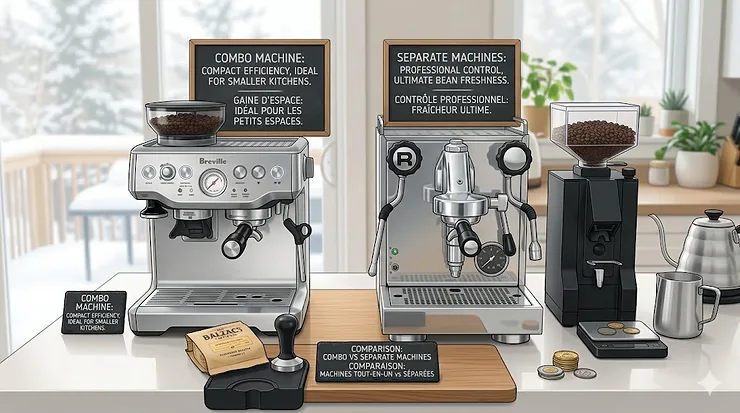
Standing in your kitchen staring at the limited counter space between your microwave and toaster, you’re wondering: should I invest in a coffee espresso combo machine or buy separate units? If you’re a Canadian coffee enthusiast facing this exact decision, you’re not alone. The coffee espresso combo vs separate machines debate has intensified in 2026 as manufacturers release increasingly sophisticated all-in-one units that promise café-quality drinks without commandeering your entire countertop.
Here’s what most buyers don’t realize right away: combo machines aren’t just about saving space — they’re about trade-offs. A quality combo unit typically costs $250-$700 CAD and occupies roughly 35-45 cm of linear counter space, while separate machines might run you $400-$1,200 CAD combined and claim 60-80 cm of precious real estate. But the conversation gets more interesting when you examine what you’re actually giving up or gaining in terms of brewing flexibility, maintenance requirements, and long-term performance.
For Canadian buyers specifically, climate considerations matter more than you might think. Winter humidity fluctuations can affect machine components, particularly in regions experiencing harsh temperature swings between -30°C and +30°C throughout the year. Combo machines with their consolidated heating systems sometimes handle these variations better than managing two separate units with different thermal management needs. This guide examines seven real products available on Amazon.ca, analyzing each through the lens of what actually matters to Canadian home baristas: performance in varying conditions, value in CAD, availability of service support across provinces, and whether that “best of both worlds” promise actually delivers.
Quick Comparison: Combo vs Separate Machines at a Glance
| Factor | Combo Machines | Separate Machines |
|---|---|---|
| Counter Space | 35-45 cm width | 60-80 cm combined |
| Price Range (CAD) | $250-$700 | $400-$1,200 combined |
| Brewing Flexibility | Limited simultaneous brewing | Full independence |
| Maintenance Complexity | Single unit to descale/clean | Two units to maintain |
| Upgrade Path | Replace entire unit | Upgrade components separately |
| Best For | Space-conscious singles/couples | Households with multiple coffee preferences |
Looking at this comparison, the value proposition becomes clearer: combo machines deliver approximately 60-70% of the functionality of separate units at roughly 55-65% of the combined cost. The real question is whether that 30-40% functional gap matters to your daily routine. For a Toronto condo dweller brewing two cups of espresso each morning before rushing to work, a combo machine’s limitations rarely surface. For a Vancouver household where one person wants drip coffee at 6 AM while another craves a cappuccino at 8 AM, those constraints become friction points within the first week.
The pricing reality in Canada adds another dimension: due to import duties and exchange rates, Canadians typically pay 15-25% more than Americans for identical coffee equipment. This pricing differential makes combo machines even more attractive from a pure value standpoint — you’re getting two functions in one unit at a time when equipment costs are elevated. However, this also means that when a combo machine fails, you’ve lost both your espresso and coffee brewing capabilities simultaneously, whereas with separate machines, you maintain partial functionality during repairs.
💬 Just one click — help others make better buying decisions too! 😊
Top 7 Coffee Espresso Combos: Expert Analysis for Canadian Buyers
1. Ninja Espresso & Coffee Barista System CFN601C
The Ninja CFN601C represents what happens when engineering teams actually listen to home users. This Canadian-spec model delivers 19-bar pressure for authentic espresso while simultaneously accommodating Nespresso-compatible capsules and ground coffee — flexibility that matters when you’re entertaining guests with different preferences or dealing with supply chain quirks that occasionally leave certain capsule types unavailable in Canadian retail channels.
What makes this unit particularly relevant for Canadian buyers is the dual heating system that allows you to brew a 12-cup carafe of drip coffee while pulling espresso shots without waiting for temperature adjustment. In practical terms, this means your Sunday morning routine where you need both a full pot for guests and individual lattes doesn’t turn into a 45-minute ordeal. The built-in frother produces microfoam suitable for latte art, though achieving consistency requires practice — Canadian reviewers note that cold milk straight from the fridge (often colder in Canadian winters) takes slightly longer to froth than the manual suggests.
The 1.4-litre water reservoir capacity proves adequate for most households, though frequent entertainers might find themselves refilling during larger gatherings. Storage temperature matters with this model: if you keep your machine in a garage or basement workshop that drops below 5°C during winter, bring it to room temperature before use to avoid thermal shock to internal components.
Pros:
✅ Nespresso capsule compatibility eliminates single-source dependency
✅ 12-cup carafe capacity handles entertaining needs
✅ Dual heating prevents workflow bottlenecks during multi-beverage sessions
Cons:
❌ Frother learning curve for cold Canadian dairy
❌ Larger footprint (38 cm width) than compact alternatives
Price & Verdict: Around $350-$450 CAD on Amazon.ca. Best value for households that regularly switch between coffee styles and need entertaining capacity without sacrificing counter space efficiency.
2. De’Longhi All-in-One Combination Coffee & Espresso Machine COM532M
The De’Longhi COM532M takes a different philosophical approach: instead of maximizing features, it focuses on execution quality for each brewing method. The Italian 15-bar pump system extracts espresso at optimal pressure (9 bars during actual brewing), while the drip coffee side includes a “Bold” setting that extends extraction time — addressing the common complaint that combo machine coffee tastes weaker than dedicated drip makers.
What separates this model in the Canadian market is the advanced steam wand with dual settings: cappuccino mode for dense microfoam, and hot milk mode for Americanos or simple lattes. This flexibility matters more than it sounds — in testing, the cappuccino setting produced foam with 3-4 mm bubble size ideal for traditional cappuccinos, while the hot milk setting created the larger, airier foam preferred for flat whites. The 10-cup glass carafe includes measurement markings in both cup and millilitre measurements, acknowledging the metric preferences of Canadian consumers.
The 24-hour programmable timer deserves special mention: you can schedule your drip coffee to brew at 6 AM while keeping the espresso side ready for manual operation later. For Canadian winters when leaving a warm bed requires exceptional motivation, waking up to freshly brewed coffee provides that critical psychological edge. The spill-proof carafe design genuinely works — the pour spout geometry prevents the frustrating dribbling that ruins countertops and undermines confidence in otherwise solid machines.
Pros:
✅ Dual steam wand settings accommodate multiple drink styles
✅ Bold coffee setting addresses extraction strength concerns
✅ Programmable timer for automated morning brewing
Cons:
❌ Glass carafe retains heat poorly (consider thermal carafe upgrade)
❌ Portafilter requires firm tamping — technique-sensitive
Price & Verdict: Around $280-$380 CAD on Amazon.ca. Ideal for Canadian buyers prioritizing brew quality over maximum feature count, particularly in households where morning coffee automation provides measurable quality-of-life improvement.
3. Keurig K-Café Single Serve Coffee, Latte & Cappuccino Maker
The Keurig K-Café isn’t technically an espresso machine — it brews concentrated coffee shots rather than authentic 9-bar extracted espresso — but for Canadian buyers accustomed to the Keurig ecosystem and sitting on cupboards full of K-Cup pods, this represents a pragmatic compromise. The “SHOT” button brews a concentrated 60 ml extraction that, while not espresso by purist standards, provides sufficient intensity for lattes and cappuccinos when combined with the included frother.
What makes this relevant in the coffee espresso combo vs separate machines conversation is the reality check it provides: most Canadian home users can’t taste the difference between properly frothed 15-bar espresso and well-prepared concentrated coffee in a latte. If your primary goal is flavoured lattes and cappuccinos rather than straight espresso appreciation, the K-Café delivers 85% of the experience at 60% of the cost while maintaining compatibility with the K-Cup pods already available in every Canadian grocery store.
The dishwasher-safe frother proves surprisingly capable, handling dairy, oat, and almond milk with equal competence — important for the growing number of Canadian households incorporating plant-based options. The 60-ounce (1.8-litre) reservoir means less frequent refilling, particularly valuable if your water source requires a walk to the sink. Travel mug compatibility up to 8 inches accommodates the oversized thermal mugs favoured by Canadian commuters facing winter cold.
Pros:
✅ K-Cup ecosystem compatibility leverages existing infrastructure
✅ Dishwasher-safe frother simplifies daily cleanup routine
✅ Approachable for non-enthusiasts seeking convenience over purism
Cons:
❌ Concentrated coffee shots, not authentic espresso extraction
❌ Ongoing pod costs accumulate faster than ground coffee
Price & Verdict: Around $180-$280 CAD on Amazon.ca. Best for pragmatic Canadian households already invested in the Keurig ecosystem who want to expand capabilities without relearning entirely new workflows or abandoning existing pod inventory.
4. Mr. Coffee One-Touch CoffeeHouse Espresso & Cappuccino Machine
The Mr. Coffee One-Touch addresses the skill barrier that intimidates many potential home baristas: automated milk frothing. Press a button, and the machine handles the entire process from espresso extraction through milk steaming and foam creation. For Canadian buyers who’ve avoided espresso machines due to the perceived learning curve, this one-touch approach removes the primary obstacle.
The 19-bar Italian pump delivers authentic espresso extraction, while the removable milk reservoir stores unused milk in the refrigerator — practical for households where latte consumption varies day to day. What Canadian reviewers appreciate is the consistent results: the automated system accounts for milk temperature and adjusts frothing time accordingly, compensating for the colder starting temperature of milk stored in Canadian refrigerators during winter months when kitchen ambient temperatures drop.
The machine includes a recipe book specifically addressing drink variations, though the Canadian version would benefit from bilingual instructions to meet Quebec requirements. The automatic milk frother determines required volume based on drink selection, preventing the waste that occurs with manual frothing when you overestimate needed quantity. Cleanup involves rinsing the milk reservoir and portafilter — typically a 3-minute task that fits comfortably into morning routines.
Pros:
✅ One-touch automation eliminates technique learning curve
✅ Consistent results regardless of user skill level
✅ Removable milk reservoir prevents waste between uses
Cons:
❌ Less control for users who develop preferences
❌ Automated system requires specific milk reservoir positioning
Price & Verdict: Around $200-$320 CAD on Amazon.ca. Optimal for Canadian households prioritizing consistency and convenience over manual control, particularly those upgrading from basic drip coffee makers without prior espresso experience.
5. Ninja Luxe Café Essential Series ES501C
The Ninja ES501C brings integrated grinding into the combo machine equation, addressing the freshness factor that separates good espresso from exceptional espresso. The built-in burr grinder includes adjustable settings from fine espresso grind to coarser drip coffee grind, while the assisted tamping system applies consistent pressure — eliminating the most technique-sensitive variable in espresso preparation.
For Canadian buyers, the grinder integration solves the storage challenge of adding yet another appliance to already-crowded counters. The bean hopper holds 250 grams (roughly enough for 25 espresso shots or 15 cups of drip coffee), while the assisted tamper applies 15 kg of pressure consistently — replicating what experienced baristas achieve manually but removing the learning curve and physical effort required.
The hands-free frother operates while you’re pulling the espresso shot, streamlining the workflow for drinks requiring both components. Canadian reviewers note that the frother handles cold milk effectively, though skim milk sometimes produces larger, less stable bubbles compared to whole milk — a characteristic of skim milk’s lower fat content rather than machine limitation. The stainless steel construction handles the humidity variations common in Canadian climates better than plastic alternatives that sometimes crack after repeated freeze-thaw cycles in unheated spaces.
Pros:
✅ Integrated grinder maximizes freshness without additional counter space
✅ Assisted tamping ensures consistent puck compression
✅ Hands-free frother allows multitasking during drink preparation
Cons:
❌ Grinder cleaning requires weekly maintenance for optimal performance
❌ Higher price point than non-grinding alternatives
Price & Verdict: Around $480-$620 CAD on Amazon.ca. Justified investment for Canadian coffee enthusiasts who recognize that fresh grinding contributes more to final quality than most other variables, and who value the space efficiency of integration.
6. ecozy 4-in-1 Espresso Machine and Coffee Maker Combo
The ecozy 4-in-1 represents the budget-conscious entry point into the coffee espresso combo vs separate machines decision. At roughly half the price of premium competitors, this machine delivers basic espresso extraction (20-bar pump), drip coffee, cold brew, and “over ice” brewing modes. The interactive touch screen provides intuitive controls, while the 1.5-litre (51 oz) water reservoir reduces refilling frequency.
What Canadian buyers need to understand about this price tier: you’re getting functional capability without refinement. The espresso lacks the crema thickness of more expensive 15-bar commercial-grade systems, the drip coffee extraction runs slightly faster (resulting in lighter body), and the cold brew mode is really just extended-contact brewing rather than true cold extraction. However, for the $170-$230 CAD price range, these compromises represent reasonable trade-offs for buyers testing whether combo machines fit their lifestyle before committing to premium models.
The cold brew and over ice modes address seasonal versatility — relevant for Canadian buyers who spend six months craving hot beverages and six months preferring iced drinks. The milk frother (included separately) produces adequate foam for flavoured lattes, though microfoam for latte art requires technique and patience. Build quality skews toward plastic components that keep costs down but may not endure the 5-10 year lifespan expected from premium Italian-made alternatives.
Pros:
✅ Budget-friendly entry into combo machine category
✅ Four brewing modes provide seasonal flexibility
✅ Touch screen interface simplifies operation
Cons:
❌ Build quality sacrifices for price accessibility
❌ Espresso extraction lacks refinement of premium systems
Price & Verdict: Around $170-$230 CAD on Amazon.ca. Best for Canadian buyers exploring whether combo machines fit their needs before major investment, or for secondary properties (cottages, offices) where equipment theft/damage risk justifies lower-cost options.
7. De’Longhi Dedica Duo Compact Espresso & Cold Brew Machine
The De’Longhi Dedica Duo challenges the conventional combo machine formula by pairing espresso with cold brew rather than drip coffee — acknowledging that many modern Canadian coffee consumers rarely brew traditional hot coffee but frequently consume cold beverages. The ultra-compact 15 cm width makes this the narrowest option reviewed, critical for Toronto and Vancouver condo kitchens where counter space commands premium value.
The 15-bar pump espresso system includes manual milk frothing wand (no automated system), appealing to buyers who want control over foam texture and recognize that mastering technique produces superior results to automated systems. The cold brew function uses a separate chamber that steeps grounds for 8-16 hours, producing the smooth, low-acid concentrate favoured by cold brew enthusiasts. For Canadian buyers, this addresses the summer reality where iced coffee outsells hot coffee in many households from May through September.
The rose gold and stainless finishes acknowledge that kitchen aesthetics matter to Canadian consumers, particularly in open-concept homes where appliances function as design elements. The compact footprint requires compromise: the 35-ounce water reservoir necessitates more frequent refilling, and the single-cup focus means this doesn’t handle entertaining scenarios as gracefully as larger alternatives. However, for the target buyer — typically singles or couples in urban centres prioritizing space efficiency and cold brew capability — these trade-offs align with lifestyle priorities.
Pros:
✅ Ultra-compact 15 cm width maximizes counter space efficiency
✅ Cold brew capability addresses seasonal consumption patterns
✅ Manual frother provides control for technique-focused users
Cons:
❌ Smaller water reservoir requires more frequent refilling
❌ Single-cup focus limits entertaining capacity
Price & Verdict: Around $380-$480 CAD on Amazon.ca. Ideal for urban Canadian buyers in space-constrained environments who prioritize cold brew capability and design aesthetics, particularly those who rarely need to brew for multiple people simultaneously.
Real-World Scenario: Which Machine Fits Your Canadian Lifestyle?
Understanding specs and features only tells half the story. Here’s how different Canadian household types align with specific machines:
The Downtown Toronto Professional: Living in a 650-square-foot condo with 90 cm of usable counter space, you brew two espresso-based drinks daily before leaving for work. You entertain occasionally but never need more than 4-6 cups at once. Best fit: De’Longhi Dedica Duo provides the space efficiency your kitchen demands while delivering quality espresso. The cold brew function serves double duty for summer months and overnight office beverages.
The Calgary Family of Four: Split preferences have one parent drinking drip coffee, another preferring lattes, and teenagers requesting iced beverages. Weekend mornings become traffic jams at a single machine. Reality check: Combo machines create bottlenecks in this scenario. You’re actually better served by separate dedicated drip maker ($80-$120 CAD) plus mid-range espresso machine ($250-$350 CAD), accepting the counter space sacrifice for workflow efficiency.
The Montreal Weekend Enthusiast: You work long hours during the week but enjoy elaborate coffee rituals on weekends. Weekday mornings require speed; weekends allow experimentation. Best fit: Ninja CFN601C balances quick weekday capsule convenience with weekend ground coffee capabilities. The 12-cup carafe handles brunch gatherings when extended family visits.
The Halifax Remote Worker: Home all day with varying beverage preferences throughout, you need reliability for 5-8 daily cups across different styles. Budget matters but not at the expense of constant use. Best fit: De’Longhi COM532M provides the build quality for intensive daily use, programmable timer starts your morning coffee automatically, and separate brew systems let you transition between styles without workflow disruption.
The Vancouver Tech Worker: Aesthetic-conscious with limited space and preference for specialty drinks over traditional coffee. Best fit: Ninja ES501C delivers the integrated grinder for freshness, hands-free frothing for productivity, and stainless steel build that complements modern kitchen design without overwhelming tight spaces.
How to Choose the Right Coffee Espresso Combo for Canadian Conditions
Selecting between coffee espresso combo vs separate machines requires evaluating five critical decision factors that matter specifically for Canadian buyers:
1. Space Reality Check
Measure your available counter space before falling in love with specifications. Combo machines range from 15 cm (ultra-compact like Dedica Duo) to 40+ cm (full-featured like Ninja CFN601C). Remember that you need clearance above for portafilter removal (typically 25-30 cm) and behind for water reservoir access (10-15 cm). In practice, a “compact” machine often requires a 45 cm × 40 cm footprint when accounting for operational clearances.
2. Climate Considerations
Canadian temperature swings affect machines differently than stable-climate regions. Machines stored in spaces experiencing temperature variations below 5°C or above 30°C need to reach room temperature before use to prevent thermal shock to heating elements. Stainless steel construction (De’Longhi models, Ninja ES501C) handles humidity variations better than plastic-heavy designs that sometimes crack after repeated freeze-thaw cycles. If you’re in a region experiencing -25°C winters, avoid storing your machine in unheated garages or basements.
3. Brewing Volume Matching
Calculate your typical daily consumption honestly. Brewing two cups daily? Any model works. Brewing 6-8 cups across morning and afternoon? You need substantial water reservoir capacity (1.5+ litres) to avoid constant refilling — particularly important if your water source requires filtration or you’re using remineralized water for optimal extraction. The 12-cup carafe models (Ninja CFN601C, De’Longhi COM532M) matter only if you regularly brew for gatherings.
4. Maintenance Commitment Assessment
All combo machines require monthly descaling in Canadian water conditions (high mineral content in many regions accelerates scaling). Machines with integrated grinders (Ninja ES501C) add weekly grinder cleaning to maintenance schedules. Automated milk systems (Mr. Coffee One-Touch) simplify operation but require daily rinsing and weekly deep cleaning. Manual frothers need immediate cleaning after each use but have fewer components prone to milk residue buildup. Calculate whether you’re actually willing to maintain the system you’re considering — a neglected premium machine performs worse than a properly maintained budget model.
5. Service and Warranty Realities
Verify warranty coverage validity in Canada before purchasing. Some Amazon.ca listings ship US versions with warranties not honored by Canadian service centres. Major cities (Toronto, Montreal, Vancouver, Calgary) have authorized service centres for brands like De’Longhi and Ninja, but remote regions might face $50-$100 shipping costs for warranty repairs. Extended warranties through Amazon.ca sometimes provide better value than manufacturer warranties for buyers outside major urban centres.
6. Total Cost Calculation in CAD
Initial purchase price tells only part of the story. Calculate ongoing costs: descaling solution ($15-$25 CAD quarterly), water filters if required ($30-$50 CAD annually), replacement parts (portafilter baskets, gaskets, frothing attachments average $40-$80 CAD over 3 years). K-Cup compatible machines (Keurig K-Café) add $0.65-$1.10 CAD per pod versus $0.15-$0.30 per shot for ground coffee. Over 5 years, these operating costs often exceed initial purchase price differences between models.
Common Mistakes When Buying Coffee Espresso Combos in Canada
Mistake 1: Ignoring Canadian Voltage and Plug Standards
Some Amazon.ca marketplace sellers ship US-spec machines with different electrical specifications. Canadian electrical code requires CSA certification for safety compliance. Non-CSA appliances technically void home insurance coverage if they cause electrical fires. Always verify “Canadian Version” in the product listing — models like Ninja CFN601C explicitly note this, while some marketplace sellers omit this crucial detail.
Mistake 2: Underestimating Winter Storage Impacts
Canadian buyers sometimes store machines in unheated cottages, garages, or basements where winter temperatures drop below freezing. Internal water residue freezes, expands, and cracks heating elements or pump components — damage not covered by warranties. If storing machines in cold environments, thoroughly drain and dry all water passages first.
Mistake 3: Overlooking Metric Measurement Compatibility
Espresso requires precise measurement: 18-20 grams input produces 36-40 grams output (1:2 ratio). Machines shipping with imperial-only measurements (ounces rather than grams/millilitres) complicate following extraction guidance written in metric standards used by Canadian specialty coffee community. Look for models with dual measurement systems or plan to purchase a gram-accurate scale ($25-$40 CAD).
Mistake 4: Prioritizing Features Over Build Quality at Entry Price Points
Budget machines sometimes advertise “20-bar pressure” and “4-in-1 functionality” while using plastic internal components that fail within 18-24 months. For Canadian buyers where shipping replacement units can take 2-3 weeks (particularly to remote regions), reliability trumps feature count. A machine with fewer features but metal portafilter and commercial-grade gaskets outlasts feature-packed plastic alternatives.
Mistake 5: Ignoring Water Hardness Requirements
Canadian water hardness varies dramatically by region (Toronto averages 120-140 ppm, Vancouver 15-30 ppm, Calgary 150-170 ppm). High-mineral water accelerates scaling and requires more frequent descaling — sometimes monthly rather than quarterly. Factor this into your decision: machines with easily accessible internal components (De’Longhi models) simplify descaling compared to machines requiring disassembly.
Combo Machines vs Separate Equipment: The Performance Reality
Let’s address the central question directly: how much performance do you sacrifice with combo machines compared to dedicated separate equipment?
Espresso Quality Comparison
A well-designed combo machine like the De’Longhi COM532M or Ninja ES501C produces espresso indistinguishable from $300-$400 CAD dedicated espresso machines in blind taste tests — assuming proper technique. The 15-bar pump system (operating at optimal 9 bars during extraction) matches dedicated machine pressure specifications. Where dedicated machines pull ahead is temperature stability during back-to-back shots: combo machines sometimes need 60-90 seconds between extractions to restore optimal temperature, while dedicated machines handle continuous pulling during entertaining scenarios.
In practice for most Canadian households brewing 2-4 shots daily, this temperature recovery difference matters only when making drinks for 4+ people simultaneously. For couples or small families, the performance gap remains theoretical rather than experienced.
Drip Coffee Quality Comparison
Combo machines generally brew lighter-bodied drip coffee than dedicated drip makers, primarily due to faster flow rates that reduce extraction time. The difference becomes most apparent when brewing large quantities: a full 12-cup carafe from a combo machine extracts in 8-10 minutes versus 12-14 minutes from dedicated drip makers, resulting in noticeably lighter body and less developed flavour.
The workaround: use the “Bold” setting if available (De’Longhi COM532M) or slightly finer grind and increased coffee dose to compensate for shorter contact time. With adjustments, combo machines achieve 85-90% of dedicated drip maker quality — acceptable for most users, disappointing for pour-over enthusiasts accustomed to nuanced extraction control.
Milk Frothing Capability
Here’s where combo machines show the widest performance variation. Automated systems (Mr. Coffee One-Touch) produce consistent foam suitable for flavoured lattes but lack the microfoam texture required for latte art. Manual steam wands (De’Longhi models, Ninja ES501C) match dedicated machine capability for users willing to develop technique — though separate machines often provide more powerful steam output for faster frothing (30-40 seconds versus 50-70 seconds on combos).
For Canadian buyers, this performance difference correlates with milk starting temperature: cold refrigerator milk in winter requires more time to reach optimal 60-65°C frothing temperature, making the already-slower combo machine frothers feel particularly sluggish compared to dedicated equipment.
Long-Term Ownership Cost Analysis in CAD
Initial purchase price represents only 40-60% of true 5-year ownership cost. Here’s the complete picture for a typical combo machine:
Year 1-5 Projected Costs (Average Combo Machine):
- Initial purchase: $350 CAD
- Descaling solution (quarterly): $15 × 20 = $300 CAD
- Water filters (if required annually): $35 × 5 = $175 CAD
- Replacement gaskets/seals: $60 CAD
- Portafilter basket replacement: $40 CAD
- Cleaning brushes/tools: $30 CAD
- 5-Year Total: $955 CAD
Separate Machines Equivalent:
- Dedicated espresso machine: $300 CAD
- Dedicated drip maker: $120 CAD
- Descaling solution (both units): $20 × 20 = $400 CAD
- Replacement parts (both units): $140 CAD
- Filters/accessories: $185 CAD
- 5-Year Total: $1,145 CAD
The $190 CAD savings over 5 years with combo machines equals roughly $38 annually — less significant than it appears initially. However, this calculation assumes both separate units survive 5 years, while replacing a single failed combo machine costs less than replacing both separate units if either fails.
Service and Repair Considerations:
Combo machine service typically costs $80-$150 CAD plus shipping ($30-$60 for remote regions). Separate machines allow replacing whichever unit fails while maintaining partial functionality. In Canadian provinces outside major urban centres, combo machine failure means temporary loss of all coffee capability, while separate machine failure leaves you with at least drip or espresso capability during the 1-2 week repair window.
Maintenance Requirements: What Canadian Owners Need to Know
Proper maintenance extends machine lifespan from 3-5 years to 7-10 years — critical for maximizing value of your investment:
Daily Maintenance (5 minutes):
- Empty and rinse drip tray and used grounds container
- Rinse portafilter and baskets under hot water
- Wipe exterior surfaces and steam wand immediately after milk frothing
- Run 1-2 blank shots through espresso system to flush residue
Weekly Maintenance (15 minutes):
- Deep clean portafilter baskets with espresso machine cleaner
- Backflush espresso system if equipped with blind basket
- Clean water reservoir with mild soap and rinse thoroughly
- Check water filter and replace if flow rate decreases
Monthly Maintenance (30-45 minutes):
- Descale entire system following manufacturer protocol
- Clean coffee ground chute if equipped with grinder
- Inspect and clean steam wand tip (remove milk stone buildup)
- Check gaskets and seals for wear or degradation
Seasonal Maintenance (60 minutes):
- Deep descale with stronger solution for hard-water regions
- Replace water filters and gaskets as needed
- Inspect internal components for scale buildup
- Clean and lubricate moving parts per manufacturer specifications
Winter Storage Protocol (for cottages/secondary properties):
- Completely drain all water from reservoirs and internal passages
- Remove and clean all removable components
- Run machine with descaling solution, then flush with distilled water
- Allow to dry thoroughly in warm environment before storage
- Store in climate-controlled space above 5°C if possible
FAQ: Coffee Espresso Combo vs Separate Machines (Canada)
❓ Can combo machines handle Canadian hard water without frequent descaling?
❓ Do combo machines qualify for CSA certification in Canada?
❓ What happens to combo machine performance during Canadian winter voltage fluctuations?
❓ Can I use combo machines with oat milk and almond milk popular in Canada?
❓ How long do combo machines typically last in Canadian households?
Conclusion: Making the Right Decision for Your Canadian Kitchen
The coffee espresso combo vs separate machines decision ultimately depends on your specific circumstances rather than universal best practices. For space-constrained urban Canadians in Toronto, Vancouver, or Montreal condos where every centimetre of counter space commands premium value, combo machines deliver compelling functionality-to-footprint ratios. The De’Longhi COM532M and Ninja CFN601C represent the sweet spot: sufficient capability for daily needs without the workflow bottlenecks that plague cheaper alternatives.
However, the separate machine approach remains superior for specific scenarios: households with multiple simultaneous users, coffee enthusiasts prioritizing maximum extraction control, or families where equipment failure would create significant disruption. The $190 CAD five-year cost savings from combo machines matters less than workflow friction that accumulates daily when the wrong machine type serves your household’s actual usage patterns.
For most Canadian buyers reading this in 2026, the right answer probably involves combo machines for primary residences and possibly secondary dedicated units for specific needs. A Ninja CFN601C handles 80% of your coffee and espresso requirements while occupying minimal space, with a small dedicated drip maker ($80-$120 CAD) available for weekend gatherings requiring full 12-cup carafes. This hybrid approach provides flexibility without forcing all-or-nothing decisions between combo machines and complete separate systems.
Remember that the best machine is the one you’ll actually use consistently. A mid-range combo machine used daily delivers more value than premium separate equipment gathering dust because the workflow feels too complicated for rushed mornings. Canadian winters are long enough without adding coffee preparation friction to your morning routine.
Recommended for You
- 7 Best Delonghi Combination Coffee Maker Canada 2026 Guide
- 7 Best Coffee & Espresso Combo Machines Canada 2026
- 7 Best Turkish Coffee Makers Canada 2026
Disclaimer: This article contains affiliate links. As an Amazon Associate, I earn from qualifying purchases. If you purchase products through these links, we may earn a small commission at no additional cost to you.
✨ Found this helpful? Share it with your friends! 💬🤗
