
In This Article
Somewhere between your first pour-over and your fourth cup of the week, you start noticing things. The grind looks different some mornings. The coffee tastes flatter than it did at the café. And somewhere in a forum thread at 11 p.m., you fall down the ceramic burr grinder vs steel burr rabbit hole, wondering if the little disc inside your grinder is secretly sabotaging your coffee. Fair question. A burr grinder crushes beans between two hard surfaces instead of hacking them apart like a blade grinder does, and the material of those surfaces — ceramic or steel — genuinely changes how the grinder ages, how it handles heat, and how much it costs to keep running. This guide breaks down real products, real specs, and honest aggregated review sentiment so you can pick the right one without guessing.
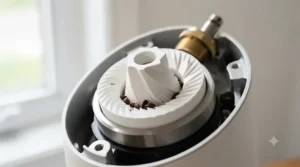
We looked at 7 real grinders sold in Canada, from budget hand-crank models under C$40 to premium picks pushing past C$200, and we’re not going to pretend one material wins every category. The truth is messier and more useful than that. As Wikipedia’s overview of burr mill mechanisms explains, ceramic ranks among the hardest common burr materials and holds up well across repeated multi-use grinding without corroding — a real, documented advantage worth understanding before you spend a dollar. By the end of this article you’ll know exactly which burr material fits your brewing habits, your budget, and how much patience you have for maintenance.
Quick Comparison Table: Ceramic vs Steel Burr at a Glance
| Factor | Ceramic Burr | Steel Burr | Best For |
|---|---|---|---|
| Typical lifespan | 10+ years, home use | 3-5 years, daily use | Ceramic: long-term owners |
| Heat during grinding | Lower, poor heat conductor | Higher, transfers more heat | Ceramic: espresso-fine grinds |
| Grind speed (manual) | Slower, more rotations | Faster, fewer rotations | Steel: busy mornings |
| Impact resistance | Brittle, can chip on debris | Tougher, resists chipping | Steel: rougher daily handling |
| Upfront cost | Often lower on entry models | Wide range, budget to premium | Depends on model tier |
Looking at the table above, neither material is a universal upgrade over the other — they trade off in different directions. Ceramic pulls ahead on longevity and cool grinding, which matters most if you’re chasing consistency in espresso-fine settings or you just don’t want to think about your grinder for a decade. Steel pulls ahead on raw speed and resilience against the occasional pebble that sneaks in with your beans, which matters more if you’re grinding daily for a household of four. We’ll unpack exactly when each edge actually shows up in your cup later in this guide.
💬 Just one click — help others make better buying decisions too! 😊
Top 7 Ceramic and Steel Burr Grinders: Expert Analysis
We picked 7 real, currently available grinders spanning budget hand-crank models to premium picks, covering both burr materials so you can compare apples to apples. Every price below is a range, since Amazon listings shift — always check the current price before buying.
1. Kyocera CM-50-CF Ceramic Coffee Grinder — the ceramic benchmark for home brewers
The Kyocera CM-50-CF is arguably the grinder that put ceramic burrs on the map for home coffee drinkers, and it’s still one of the most recognizable ceramic options on Amazon.ca today. It uses a hand-crank conical ceramic burr with an adjustable dial that runs from espresso-fine to French-press coarse, paired with a compact glass container that holds enough grounds for two to three cups. Based on the spec comparison with entry steel grinders, what stands out here isn’t raw grinding speed — it’s that the ceramic core resists dulling far past the point where a cheap steel burr would already need replacing, so the grind consistency you get on day one is close to what you’ll get five years from now. This makes the Kyocera CM-50-CF a strong pick for someone who brews one or two cups a day and values a “buy it once” mentality over speed. Reviewers consistently report that the crank requires a bit of forearm effort on finer settings, and a recurring theme in aggregated feedback is that the plastic crank handle feels less premium than the ceramic mechanism it’s attached to.
Pros:
- ✅ Ceramic burr resists dulling for years of regular use
- ✅ Wide range of grind settings from espresso to French press
- ✅ Compact footprint that stores easily in small kitchens
Cons:
- ❌ Hand-crank grinding takes noticeably more effort on fine settings
- ❌ Plastic components feel less durable than the burr itself
Expect the Kyocera CM-50-CF to sit in the C$55-C$70 range, and for a grinder you’ll likely still be using in 2031, that’s a reasonable value verdict.
2. Hario Skerton Pro — best all-rounder ceramic grinder for pour-over
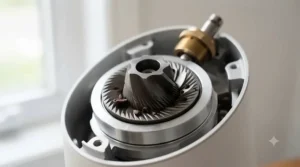
The Hario Skerton Pro updated Hario’s long-running Skerton line with a redesigned frame that fixes one of the most common complaints about the original: wobble during grinding. It features a conical ceramic burr, a 24-click adjustment ring for grind size, and a glass jar body that doubles as a serving vessel once you’ve ground your beans. What most buyers overlook about this model is that the improved bearing assembly matters just as much as the burr material — a ceramic burr in a wobbly housing still grinds unevenly, so the mechanical fix is arguably the bigger upgrade here. The extended handle also gives more leverage than older Hario models, which meaningfully reduces the arm fatigue that ceramic hand grinders are sometimes criticized for. Aggregated review sentiment points to strong satisfaction for pour-over and Aeropress use, with a common complaint being that dialing in true espresso fineness pushes the limits of what this burr geometry was designed for.
Pros:
- ✅ Redesigned frame eliminates the wobble of earlier Skerton models
- ✅ Ceramic burr stays sharp well beyond typical steel lifespans
- ✅ Glass jar doubles as a pour-friendly serving container
Cons:
- ❌ Struggles to hit truly fine, consistent espresso grind
- ❌ Slower per-cup grinding than comparable steel manual models
Priced around C$45-C$60, the Hario Skerton Pro offers strong value for drip, pour-over, and French press drinkers who aren’t chasing espresso.
3. Mixpresso Manual Coffee Grinder with Ceramic Burr — best budget entry into ceramic grinding
If you want to try ceramic burrs without committing much money, the Mixpresso Manual Coffee Grinder is a real, widely available option built around a ceramic core paired with two glass storage jars. It’s a straightforward adjustable grinder with a stainless steel crank and silicone lid, aimed squarely at people replacing a blade grinder for the first time. Here’s what to weigh: the ceramic burr in a sub-C$35 grinder won’t have the same tooth precision as the burrs in the Kyocera or Hario models above, so while it still won’t generate grinding heat, the particle consistency is noticeably looser at the finest settings. That tradeoff is honest and worth stating plainly rather than pretending a budget ceramic burr performs identically to a premium one. For French press or basic drip brewing, though, that looser consistency barely registers in the cup, and dual jars are a genuinely practical touch for storing beans separately from grounds. Reviewers frequently mention the low price as the main draw, with a recurring complaint about slower grinding on coarser settings due to lighter-weight internal gearing.
Pros:
- ✅ Lowest-cost way to try a genuine ceramic burr
- ✅ Two glass jars simplify bean and grounds storage
- ✅ Silicone lid keeps beans contained during loading
Cons:
- ❌ Grind consistency loosens noticeably at fine settings
- ❌ Lighter build feels less sturdy under daily heavy use
At roughly C$25-C$35, the Mixpresso Manual Coffee Grinder is a low-risk way to test whether ceramic grinding suits your routine before spending more.
4. JavaPresse Manual Stainless Steel Coffee Grinder — best budget steel burr for travel
The JavaPresse Manual Coffee Grinder is one of the most recognizable steel-burr manual grinders on the market, built around a conical stainless steel burr with 18 external click settings and a compact wood-topped body. On paper this means fewer rotations per gram than a comparable ceramic hand grinder, since steel bites into beans more aggressively — and in practice, reviewers consistently note it grinds noticeably faster than ceramic competitors at the same price point. The external adjustment dial is also a genuine usability win, letting you change grind size without disassembling the burr chamber, which matters when you’re switching between French press one morning and pour-over the next. What most buyers overlook about steel manual grinders in this price bracket is that the burrs will eventually dull faster than ceramic, but stainless steel simply shrugs off the occasional hard debris that would risk chipping a ceramic burr — a real tradeoff, not a marketing footnote. Aggregated feedback frequently praises portability for travel and camping, with a common complaint about capacity feeling small for grinding more than two cups at once.
Pros:
- ✅ Fast, low-effort grinding thanks to aggressive steel geometry
- ✅ External click adjustment without disassembly
- ✅ Compact and genuinely travel-friendly design
Cons:
- ❌ Small hopper limits batch size for multiple cups
- ❌ Steel burr will need replacement sooner than ceramic
Typically listed around C$35-C$45, the JavaPresse Manual Coffee Grinder delivers strong value for solo brewers and travelers who prioritize speed over capacity.
5. Timemore Chestnut C2 — best mid-range steel burr manual grinder
The Timemore Chestnut C2 has become something of a cult favourite among home espresso and pour-over enthusiasts, and for good reason: it pairs a 420 stainless steel conical burr with a stepless adjustment ring, meaning you can dial grind size with far more precision than click-based competitors. Based on the spec comparison with other manual grinders in this review, the stepless mechanism is the standout feature — it lets you fine-tune between what would otherwise be two fixed settings on a click grinder, which is the kind of granular control that actually shows up as a taste difference in espresso and Aeropress. The redesigned handle and bearing system from the earlier Chestnut line also reduce wobble considerably. One independent coffee-gear reviewer who tested both generations noted that the C2 remains the more sensible pick for most buyers, since it costs less and grinds faster than the newer C3 model that replaced it. Reviewers consistently highlight the stepless adjustment as the reason they upgraded from a click-based ceramic grinder, while a common complaint is that beginners find the lack of numbered settings makes repeatable dialing-in slightly harder at first.
Pros:
- ✅ Stepless adjustment allows precise, granular grind tuning
- ✅ Steel burr grinds quickly with minimal arm fatigue
- ✅ Sturdy build with a notably reduced wobble versus older models
Cons:
- ❌ No numbered click settings makes repeat dial-in trickier
- ❌ Steeper learning curve for total beginners
Expect a price in the C$75-C$95 range, and for espresso-curious brewers, the Timemore Chestnut C2 justifies the step up from budget steel grinders.
6. Baratza Encore — best all-around electric steel burr grinder
The Baratza Encore is the grinder most frequently recommended in Canadian coffee forums, and it earns that reputation with a 40-position stepped steel conical burr, a continuous on/off switch, and a straightforward single-button interface with no unnecessary digital extras. What the spec sheet won’t tell you, but reviewer consensus makes clear, is that its wide grind range covers everything from cold brew to drip beautifully but genuinely falls short for espresso, where finer, more expensive grinders pull ahead. Aggregated Reddit review data on the Encore shows strongly positive sentiment overall, with one long-term owner describing years of daily use without a single worry after the initial purchase. That kind of “buy it once” sentiment shows up repeatedly across owner discussions, alongside more measured feedback that it’s not built for anyone chasing serious home espresso. The direct-drive-style reduction gear motor is quieter than cheaper blade or entry burr grinders, though not silent, and the steel burrs are user-replaceable when they eventually dull.
Pros:
- ✅ Wide, reliable grind range for drip, pour-over, and French press
- ✅ Simple, durable interface with minimal failure points
- ✅ Replaceable burrs extend the grinder’s usable lifespan
Cons:
- ❌ Not fine or consistent enough for serious espresso work
- ❌ Heavier and larger footprint than manual alternatives
Priced roughly C$220-C$260, the Baratza Encore is a strong value pick if espresso isn’t your daily brew method.
7. 1Zpresso JX-Pro — best premium steel burr manual grinder
The 1Zpresso JX-Pro sits at the top of the manual grinder market, built around a large 48mm stainless steel conical burr designed originally for filter coffee precision, with an external stepless adjustment collar and a magnetic catch cup for zero-mess dosing. Here’s what to weigh: the larger burr diameter reduces the number of crank rotations needed per dose compared to smaller manual grinders, which matters more than it sounds like once you’re grinding 20+ grams every morning. Based on the spec comparison with mid-range steel grinders like the Chestnut C2, the JX-Pro’s burr edges are cut to a finer tolerance, which reviewers consistently link to noticeably better particle uniformity — the kind of upgrade that becomes obvious once you’ve tasted the difference in a clean pour-over cup. The magnetic catch cup is a small but genuinely useful detail that eliminates the static cling and mess common to cheaper manual grinders. A recurring theme in owner feedback is that the premium price is easier to justify for filter coffee obsessives than for casual French press drinkers, who likely won’t notice the full benefit.
Pros:
- ✅ Large 48mm burr reduces cranking effort per dose
- ✅ Exceptional particle uniformity for filter and pour-over
- ✅ Magnetic catch cup minimizes static and mess
Cons:
- ❌ Premium price hard to justify for casual brewers
- ❌ Overkill if you mainly brew French press or cold brew
At around C$210-C$250, the 1Zpresso JX-Pro delivers genuine value if you brew pour-over daily and can taste the difference in particle uniformity.
Top 7 Products: Specs & Value Comparison
| Product | Burr Material | Type | Price Range | Best For |
|---|---|---|---|---|
| Kyocera CM-50-CF | Ceramic | Manual | C$55-C$70 | Long-term, low-maintenance ownership |
| Hario Skerton Pro | Ceramic | Manual | C$45-C$60 | Pour-over and Aeropress drinkers |
| Mixpresso Manual Grinder | Ceramic | Manual | C$25-C$35 | First-time ceramic buyers on a budget |
| JavaPresse Manual Grinder | Steel | Manual | C$35-C$45 | Travel and solo, fast grinding |
| Timemore Chestnut C2 | Steel | Manual | C$75-C$95 | Espresso-curious precision brewers |
| Baratza Encore | Steel | Electric | C$220-C$260 | Daily electric grinding, drip and filter |
| 1Zpresso JX-Pro | Steel | Manual | C$210-C$250 | Serious pour-over enthusiasts |
Scanning the lineup, the price spread tells its own story: ceramic dominates the budget tier while steel spans both the cheapest and most premium options on this list. If you’re brand new to burr grinding, the Mixpresso Manual Grinder or JavaPresse Manual Grinder each offer a low-risk entry point under C$45, while the Baratza Encore and 1Zpresso JX-Pro represent the ceiling of what steel burrs can deliver once you’re grinding daily and demanding more precision.
Ceramic vs Steel Burr: Which Is Better for Your Brew Method?
The honest answer is that “better” depends entirely on what’s in your cup tomorrow morning. Ceramic burrs generate less friction heat, and since burr mills as a category already produce far less frictional heat than blade grinders to begin with, the added heat-reduction benefit of ceramic is real but modest for most home brewing — it becomes more noticeable during longer, continuous electric grinding sessions than during quick manual grinds. For pour-over, drip, and French press, the difference between the Hario Skerton Pro‘s ceramic burr and the JavaPresse Manual Grinder‘s steel burr is genuinely hard to detect blind, and both grinders in this guide perform well for those methods.
Espresso is where the story shifts. Fine, consistent espresso grinds demand tight burr tolerances, and premium steel grinders like the Timemore Chestnut C2 and 1Zpresso JX-Pro are engineered with sharper edge geometry specifically for that job. Ceramic burrs can grind fine, but the wider particle distribution common in ceramic designs tends to produce muddier, less balanced espresso shots compared to a well-tuned steel burr at the same price tier. If your daily cup is a Chemex or Aeropress, lean ceramic for longevity. If espresso is the goal, lean steel and budget for a model built with that grind range in mind.
✨ Don’t Miss These Exclusive Deals!
🔍 Ready to upgrade your morning routine? Click through to check current pricing on any grinder above and see which one fits your budget today.
Does Ceramic Burr Last Longer? The Straight Answer
Yes, generally — but the gap is bigger in theory than most buyers expect in daily practice. Ceramic material is measured around 9 on the Mohs hardness scale, compared to roughly 5-6 for typical burr steel, which is why ceramic burrs resist wearing down for a decade or more of home use while steel burrs in daily-use electric grinders often need replacement within 3-5 years. That said, “lasts longer” only applies to gradual wear from normal grinding. It does not apply to sudden impact damage: a small stone or hard foreign object in your beans can chip or crack a ceramic burr outright, while the same object would likely just dull a steel burr slightly rather than break it. So the practical answer is that ceramic wins on slow wear, steel wins on toughness against accidents, and both failure modes are worth knowing about before you commit to either material for a grinder you plan to keep for years.
Ceramic Burr Grinder Heat Retention: What It Means for Flavour
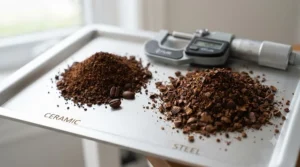
Heat retention gets talked about constantly in ceramic vs steel debates, so let’s separate the real effect from the exaggerated one. Ceramic has low thermal conductivity, meaning it resists absorbing and transferring heat during grinding, which helps keep ground coffee cooler and theoretically better preserves volatile aromatic compounds. Steel conducts heat more readily, so during extended or continuous grinding — think a busy electric grinder running back-to-back doses for a household — steel burrs can measurably warm up more than ceramic. For a single manual grind session lasting under a minute, though, this heat difference is small enough that most drinkers won’t taste it. Where it matters more is in electric grinders like the Baratza Encore running frequent, longer batches, where steel’s higher thermal conductivity has more opportunity to build up warmth over a grinding session. If heat retention genuinely worries you and you’re grinding large batches often, a ceramic manual grinder or a steel electric grinder with rest breaks between doses both address the concern effectively.
How to Choose a Ceramic or Steel Burr Grinder
- Identify your primary brew method first. Espresso demands finer, tighter tolerances that favour premium steel burrs, while drip, French press, and pour-over are forgiving of either material.
- Decide manual or electric based on daily grind volume. If you’re grinding for one or two cups, a manual grinder like the Hario Skerton Pro or JavaPresse Manual Grinder saves money without costing you convenience.
- Set a realistic budget band, not a single number. Entry burr grinders run C$25-C$45, mid-range sits around C$75-C$100, and premium options like the 1Zpresso JX-Pro or Baratza Encore land C$200 and up.
- Weigh longevity against upfront cost. Ceramic burrs generally need replacing less often, which can offset a higher entry price over several years of ownership.
- Check adjustment style. Stepless grinders like the Timemore Chestnut C2 offer finer control; click-based grinders are easier for beginners to repeat a setting reliably.
- Consider your beans’ storage conditions. If your beans occasionally carry small debris, steel’s impact resistance is a real practical advantage over brittle ceramic.
- Read aggregated review sentiment, not star ratings alone. A 4.5-star average hides a lot; look for recurring, specific complaints before you buy.
Common Mistakes When Buying a Burr Grinder
The most common mistake is assuming burr material alone determines grind quality — burr geometry, motor consistency, and build tolerance matter just as much, and a well-engineered ceramic burr can outperform a poorly manufactured steel one. Another frequent misstep is buying a grinder built for filter coffee and expecting espresso-level fineness from it; the Hario Skerton Pro, for instance, is excellent for pour-over but genuinely struggles at true espresso settings, and that’s a spec limitation, not a manufacturing flaw. Shoppers also commonly underestimate how much daily grind volume matters: a manual grinder that’s delightful for one cup becomes a chore for a household of four, which is exactly where an electric option like the Baratza Encore earns its higher price. Finally, plenty of buyers focus entirely on burr material and skip checking hopper capacity, adjustment range, and cleaning difficulty, three factors that shape your daily experience far more than most people expect going in.
Practical Usage Guide: Getting the Most from Your New Grinder
Setting up a new burr grinder right in the first week prevents most of the common frustrations. Start by running a small batch of cheap, old beans through the grinder before your good beans — this clears manufacturing dust and lets you sanity-check the grind settings without wasting a fresh bag. For manual ceramic grinders like the Kyocera CM-50-CF, expect the first few grinds to feel stiffer than later ones; the ceramic burr mechanism loosens slightly as components settle into place. For electric steel grinders like the Baratza Encore, resist the urge to run continuous back-to-back doses in your first sessions; let the motor rest between grinds while you’re still calibrating your preferred setting, both to protect the motor and to keep bean temperature down.
Maintenance schedules differ meaningfully by material. Ceramic burrs should never be washed with water repeatedly, since trapped moisture in a housing can promote mould in the chamber over time; a dry brush after each use is sufficient. Steel burrs specifically should never be washed with water at all, since surface oxidation can develop on exposed metal — dry brushing or a designated grinder-cleaning tablet is the safer routine. A common first-30-days mistake is over-tightening the burr adjustment past its intended range, which can strip the mechanism on manual grinders; always adjust gradually and note your preferred click or collar position so you can return to it after cleaning.
Real-World Scenarios: Who Should Buy Ceramic vs Steel
The apartment-dwelling pour-over drinker. If you’re brewing one cup most mornings in a small kitchen, budget matters, and you don’t want another appliance’s motor humming at 6 a.m., the Hario Skerton Pro or Mixpresso Manual Grinder fits well. Ceramic’s slower pace is a non-issue for a single cup, and the quiet manual grinding suits shared walls.
The family of four running drip coffee every morning. Grinding four cups by hand daily gets old fast. The Baratza Encore‘s wide grind range and hands-free operation make it the practical choice here, and its steel burrs handle daily volume without the wear concerns that come with cheaper electric grinders.
The home barista chasing better espresso. If you’ve already got a decent espresso machine and you’re frustrated by muddy shots, the Timemore Chestnut C2 or 1Zpresso JX-Pro are worth the premium. Their tighter steel burr tolerances directly translate into cleaner, more balanced extraction that a ceramic manual grinder genuinely can’t match at this price point.
Long-Term Cost & Maintenance: Ceramic vs Steel Total Cost of Ownership
Sticker price only tells part of the story. A ceramic burr grinder like the Kyocera CM-50-CF, bought once around C$65, can realistically run 8-10 years without needing burr replacement, working out to roughly C$6-C$8 per year of ownership. A budget steel electric grinder in the same price bracket might need a burr replacement every 3-4 years under daily use, which usually runs an additional C$20-C$40 per swap, pushing its effective annual cost higher despite a similar starting price. Premium steel grinders like the Baratza Encore offset this somewhat with user-replaceable burrs and a track record of owners reporting years of reliable service, but the parts availability and replacement cost still factor into true ownership math. If you’re grinding daily and comparing total cost over five years rather than just the price tag today, ceramic often edges ahead on value for filter and drip use, while steel’s higher performance ceiling for espresso justifies its higher maintenance cost for that specific use case.
Safety, Certification & Buying Confidently on Amazon.ca
Coffee grinders are electrical kitchen appliances, and Canadian safety expectations apply the same way they do to any plug-in device. Before buying an electric grinder like the Baratza Encore, it’s worth knowing that Health Canada advises checking for recognized certification marks such as CSA, cUL, or cETL before purchasing any electrical product that plugs into an outlet, since uncertified products may not meet Canadian national safety standards. This applies equally to budget electric grinders sold by third-party sellers on Amazon.ca, where certification marks aren’t always as prominently listed as they should be.
Manual grinders like the 1Zpresso JX-Pro or JavaPresse Manual Grinder don’t carry the same electrical certification concerns, but general online-shopping diligence still applies — check seller reputation, compare product photos against the manufacturer’s own listings, and confirm return policies before buying, especially for higher-ticket premium grinders.
What Ceramic Burr Grinder Reviews Actually Say
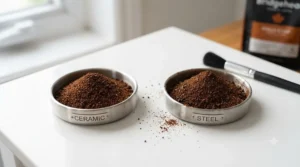
Aggregated review sentiment across ceramic burr grinders is fairly consistent: owners praise the quiet, cool grinding and long-term durability, while the most common complaint centres on grinding speed and effort compared to steel alternatives. For the Kyocera CM-50-CF and Hario Skerton Pro specifically, reviewers repeatedly highlight that the ceramic burr still feels sharp years into ownership, which lines up with the material’s documented hardness advantage. A Canadian consumer testing roundup of coffee grinders found that burr grinders consistently produced even, controlled results across brewing methods without overheating the coffee, reinforcing that the burr-versus-blade distinction matters more for most drinkers than the ceramic-versus-steel choice within burr grinders themselves. Negative feedback on ceramic models tends to cluster around two specific issues: slower grinding on coarse settings and, less commonly, chipped burrs traced back to a stray stone in a bag of beans — a rare but real failure mode worth guarding against by giving your beans a quick visual check before loading the hopper.
Best Ceramic Burr Grinder on Amazon.ca: Quick Picks Recap
If you’re short on time, here’s the condensed version. For the best overall ceramic pick, the Hario Skerton Pro balances build quality, grind range, and price better than any other ceramic grinder in this guide. For the absolute lowest-cost way to try ceramic grinding, the Mixpresso Manual Grinder gets the job done under C$35. For buyers who want a slightly more premium ceramic experience with a longer grind-setting range, the Kyocera CM-50-CF remains a proven, widely reviewed choice. All three avoid the friction heat that steel burrs generate under heavier use, making them a sound choice for anyone prioritizing longevity and cool grinding over raw speed.
Frequently Asked Questions
❓ Does ceramic burr last longer than steel in a coffee grinder?
❓ Is a ceramic burr grinder better than steel for espresso?
❓ Why do ceramic burr grinders run cooler than steel ones?
❓ Can you wash a ceramic burr grinder with water?
❓ What is the best ceramic burr grinder on amazon.ca for beginners?
Conclusion
There’s no universal winner in the ceramic burr grinder vs steel burr debate, and honestly, that’s a more useful takeaway than a forced verdict would be. Ceramic burrs, found in the Kyocera CM-50-CF, Hario Skerton Pro, and Mixpresso Manual Grinder, reward you with years of low-maintenance, cool grinding if your daily brew is drip, pour-over, or French press. Steel burrs, found in the JavaPresse Manual Grinder, Timemore Chestnut C2, Baratza Encore, and 1Zpresso JX-Pro, earn their keep through faster grinding, tougher build resistance, and the tighter tolerances that serious espresso demands. The right choice comes down to what’s actually in your cup most mornings and how much you value speed versus longevity. Whichever direction you lean, buying from a reputable seller matters just as much as the burr material itself — Canada’s own consumer safety guidance recommends checking seller reputation and product certifications before completing an online purchase, a habit worth carrying into any coffee gear purchase, not just this one.
Recommended for You
- 83mm vs 64mm Flat Burr Difference: 7 Grinders Ranked (2026)
- 83mm Flat Burr Grinder: 7 Top Picks for Canadian Baristas 2026
- 64mm Flat Burr vs Conical Burr: 7 Grinders Ranked for 2026
Disclaimer: This article contains affiliate links. As an Amazon Associate, I earn from qualifying purchases. If you purchase products through these links, we may earn a small commission at no additional cost to you.
✨ Found this helpful? Share it with your friends! 💬🤗
