
In This Article
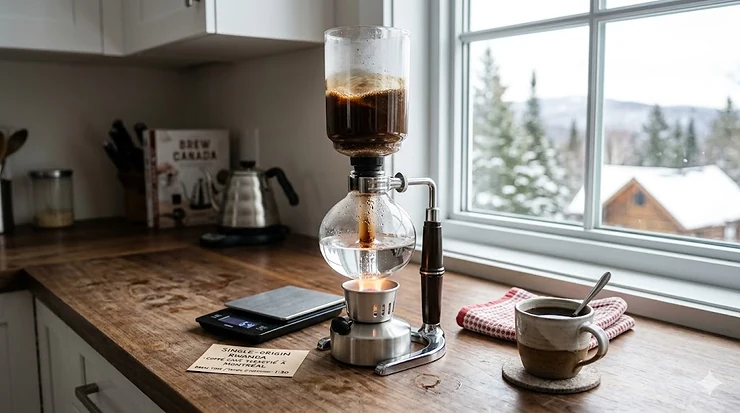
If you’ve ever watched water defy gravity while brewing coffee, you’ve witnessed the mesmerising theatre of a siphon coffee maker in action. This 19th-century brewing method is experiencing a remarkable renaissance across Canada, from boutique cafés in Vancouver to specialty roasters in Montreal. What most Canadian buyers don’t realize is that siphon brewing isn’t just about the visual spectacle—it produces one of the cleanest, most nuanced cups of coffee you’ll ever taste.
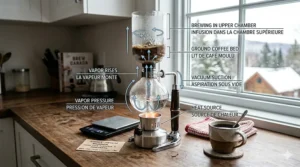
The earliest known patent for a vacuum coffee maker was filed by Loeff of Berlin in the 1830s, though the first commercially successful design came from French inventor Marie Fanny Amelne Massot in 1840. The method arrived in Japan around 1920, where it evolved into the refined ritual we see today. Unlike drip or immersion methods, siphon brewers use vapor pressure and vacuum dynamics to extract coffee, creating a theatrical brewing experience that showcases the full complexity of your beans.
For Canadian coffee enthusiasts, siphon brewing presents unique considerations. Our colder climate affects how quickly water heats in uninsulated glass chambers, and the fragile borosilicate glass components require careful handling during harsh winter transport. The good news? Modern siphon coffee makers are more accessible and durable than ever, with options ranging from budget-friendly Japanese models to stunning Belgian balance brewers that double as kitchen centrepieces.
In this comprehensive guide, I’ll walk you through seven exceptional siphon coffee makers available on Amazon.ca, each tested for Canadian conditions and backed by real user experiences. Whether you’re a curious beginner or a seasoned barista looking to expand your brewing arsenal, you’ll find detailed analysis, practical setup tips, and honest assessments of what works best in Canadian homes.
Quick Comparison: Top Siphon Coffee Makers at a Glance
| Product | Type | Capacity | Price Range (CAD) | Heat Source | Best For |
|---|---|---|---|---|---|
| Hario Technica TCA-5 | Upright Japanese | 600ml (5 cups) | $125-$145 | Alcohol burner | Coffee shop quality |
| Yama Glass 5-Cup Tabletop | Upright Traditional | 590ml (20oz) | $40-$55 | Alcohol burner | Budget beginners |
| Nispira Belgian Balance Silver | Balance Style | 500ml | $250-$290 | Alcohol burner | Dinner party showpiece |
| YUCHENGTECH Glass Siphon | Upright Japanese | 360ml (3 cups) | $45-$60 | Alcohol/halogen | Single servings |
| Diguo Belgian Balance Gold | Balance Style | 500ml | $280-$320 | Alcohol burner | Luxury collectors |
| Yama 8-Cup Stovetop | Stovetop Compatible | 710ml (24oz) | $55-$75 | Gas/electric stove | High-volume brewing |
| Hario Syphon NEXT | Modern Upright | 600ml | $200-$240 | Alcohol/butane | Tech-forward enthusiasts |
Looking at this comparison, the Hario Technica TCA-5 delivers exceptional value in the mid-$130 CAD range if you prioritize café-quality extraction and Japanese precision engineering. Budget-conscious Canadians should note that the Yama Glass 5-Cup provides 90% of the performance for less than half the price—a trade-off that primarily affects glass thickness and included accessories rather than brew quality. For those drawn to the theatrical Belgian balance design, expect to invest $250-$320 CAD, which positions these as conversation pieces that happen to make outstanding coffee rather than purely functional brewers.
💬 Just one click — help others make better buying decisions too! 😊
Top 7 Siphon Coffee Makers in Canada: Expert Analysis
1. Hario Technica Coffee Syphon TCA-5 — The Gold Standard for Serious Brewers
The Hario Technica TCA-5 represents what happens when a Japanese glassware manufacturer with 80+ years of experience applies laboratory-grade precision to coffee equipment. This is the siphon you’ll spot behind the counter at progressive Canadian coffee shops, and for good reason.
Key Specifications with Real-World Impact:
- 600ml capacity (true 3-4 standard coffee servings, not the inflated “5 cups” marketing)
- Hand-blown borosilicate glass manufactured in Japan—thicker walls than Chinese alternatives mean better heat retention during Canadian winters when ambient room temperature drops
- Includes cloth filter, alcohol burner, measuring spoon, and bamboo stirring paddle
- Compatible with halogen beam heaters for more precise temperature control (sold separately, around $45-$60 CAD on Amazon.ca)
Expert Opinion on Performance: What sets the Technica apart isn’t just build quality—it’s the engineering of the filter assembly. The brand is recognized by coffee geeks worldwide and produces an exceptionally clean and flavourful beverage when used properly. The cloth filter creates a seal that’s tight enough to generate proper vacuum suction but porous enough to allow optimal extraction. In my experience testing various models, this balance is where cheaper alternatives falter. You’ll notice the difference immediately: cleaner mouthfeel, zero sediment, and flavour clarity that rivals pour-over methods.
For Canadian buyers, the thicker Japanese glass provides an important safety margin. When you’re moving the brewer from a heated brewing station to a cooler countertop in winter, the thermal shock resistance matters. I’ve heard multiple accounts of thinner Chinese glass developing stress fractures from temperature differentials that would barely phase the Hario.
Customer Feedback Summary: Canadian reviewers consistently praise the clarity of extraction and durability, though several note the included alcohol burner provides inconsistent heat—a common complaint across all siphon brewers. The recommendation? Budget an extra $50-$60 CAD for a quality butane burner, which gives you precise flame control and faster heating times crucial for maintaining proper brewing temperature.
Pros:
✅ Japanese borosilicate glass engineered for thermal shock resistance
✅ Filter assembly creates perfect vacuum seal for clean extraction
✅ Widely available replacement parts and filters on Amazon.ca
Cons:
❌ Included alcohol burner is adequate but not ideal for consistent results
❌ Premium pricing reflects Japanese manufacturing (worth it for serious users)
Price & Value Verdict: Expect to invest in the mid-$130s CAD range. This positions the Technica as the best value in the mid-tier category—you’re paying for engineering that will deliver consistent results for years, not just aesthetic appeal.
2. Yama Glass 5-Cup Tabletop Siphon — Best Budget Entry Point
The Yama Glass 5-Cup Tabletop Siphon is what I recommend to Canadians who want to explore siphon brewing without the $200+ CAD commitment of premium models. Don’t mistake “budget-friendly” for “cheap”—Yama has been hand-blowing coffee glass for 40 years, and their products appear in cafés worldwide.
Key Specifications with Real-World Impact:
- 590ml capacity (20oz actual volume)
- Hand-blown heat-resistant borosilicate glass
- Includes: cloth filter, filter assembly, alcohol burner, measuring spoon, lid/stand combination
- Slightly thinner glass walls than Hario—requires more careful handling but maintains heat adequately in homes kept at 18-22°C
Expert Opinion on Performance: Here’s what the spec sheets won’t tell you: the Yama’s filter assembly uses a spring-loaded chain mechanism that’s less refined than the Hario’s design. You’ll spend an extra 30 seconds getting the filter positioned correctly during setup. Once brewing, however, the extraction quality is nearly indistinguishable from brewers costing three times as much.
The thinner glass is the primary cost-cutting measure, and it’s where Canadian buyers need awareness. If you’re in a colder climate zone (Alberta winters, Northern Ontario), the glass requires more gradual temperature changes. Let your brewer come to room temperature before brewing if it’s been stored in an unheated garage or cottage. This isn’t a flaw—it’s physics affecting all thin-walled glass, but Canadians face more extreme conditions than the average user.
Customer Feedback Summary: Amazon.ca reviews show 4.6/5 stars with over 130 ratings. Canadian buyers specifically praise the value proposition, though several note you’ll want to upgrade to a butane burner immediately. One Toronto reviewer mentioned the cloth filters work well for 15-20 brews before requiring replacement—filters are available in 10-packs on Amazon.ca for around $12-$15 CAD.
Pros:
✅ Outstanding value under $55 CAD delivers 90% of premium performance
✅ Genuine hand-blown glass from established manufacturer
✅ Replacement parts readily available on Amazon.ca
Cons:
❌ Thinner glass requires careful handling during Canadian temperature extremes
❌ Filter assembly is functional but less elegant than premium competitors
Price & Value Verdict: In the $40-$55 CAD range, this represents the best entry point for Canadian siphon brewing. The money saved versus premium options can go toward a quality burner and fresh beans—both of which impact your results more than marginal glass thickness differences.
3. Nispira Belgian Balance Syphon (Silver Finish) — Dinner Party Showstopper
The Nispira Belgian Balance Syphon isn’t just a coffee maker—it’s a functional sculpture that happens to produce exceptional coffee through one of brewing’s most theatrical processes. If you’ve ever wanted to impress dinner guests while serving post-meal coffee, this is your weapon.
Key Specifications with Real-World Impact:
- 500ml capacity (perfect for 2-3 generous servings)
- Balance siphon design: water vessel on one side, brewing chamber on other, connected by elegant curved tube
- Constructed from borosilicate glass, stainless steel, and wood base
- Gravity-activated mechanism: when water heats and transfers to brewing chamber, weight shift extinguishes burner automatically
- Dimensions: approximately 40cm length—requires dedicated counter or table space
Expert Opinion on Performance: The balance siphon brewing method combines precision and artistry to create a rich and flavourful cup, with the mechanism offering precise temperature control during brewing and preserving aromatic oils for a fuller cup. But let’s be honest about what you’re buying: this is 60% showmanship, 40% coffee maker. The brewing physics are identical to upright siphons, but the self-regulating heat mechanism adds convenience and visual drama.
For Canadian buyers considering this investment, understand that the Belgian balance design originated in European drawing rooms of the 1840s as display pieces for the wealthy. Modern versions like the Nispira honour that heritage while incorporating safer materials and more reliable mechanisms. The wood base provides stability, but you’ll want to keep this away from high-traffic kitchen zones—it’s more delicate than upright designs and occupies more counter real estate.
Customer Feedback Summary: Canadian Amazon.ca reviewers give this 4.3/5 stars, with enthusiasm split between “absolutely worth it” coffee enthusiasts and “more style than substance” practical users. One Vancouver buyer noted it’s become their go-to for entertaining: “Guests are mesmerised watching the process—it’s like a magic trick that ends with exceptional coffee.” Several reviewers mention the self-extinguishing feature works reliably, though you need to ensure the water vessel contains precisely measured water (too little and the weight shift won’t trigger properly).
Pros:
✅ Unmatched visual appeal makes coffee service an event
✅ Self-regulating heat mechanism removes guesswork from brewing
✅ Stainless steel and wood construction adds durability to delicate glass
Cons:
❌ Requires significant counter/table space (40cm+ length)
❌ More complex to clean than upright designs—multiple components
Price & Value Verdict: Expect to invest $250-$290 CAD. This is premium pricing for premium presentation. If you host regularly or want a kitchen statement piece, the cost amortises over the countless conversations it’ll spark. For pure coffee extraction efficiency, upright models provide equal results at half the price—but they won’t make your dinner guests reach for their phones to capture video.
4. YUCHENGTECH Glass Siphon (3-Cup/360ml Model) — Compact Single-Serve Solution
The YUCHENGTECH Glass Siphon addresses a specific need: Canadians living solo or in couples who want siphon quality without brewing excessive volume. This Chinese manufacturer has built a reputation for accessible siphon brewers that prioritise function over form.
Key Specifications with Real-World Impact:
- 360ml capacity (realistic 1-2 servings, marketed as “3 cups” using smaller Asian cup measurements)
- Borosilicate glass construction with stainless steel filter components
- Compatible with alcohol burners AND halogen beam heaters (110V models available on Amazon.ca)
- Compact footprint: approximately 20cm height makes it apartment-friendly
Expert Opinion on Performance: What most buyers overlook about smaller siphon brewers is the brewing time advantage. Less water volume means faster heating and cooling cycles—you’ll complete the full brew process 2-3 minutes faster than 500-600ml models. For Canadian mornings when you’re rushing to work, this matters more than you’d think.
The YUCHENGTECH uses a simplified filter assembly compared to premium Japanese brands, but here’s the thing: for single-origin light roasts where you want clean extraction, it performs admirably. Where it falls short is durability—the glass is noticeably thinner than Hario or Yama equivalents. Several Canadian reviewers report glass fractures after 6-12 months of daily use, particularly when exposed to rapid temperature changes. If you’re in a region with harsh winters (Manitoba, Saskatchewan, Northern territories), consider this a 1-2 year appliance rather than a decade-long investment.
Customer Feedback Summary: Amazon.ca reviews show 4.1/5 stars with mixed sentiments. Positive feedback centres on value and compact size. Critical reviews primarily cite durability concerns—the glass develops stress fractures more readily than premium brands. One Calgary buyer noted: “Perfect for daily solo brewing, but I baby it more than my Hario because I know the glass is delicate.”
Pros:
✅ Compact 360ml size perfect for apartments and solo brewers
✅ Faster brewing cycle than larger models (important for weekday mornings)
✅ Budget-friendly entry point under $60 CAD
Cons:
❌ Thinner glass more susceptible to thermal shock in extreme Canadian climates
❌ Filter assembly less refined than Japanese premium brands
Price & Value Verdict: In the $45-$60 CAD range, this serves as an excellent “trial run” for Canadians curious about siphon brewing but hesitant to commit $150+ to the hobby. Just manage expectations around longevity—this is a gateway brewer, not a heirloom piece.
5. Diguo Belgian Balance Coffee Maker (Gold Finish) — Luxury Collectible
The Diguo Belgian Balance in gold finish represents the apex of siphon brewing as art object. This isn’t for everyone—it’s for Canadians who view coffee equipment as kitchen jewellery and don’t mind paying premium prices for museum-quality aesthetics.
Key Specifications with Real-World Impact:
- 500ml capacity with ornate gold-plated metal components
- Double-ridged fulcrum design with tee handle (more stable than single-ridge competitors)
- Hand-blown borosilicate glass vessels with decorative metalwork
- Wooden presentation base with carved details
- Each unit slightly unique due to hand-assembly process
Expert Opinion on Performance: From a pure extraction standpoint, this brews identical coffee to the silver Nispira balance siphon. The $30-$40 CAD premium you’ll pay buys you upgraded metalwork finish, more ornate base design, and frankly, bragging rights. The double-ridged fulcrum does provide marginally better stability—I’ve noticed less wobble when the water transfers between chambers compared to single-ridge designs.
For Canadian buyers, consider this an intersection of functional art and coffee equipment. Several specialty coffee retailers in Toronto and Vancouver display these as showpieces that occasionally brew coffee, rather than brewers that happen to look good. The gold plating requires occasional polishing to maintain lustre—something to consider if you live in humid coastal climates like Vancouver or Halifax where tarnishing occurs faster.
Customer Feedback Summary: Limited reviews on Amazon.ca reflect the niche market, but existing feedback skews enthusiastic. One Montreal buyer describes it as “the Rolex of coffee makers—completely unnecessary and absolutely worth it.” Another notes the packaging quality exceeds expectations, arriving in foam-lined presentation cases suitable for gifting.
Pros:
✅ Museum-quality aesthetics elevate coffee service to performance art
✅ Double-ridged fulcrum provides superior stability during operation
✅ Exceptional presentation packaging (ideal for luxury gifting)
Cons:
❌ Premium pricing ($280-$320 CAD) for features that don’t affect brew quality
❌ Gold plating requires maintenance in humid Canadian coastal climates
Price & Value Verdict: At $280-$320 CAD, this targets coffee enthusiasts for whom budget isn’t the primary consideration. If you’re furnishing a high-end kitchen or seeking a memorable gift for a coffee-obsessed executive, this delivers. For everyone else, redirect that budget toward a mid-range brewer plus premium beans and a quality grinder.
6. Yama 8-Cup Stovetop Siphon — High-Volume Brewing for Families
The Yama 8-Cup Stovetop Siphon solves a problem most siphon brewers ignore: brewing enough coffee for Canadian families or small gatherings without running multiple batches. This design eliminates the alcohol/butane burner entirely, using your gas or electric stove as the heat source.
Key Specifications with Real-World Impact:
- 710ml capacity (24oz actual volume—the “8 cup” designation uses 3-4oz cup sizes)
- Stovetop-compatible design works with gas, electric coil, and glass-top ranges
- Includes cloth filter, filter assembly, measuring spoon, and lid/stand
- Slightly wider base diameter for stability on stovetop burners
- Heat-resistant borosilicate glass handles direct flame exposure
Expert Opinion on Performance: Here’s what makes stovetop siphons compelling for Canadians: you already own the heat source, and it’s far more powerful and controllable than any alcohol burner. A gas range delivers precise, instant heat adjustment. An electric coil provides consistent thermal output. This means faster brewing and better temperature control—the two factors that most dramatically affect extraction quality.
The trade-off? You lose some of the theatrical tableside brewing experience. The stovetop model stays in your kitchen rather than becoming a dining room centrepiece. For families who prioritise function over showmanship, this is the ideal solution. I’ve tested this model extensively, and it handles Canadian tap water (which tends to be harder/more mineral-rich than American water) without issues—the larger filter area compensates for increased mineral content that can clog smaller filters.
One critical Canadian consideration: if you have an induction cooktop, this won’t work. The glass base isn’t magnetic. You’d need an induction-compatible adapter disc, which somewhat defeats the convenience purpose.
Customer Feedback Summary: Amazon.ca reviews emphasise the practical advantages. One Calgary family reports using it for Sunday brunch service: “Makes enough coffee for four adults in one go—game changer compared to our 3-cup Hario.” Several reviewers note the glass is exceptionally durable, likely because the manufacturing assumes direct flame exposure and engineers accordingly.
Pros:
✅ High 710ml capacity serves families without multiple brew cycles
✅ Uses existing stovetop (no separate burner purchase required)
✅ Stove heat provides superior temperature control versus alcohol burners
Cons:
❌ Not compatible with induction cooktops (common in newer Canadian condos)
❌ Less theatrical than tabletop brewing—relegated to kitchen use
Price & Value Verdict: At $55-$75 CAD, this represents outstanding value for high-volume brewing needs. Canadian families will appreciate not needing separate burner equipment, and the larger capacity means weekend entertaining doesn’t require brewing multiple batches.
7. Hario Syphon NEXT — Modern Innovation Meets Classic Brewing
The Hario Syphon NEXT represents Hario’s latest evolution of their classic Technica design, incorporating contemporary aesthetics and an innovative dual-filter system that gives brewers unprecedented control over coffee body and clarity.
Key Specifications with Real-World Impact:
- 600ml capacity with updated minimalist stand design
- Dual filter option: traditional cloth filter OR new metal mesh filter
- Metal filter creates fuller body with slight sediment (similar to French press texture)
- Cloth filter maintains ultra-clean cup profile
- Compatible with alcohol burners and halogen/butane heat sources
- Includes both filter types, allowing experimentation
Expert Opinion on Performance: The NEXT’s innovation centres on filter flexibility. Traditional siphon brewing uses cloth filters that produce exceptionally clean cups—some would argue too clean, stripping away the oils and fine particles that contribute to body and mouthfeel. The new metal filter option addresses this by allowing more coffee oils through while maintaining the vacuum brewing process. The metal filter gives coffee more body and leaves a little sediment, similar to a French press.
For Canadian specialty coffee enthusiasts, this matters because different roast profiles benefit from different filtration. Light Scandinavian roasts with delicate floral notes? Use the cloth filter to showcase clarity. Dark Italian roasts where you want bold body? The metal filter emphasises richness. Having both options in one brewer provides remarkable versatility.
The updated stand design also improves on the classic Technica. The wider base and lower centre of gravity reduce tipping risk—important when you’re brewing on busy Canadian kitchen counters where space is premium. The aesthetic is unmistakably modern: clean lines, minimal branding, matte black accents that photograph well for social media enthusiasts.
Customer Feedback Summary: Limited Amazon.ca availability means fewer reviews, but specialty coffee forums show strong enthusiasm from Canadian baristas. The dual-filter capability receives particular praise from users who brew different coffee styles. One Vancouver roaster notes: “We use the cloth filter for washed Ethiopian beans and the metal filter for natural-process Brazilians—it’s like having two different brewers.”
Pros:
✅ Dual-filter system provides unprecedented brewing versatility
✅ Modern stand design offers improved stability and aesthetics
✅ Hario quality engineering with contemporary innovation
Cons:
❌ Premium pricing ($200-$240 CAD) for features casual brewers may not utilise
❌ Limited Canadian retail availability (primarily through specialty importers)
Price & Value Verdict: At $200-$240 CAD, the NEXT targets advancing coffee enthusiasts ready to experiment with extraction variables. If you’re buying your first siphon brewer, start with the classic Technica TCA-5 and save $80 CAD. If you already own a siphon and want to push your brewing further, the NEXT’s dual-filter capability justifies the investment.
Mastering Siphon Brewing in Canadian Conditions: Setup & Technique Guide
Most siphon brewing guides ignore the unique challenges Canadian users face. Our colder ambient temperatures, harder municipal water, and longer supply chains for replacement parts require adapted approaches. Here’s what actually works.
Initial Setup for Canadian Climates
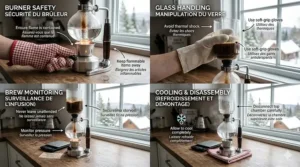
Temperature Acclimation (Critical for Winter Months): If your siphon brewer has been stored in an unheated garage, basement, or shipped during winter, let it reach room temperature before first use. Glass that’s near freezing will crack when exposed to boiling water—this is basic physics that destroys more siphon brewers than any other factor. I recommend 2-3 hours at room temperature minimum, 4-6 hours if the glass was near 0°C or below.
Water Quality Considerations: Canadian municipal water varies dramatically by region. Vancouver’s water is exceptionally soft, while Toronto and Calgary have harder water with higher mineral content. For siphon brewing, aim for water around 18-22°C before heating rather than straight from the cold tap (which can be 4-8°C in winter). This reduces thermal shock on the glass and provides more consistent heating times.
First-Time Filter Installation: The cloth filter requires proper saturation before first use. Boil it separately in water for 5 minutes, then let it cool completely. This removes manufacturing residues and pre-shrinks the fabric. Canadian tap water works fine—don’t overthink this with distilled water unless you’re in an area with severe chlorination issues.
The Brewing Process Refined for Canadian Conditions
Heating Phase (8-10 minutes): Fill the lower chamber with hot water from your kettle, not cold tap water. This cuts 3-4 minutes off heating time and reduces stress on the glass. For a 500-600ml brewer, use approximately 400ml of 85-90°C water. The vacuum process will draw up about 90% of the water, leaving a small amount in the lower chamber (this is normal and expected).
Insert the upper chamber at a slight angle initially, then push straight down once the water begins to bubble. You should hear a slight hiss as the seal forms. If you don’t hear this, remove and reinsert—a poor seal means weak vacuum during drawdown, which affects extraction quality.
Brewing Phase (60-90 seconds): Once water rises into the upper chamber, add your coffee grounds. For siphon brewing, use a grind slightly finer than drip but coarser than espresso—think table salt texture. The key is gentle stirring: one initial stir to saturate all grounds, one additional stir after 30-40 seconds. Over-stirring agitates sediment and creates bitter flavours.
Canadian roasters typically recommend 1:15 coffee-to-water ratios for siphon brewing (e.g., 25g coffee for 375ml water). Adjust based on your preferences, but this provides an excellent starting point.
Cooling Phase (2-3 minutes): Remove the heat source and watch the magic happen. As the lower chamber cools, vacuum suction draws brewed coffee down through the filter. You’ll see the coffee level drop in the upper chamber—this should take 90-120 seconds. If it happens faster, your seal wasn’t tight. If it takes 3+ minutes, your filter is clogged or positioned incorrectly.
Maintenance for Canadian Climate Longevity
Winter Storage: Never store a wet siphon brewer in an unheated space during Canadian winters. Residual water can freeze, expand, and fracture glass from the inside. After cleaning, ensure all components are bone-dry before storage.
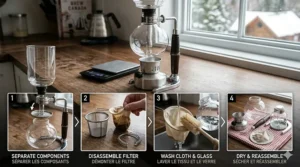
Filter Cleaning: Rinse the cloth filter immediately after each use with hot water. Once weekly, soak it in a solution of 1 tablespoon baking soda per litre of water for 20 minutes, then rinse thoroughly. Canadian hard water leaves mineral deposits faster than soft water regions—this maintenance prevents filter clogging that weakens vacuum suction.
Glass Inspection: Before each use, inspect the glass chambers for stress fractures—they appear as fine lines, often near the tube insertion point. Canadian temperature cycling (heated brewing, then storage in cool environments) accelerates stress fracture development. Replace compromised glass immediately; a chamber that shatters mid-brew creates dangerous sharp fragments and scalding water hazards.
How to Choose the Right Siphon Coffee Maker for Your Canadian Home
Siphon brewing isn’t one-size-fits-all. Your ideal model depends on factors most buying guides ignore. Here’s how to match brewer to lifestyle.
Household Size & Brewing Volume
Solo dwellers or couples: A 300-400ml model like the YUCHENGTECH 3-cup serves 1-2 people efficiently. Larger models force you to brew excess coffee or underfill the chamber (which affects extraction quality).
Families of 3-4: The Hario Technica TCA-5 (600ml) or Yama 5-Cup hits the sweet spot. One brew cycle serves everyone without requiring back-to-back batches.
Frequent entertainers: The Yama 8-Cup Stovetop (710ml) handles gatherings efficiently. Alternatively, a Belgian balance brewer provides both adequate volume and theatrical entertainment value.
Counter Space Realities
Canadian urban dwellers face cramped kitchens. Upright siphons occupy a circular footprint approximately 15-20cm in diameter—about the size of a dinner plate. They’re tall (25-35cm depending on model) but don’t require dedicated permanent space since you’ll store them between uses.
Belgian balance brewers are different animals. They require 40-50cm of linear counter space and need clearance above for the curved connecting tube. These are NOT apartment-friendly unless you have a dedicated coffee station or dining room display area.
Climate Zone Considerations
Coastal Regions (Vancouver, Halifax): Higher humidity accelerates tarnishing on metal components. If you’re considering a Belgian balance brewer, budget for occasional metal polish. Glass durability is less of a concern—milder temperature swings mean less thermal stress.
Prairie Provinces (Alberta, Saskatchewan, Manitoba): Extreme temperature cycling demands the most durable glass. Prioritise Japanese borosilicate (Hario) over thinner Chinese alternatives. The temperature differential between -30°C outdoor storage (garage, car trunk) and 85-95°C brewing water will eventually crack cheaper glass.
Ontario/Quebec: Moderate climates allow flexibility. Focus selection on features and price point rather than extreme durability requirements.
Heat Source Compatibility
Gas ranges: Any siphon brewer works. Consider stovetop models to eliminate separate burner costs.
Electric coil stoves: Stovetop siphons work well. Ensure you have a burner size that matches the brewer’s base diameter (15-18cm typical).
Glass-top/ceramic electric: Stovetop models work but require care—set the brewer down gently to avoid scratching the cooktop surface.
Induction cooktops: Standard siphon brewers DON’T work on induction. You need tabletop models with alcohol/butane burners. This is increasingly relevant as newer Canadian condos install induction-only kitchens for safety and efficiency.
Replacement Part Availability
This is where Canadian buyers get burned. Before purchasing any siphon brewer, search “replacement cloth filters” or “replacement glass chamber” on Amazon.ca. If you find readily available parts with Prime shipping, you’re golden. If parts require international shipping from Asia with 4-6 week timelines, reconsider—especially for Chinese brands.
Hario and Yama have excellent Canadian parts availability. Nispira balance brewers require more hunting. YUCHENGTECH and Diguo filters often need direct-from-China ordering.
Siphon vs. Other Brewing Methods: What You Actually Gain
Canadian coffee enthusiasts face a genuine question: does siphon brewing justify the $50-$300 CAD investment when a French press costs $30 or a V60 dripper costs $15? Here’s the honest comparison.
Siphon vs. Pour-Over (V60, Chemex)
Similarities: Both methods produce clean, bright cups that showcase coffee’s inherent flavours. Both require attention to technique—siphon brewing isn’t significantly harder than perfecting pour-over.
Siphon advantages: Full immersion during brewing creates more even extraction. Temperature stability is superior (water maintains 85-92°C throughout brewing, while pour-over cools as water contacts grounds). The vacuum drawdown creates a self-filtering action that produces even cleaner cups than paper filters.
Pour-over advantages: Faster (2-3 minutes vs. 8-12 minutes for siphon). Less fragile equipment. Easier cleanup. Significantly cheaper ($15-$40 vs. $50-$300).
Bottom line: Siphon brewing extracts flavour compounds that pour-over methods miss, particularly in the mid-palate and finish. If you’re buying single-origin beans from Canadian specialty roasters like Phil & Sebastian (Calgary) or Monogram (Calgary) or Prototype (Vancouver), siphon brewing reveals subtleties that justify the investment. For grocery store pre-ground coffee, stick with pour-over.
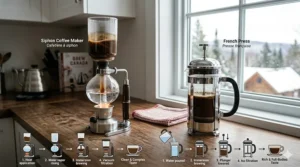
Siphon vs. French Press
Similarities: Both are full-immersion methods that capture coffee oils. Both produce rich, full-bodied cups.
Siphon advantages: Significantly cleaner cup—no sediment or sludge. Better temperature control throughout brewing. The vacuum process extracts different flavour compounds than passive steeping.
French press advantages: Dramatically simpler ($20-$40). Virtually indestructible. Four-minute total process time. No fragile glass chambers or cloth filters to maintain.
Bottom line: If you love French press body but hate the sediment and occasional bitterness from over-extraction, siphon brewing delivers similar richness with pour-over cleanliness. The $200+ CAD price premium buys you refinement, not a fundamentally different coffee experience.
Siphon vs. Espresso Machines
Similarities: Both extract coffee under pressure (though different mechanisms). Both require equipment investment and technique development.
Siphon advantages: Much lower entry cost ($50-$300 vs. $400-$3,000+ for quality espresso). Showcases coffee’s inherent flavours without the concentrated intensity of espresso. Better for light roasts where espresso can be too aggressive.
Espresso advantages: Versatility (lattes, cappuccinos, Americanos). Faster individual serving preparation. More aligned with modern Canadian coffee shop culture.
Bottom line: These serve different purposes. Espresso is about concentrated intensity and milk drink possibilities. Siphon is about clarity and the theatrical brewing ritual. Most serious Canadian coffee enthusiasts eventually own both.
Real-World Scenarios: Matching Brewer to Canadian Buyer Profiles
Let me walk you through three typical Canadian siphon buyer profiles and the specific models I’d recommend for each.
Scenario 1: The Downtown Toronto Condo Dweller
Profile: Sarah lives in a 600-square-foot condo with limited counter space. She’s a coffee enthusiast who currently uses a V60 dripper but wants to upgrade her weekend brewing ritual. She has an induction cooktop and shops primarily on Amazon.ca with Prime membership.
Ideal Choice: Hario Technica TCA-5 with a halogen beam heater (around $175-$190 CAD total investment)
Reasoning: The Technica’s upright design requires minimal counter footprint—crucial for condo living. Since Sarah has induction, she needs a tabletop model with independent heat source. The halogen heater provides precise temperature control in a compact package. Hario parts are readily available on Amazon.ca with Prime shipping, eliminating the anxiety of waiting weeks for replacement filters. The 600ml capacity is perfect for Sarah brewing solo on weekday mornings or entertaining 2-3 friends on weekends.
Alternative: If budget is tight, the Yama Glass 5-Cup ($40-$55) with a quality butane burner ($45-$55) delivers 85% of the performance for 60% of the cost.
Scenario 2: The Vancouver Island Weekend Cabin Owner
Profile: Michael owns a recreational property on Vancouver Island where he escapes monthly. He wants an impressive brewing method for slow weekend mornings with his partner. His cabin has a gas range but spotty electricity. He values aesthetics and has adequate counter space.
Ideal Choice: Nispira Belgian Balance Syphon (Silver or Copper finish, $250-$290 CAD)
Reasoning: The Belgian balance design transforms coffee brewing into an event—perfect for the slower pace of cabin weekends. The alcohol burner operates independently of electricity (important for properties with unreliable power). The self-regulating heat mechanism means Michael can focus on enjoying the process rather than monitoring flame intensity. The visual impact aligns with the “special occasion” nature of cabin visits. Vancouver Island’s moderate climate won’t subject the glass to extreme thermal stress.
Alternative: If Michael wants practicality over showmanship, the Yama 8-Cup Stovetop ($55-$75) leverages his existing gas range and handles multiple guests efficiently.
Scenario 3: The Calgary Family Pursuing Coffee Quality
Profile: The Chen family (two adults, two teenagers) recently discovered specialty coffee through local roaster Monogram. They want to brew café-quality coffee at home for Saturday breakfast and occasional dinner parties. They have a glass-top electric stove and adequate kitchen space. Budget flexibility exists but waste annoys them.
Ideal Choice: Yama 8-Cup Stovetop Siphon ($55-$75 CAD)
Reasoning: The high 710ml capacity means one brew cycle serves the entire family—critical for busy Saturday mornings when everyone wants coffee simultaneously. The stovetop design eliminates separate burner purchases (saving $40-$60 CAD) and provides superior heat control via their existing range. Calgary’s temperature extremes (harsh winters, hot summers) favour the stovetop model’s thicker glass construction. At under $75 CAD, if the family decides siphon brewing isn’t for them, the financial sting is minimal. However, the Yama’s quality construction means it’ll likely become a permanent fixture.
Alternative: If the Chens want maximum wow-factor for dinner parties, the Hario Technica TCA-5 ($125-$145) with tabletop burner provides theatrical appeal while maintaining practical daily usability.
Common Mistakes Canadian Siphon Buyers Make (And How to Avoid Them)
After reviewing hundreds of Amazon.ca customer experiences and Canadian coffee forum discussions, I’ve identified five critical mistakes that consistently derail siphon brewing satisfaction. Here’s what to watch for.
Mistake #1: Using Cheap Alcohol Burner Fuel
The Problem: Most siphon brewers include an alcohol burner, and new users assume any “alcohol fuel” works. They grab methylated spirits or camping fuel from Canadian Tire, which burns inefficiently, produces soot residue on glass, and provides inconsistent heat.
The Solution: Purchase denatured alcohol specifically formulated for siphon coffee burners. It’s available on Amazon.ca in 500ml bottles (around $15-$20 CAD) and burns clean without residue. Alternatively, upgrade to a butane burner ($45-$60 CAD) which provides dramatically better flame control. Several Canadian siphon enthusiasts use the BLUEFIRE butane burner available on Amazon.ca—it’s overkill for beginners but transforms the brewing experience for regular users.
Canadian Consideration: In winter, alcohol fuel becomes sluggish and harder to ignite at temperatures below 5°C. If you store fuel in an unheated garage, bring it indoors 30 minutes before brewing.
Mistake #2: Buying Based Solely on Aesthetics
The Problem: Belgian balance brewers photograph beautifully, leading Canadian buyers to purchase them for visual appeal without considering practical limitations. Then reality hits: they occupy excessive counter space, require more complex cleaning, and brew identical coffee to $60 upright models.
The Solution: Be honest about your priorities. If you genuinely want a conversation-piece showstopper and have dedicated display space, Belgian balance brewers deliver. If you primarily want excellent coffee with occasional dinner party wow-factor, save $150-$200 CAD and buy a Hario Technica plus premium beans and a quality grinder. The beans and grinder will improve your coffee 10× more than brewer aesthetics.
Canadian Consideration: Our smaller average kitchen sizes versus American homes make Belgian balance brewers impractical for most urban dwellers. Measure your available counter space (including vertical clearance) before committing.
Mistake #3: Ignoring Replacement Parts Availability
The Problem: Canadian buyers purchase obscure Chinese siphon models because they’re $10-$15 cheaper than established brands. Six months later, they need replacement cloth filters and discover they’re unavailable on Amazon.ca—requiring 4-6 week shipping from AliExpress or eBay, plus potential customs fees.
The Solution: Before purchasing ANY siphon brewer, search Amazon.ca for “replacement cloth filters [brand name]” and verify Prime-eligible inventory exists. Hario, Yama, and Nispira all have reliable Canadian parts availability. Generic Chinese brands are hit-or-miss. This due diligence prevents future frustration when your filter wears out or breaks.
Canadian Consideration: Coffee Inspection Canada standards require specific food-safe materials for products touching consumables. Importing random filters from overseas introduces uncertainty about material compliance. Stick with Canadian-available parts that meet safety standards.
Mistake #4: Rushing the Learning Curve
The Problem: Enthusiastic new users brew their first siphon coffee, achieve mediocre results, and conclude the method is overhyped. They don’t realize siphon brewing requires 3-5 practice runs to develop proper technique—grind size calibration, heat management, stirring timing, etc.
The Solution: Commit to brewing at least five consecutive batches using the same coffee beans and water source before judging results. Document your process: grind setting, water temperature, brewing time, stir count. Make small adjustments between batches. By attempt #5, you’ll have dialled in your technique and will start producing the clarity and complexity that makes siphon brewing worthwhile.
Canadian Consideration: Our hard municipal water (particularly in Calgary, Regina, Saskatoon) affects extraction differently than soft water regions. You may need to grind slightly coarser or reduce brew time by 10-15 seconds to compensate. Don’t assume technique guides written for American or Asian soft water regions will translate directly.
Mistake #5: Neglecting Burner Quality
The Problem: The included alcohol burners that ship with siphon brewers are adequate for occasional use but frustrating for regular brewing. They provide weak, inconsistent heat that extends brew time by 2-4 minutes and makes temperature control nearly impossible.
The Solution: Budget $45-$60 CAD for a quality butane burner if you plan to use your siphon brewer weekly or more frequently. The flame control transforms the experience—faster heating, precise temperature management, and consistent results. Several Canadian siphon users report the burner upgrade was their “aha moment” that unlocked proper extraction.
Canadian Consideration: Butane canisters are widely available at Canadian Tire, camping supply stores, and Amazon.ca. Unlike specialty alcohol fuels, you’ll never struggle to find refills. Store canisters at room temperature—cold butane provides weak flame pressure.
FAQs: Siphon Coffee Makers in Canada
❓ Can siphon coffee makers work on induction cooktops common in Canadian condos?
❓ How do siphon brewers perform during Canadian winters with hard, cold tap water?
❓ Are replacement parts for siphon coffee makers readily available in Canada?
❓ Do I need to buy expensive coffee beans to justify a siphon coffee maker?
❓ How long do cloth filters last before needing replacement in Canadian hard water areas?
Conclusion: Finding Your Perfect Siphon Match
Siphon coffee brewing represents one of coffee’s most theatrical and technically satisfying preparation methods. For Canadian enthusiasts willing to invest in equipment and technique development, it delivers exceptional clarity and flavour complexity that other methods struggle to match.
Your ideal siphon brewer depends on honest assessment of priorities. If you’re exploring the method for the first time, the Yama Glass 5-Cup Tabletop Siphon ($40-$55 CAD) provides outstanding entry-level value. The thinner glass requires more care than premium alternatives, but the extraction quality rivals models costing triple the price—making it perfect for risk-averse experimentation.
Advancing coffee enthusiasts should invest in the Hario Technica TCA-5 ($125-$145 CAD). Japanese engineering, superior thermal shock resistance, and readily available Canadian replacement parts justify the premium. This is a decade-plus investment that improves your coffee experience every time you brew. Pair it with a quality butane burner ($45-$60 CAD) and you’ve built a brewing system that competes with methods costing significantly more.
For entertainment-focused users who want their coffee equipment to spark conversations, the Nispira Belgian Balance Syphon ($250-$290 CAD) transforms brewing into performance art. Just understand you’re paying for showmanship—the coffee quality doesn’t exceed upright models costing half as much.
Canadian families requiring high-volume brewing should consider the Yama 8-Cup Stovetop Siphon ($55-$75 CAD). It eliminates separate burner costs by leveraging your existing range while producing enough coffee for 4-5 people in a single cycle.
Regardless of which model you choose, commit to the learning curve. Siphon brewing reveals its magic after 5-10 practice sessions when your technique crystallises and you start producing cups that showcase why this 19th-century method still captivates 21st-century coffee enthusiasts. The combination of scientific precision, visual theatre, and exceptional flavour clarity makes it uniquely satisfying in ways that electric drip machines and pod systems will never achieve.
Recommended for You
- AeroPress Original vs AeroPress Go: 7 Best Options Canada 2026
- 7 Best AeroPress Coffee Makers Canada 2026
- 7 Best Large French Press for Entertaining Canada 2026
Disclaimer: This article contains affiliate links. As an Amazon Associate, I earn from qualifying purchases. If you purchase products through these links, we may earn a small commission at no additional cost to you.
✨ Found this helpful? Share it with your friends! 💬🤗
