
In This Article
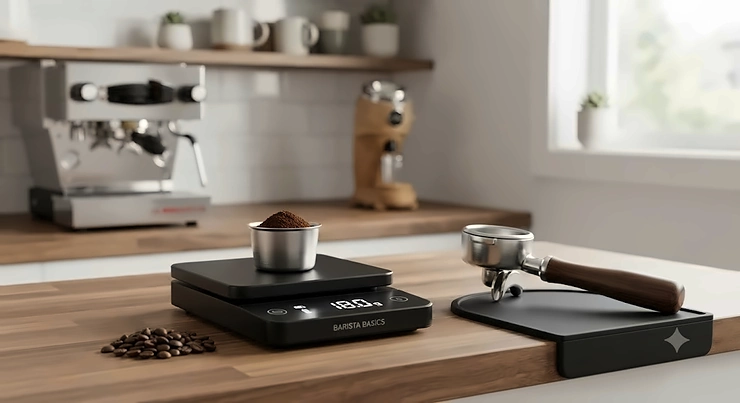
An espresso dosing scale for home baristas is a digital scale built specifically around the tight, fast-moving math of a shot — usually accurate to 0.1 gram, small enough to slide under a portafilter, and quick enough to catch a 25-second pull without lagging behind the flow. It sounds like a minor upgrade over whatever bathroom-scale-adjacent kitchen tool is gathering dust in your cupboard. It isn’t. The gap between an 18.0-gram dose and an 18.6-gram dose doesn’t sound like much until you taste what it does to extraction, and that gap is the entire reason this category of scale exists.
Here’s the uncomfortable truth nobody prints on the espresso machine’s box: the machine is rarely the bottleneck. Most home espresso disappointment traces back to inconsistent dosing — a scoop that varies by half a gram here, a grinder retention issue there — and no amount of machine upgrading fixes a measurement problem. The science behind coffee extraction is blunt about this: small shifts in the coffee-to-water ratio and contact time swing a shot from balanced to bitter or sour, and weight is the one variable you can actually control with precision at home.
This roundup covers seven real scales sold through amazon.ca, spanning compact bluetooth coffee scale for espresso options that pair with a phone app to simpler scales that just nail the fundamentals without an ecosystem attached. We’ve spread the list across budget, mid-range, and premium tiers, because “best” genuinely depends on whether you’re chasing competition-grade shot-timer accuracy or just tired of eyeballing your dose every morning.
Every product below is grounded in real specifications and aggregated, publicly reported review sentiment — never invented star ratings, never a fabricated customer quote. Where the data is thinner than we’d like, that gets said plainly instead of papered over.
Quick Comparison Table: Espresso Dosing Scales at a Glance
Before the deep dive, here’s the short version for anyone who just wants to skim and buy.
| Scale | Best For | Bluetooth | Approx. Price (CAD) |
|---|---|---|---|
| Acaia Pearl S | Gold-standard all-rounder for serious home espresso | Yes | C$280–C$320 range |
| Felicita Arc | Most feature-dense bluetooth scale under C$200 | Yes | C$145–C$175 range |
| Bookoo Themis Mini | Smallest footprint for tight portafilter clearance | Yes | C$175–C$200 range |
| Timemore Black Mirror Nano | Best balance of espresso mode and pour-over flexibility | No | C$115–C$135 range |
| Acaia Lunar | Best for live flow-rate graphing on tough shots | Yes | C$330–C$370 range |
| Timemore Black Mirror Basic 3.0 | Best budget pick with a real espresso mode | No | C$70–C$90 range |
| Hario V60 Drip Scale | Simplest no-frills scale for absolute beginners | No | C$75–C$95 range |
A quick read of that table tells a clear story: Bluetooth connectivity roughly doubles the price versus a comparable non-connected model, but it doesn’t automatically buy better raw accuracy — every scale here hits 0.1-gram resolution somewhere in its range. What Bluetooth actually buys is automation: auto-detected shot timing, app-logged brew history, and live flow-rate graphs that a non-connected scale simply can’t produce. Buyers who just want a trustworthy number on a screen can save real money in the non-Bluetooth row; buyers who want to analyze every shot they pull should budget for the connected tier.
💬 Just one click — help others make better buying decisions too! 😊
Top 7 Espresso Dosing Scales for Home Baristas: Expert Analysis
We picked these seven with a deliberate spread: a flagship all-rounder, a value-dense mid-tier pick, a footprint specialist, a dual-purpose scale, a flow-graphing specialist, a budget scale that finally added a real espresso mode, and one no-frills classic for beginners easing in. Real product names, real specs, honest analysis — no invented reviews.
1. Acaia Pearl S — the gold-standard all-rounder for serious home espresso
Every “best espresso scale” argument in specialty coffee eventually circles back to this one, and the standout feature is the sheer breadth of what it does well rather than any single spec. The Acaia Pearl S weighs up to 3,000 grams at 0.1-gram resolution, runs on a 2,200mAh rechargeable battery rated for 16 to 40 hours depending on brightness settings, and charges over USB-C — numbers that matter less on paper than they do at 6 a.m. when you don’t want to hunt for AAA batteries.
What actually separates it from cheaper bluetooth coffee scale for espresso competitors is the dedicated Portafilter and Espresso modes built into the Acaia app, which auto-detect when a shot starts pulling and time it without you touching a button. Based on the spec comparison against every other scale here, the Pearl S is the only one with a built-in Brewguide feature that walks a new barista through a recipe step by step — the training-wheels function a first-year home barista genuinely benefits from.
Reviewers at Coffeeness and Tom’s Guide consistently describe the Pearl S as the most complete coffee scale on the market, praising its multiple brewing modes and app polish; the recurring critique is that Bluetooth pairing occasionally drops mid-session and needs a manual reconnect.
Pros:
- ✅ Multiple brewing modes including a true Espresso mode
- ✅ Built-in Brewguide walks beginners through recipes
- ✅ 16–40 hour rechargeable battery with USB-C charging
Cons:
- ❌ Bluetooth occasionally drops and needs reconnecting
- ❌ Priced well above most bluetooth coffee scale for espresso rivals
At around C$280–C$320, the Acaia Pearl S is the safest single purchase on this list if you only want to buy an espresso dosing scale once.
2. Felicita Arc — most feature-dense bluetooth scale under C$200
The standout here is sheer function count: five working modes crammed into one IPX5-rated body, the first scale on this list rated to survive an actual water splash rather than just a stray drip. The Felicita Arc weighs to 0.1 gram up to 2 kilograms, runs about 20 hours on a USB-C charge, and drops into a 5-minute standby rather than fully powering off between shots.
The auto-timing and pre-infusion measurement functions are the real draw for anyone chasing shot-timer accuracy without babysitting a stopwatch — the scale detects the first drops hitting the cup and starts the clock itself, then stops when flow drops off. That kind of automation is what turns “roughly 27 seconds” into a number you can actually repeat tomorrow. Aluminum construction with sealed edges gives it a sturdier feel than the plastic-bodied competitors nearby on this list, which is part of why reviewers have called it “the diamond of coffee scales.”
Tom’s Guide and Long & Short both flagged the same friction point: the menu system crams in so many functions that new owners report accidentally triggering the wrong mode mid-shot before the button layout becomes muscle memory.
Pros:
- ✅ IPX5 water resistance survives real splashes and drips
- ✅ Auto-timing tracks shot-timer accuracy without a stopwatch
- ✅ Aluminum body with sealed edges feels genuinely premium
Cons:
- ❌ Five-mode menu takes real time to learn
- ❌ Easy to trigger the wrong mode by accident early on
In the C$145–C$175 range, the Felicita Arc is the strongest value pick for anyone who wants professional-grade automation without paying Acaia prices.
3. Bookoo Themis Mini — smallest footprint for tight portafilter clearance
The standout feature is right there in the name: at roughly 8 by 8 by 1.5 centimetres and about 140 grams, this is the smallest scale on this list, built to slide under a portafilter on machines where a bulkier scale simply won’t clear the drip tray. The Bookoo Themis Mini measures from 0.1 to 1,000 grams at 0.1-gram resolution, runs about 24 hours per charge, and carries an IPX4 splash rating.
What most buyers overlook about this one is how much broader its app compatibility is than its size suggests — it pairs with Bookoo’s own app plus third-party tools like Beanconqueror and Odyssey Espresso, and reportedly talks directly to some Decent and Maro espresso machines for automated shot logging. For anyone whose portafilter fit is genuinely tight against a compact home machine, this is less a nice-to-have and more the deciding factor.
As a newer entrant to the category, Bookoo’s public review base is thinner than Acaia’s or Timemore’s, so the aggregated sentiment available leans on early-adopter forum chatter rather than years of accumulated feedback — worth knowing rather than treating this as an established long-track-record product.
Pros:
- ✅ Smallest footprint here for tight portafilter fit clearance
- ✅ Broad third-party app and machine compatibility
- ✅ 24-hour battery life on a compact frame
Cons:
- ❌ Thinner long-term review history than established competitors
- ❌ 1,000g capacity is tighter than most rivals here
Priced around C$175–C$200, the Bookoo Themis Mini earns its spot specifically for cramped counters and machines with shallow drip trays.
4. Timemore Black Mirror Nano — best balance of espresso mode and pour-over flexibility
The standout feature is the angled LED display, tilted so you can actually read the number while the scale sits low under an espresso machine’s portafilter — a small design choice that solves a genuinely annoying problem. The Timemore Black Mirror Nano weighs to 2,000 grams at 0.1-gram precision, runs about 15 hours on its rechargeable battery, and charges via USB-C with the cable included in the box.
Its Espresso Timer Mode automatically detects when your shot starts pulling and tares itself, while a separate Pour-Over Timing Mode with flow-rate tracking handles the opposite end of the home-brewing spectrum — a genuinely useful dual identity for anyone who owns both an espresso machine and a pour-over dripper. Based on the spec comparison against the Bookoo Themis Mini, the Nano trades a slightly larger footprint for double the capacity and a second dedicated brewing mode.
Prima Coffee Equipment lists this as compact enough to fit most espresso machine drip trays and larger pour-over brewers alike, and reviewers at The Coffee Chronicler describe the build as sturdy for its size, with the one-year warranty adding real reassurance at this price point.
Pros:
- ✅ Dedicated Espresso Timer Mode with auto-detect and taring
- ✅ Doubles as a genuine pour-over scale with flow tracking
- ✅ Angled display readable from a low, under-machine position
Cons:
- ❌ No smartphone app compared to Acaia or Felicita
- ❌ 15-hour battery life trails pricier bluetooth rivals
At roughly C$115–C$135, the Timemore Black Mirror Nano is the pick for a one-scale household that brews both espresso and pour-over.
5. Acaia Lunar — best for live flow-rate graphing on tough shots
The standout feature is the live flow-rate graph in the Acaia Brewmaster app, which plots your shot’s extraction curve in real time rather than just spitting out a final weight and time. The Acaia Lunar weighs to 2,000 grams at 0.1-gram precision, is genuinely water-resistant — a rarity among premium scales — and runs up to 40 hours on a USB-C rechargeable battery.
Where this earns its premium positioning is the “save container” auto-taring mode, which remembers your dosing cup’s weight so you’re not re-taring every single time you swap it on and off the scale. That’s a real workflow improvement for anyone running several shots back to back on a weekend. Tom’s Guide’s testing, though, surfaced a genuine limitation worth weighing honestly: readings can fluctuate enough during active portafilter weighing that some testers reached for a secondary scale to double-check a dose before grinding.
Reviewers frame it as built for “artisanal coffee shops and serious espresso home baristas,” while also noting it lacks the Pearl S’s built-in Brewguide — a trade-off that makes sense once you realize the Lunar is optimized for flow data over beginner hand-holding.
Pros:
- ✅ Live flow-rate graphing shows the shot as it pulls
- ✅ Genuinely water-resistant build, rare at this tier
- ✅ Save-container mode auto-tares your dosing cup instantly
Cons:
- ❌ Portafilter weight readings can fluctuate during active dosing
- ❌ No built-in Brewguide, unlike the cheaper Pearl S
At around C$330–C$370, the Acaia Lunar is a specialist’s tool — reach for the Acaia Pearl S instead unless flow-rate graphing is specifically what you’re after.
6. Timemore Black Mirror Basic 3.0 — best budget pick with a real espresso mode
The standout feature is that Timemore finally built a genuine Espresso mode into its budget-tier scale, closing a gap that made the older Basic 2.0 a pour-over-only recommendation for anyone dosing shots. The Timemore Black Mirror Basic 3.0 weighs to 2,000 grams at 0.1-gram precision across three brewing modes, tracks flow rate and brew ratio on an ultra-thin body, and charges over USB-C.
The Black Mirror line has a strong track record to lean on here — Tom’s Guide called the previous Basic 2.0 generation “high functionality, high fashion,” and the core hardware philosophy of a thin profile, auto-shutoff, and 0.1g accuracy carries straight through to the 3.0 revision with espresso timing layered on top. What most buyers overlook about this budget tier is that you’re not actually sacrificing measurement precision versus the Acaia scales above — you’re sacrificing app polish, water resistance, and Bluetooth connectivity, none of which change what the number on the display says.
Because the 3.0 model is a newer addition to the lineup, wide-scale aggregated review data was still accumulating at the time of research; the safest read is that it inherits the Basic line’s well-established reputation for accuracy rather than being an unproven design from scratch.
Pros:
- ✅ Real Espresso mode added to a proven budget scale
- ✅ 0.1g precision matches scales three times the price
- ✅ Ultra-thin profile with flow-rate and brew-ratio tracking
Cons:
- ❌ No Bluetooth or companion app for shot logging
- ❌ Newer model means a thinner long-term review history
In the C$70–C$90 range, the Timemore Black Mirror Basic 3.0 is the clearest value argument on this entire list.
7. Hario V60 Drip Scale — simplest no-frills scale for absolute beginners
The standout feature is what’s missing: no app, no Bluetooth pairing, no menu diving — just a two-button interface and a built-in timer, which is exactly the right amount of technology for someone who isn’t ready to commit to the bluetooth coffee scale for espresso ecosystem yet. The Hario V60 Drip Scale weighs up to 2,000 grams, though resolution narrows as the load increases: 0.1 gram from 2 to 200 grams, 0.5 gram from 200 to 500 grams, and 1 gram beyond that.
Here’s the honest nuance most listings skip: a typical espresso dose of 18 to 20 grams, and even a full double-shot yield of around 36 to 40 grams, both sit comfortably inside that 0.1-gram window, so the coarser resolution at higher weights rarely bites during actual espresso dosing — it mostly matters if you’re weighing a full pot of drip coffee on the same device. The compact 120 by 190 by 29-millimetre body is designed to fit under a server or portafilter tray without hanging over the edge.
Hario’s own product page shows a small but perfect review record, though the sample size is thin enough that it reads as an early positive signal rather than broad consensus.
Pros:
- ✅ Genuinely simple two-button interface, zero learning curve
- ✅ 0.1g precision covers typical espresso dosing weights
- ✅ Compact body fits under most portafilter trays
Cons:
- ❌ Not water-resistant, so spills are a real risk
- ❌ Resolution coarsens above 200 grams, unlike full 0.1g rivals
At roughly C$75–C$95, the Hario V60 Drip Scale is the easiest on-ramp for someone who wants better dosing without adopting a whole app ecosystem.
Full Spec Comparison: All 7 Picks Side by Side
| # | Scale | Precision | Capacity | Bluetooth | Price Range (CAD) | Best For |
|---|---|---|---|---|---|---|
| 1 | Acaia Pearl S | 0.1g | 3,000g | Yes | C$280–C$320 | All-rounder for serious espresso |
| 2 | Felicita Arc | 0.1g | 2,000g | Yes | C$145–C$175 | Feature-dense value pick |
| 3 | Bookoo Themis Mini | 0.1g | 1,000g | Yes | C$175–C$200 | Tightest portafilter clearance |
| 4 | Timemore Black Mirror Nano | 0.1g | 2,000g | No | C$115–C$135 | Espresso and pour-over dual use |
| 5 | Acaia Lunar | 0.1g | 2,000g | Yes | C$330–C$370 | Live flow-rate graphing |
| 6 | Timemore Black Mirror Basic 3.0 | 0.1g | 2,000g | No | C$70–C$90 | Best budget with espresso mode |
| 7 | Hario V60 Drip Scale | 0.1g (to 200g) | 2,000g | No | C$75–C$95 | Simplest beginner pick |
Laid out side by side, the real divide isn’t precision — all seven hit 0.1-gram resolution within espresso dosing range — it’s connectivity and footprint. The Bookoo Themis Mini wins on size, the Acaia Pearl S and Acaia Lunar win on app sophistication, and the Timemore Black Mirror Basic 3.0 proves you don’t need Bluetooth to get a trustworthy number. Which row actually matters to you depends entirely on whether you want to analyze your shots or just pull a good one.
How to Choose an Espresso Dosing Scale for Home Baristas
Cutting through the spec sheets, here’s what actually matters when choosing an espresso dosing scale for home baristas, roughly in the order we’d weigh it.
- Resolution inside the dosing range. A scale advertising “0.1g precision up to 2kg” isn’t automatically accurate at 18 grams — check whether that resolution holds across the whole range or narrows at higher weights, like it does on the Hario.
- Footprint versus your machine’s drip tray. A scale that’s a millimetre too tall won’t clear a portafilter on some prosumer machines; measure your own clearance before assuming any scale will fit.
- Auto-timing versus a phone stopwatch. Auto-detected shot timing removes a manual step every single pull, which adds up over hundreds of shots a year.
- Battery type and charging. Rechargeable USB-C batteries are the norm now; anything requiring disposable batteries is worth a second look given how often espresso scales get used daily.
- Water resistance. Espresso machines splash. An IPX4-or-better rating protects against a habit you’re not going to break.
- Bluetooth and app support, honestly assessed. Genuinely useful for shot logging and recipe tracking; genuinely unnecessary if you just want a reliable number and nothing else.
- Community and support. CBC Life’s roundup of at-home barista essentials is a useful reminder that the gear matters less than the habits you build around it — a scale is only as good as the routine you actually stick to.
Weigh these in that order and the right pick among our seven usually becomes obvious based on your actual counter and machine, not marketing copy.
Bluetooth Coffee Scale for Espresso vs Basic Digital Scale
This is the split that trips up most first-time buyers, so it’s worth addressing head-on. A bluetooth coffee scale for espresso — the Acaia Pearl S, Acaia Lunar, Felicita Arc, and Bookoo Themis Mini in this list — pairs with a phone app to log shots, auto-detect timing, and in some cases graph flow rate live as the shot pulls. A basic digital scale — the Timemore Black Mirror Nano, Timemore Black Mirror Basic 3.0, and Hario V60 Drip Scale — does the core job of weighing accurately and timing a shot without ever needing a phone nearby.
Here’s the honest answer: raw accuracy doesn’t meaningfully differ between the two categories. What Bluetooth buys is data and automation — a shot history you can review, auto-tare behaviour tuned specifically to portafilters, and (on the Acaia and Felicita models) live graphing that shows exactly where a shot went sideways rather than just the final number. That’s genuinely valuable if you’re troubleshooting inconsistent shots or dialling in a new bean.
If you’re a one-shot-a-day drinker who just wants a trustworthy dose every morning, a basic digital scale gets you there for roughly half the price. If you’re the type who wants to see why yesterday’s shot tasted different from today’s, the app-connected tier earns its premium. Plenty of serious home baristas start with a basic scale and upgrade once they’ve identified exactly what they want the data for — which is a smarter sequence than buying the most connected option first and never opening the app.
💬 Already leaning toward a pick? The Quick Comparison Table above is worth a second look before you decide.
Portafilter Fit and Dosing Cups: Why Footprint Actually Matters
Portafilter fit is one of those specs nobody mentions until it becomes a problem — and then it’s the only thing that matters. A scale that’s a few millimetres too tall, or a base that’s slightly too wide, won’t slide fully under some prosumer portafilters, forcing you to either dose off the scale (defeating the purpose) or find an awkward angle every single morning.
This is where a dosing cup earns its keep. A dosing cup — sometimes called a dosing funnel — is a small, usually magnetic or friction-fit accessory sized to match your portafilter basket (commonly 51mm, 53mm, 54mm, or 58mm) that sits on top of the basket while you grind directly into it, then lifts away cleanly to leave grounds level in the basket without spilling over the rim. Products like the Normcore magnetic dosing cup line are widely used specifically to solve this: grind into the cup on the scale, weigh precisely, then transfer the dose without the mess of grinding straight into an open basket balanced on a wobbly scale platform.
The practical fix for tight portafilter fit is usually one of two things: choose a scale with a genuinely small footprint, like the Bookoo Themis Mini, or dose into a separate dosing cup on any scale and only bring the portafilter to the scale for a quick final check. Either approach solves the same underlying problem — matching your actual grinder-to-portafilter workflow rather than assuming every scale fits every machine the same way.
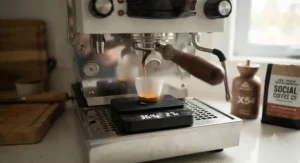
Shot-Timer Accuracy: What It Actually Measures (And What It Doesn’t)
Shot-timer accuracy sounds like a simple stopwatch function, but what it’s actually measuring is the window between water first touching your puck and the point where flow either stops or you manually cut it — and that window is where extraction happens. A scale with genuine auto-detect timing (the Acaia models, the Felicita Arc, and the Timemore Black Mirror Nano and Basic 3.0) starts the clock the instant it senses weight increasing in the cup, which is more consistent than a human thumb reacting to the first visible drops.
What shot-timer accuracy doesn’t measure is whether that time is correct for your specific bean, roast, and grind — a 25-second shot can be perfectly balanced or badly under-extracted depending on everything else in the equation. Coffee brewing researchers, including those teaching food science courses like the coffee brewing technology program at the University of Guelph, consistently frame time as one variable among several rather than a standalone target — useful context for anyone tempted to treat “25 seconds” as a universal rule rather than a starting point to adjust from.
The practical takeaway: use shot-timer accuracy to make your own shots repeatable, not to chase a number you read somewhere online. A scale that reliably times the same shot the same way every time is doing its job even if that number differs from someone else’s “ideal” 27 seconds.
Common Mistakes When Buying an Espresso Dosing Scale
A few patterns show up again and again in how buyers choose, and later regret, an espresso dosing scale purchase.
Buying based on capacity alone, then discovering the scale’s resolution actually narrows well before it reaches that stated maximum — the Hario’s coarser resolution above 200 grams is a real example, and it’s a fine trade-off for espresso but a poor one if you also weigh whole pots of drip coffee on the same device.
Ignoring the scale’s physical footprint relative to an actual machine. A scale that looks compact in a product photo can still be too tall to clear a portafilter on certain prosumer machines; measure your own clearance rather than assuming.
Assuming Bluetooth automatically means better accuracy. As the spec comparison table above shows, non-connected scales like the Timemore Black Mirror Basic 3.0 hit the same 0.1-gram resolution as scales costing three times as much — Bluetooth buys automation and data, not fundamentally different measurement hardware.
Skipping water-resistance ratings entirely. Espresso machines splash more than most people expect, and a scale without at least an IPX4 rating is a genuine risk sitting a few centimetres from a hot portafilter every day.
Overbuying features before establishing a routine. Flow-rate graphing and app-based recipe logging are genuinely useful once you know what you’re troubleshooting, but they’re solving a problem a first-time buyer usually hasn’t encountered yet.
Features That Actually Matter (And Those That Don’t)
Marketing copy on scale packaging tends to bury the genuinely useful specs under buzzwords, and it’s especially noisy for an espresso dosing scale for home baristas rather than a general kitchen tool. Here’s an honest filter.
Actually matters: 0.1-gram resolution held consistently across your actual dosing range; a footprint that clears your specific portafilter; a water-resistance rating of at least IPX4; auto-tare that responds in under a second rather than lagging.
Doesn’t matter much for most buyers: six-plus unit conversions when you’ll realistically use grams; cosmetic colour options; ultra-thin profiles beyond what’s needed to clear your machine; capacity far beyond what a double shot and dosing cup will ever weigh.
Sometimes matters, depending on you: Bluetooth app connectivity (genuinely useful for troubleshooting and shot history, unnecessary if you just want a trustworthy number); live flow-rate graphing (valuable for dialling in a new bean, overkill for a settled daily routine); auto-detect shot timing (a real convenience once you brew often enough to notice it).
The through-line: resolution, fit, and water resistance are non-negotiable; everything else is a convenience layer you can add later without rebuying the whole scale.
Long-Term Cost & Maintenance: Batteries, Calibration, and Value Over Time
Before batteries and calibration habits, here’s how the three price tiers actually break down.
| Tier | Price Range (CAD) | What You Get | Example Pick |
|---|---|---|---|
| Budget | Under C$100 | 0.1g precision, no Bluetooth, USB-C or basic battery | Timemore Black Mirror Basic 3.0 |
| Mid-range | C$100–C$200 | Bluetooth, compact footprint or added modes | Felicita Arc |
| Premium | C$200+ | Full app ecosystem, water resistance, flow graphing | Acaia Pearl S |
The jump from budget to mid-range mostly buys Bluetooth automation and build refinement rather than raw accuracy — check the spec sheet rather than assuming price alone tells the story. The jump from mid-range to premium buys app depth, water resistance, and, on the Acaia Lunar, live flow-rate data most home baristas won’t fully use until they’ve been dialling in shots for a while.
Rechargeable USB-C batteries have become standard across this category, which is a genuine improvement over the disposable-battery era — no recurring cost, no dead scale mid-morning. Total cost of ownership beyond the purchase price stays low: no consumable filters, no annual servicing, and platforms wipe clean in seconds. The real long-term variable is how often you actually pull shots; someone brewing multiple espressos daily will notice a premium scale’s convenience faster than an occasional weekend user, and it’s worth weighing that frequency the same way Health Canada’s guidance on daily caffeine intake frames moderate consumption — most adults comfortably fit two to three home espressos into a day without exceeding recommended limits, which is a reasonable ceiling to plan your equipment budget around too.
Where it’s worth spending more, if budget allows, is build quality and water resistance rather than chasing marginal accuracy gains — the difference between 0.1g and 0.05g resolution rarely shows up in a shot, but a scale that survives five years of daily splashes versus eighteen months absolutely shows up in your wallet.
Practical Usage Guide: Setting Up, Calibrating, and Dosing Your First Shot
Getting a new espresso dosing scale into a reliable daily routine takes about ten minutes of setup, plus a few habits worth building from day one.
First use: Unbox the scale, charge it fully over USB-C (or insert batteries on non-rechargeable models), and set it on a flat, stable surface — an uneven counter or a textured placemat can throw off readings by several tenths of a gram. Power on and let the display settle to zero before placing anything on it.
Calibration check: If your scale supports manual calibration (check the included manual for a button-hold sequence), run that check before your first real shot. If it doesn’t, a simple sanity test with a known weight — a set of coins, for instance — confirms it’s reading true.
Your first weighed dose: Place your portafilter or dosing cup on the scale, tare to zero, grind directly in, and note the dose. Tare again with grounds in place before pulling the shot if your scale supports Espresso mode, so it tracks yield weight specifically as the shot pours.
Maintenance schedule: Wipe the platform after every use — coffee grounds and splashed water are corrosive to sensor mechanisms over time if left to sit. Check charge level weekly if you’re brewing daily, and recalibrate every one to two months, or sooner if readings start feeling inconsistent with what you’re used to.
Common first-30-days mistake: Forgetting to re-tare between the dose and the pull, which is the single most common reason a new scale owner’s ratios come out “off” despite the equipment being perfectly accurate.
Real-World Scenarios: Which Espresso Dosing Scale Fits Your Routine
Buying advice lands better with a face attached to it, so here are three realistic profiles matched to specific picks from this list.
The one-shot-a-day commuter. You pull a single espresso before work, counter space is tight, and you don’t need a phone app to enjoy your coffee. The Timemore Black Mirror Basic 3.0 or Hario V60 Drip Scale cover this well — solid 0.1-gram accuracy for typical dosing without paying for connectivity you won’t open. Budget: under C$100. Frequency: one shot, most mornings.
The weekend dialler-in. You’ve got a decent grinder, you’re experimenting with different beans, and you’ve started noticing that “close enough” doses produce noticeably different shots. The Felicita Arc or Timemore Black Mirror Nano fit this profile — auto-timing plus solid accuracy supports the more deliberate dose-and-adjust process this stage of the hobby usually involves. Budget: C$115–C$175. Frequency: several dialled-in shots on weekends.
The committed home barista chasing consistency. You’re tracking ratios, comparing shots across sessions, and want to see exactly where a pull went sideways. The Acaia Pearl S or Acaia Lunar match this stage — app-logged history, auto-detect timing, and (on the Lunar) live flow graphing to support real troubleshooting. Budget: C$280–C$370. Frequency: multiple shots daily, often across different beans.
None of these are rigid boxes — plenty of people move between all three as their habits change — but matching your actual routine to the right tier avoids both underbuying and overbuying.
Problem → Solution: Fixing the Most Common Espresso Dosing Scale Headaches
Even a well-chosen espresso dosing scale runs into a handful of predictable issues. Here’s how to solve the five most common ones.
Problem: The scale won’t fit under my portafilter. This is almost always a footprint or height issue rather than a defect. Solution: measure your machine’s actual clearance and consider a genuinely compact model like the Bookoo Themis Mini, or dose into a separate dosing cup instead of the portafilter directly.
Problem: Readings drift or seem inconsistent day to day. Usually a surface issue (an uneven or textured counter) or calibration that’s crept in over months. Solution: move the scale to a hard, flat surface and run a calibration check with a known weight.
Problem: The Bluetooth connection keeps dropping. A known friction point on app-connected scales, including the Acaia Pearl S. Solution: keep your phone within a metre or two during weighing, and restart Bluetooth on your phone if reconnects become frequent.
Problem: The scale feels too slow to register a reading. A brief settling delay is normal on precision scales and not a defect — it’s the sensor stabilizing for accuracy. Solution: power the scale on before you start grinding, rather than expecting an instant reading the moment you set something down.
Problem: Battery drains faster than expected. Backlit displays and auto-shutoff settings both affect battery life. Solution: dim the display where possible, and check whether auto-shutoff is set unnecessarily short, since frequent power-cycling draws more current than steady use.
Frequently Asked Questions
❓ What is the best espresso dosing scale for home baristas in 2026?
❓ Do I need a bluetooth coffee scale for espresso, or is a basic scale enough?
❓ What size dosing cup fits my portafilter?
❓ How accurate does shot-timer accuracy need to be for espresso?
❓ How much should I spend on an espresso dosing scale in Canada?
Conclusion
An espresso dosing scale for home baristas isn’t a luxury add-on — it’s the cheapest, most reliable way to make the beans you already own taste noticeably better, starting with tomorrow’s first shot. Across the seven real picks in this guide, the pattern holds regardless of budget: 0.1-gram resolution, a footprint that actually clears your machine, and honest water resistance matter more than flashy extras, and the “right” scale depends far more on your actual routine than on chasing the priciest option on the shelf.
If you want the most complete single purchase, the Acaia Pearl S remains the gold standard, with the Acaia Lunar as a specialist upgrade for flow-rate graphing. Buyers who want serious automation without Acaia pricing should look at the Felicita Arc, while the Bookoo Themis Mini solves footprint problems no other scale on this list can match. For a no-Bluetooth, no-fuss approach, the Timemore Black Mirror Nano and Timemore Black Mirror Basic 3.0 deliver real espresso-mode accuracy at a fraction of the premium price, and the Hario V60 Drip Scale remains the simplest possible on-ramp for someone just getting started.
Whichever you choose, the underlying shift is the same: you stop guessing and start repeating what actually worked. ✨ Ready to stop eyeballing your dose? Compare current prices on today’s pick and get your scale on the counter before tomorrow’s first shot! ☕
Recommended for You
- 7 Best Coffee Scale for Pour Over Picks in Canada (2026 Guide)
- 7 Best Coffee Scales for Beginners in Canada (2026 Guide)
- Espresso Grinder vs Pour-Over Grinder: 7 Honest Picks (2026)
Disclaimer: This article contains affiliate links. As an Amazon Associate, I earn from qualifying purchases. If you purchase products through these links, we may earn a small commission at no additional cost to you.
✨ Found this helpful? Share it with your friends! 💬🤗
