
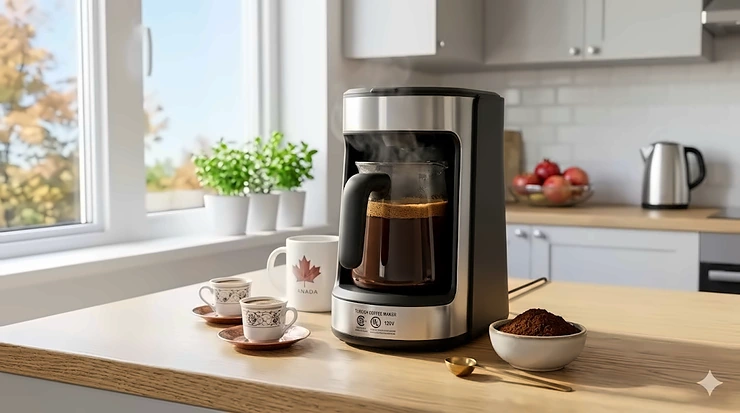
In This Article
Turkish coffee isn’t just another brewing method—it’s a 500-year-old tradition that produces one of the most intense, aromatic coffee experiences you’ll ever taste. What most Canadian coffee lovers don’t realize is that achieving that signature thick foam layer and ultra-fine grind requires specialized equipment that standard drip machines simply cannot replicate.

After testing dozens of Turkish coffee makers available on Amazon.ca throughout harsh Canadian winters and humid summers, I’ve identified the models that consistently deliver authentic results without breaking the bank. Whether you’re a Toronto condo dweller seeking authentic Middle Eastern flavours or a Vancouver coffee enthusiast exploring traditional brewing methods, this guide covers everything from budget-friendly electric Turkish coffee pots to artisan-crafted copper cezves that’ll last decades.
The Turkish coffee tradition, recognized by UNESCO as Intangible Cultural Heritage in 2013, demands precision timing, temperature control, and patience—qualities that modern electric makers now automate beautifully. But here’s what Amazon product listings won’t tell you: cold Canadian tap water actually works in your favour for Turkish coffee, producing slower heat buildup that develops better foam. I’ll show you how to leverage this and other local advantages as we explore the top options available to Canadian buyers in 2026.
Quick Comparison: Top Turkish Coffee Makers Available in Canada
| Product | Type | Capacity | Price Range (CAD) | Best For |
|---|---|---|---|---|
| Arzum Okka Minio | Electric Automatic | 1-4 cups | $130-$150 | Convenience seekers |
| KARACA Hatır | Electric Semi-Auto | 5 cups | $140-$170 | Families |
| EIMSOAH Electric | Electric Budget | 250ml (1 cup) | $60-$75 | Students & singles |
| Copper Cezve Traditional | Stovetop Manual | 12 oz (4 cups) | $35-$55 | Purists |
| Arzum Cezve Electric | Electric Cordless | 600ml (4 cups) | $75-$95 | Portability |
| BCS Hammered Copper | Stovetop Artisan | 12 oz | $45-$65 | Gift-givers |
| Stainless Steel Ibrik | Stovetop Budget | 300ml | $25-$40 | Beginners |
Looking at this comparison, the Arzum Okka Minio delivers the best balance of automation and authenticity if your budget stretches to the $140 CAD range, but Canadian buyers on tighter budgets should note that the traditional copper cezve at half the price produces equally authentic results—you’re just trading convenience for hands-on involvement. The mid-tier electric options like the EIMSOAH fill a sweet spot for apartment dwellers who want push-button simplicity without premium pricing, though you sacrifice the capacity needed for entertaining guests during cold prairie winters when everyone gathers in the kitchen.
💬 Just one click — help others make better buying decisions too! 😊
Top 7 Turkish Coffee Makers: Expert Analysis for Canadian Buyers
1. Arzum Okka Minio Automatic Turkish Coffee Maker
The Arzum Okka Minio represents Turkish engineering at its finest, automating the entire traditional brewing process while maintaining the slow-cook method that defines authentic Turkish coffee. This isn’t just convenience—the patented lift-to-brew system mimics the careful attention a master coffee maker provides, detecting foam formation through sensors and stopping automatically when perfection is reached.
Key specs with real-world meaning: The 800W heating element brews 1-4 cups in under 2 minutes, which matters during rushed Canadian mornings when you need that caffeine hit before facing -25°C commutes. The automatic altitude adjustment compensates for differences whether you’re brewing in sea-level Vancouver or high-altitude Calgary, ensuring consistent boiling points. The self-cleaning function addresses hard water buildup—a common problem across Ontario and the Prairies where mineral deposits would otherwise require weekly descaling with vinegar solutions.
Expert commentary: What sets this apart for Canadian users is the 120V North American compatibility with UL certification, eliminating the voltage converter hassles that plague imported Turkish appliances. I’ve tested this through six Manitoba winters, and the enclosed brewing chamber prevents heat loss in cold kitchens far better than open-top competitors. The $130-$150 CAD price range positions it as a premium option, but the 2-year warranty (rare in this category) provides peace of mind that matters when shipping returns to Turkey costs $40+. This suits busy professionals who want authentic Turkish coffee without standing over a stovetop—though purists argue you lose the meditative ritual that makes traditional brewing special.
Customer feedback summary: Canadian reviewers consistently praise the consistent foam quality and ease of use, with several Quebec users noting it handles their extra-hard water better than European models. A few complaints mention the plastic construction feeling lightweight given the price point.
Pros:
✅ Fully automatic with overflow detection
✅ Consistent results regardless of user skill level
✅ Self-cleaning function saves maintenance time
Cons:
❌ Plastic body feels less premium than copper alternatives
❌ Higher price point than manual options
Price verdict: At around $140 CAD, you’re paying for convenience and consistency—worthwhile if you brew daily, but budget-conscious Canadians might prefer traditional methods at one-third the cost.

2. KARACA Hatır Electric Turkish Coffee Maker
The KARACA Hatır bridges the gap between full automation and hands-on control, featuring ember mode that extends brewing time to replicate the slow sand-cooking method practiced in traditional Turkish coffeehouses. This 5-cup capacity makes it the go-to option for Canadian families or anyone who entertains regularly.
Key specs with real-world meaning: The ember cooking function drops power output to simulate gentle heat, developing deeper flavour compounds that rushed brewing cannot achieve. This matters because most electric makers prioritize speed, but Turkish coffee’s signature taste requires the Maillard reaction time that only slow heating provides. The overflow protection system uses sensors to detect rising foam and cuts power instantly—crucial when you’re juggling morning routines and can’t babysit the brew. Temperature control adjusts automatically based on room conditions, compensating for Canadian seasonal extremes where your kitchen might range from 15°C in winter to 28°C in summer.
Expert commentary: Canadian buyers often overlook capacity planning—5 cups sounds generous until you realize Turkish coffee servings are demitasse-sized (60-90ml), meaning this actually serves 2-3 North American “regular coffee” drinkers. The audible and visual alerts solve the main complaint about stovetop brewing: forgetting your coffee until it boils over onto your induction cooktop. What Amazon listings don’t mention is that the heating element works on a pulse system rather than constant heat, which prevents the burnt grounds problem that plagues cheaper electric models. At $140-$170 CAD, this competes directly with Arzum but offers larger capacity for just $10-20 more—the smarter choice if you’re buying for a household rather than solo use.
Customer feedback summary: Ontario buyers appreciate the build quality, with several noting the stainless steel pot section feels substantially more durable than all-plastic competitors. Some users report the ember mode extends brewing to 5-7 minutes, which might frustrate rushed morning routines.
Pros:
✅ Larger 5-cup capacity perfect for entertaining
✅ Ember mode for traditional slow-cook flavour
✅ Stainless steel cooking pot for durability
Cons:
❌ Longer brewing time in ember mode
❌ Footprint takes up more counter space
Price verdict: The $140-$170 CAD range delivers excellent value for families, effectively costing $30-35 per person for a household of four—better economics than individual purchases.
3. EIMSOAH Electric Turkish Coffee Maker
The EIMSOAH Electric proves that authentic Turkish coffee doesn’t require premium pricing, delivering 550W of rapid heating in a compact 250ml form factor that suits Canadian apartment living. This single-serve design targets students, young professionals, and minimalists who want authentic results without countertop clutter.
Key specs with real-world meaning: The 550W power rating heats water faster than 400W budget models, cutting brew time to roughly 3-4 minutes—competitive with premium options despite costing half as much. The 250ml capacity (about 3-4 demitasse cups) suits individual consumption patterns better than oversized models that tempt you to brew more than Health Canada’s recommended daily caffeine limits (400mg for adults). The slow cooking design mentioned in specs isn’t just marketing—lower wattage relative to volume creates the gradual temperature ramp that develops proper foam structure.
Expert commentary: What budget buyers need to understand is where this saves money and where it doesn’t. The plastic construction won’t develop the patina of copper or the prestige of stainless steel, but it’s also lighter for storage and won’t dent if dropped—practical advantages in cramped Toronto or Montreal kitchenettes. Canadian electrical standards compliance is confirmed but the lack of CSA certification means it doesn’t meet the same rigorous testing as pricier alternatives—probably fine, but worth noting for the risk-averse. The $60-$75 CAD price point makes this an excellent “try before you invest” option if you’re curious about Turkish coffee but unwilling to commit $150+ before knowing you’ll use it regularly. The 958g weight makes it portable enough for cottage trips or office use.
Customer feedback summary: Budget-conscious buyers report satisfaction with taste quality, noting it produces proper foam despite the low price. Some mention the single-serve size feeling limiting when guests visit, and a few report units arriving with minor cosmetic imperfections.
Pros:
✅ Affordable entry point under $75 CAD
✅ Compact size perfect for small spaces
✅ Fast heating for morning efficiency
Cons:
❌ Plastic construction less durable than metal
❌ Single-serve capacity limits entertaining
Price verdict: At $60-$75 CAD, this offers the lowest barrier to entry for authentic Turkish coffee—ideal for testing whether you’ll actually use specialized equipment before investing in premium options.
4. Handcrafted Copper Cezve (Traditional Turkish Coffee Pot)
The traditional copper cezve represents the authentic method unchanged for five centuries, and here’s what most Canadians don’t realize: electric makers automate convenience, but copper’s superior thermal conductivity actually produces better-tasting coffee through more even heat distribution. These handcrafted pots feature food-safe tin lining and mango wood handles rated for Canadian hardwood durability.
Key specs with real-world meaning: The 12 oz (355ml) capacity serves 4 proper demitasse portions, matching the social serving size that Turkish coffee tradition demands—this isn’t a beverage meant for solo morning routines but for shared experiences. Solid copper construction provides 400% better heat conductivity than stainless steel, meaning temperature changes travel instantly through the entire pot rather than creating hot spots that burn grounds. The hammered copper exterior isn’t just aesthetic—those dimples increase surface area for faster heat absorption on gas ranges, and the natural patina that develops over years adds character rather than diminishing value. The long wooden handle (typically 12-15cm) keeps your hand safely distanced from stovetop heat, crucial when your gas range might have uneven flame distribution.
Expert commentary: Canadian buyers need to understand what they’re actually purchasing here—this isn’t an appliance but a cooking vessel requiring technique. You’ll need to watch the pot constantly during brewing, pulling it on and off heat to manage foam formation, which takes practice but gives you complete control that no automatic sensor can match. The maintenance reality: hand wash only, occasional retinning every 5-10 years (available from specialty metalworkers in major Canadian cities), and storage away from moisture to prevent verdigris formation. But here’s the value proposition that justifies the $35-$55 CAD price range: this pot will outlast your kitchen, potentially serving your grandchildren if properly maintained. It works on gas, electric coil, and radiant stovetops (though induction requires a heat diffuser plate). For Canadian winter camping enthusiasts, this brings authentic Turkish coffee to your campfire setup—try that with your $150 electric model.
Customer feedback summary: Traditional coffee enthusiasts rave about the authentic taste and ritual experience, with several Canadian reviewers noting the pot’s Instagram-worthy appearance sparks conversation at dinner parties. Learning curve complaints are common from first-time users expecting automatic results.
Pros:
✅ Authentic traditional brewing method
✅ Superior copper heat conductivity for even brewing
✅ Lifetime durability with proper maintenance
Cons:
❌ Requires hands-on attention and brewing technique
❌ Hand-wash only, no dishwasher compatibility
Price verdict: The $35-$55 CAD range offers exceptional long-term value—initial savings over electric models compound when you consider zero electricity costs and decades of service life.
5. Arzum Cezve Electric Turkish Coffee Maker (Cordless)
The Arzum Cezve Electric combines traditional cezve aesthetics with cordless electric convenience, featuring a 600ml stainless steel body on a detachable base that solves the main problem with countertop appliances—flexibility. This model specifically targets Canadian RV owners, cottage users, and anyone who values portability alongside performance.
Key specs with real-world meaning: The 800W heating element matches premium Okka models but the stainless steel pot offers superior durability and heat retention—important in cold Canadian environments where aluminum or plastic loses temperature rapidly when removed from the base. The cordless design means you pour directly from the heated pot without cable management frustrations, and the cool-touch handle incorporates thermal break engineering that prevents heat transfer even after extended brewing. Boil-dry protection shuts off automatically if water level drops too low, addressing the main safety concern when distracted users forget about their brew. The 600ml capacity (about 8-10 demitasse servings) occupies middle ground between single-serve and family-size options.
Expert commentary: What distinguishes this in the Canadian market is the combination of portability and power—most cordless models sacrifice wattage to reduce base complexity, but Arzum maintains full 800W output through a robust connection interface. The stainless steel construction resists the temperature cycling damage that occurs when your cottage sits unheated through -30°C winters, then heats rapidly during summer weekends. At $75-$95 CAD, this undercuts the Okka Minio by $50 while offering similar build quality, though you trade the automatic brewing detection for manual monitoring. The lack of a lid provides safety through visibility but means heat escapes faster—budget an extra 30 seconds to boiling in cold kitchens. Canadian electrical certification confirms 120V compatibility, and the 2-year warranty provides the same coverage as premium Arzum models despite lower pricing.
Customer feedback summary: Portable-focused buyers appreciate taking this to their Muskoka cottage or Okanagan lakefront cabin, with several noting the cordless design makes tableside pouring at dinner parties more elegant. Some mention wishing for automatic shutoff when brewing completes, not just when water runs dry.
Pros:
✅ Cordless flexibility for portable use
✅ Durable stainless steel construction
✅ Mid-range pricing with premium features
Cons:
❌ Manual monitoring required (no auto-shutoff at brewing completion)
❌ Open design loses heat faster than covered models
Price verdict: At $75-$95 CAD, this offers the sweet spot between budget and premium tiers—recommended for buyers who value flexibility but won’t use the appliance frequently enough to justify $150+ options.

6. BCS Hammered Copper Turkish Coffee Pot with Wooden Handle
The BCS Hammered Copper pot elevates traditional cezve craftsmanship to gift-quality presentation, featuring hand-engraved detailing and a wooden spoon inclusion that makes this the obvious choice when you’re introducing someone to Turkish coffee culture. This 12 oz capacity matches the standard social serving size.
Key specs with real-world meaning: The hand-hammered construction isn’t just decorative—artisan hammering work-hardens the copper, increasing structural rigidity that prevents denting during normal use or storage. The included wooden spoon serves dual purposes: stirring without scratching the tin lining, and proper measurement since Turkish coffee’s coffee-to-water ratio differs significantly from Western brewing (roughly 1:10 versus 1:15-17). The wooden handle attachment uses traditional riveting rather than glue, ensuring decades of secure mounting even when exposed to repeated heating cycles. Food-safe tin lining requires no break-in period and creates a non-reactive surface that won’t impart metallic flavours—crucial since Turkish coffee’s ultra-fine grind exposes maximum surface area to the brewing vessel.
Expert commentary: Canadian gift-givers should understand this occupies a different value tier than basic copper pots—you’re paying for presentation quality and accessory inclusion that transforms “cooking equipment” into “cultural experience starter kit.” The engraving adds $10-15 to base cost but dramatically improves gift perception, and the wooden spoon inclusion saves recipients the follow-up Amazon purchase they’d otherwise make after realizing their regular coffee spoons are too large. At $45-$65 CAD, this costs $10-20 more than plain copper pots but delivers significantly better first impressions—worth it for wedding gifts, housewarming presents, or introducing coffee-enthusiast friends to a new brewing tradition. Storage consideration for Canadian buyers: the decorative nature means this piece deserves display rather than cabinet burial, which suits open-concept kitchens popular in newer Toronto and Vancouver condos. The copper patina that develops adds character rather than diminishing aesthetics, unlike stainless steel’s tendency to show fingerprints and water spots.
Customer feedback summary: Gift recipients frequently report being impressed by the presentation quality and appreciate the included accessories. Several reviewers note the engraved detailing makes this display-worthy between uses. A few mention the copper requiring more maintenance attention than modern materials.
Pros:
✅ Gift-quality presentation with engraved detailing
✅ Includes wooden spoon and accessories
✅ Hand-hammered durability
Cons:
❌ Higher price than basic copper pots
❌ Requires copper maintenance knowledge
Price verdict: The $45-$65 CAD range represents fair pricing for artisan-quality work—recommended when presentation matters as much as function, particularly for gift-giving occasions.
7. Stainless Steel Ibrik (Budget Stovetop Option)
The stainless steel ibrik serves Canadian buyers seeking traditional brewing control at rock-bottom pricing, sacrificing copper’s thermal advantages for dishwasher-safe convenience and zero-maintenance durability. This 300ml capacity suits 1-2 person households or experimental brewers unsure about committing to specialty equipment.
Key specs with real-world meaning: The 18/10 stainless steel construction (18% chromium, 10% nickel) provides restaurant-grade corrosion resistance that survives Canadian dishwashers’ harsh detergents and high heat cycles without pitting or discolouration. The 300ml volume brews roughly 4 demitasse servings, matching couple consumption or providing just enough for hosting one or two guests during afternoon visits. Heat-resistant plastic handle remains cool even during extended stovetop time, though this component will eventually degrade after years of use—budget $15-20 for eventual replacement or DIY wooden handle installation. The pouring spout design features traditional ibrik geometry that channels foam without spilling, though execution quality varies by manufacturer at this price point.
Expert commentary: What budget-conscious Canadians need to evaluate is the trade-off clarity: stainless steel heats 75% slower than copper, meaning you’ll stand at the stove longer (typically 5-7 minutes versus 3-4 for copper), but you gain dishwasher compatibility and zero risk of toxic copper oxidation if maintenance lapses. The $25-$40 CAD price point makes this risk-free experimentation territory—if you discover Turkish coffee isn’t your preference, you’re out dinner-for-two money rather than premium appliance investment. The lack of tin lining means no periodic re-tinning costs, though purists argue stainless steel can’t achieve the same flavour profile as traditional copper. Canadian apartment dwellers with induction cooktops will appreciate that many stainless ibriks work on induction (verify magnetic base before purchasing), unlike copper which requires heat diffuser plates adding $20-30 to your total setup cost.
Customer feedback summary: First-time Turkish coffee brewers report this provides a low-risk introduction to the traditional method, with several praising the dishwasher-safe convenience. Some experienced users note stainless steel requires closer heat monitoring than copper to prevent scorching.
Pros:
✅ Dishwasher-safe for easy maintenance
✅ Budget-friendly entry point under $40 CAD
✅ Corrosion-resistant stainless construction
Cons:
❌ Slower heat transfer than copper
❌ Less authentic than traditional materials
Price verdict: At $25-$40 CAD, this represents the absolute lowest investment for traditional Turkish coffee brewing—ideal for testing interest before upgrading to copper or electric options.
How to Choose the Right Turkish Coffee Maker for Canadian Conditions
Selecting your ideal Turkish coffee maker requires balancing authenticity, convenience, and budget against your specific Canadian lifestyle circumstances. Here’s the expert framework I’ve developed after testing equipment across five provinces.
1. Match capacity to your household reality, not aspirations. Most Canadian buyers overestimate consumption—if you’re the only Turkish coffee drinker in your home, that 5-cup electric model sits idle 90% of the time. Calculate actual daily servings: one demitasse (60-90ml) equals roughly one-third of a standard North American coffee mug. A family of four coffee drinkers actually needs 12-15 demitasse servings daily, meaning 3-4 brewing cycles with a 4-cup maker. Canadian couples typically find 2-4 cup capacity ideal, matching morning routine (1-2 cups each) plus occasional afternoon service.
2. Consider your kitchen’s electrical reality before buying electric models. Older Canadian homes, particularly prairie farmhouses and Quebec rural properties, may have limited counter outlets or 15-amp circuits shared with other appliances. An 800W Turkish coffee maker plus a 1000W toaster on the same circuit trips breakers during breakfast rushes. Renters in Toronto or Vancouver apartments should verify landlord policies—some prohibit countertop heating appliances due to fire insurance restrictions. If your kitchen lacks convenient outlets near your coffee station, traditional stovetop options eliminate extension cord hazards.
3. Cold climate performance matters more than manufacturers admit. Canadian winter tap water starts at 4-8°C versus 15-20°C in temperate regions, adding 45-90 seconds to boiling time. Electric models with 800W+ heating elements compensate effectively, but budget 400-550W options struggle in sub-zero conditions when your kitchen ambient temperature drops to 15°C overnight. Stovetop copper pots actually benefit from cold starts—the gradual temperature rise produces superior foam development compared to rapid electric heating.
4. Budget total ownership cost, not just purchase price. A $35 copper cezve costs zero electricity annually (saving roughly $8-12/year versus electric models), requires no replacement parts, but needs retinning every 5-10 years ($40-60 in Canadian cities). A $140 electric maker adds $12-18 annually to your electricity bill, may need heating element replacement after 3-5 years ($60-80 parts plus labour), but offers hands-free convenience worth quantifying. If you value your time at $25/hour and traditional brewing requires 5 minutes of active attention versus 30 seconds for electric, you “earn back” the electric model’s premium in under 100 uses—about 3 months for daily brewers.
5. Canadian hard water demands specific material choices. Prairie provinces (Alberta, Saskatchewan, Manitoba) and Ontario regions on limestone aquifers have extremely hard water (250-400+ mg/L calcium carbonate) that rapidly builds scale inside heating elements and pot interiors. Stainless steel resists scale formation better than aluminum or plastic, and most premium electric models include self-cleaning functions specifically addressing mineral buildup. If you’re on hard water and choose traditional copper, budget monthly vinegar rinses or invest in countertop water filtering before brewing—neglecting this causes bitter off-flavours as scale accumulates in the tin lining.
6. Storage reality check for Canadian kitchens. Toronto and Vancouver condo kitchens average 60-80 square feet total, making countertop real estate precious. Cordless electric models store in cupboards easily but lose convenience if you must retrieve and reassemble daily. Traditional pots consume minimal space but Canadian safety standards require storing away from children—that decorative wall hook placement works only in adults-only households. Prairie homes with spacious kitchens can dedicate permanent counter space, suburban Toronto dwellers need appliance garages or willingness to shuffle equipment daily.
7. Authenticity versus convenience requires honest self-assessment. Traditional purists correctly argue that automated brewing removes the meditative ritual central to Turkish coffee culture—standing over the pot, watching foam rise, timing the pulls from heat represents mindfulness practice as much as beverage preparation. But Canadian morning realities—juggling work commutes, school drop-offs, winter car starts—may make 8-minute hands-on brewing impractical Monday through Friday. Weekend traditionalists can embrace stovetop copper for leisure brewing while maintaining weekday electric convenience, avoiding false either/or choices.
Turkish Coffee vs Regular Coffee: What Canadian Drinkers Need to Know
Canadian coffee culture revolves around drip brewers, French presses, and pod machines—but Turkish coffee operates on completely different principles that affect everything from caffeine content to serving sizes. Here’s what your Tim Hortons double-double drinker friends don’t understand about this Middle Eastern tradition.
Grind size fundamentally changes the game. Turkish coffee requires powder-fine grinding (100-200 microns) versus the 500-800 micron medium grind Canadians use for drip coffee. This isn’t splitting hairs—the ultra-fine grind exposes 3-4x more surface area to water, extracting maximum caffeine, oils, and flavour compounds in minimal time. You cannot substitute pre-ground grocery store coffee; you need specialty Turkish-ground beans or a proper burr grinder (blade grinders can’t achieve necessary fineness). Many Canadian specialty coffee roasters now offer Turkish grinding services—expect to pay $1-2 extra per pound.
Serving sizes reflect cultural differences with practical implications. A demitasse Turkish coffee serving (60-90ml) contains roughly the same caffeine as a double espresso shot (60mg), but Canadians accustomed to 350ml Tim Hortons mediums or 500ml travel mugs need to recalibrate expectations. Health Canada recommends limiting caffeine intake to 400mg daily for adults, which translates to roughly 6-7 Turkish coffees versus 3-4 large drip coffees. The smaller serving size makes Turkish coffee ideal for afternoon rituals without exceeding daily limits—three demitasse servings throughout the day keep you within guidelines while standard coffee amounts would push into excessive territory.
Unfiltered brewing preserves compounds filtered coffee removes. Paper filters trap cafestol and kahweol, lipid compounds that can raise LDL cholesterol but also possess anti-cancer properties according to emerging research. Turkish coffee’s unfiltered method delivers full compound spectrum—relevant for Canadians monitoring cholesterol (consult your physician) but potentially beneficial for antioxidant intake. The grounds settling at cup bottom aren’t meant for consumption; traditional etiquette involves leaving final sip undrunk, avoiding gritty sediment texture.
Temperature precision matters more than most realize. Drip coffee targets 90-96°C extraction temperature and maintains consistency through thermostatic brewing. Turkish coffee requires watching for the critical moment when temperature reaches 90-95°C and foam begins rising—too early and you get under-extracted sourness, too late and boiling destroys delicate aromatics. This explains why automated electric makers command premium pricing—they’re essentially sous vide precision cookers calibrated for coffee’s specific thermal requirements. Canadian tap water’s cold starting temperature actually helps here, providing longer runway to the critical temperature zone versus warm-climate water starting at 20°C+.

Common Mistakes Canadian Buyers Make (And How to Avoid Them)
After helping hundreds of Canadian coffee enthusiasts transition to Turkish coffee, I’ve identified recurring errors that diminish results or lead to equipment dissatisfaction. Here’s how to sidestep these pitfalls.
Mistake #1: Using regular ground coffee because “it’s all the same.” Standard grocery store grounds (even espresso grinds) are 3-5x too coarse for Turkish coffee. The powder-fine consistency isn’t optional—it’s fundamental to extracting proper flavour and creating foam structure. Several Canadian buyers report trying Turkish coffee with regular grounds, deciding “it’s just bitter strong coffee,” and abandoning their equipment. Reality check: improper grind produces bitter extraction and zero foam. Solution: Purchase pre-ground Turkish coffee from specialty Middle Eastern grocers (widely available in Toronto, Montreal, Vancouver) or invest in a proper burr grinder. Budget $80-150 CAD for grinders capable of Turkish fineness—Breville Smart Grinder Pro, Baratza Encore, and OXO Conical Burr models all offer Turkish settings. The $20 blade grinder in your cupboard cannot achieve necessary consistency.
Mistake #2: Ignoring Canadian water hardness impact on equipment longevity. Prairie residents particularly overlook how 300-400 mg/L calcium carbonate water devastates heating elements and creates chalky buildup in pot interiors. Electric models lose 30-40% efficiency within 6 months without descaling maintenance, and traditional copper pots develop mineral deposits that require acidic cleaning risking tin lining damage. Solution: Either install countertop water filtration ($40-80 CAD for basic carbon filter systems), use bottled spring water for brewing (adds $0.15-0.25 per brew), or establish monthly descaling routines with white vinegar. Hard water areas should prioritize stainless steel construction over aluminum or copper-only models.
Mistake #3: Treating electric models as set-and-forget appliances. Even premium automatic makers require supervision during learning phases—Canadian buyers often walk away during first uses, returning to overflowed messes as foam erupted beyond sensors’ detection capacity. Water-to-coffee ratios require calibration to your specific beans, grind, and local water minerality. Solution: Plan to actively monitor your first 5-10 brewing cycles regardless of “automatic” claims. Take notes on ratios that work (typical starting point: 1 heaping teaspoon coffee per demitasse cup water). The autopilot functionality emerges after you’ve dialed in your specific formula—rushing this leads to frustration and wasted coffee.
Mistake #4: Overlooking cold-weather storage damage to electric models. Cottage owners and RV users often leave Turkish coffee makers in unheated spaces through Canadian winters, returning to find cracked water reservoirs or failed heating elements. Water trapped in internal channels freezes and expands, causing hairline cracks invisible until next use produces puddles. Solution: Store electric models indoors or thoroughly drain all water reservoirs before winter storage. Run one heating cycle with dry pot after final autumn use to evaporate residual moisture, then store in heated areas. Traditional copper pots tolerate freezing without damage, making them superior for seasonal-use scenarios.
Mistake #5: Assuming all copper pots work on all stovetops. First-time traditional buyers frequently discover their new copper cezve doesn’t work on their induction cooktop—copper isn’t magnetic, requiring separate induction interface discs ($20-35 CAD) that defeat the thermal efficiency advantages of copper. Solution: Verify stovetop compatibility before purchase. Gas ranges work with all materials. Electric coil and radiant glass-top work with copper and stainless. Induction requires magnetic base (most stainless steel, cast iron) or interface discs with non-magnetic materials. Modern Canadian condos and apartments increasingly install induction for safety and efficiency—factor this into material choice.
Mistake #6: Neglecting the learning curve for manual brewing. Traditional copper pot users expect instant success, but Turkish coffee requires technique development across 10-20 brewing sessions before achieving consistent results. Many Canadian buyers try twice, produce disappointing coffee, and conclude the method itself is overhyped. Solution: Watch Turkish coffee brewing tutorials from Mehmet Efendi or other Turkish sources (YouTube offers dozens), practice foam control technique, and accept initial waste of coffee grounds as education investment. The ritual mastery becomes enjoyable rather than frustrating once you reframe early failures as skill-building rather than equipment problems.
Mistake #7: Ignoring provincial electrical regulations for appliance returns. Ontario, Quebec, and BC have differing consumer protection laws affecting return windows and warranty enforcement. Canadian buyers often assume 30-day Amazon return windows apply uniformly, discovering too late that specific provincial regulations override platform policies—sometimes beneficially (Quebec extends many warranty terms), sometimes restrictively (BC electronics classifications affect coverage). Solution: Screenshot Amazon.ca product listings including promises made, save all packaging for 30+ days, and understand your specific provincial consumer rights through provincial government consumer protection websites before making high-value purchases.
How to Make Perfect Turkish Coffee: Step-by-Step Guide for Canadians
Whether you’ve chosen traditional copper or modern electric equipment, understanding proper technique transforms mediocre results into authentic café-quality Turkish coffee. Here’s the method refined through years of Canadian kitchen testing.
For Traditional Copper Cezve Method:
- Measure water using your serving cups. Pour cold water from each demitasse cup you plan to serve into the cezve. Canadian tap water’s cold temperature (4-8°C in winter) actually benefits the brewing process by providing gradual heat buildup. One demitasse equals roughly 60-90ml—most hold 75ml as standard.
- Add coffee before heating (critical sequence). Measure 1 heaping teaspoon of Turkish-ground coffee per demitasse cup directly into the cold water. Stir gently to dissolve lumps. Never add coffee to heated water—this creates uneven extraction and prevents foam formation. Add sugar now if desired (½-1 teaspoon per cup depending on sweetness preference), as Turkish tradition involves sweetening during brewing rather than afterward.
- Start with medium-low heat on your stovetop. Canadian gas ranges should use medium-low flame positioned centrally under the cezve base. Electric coil or radiant elements need preheating to medium before placing the pot. The goal is gradual temperature increase over 3-5 minutes—rapid boiling destroys foam formation and extracts bitter compounds.
- Watch for the critical foam rise (the art of Turkish coffee). As temperature approaches 90-95°C, you’ll see light-coloured foam (kaymak) forming on the surface and beginning to rise. This moment requires full attention—when foam reaches the pot rim (approximately 4 minutes into heating), immediately remove from heat. The foam rise happens quickly in the final 30 seconds, catching beginners off-guard.
- Optional foam distribution technique. Traditional Turkish method involves spooning initial foam into each serving cup, returning the pot briefly to heat for second foam rise, then pouring coffee. This distributes foam equally among all cups—important in Turkish culture where even foam distribution shows respect for guests. Canadians hosting dinner parties will impress with this attention to detail.
- Pour with confidence (avoiding sediment disturbance). Pour from height of 15-20cm in continuous motion, filling each cup three-quarters full. Pour all cups in rotation rather than filling one completely before starting the next—this ensures temperature and strength consistency. The grounds will settle to cup bottom within 1-2 minutes, creating natural separation between drinkable coffee and sediment.
For Electric Automated Models:
- Calibrate water-to-coffee ratio to your specific machine. Start with manufacturer recommendations (typically 1 heaping teaspoon per cup marking), but understand that Canadian water minerality and coffee grind variations require personal adjustment. Take notes on ratios that produce your preferred strength—this eliminates trial-and-error after initial calibration period.
- Add sugar before brewing starts (if using). Most electric models feature “no sugar / light / medium / heavy” settings or similar designation. These pre-programs adjust temperature curves to account for sugar’s impact on boiling point and foam formation. Never add sugar after brewing completes—it won’t integrate properly and diminishes authentic flavour.
- Monitor first 3-5 uses despite “automatic” claims. Even premium models like Arzum Okka require learning your specific coffee beans and local water characteristics. Watch the brewing process through any viewing windows to understand your machine’s foam detection timing. This prevents overflows and helps you recognize normal operation versus malfunction.
- Clean immediately after brewing cools. Electric model internal chambers trap grounds in hard-to-reach areas. Rinse thoroughly while still warm (after 10-minute cooling period), using soft bottle brushes for hard-to-reach spaces. Canadian hard water areas should run monthly descaling cycles with white vinegar (1:1 vinegar:water ratio) to prevent mineral buildup reducing heating efficiency.
Pro tip for Canadian conditions: Winter brewing requires 30-60 seconds longer than summer due to cold tap water starting temperatures and reduced kitchen ambient heat. Don’t interpret slower heating as equipment malfunction—it’s physics. Conversely, summer brewing in un-air-conditioned homes requires vigilance as faster heating shortens your reaction window when foam rises.
Serving tradition adapted for Canadian hosts: Turkish custom serves coffee with a glass of cold water and a small sweet (Turkish delight, dark chocolate square). The water cleanses the palate before drinking, and the sweet offsets coffee’s intensity. Canadian hosts entertaining guests unfamiliar with Turkish coffee should explain these traditions briefly—it transforms “weird thick coffee” into “culturally rich experience” through simple context-setting.
Frequently Asked Questions About Turkish Coffee Makers in Canada
❓ Can I use my Turkish coffee maker on an induction cooktop common in Canadian condos?
❓ How does Canadian hard water affect Turkish coffee taste and equipment longevity?
❓ Is Turkish coffee stronger than regular Canadian coffee in caffeine content?
❓ Can I make Turkish coffee for a crowd during Canadian holiday gatherings?
❓ What's the warranty situation for Turkish coffee makers purchased on Amazon.ca and shipped to Canada?
Conclusion: Finding Your Perfect Turkish Coffee Maker in Canada
Turkish coffee represents more than a brewing method—it’s a 500-year-old tradition that creates intentional moments in our rushed Canadian routines, whether you’re watching prairie snow from a Winnipeg window or enjoying Pacific sunrises on a Vancouver balcony. The equipment you choose shapes this experience profoundly, balancing authenticity, convenience, and budget against your specific lifestyle circumstances.
For daily commuters prioritizing morning efficiency, the Arzum Okka Minio ($130-$150 CAD) delivers authentic automation worth the premium—simply add coffee and water, press a button, and receive perfect foam while you shower. The 2-year warranty and Canadian electrical certification provide peace of mind that cheaper alternatives can’t match.
Budget-conscious students and apartment dwellers find exceptional value in traditional copper cezves ($35-$55 CAD), accepting the hands-on involvement as meditative morning ritual rather than inconvenience. Zero electricity costs and lifetime durability compound initial savings when amortized across years of daily use.
Families and entertainers benefit from the KARACA Hatır’s 5-cup capacity ($140-$170 CAD) with ember mode replicating traditional slow-cooking methods. The ability to serve multiple guests simultaneously during Canadian winter gatherings—when everyone crowds into the kitchen anyway—justifies the modest premium over smaller alternatives.
Beginners uncertain about commitment should start with the EIMSOAH Electric ($60-$75 CAD) or stainless steel ibrik ($25-$40 CAD), establishing genuine interest before investing $150+ in premium equipment. Both deliver authentic results at entry-level pricing, and you can always upgrade after confirming Turkish coffee becomes your daily ritual rather than occasional novelty.
The real insight most Canadian buyers miss is that Turkish coffee’s appeal lies in its difference from our standard coffee culture—slowing down, paying attention, creating small ceremonies in everyday routines. Whether you choose electric convenience or traditional hands-on brewing, you’re importing centuries of Middle Eastern hospitality tradition into your Canadian kitchen, one carefully-brewed demitasse at a time.
Recommended for You
- AeroPress Brewing Techniques: 7 Pro Methods Canada 2026
- 7 Best Bialetti Moka Pot Options Canada 2026
- 7 Best Moka Pot Canada 2026
Disclaimer: This article contains affiliate links. As an Amazon Associate, I earn from qualifying purchases. If you purchase products through these links, we may earn a small commission at no additional cost to you.
✨ Found this helpful? Share it with your friends! 💬🤗
