
In This Article
A tamping station with knock box is a single countertop unit that gives your portafilter a stable, level spot to be tamped, plus a bin and knock bar for dumping spent espresso pucks. It replaces the loose mat and the separate bucket, keeping grounds contained and your tools within reach.
Picture the usual morning. You tamp on a folded tea towel, the portafilter skids, and a puck ends up on the counter, where it dries into something resembling a hockey puck. Multiply that by 365 and you have a very expensive hobby with a very messy habit. Espresso is a concentrated coffee made by forcing hot water through finely ground beans under pressure. Because the process is so sensitive, a level, repeatable tamp and a tidy workflow matter more than most newcomers expect.
I researched seven real, currently listed units and compared their published specs, materials and fit. I also read the aggregated sentiment from published roundups and Canadian retailer feedback. Amazon.ca review counts change constantly and I couldn’t verify them here, so read the live reviews before you buy. All prices below are ranges in Canadian dollars, and they move, so check current pricing.
Beyond the picks, this guide covers three questions buyers keep asking: the tamping station vs tamping mat comparison, the best compact tamping station for small kitchens, and how knock-bar durability plays out over years of daily use.
Quick Comparison: Top 7 Tamping Station With Knock Box Options at a Glance
| Product | Material | Portafilter Fit | Standout | Price Range (CAD) | Best For |
|---|---|---|---|---|---|
| IKAPE V5 Espresso Knock Box | Solid walnut | Standard sizes | 1.7 L knock box | C$90-C$140 | Heavy daily users |
| JOYONE Tamping Station and Knock Box | Walnut + silicone | 51/54/58 mm | Height-adjustable, anti-wobble | C$70-C$110 | Multi-machine households |
| KNODOS Walnut Tamping Station | Walnut | 54 mm | 7 tool slots, all-in-one | C$100-C$170 | Breville/Sage owners |
| TREELF Espresso Knock Box Tamping Station | Walnut | 51-54 mm | Detachable support stand | C$80-C$130 | Workflow-minded baristas |
| Normcore Stainless Steel Knock Box | Stainless + walnut base | Most sizes | Minimalist, 1 L bin | C$70-C$110 | Small counters |
| MEION 10-in-1 Detachable Station | ABS plastic | Multi-size | Detachable knock box | C$40-C$70 | Tight budgets |
| NICEPRING 8-in-1 Espresso Tamping Station | Sapele wood | 51-58 mm | Magnetic storage | C$60-C$100 | Value-minded buyers |
Looking at the table, the IKAPE V5 Espresso Knock Box buys the biggest bin, while the KNODOS Walnut Tamping Station is the tidiest answer for 54 mm machines. If you’re watching the budget, the MEION 10-in-1 Detachable Station costs roughly half of the walnut options, though you trade away some heft. The Normcore Stainless Steel Knock Box is the pick when you care more about footprint than tool storage.
💬 Just one click — help others make better buying decisions too!😊
Top 7 Tamping Station With Knock Box Picks: Expert Analysis
Each pick below gets the same treatment: what stands out, what the specs mean in practice, who it suits, what published reviewers keep saying, and whether the price range justifies it.
1. IKAPE V5 Espresso Knock Box — biggest bin in the group
The headline here is capacity. The IKAPE V5 Espresso Knock Box pairs a 1.7 L knock box with a solid walnut body, and that volume is the whole story. Roundup reviewers describe the dense walnut as giving it a drop-proof, anchored feel. In practice, that weight keeps the unit planted when you give a stubborn puck a proper whack. Based on the spec, 1.7 L should swallow a day’s worth of shots for a household without a daily emptying chore. That suits a two-adult home pulling four to six shots a day. One recurring criticism is that there’s little storage for puck screens, brushes or other bits, so you’ll still need a small tray alongside it. Reviewers lean positive on build and stability. Verify the live Amazon.ca feedback for fit with your specific portafilter.
Pros:
- ✅ Large 1.7 L bin for heavy use
- ✅ Solid walnut feels dense and stable
- ✅ Quiet, planted knock
Cons:
- ❌ Little accessory storage
- ❌ Larger footprint than compact options
Expect roughly C$90-C$140. For high-volume households, the capacity makes it a strong value.
2. JOYONE Tamping Station and Knock Box — adjustable height that stops the wobble
What makes the JOYONE Tamping Station and Knock Box interesting is its adjustable nut, which published testers credit with eliminating wobble. A wobbling station is a quiet espresso saboteur, because uneven support leads to an uneven tamp. This one covers 51, 54 and 58 mm portafilters, and it combines walnut with a silicone mat insert and four anti-slip pads. Those pads matter on a granite or quartz counter, where bare wood tends to creep. On paper, the height-adjustable design lets you set the tamping surface to suit your tamper and wrist angle. That’s a detail most competitors skip.
The trade-offs are practical. The knock section holds fewer pucks than a standalone bin, and the silicone hole inserts can trap grounds, so they need regular upkeep. Reviewers like the all-in-one design, and one roundup author said they retired their separate knock box afterward. That’s one reviewer’s view, not a universal result.
Pros:
- ✅ Adjustable height eliminates wobble
- ✅ Fits 51, 54 and 58 mm portafilters
- ✅ Four anti-slip pads for grip
Cons:
- ❌ Smaller knock capacity than standalone bins
- ❌ Silicone inserts trap grounds
Expect roughly C$70-C$110. For versatility, it’s a strong middle-of-the-road buy.
3. KNODOS Walnut Tamping Station — built for 54 mm Breville and Sage machines
The KNODOS Walnut Tamping Station is a purpose-built companion for 54 mm machines such as Breville and Sage models. It combines a stable tamping stand, an integrated knock box and seven tool slots in a footprint of about 10 x 10 inches (roughly 25 x 25 cm). Dedicated fit is the real advantage here. Universal stations compromise on slot size, whereas this one is cut for the 54 mm basket and handle geometry. The tool slots keep your tamper, distributor and brush off the counter, which counts for more than it sounds in a busy kitchen.
The flip side is that it isn’t a small unit. A 25 cm square is a real commitment on a narrow counter, and 58 mm owners are out of luck. Published roundups consistently rate it highly for Breville owners specifically. Buyers with other machines should look elsewhere.
Pros:
- ✅ Cut specifically for 54 mm portafilters
- ✅ Seven tool slots keep gear organized
- ✅ Integrated knock box and stand
Cons:
- ❌ Roughly 25 cm square footprint
- ❌ Not suited to 58 mm machines
Expect roughly C$100-C$170. It’s pricier, but it’s the cleanest solution if you own a 54 mm machine.
4. TREELF Espresso Knock Box Tamping Station — detachable stand for a flexible workflow
The standout feature of the TREELF Espresso Knock Box Tamping Station is its detachable support stand. That makes it a 3-in-1: tamping platform, knock box and removable stand, in natural walnut for 51-54 mm portafilters. Detachability means you can reposition the pieces to match your workflow. You might pull the stand forward for tamping and slide the knock box aside to empty it. That’s handy when you share a kitchen and need to clear the counter quickly.
Roundup reviewers single it out for barista-style workflow, praising how the pieces move independently. The limits are the fit range (no 58 mm) and the usual question of how stable detachable parts feel compared with a single block. Test the join when it arrives. A little wobble in a detachable joint is the thing to watch for.
Pros:
- ✅ Detachable stand adds layout flexibility
- ✅ Natural walnut looks great
- ✅ Fits 51-54 mm portafilters
Cons:
- ❌ No 58 mm compatibility
- ❌ Detachable joints need a stability check
Expect roughly C$80-C$130. It offers good flexibility for the money.
5. Normcore Stainless Steel Knock Box — the minimalist’s quiet knock
The Normcore Stainless Steel Knock Box is the one that cares least about decoration and most about footprint. It offers a 1 L stainless bin on a walnut base, and roundups tag it as the quiet-knock, minimalist option. Stainless steel is easy to rinse and doesn’t hold odours the way porous materials can, so it’s the low-maintenance choice for people who dislike scrubbing. A 1 L capacity covers a few shots’ worth of pucks, which suits one or two daily drinkers. The compromise is storage. It’s a bin, not an organizer, so your tools still need a home.
Reviewers appreciate the clean look and compact size, and the walnut base adds warmth to the stainless. If your counter is tight, this is a smart pick. If you need an all-in-one, it isn’t.
Pros:
- ✅ Compact footprint for tight counters
- ✅ Stainless bin rinses clean easily
- ✅ Quiet, minimalist design
Cons:
- ❌ Limited tool storage
- ❌ Smaller 1 L capacity
Expect roughly C$70-C$110. It’s good value for small spaces.
6. MEION 10-in-1 Detachable Station — the budget route with a detachable knock box
The MEION 10-in-1 Detachable Station is the low-cost entry, built from ABS plastic with a detachable knock box and multi-size compatibility. A detachable knock box is a clever budget feature, because you can carry it to the sink or green bin without lifting the whole station. ABS plastic is lighter than walnut or stainless, which makes it easy to move but less planted on the counter. A knock bar slamming into a light body can shift it, so expect to hold it steady with your other hand.
Roundups position it as the budget-friendly option rather than a long-term heirloom. That’s the honest framing: it solves the mess problem for a fraction of the price, but you shouldn’t expect the heft of the wood models. Test the knock bar early to see how it feels against your portafilter.
Pros:
- ✅ Lowest price of the seven
- ✅ Detachable knock box for easy emptying
- ✅ Multi-size portafilter compatibility
Cons:
- ❌ Lighter plastic can shift when knocking
- ❌ Less premium feel and longevity
Expect roughly C$40-C$70. It’s strong value if you’re testing whether you’ll stick with the habit.
7. NICEPRING 8-in-1 Espresso Tamping Station — sapele wood with magnetic storage
The NICEPRING 8-in-1 Espresso Tamping Station is billed in roundups as the best-value wood option, built from sapele with magnetic storage for tools. Magnetic storage is a smart organizational trick, since your distributor or tool plate can be held in place without a fussy slot. Sapele is a warm, reddish hardwood that gives you a premium look without walnut’s price. Two reviewer-flagged quirks are worth knowing. The rubberized inserts can make tool removal tight and sticky, and the 58 mm slot may not fit thicker E61-style collars. Confirm the listing’s exact knock-box configuration before ordering, since similar multi-in-one stations vary.
If you own an E61 machine with a chunky group collar, measure first. For everyone else, it’s an attractive, organized station at a modest price.
Pros:
- ✅ Magnetic tool storage keeps things tidy
- ✅ Attractive sapele wood finish
- ✅ Strong value for a wood unit
Cons:
- ❌ Rubber inserts can feel sticky
- ❌ 58 mm slot may not fit E61 collars
Expect roughly C$60-C$100. Check current price and fit before buying.
How to Set Up and Maintain Your Tamping Station With Knock Box
Amazon listings tell you what a station is. They rarely tell you how to live with one. Here’s a practical first-30-days routine.
- Placement. Put the unit beside the machine, not behind it. You want the portafilter to travel the shortest path from grinder to station to group head.
- Stability test. Press down firmly with your tamper. If the surface creeps or rocks, add a thin silicone mat underneath. The JOYONE Tamping Station and Knock Box solves this with built-in adjustment and anti-slip pads.
- Tool layout. Park the tamper, distributor and brush in their slots every time. Habit beats tidiness.
- Knock technique. Use a firm tap or two against the bar. Hammering rarely helps, and it wears the bar faster.
Maintenance matters more than it seems. Damp grounds left sitting turn to mould surprisingly fast, and one Calgary reviewer of a different station noted that its small capacity forces frequent emptying, which they preferred. Empty daily, wash removable parts weekly, and inspect the bar monthly. For general kitchen hygiene, Health Canada’s safe food handling tips are a useful baseline for keeping food-contact surfaces clean.
The most common first-month mistake is leaving grounds in silicone inserts, where they trap and smell. A quick rinse and a dry cloth fixes it. The NICEPRING 8-in-1 Espresso Tamping Station and JOYONE models both have rubber or silicone details that reward this habit.
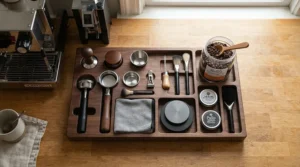
Real-World Scenarios: Which Tamping Station With Knock Box Fits Your Life?
Picking the right unit is about matching the gear to the person, not chasing the highest price.
The condo renter with a Breville. She pulls two shots a day on a 54 mm machine, has a 60 cm stretch of counter, and values looks. The KNODOS Walnut Tamping Station fits her portafilter exactly and keeps tools off the counter. If the 25 cm footprint feels too large, the TREELF Espresso Knock Box Tamping Station is a flexible alternative.
The student on a tight budget. He makes one latte a day and moves apartments every year. The MEION 10-in-1 Detachable Station is light, cheap and easy to carry, and it solves the mess problem without a big spend. Durability matters less here than portability.
The household espresso fanatic. A couple pulling six shots daily needs capacity above all. The IKAPE V5 Espresso Knock Box with its 1.7 L bin means one emptying a day, not three.
The minimalist with a small counter. The Normcore Stainless Steel Knock Box keeps footprint low and cleans up in seconds, as long as you’re happy storing tools elsewhere.
Problem → Solution: Fixing the Most Common Station Annoyances
Problem 1: The station slides when you knock. Add anti-slip pads or a silicone mat. Heavier units like the IKAPE V5 Espresso Knock Box resist this naturally, while lighter ones like the MEION 10-in-1 Detachable Station benefit from a steadying hand.
Problem 2: Grounds stuck in silicone or rubber inserts. Tap out, rinse and dry. Reviewers flag this on models with silicone hole inserts, including the JOYONE Tamping Station and Knock Box.
Problem 3: Tools stick in tight rubber slots. The NICEPRING 8-in-1 Espresso Tamping Station has been described as tight in this respect. A light wipe and a bit of break-in usually loosen things.
Problem 4: Your portafilter doesn’t sit right. Measure the collar and handle before buying. A 58 mm slot may not suit thicker E61 collars, and 54 mm-only units like the KNODOS Walnut Tamping Station won’t take 58 mm at all.
How to Choose a Tamping Station With Knock Box
If you want the short version, follow these steps in order.
- Confirm your portafilter size. 51, 54 and 58 mm are the common ones. A mismatch is the most expensive mistake.
- Decide your daily shot volume. One or two shots a day tolerates a 1 L bin, while four or more benefits from something like the 1.7 L on the IKAPE V5 Espresso Knock Box.
- Measure your counter. Allow clearance for your portafilter handle, not just the base.
- Pick a material you’ll maintain. Stainless rinses easily, walnut needs a wipe-down, and ABS is light but less heavy-duty. Silicone and plastic parts touch your coffee, so look for food-grade materials. Health Canada regulates food packaging materials under the Food and Drug Regulations. A kitchen accessory isn’t packaging, but the same principle applies: buy from sellers who state the material clearly.
- Check the knock bar. Is it rubber-covered, removable, replaceable? More on that below.
- Weigh storage vs minimalism. If you own a distributor, puck screen and brush, tool slots are worth paying for.
Tamping Station vs Tamping Mat Comparison: Which Do You Actually Need?
This tamping station vs tamping mat comparison comes up constantly, and the answer depends on how you brew.
| Factor | Tamping Mat | Standalone Knock Box | Tamping Station With Knock Box |
|---|---|---|---|
| Stability | Good if non-slip | N/A | Excellent, fixed platform |
| Mess control | Limited | Good | Best, contained workflow |
| Footprint | Smallest | Small | Medium |
| Cost (CAD) | Roughly C$15-C$35 | Roughly C$30-C$80 | Roughly C$40-C$170 |
| Best For | Occasional use, tight budgets | Bin only | Daily brewers |
Mats are cheap, quiet and unobtrusive. Homegrounds’ guide to tamping mats notes that a secure non-slip surface helps you apply even pressure, and Pro Coffee Gear says a mat works for occasional use while a station gives better control for regular shots. That matches the logic: a mat protects the counter, while a station creates a workstation.
In this tamping station vs tamping mat comparison, the mat wins on price and portability, and the station wins on workflow and mess control. If you pull a shot most days, a station with a knock box saves you from juggling three separate items. If you pull a couple of shots a week, a mat plus a small bin may be plenty. A mat plus a standalone knock box can cost more in total than a mid-range station, which surprises people.
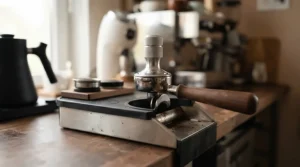
Compact Tamping Station for Small Kitchens: Space-Saving Strategies
A compact tamping station for small kitchens needs to earn every centimetre. Canadian condo and rental kitchens often have counters as shallow as 60 cm, with wall cabinets overhead, so measure vertical clearance too. A portafilter handle sticks out further than most people picture.
Your best options differ by priority. For the smallest footprint, the Normcore Stainless Steel Knock Box is a bin-only design with a walnut base. For a tidy all-in-one at moderate size, the KNODOS Walnut Tamping Station works if you own a 54 mm machine, though its roughly 25 cm footprint is not tiny. For portability, the MEION 10-in-1 Detachable Station lets you separate the bin and stash it.
One non-Amazon note: Eureka Mignon Knock Drawer with Tamping Station, sold by a Canadian retailer, is designed specifically for Eureka Mignon grinders as an ultra-compact drawer that doubles as a tamping surface. It sits in the high-C$100s, so it’s a premium route for that grinder only.
The most efficient compact tamping station for small kitchens is the one you’ll actually empty. Smaller bins force the habit. A Calgary reviewer of the Saint Anthony Industries The Bloc, which holds roughly six pucks, said the small capacity encouraged frequent emptying and prevented mould, while another called it a sturdy station but too small and messy as a knock box. Both are fair, and both point to the trade-off: small footprint, small bin.
Knock-Bar Durability: What Wears Out First, and What to Check
Knock-bar durability decides whether your station feels solid in year three or rattles in month six. The bar takes the beating, as Clive Coffee notes in its knock box guide, and it highlights bar material and replaceability as key factors.
| Bar Type | Typical Construction | Durability Profile | Best For |
|---|---|---|---|
| Rubber over steel rod | Stainless rod with rubber sleeve | Strong core, sleeve may wear | Daily users |
| Welded bar | Metal bar fixed to the box | Strong sides, harder to clean | Heavy use |
| Removable NBR rubber bar | Pull-out rubber bar | Easy to clean and replace | Easy upkeep |
| Plastic knock block | Rigid plastic insert | Lightweight, can crack over time | Light use |
Here’s how to read that. Rubber-over-steel bars, like the type sold with Tiamo knock boxes, combine a rigid core with a sacrificial surface. Welded bars are structurally strong but you can’t remove them for cleaning, while removable bars trade a little rigidity for easy washing. Barista Basics ABS knock boxes use a removable NBR rubber bar and a rubber base to reduce noise, a design built for café use.
Replaceability is the sleeper factor. Revolution sells a replacement rubber bar cover, which shows how serious makers think about longevity. On the other hand, Seattle Coffee Gear notes that finding an exact replacement for a worn Rattleware bar is hard. So before you buy any station, ask: when the rubber wears, can I replace it?
For the stations above, durability expectations differ. Wood and stainless models like the IKAPE V5 Espresso Knock Box and Normcore Stainless Steel Knock Box tend to have more robust bodies, while the MEION 10-in-1 Detachable Station is plastic, so check its bar early. A bar that dents, loosens or cracks within weeks is a sign to return it while you can.
Long-Term Cost & Value: What a Tamping Station With Knock Box Really Costs
Think in cost per use. A station costing C$100 and used for two shots daily over three years sees roughly 2,200 knocks. That works out to under five cents per use, which is almost nothing next to the coffee itself. A C$50 plastic unit lasting two years comes out around three cents per use if it survives. Cheap isn’t automatically wise if it cracks, but it isn’t a bad bet either.
| Tier | Typical Range (CAD) | What You Get | Best For |
|---|---|---|---|
| Budget | C$40-C$70 | ABS or basic build, detachable bin | Beginners, students |
| Mid-range | C$70-C$110 | Walnut or stainless, decent storage | Most households |
| Premium | C$110-C$170+ | Dedicated fit, more tool slots | Breville/Sage owners, gift buyers |
The mid-range tier is where value peaks. You get real materials without paying for brand styling. Spend up only if you need a specific fit, like the KNODOS Walnut Tamping Station for 54 mm machines, or a bigger bin like the IKAPE V5 Espresso Knock Box. Spend down with the MEION 10-in-1 Detachable Station if you’re unsure about the hobby.
Remember the end-of-life side. Coffee grounds are a good fit for municipal organics programs where they exist, and green bin programs in several Canadian cities accept them. Rules vary by municipality, so confirm yours. Emptying into the green bin daily also keeps the knock box from turning into a science project.
Common Mistakes When Buying a Tamping Station With Knock Box
Ignoring portafilter fit. A 54 mm-only unit won’t take a 58 mm handle. Check twice.
Buying for looks alone. Walnut is lovely, but if the bar is weak or the base slides, you’ll hate it by March.
Ignoring counter depth. Measure clearance for the handle, not just the base.
Overlooking replaceable parts. Knock-bar durability matters, and a non-replaceable bar turns a wear item into a dead unit.
Paying for features you won’t use. Seven tool slots are wasted if you only own a tamper. If you already have a tidy drawer, the Normcore Stainless Steel Knock Box may suit you better than a full organizer.
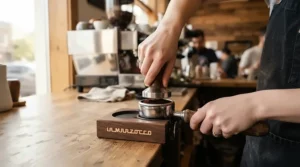
FAQ: Tamping Station With Knock Box
❓ Can a tamping station with knock box work on a very small counter?
❓ How often should I empty a tamping station with knock box?
❓ Does a knock box with a tamping station fit 58 mm portafilters?
❓ Is a tamping mat enough, or do I need a full station?
❓ Will the knock bar damage my portafilter?
Conclusion
Here’s the short answer. If you own a 54 mm Breville or Sage machine and want everything in one place, the KNODOS Walnut Tamping Station is the tidiest fit. If you pull lots of shots, the IKAPE V5 Espresso Knock Box has the biggest bin. For multi-size flexibility, the JOYONE Tamping Station and Knock Box and TREELF Espresso Knock Box Tamping Station give you adjustment and layout options. If space is tight, the Normcore Stainless Steel Knock Box keeps things minimal. And if budget rules, the MEION 10-in-1 Detachable Station and NICEPRING 8-in-1 Espresso Tamping Station deliver the most for the least.
The deeper lesson is that the right tamping station with knock box matches your machine, counter and habits. Choose a fit that works, check the knock bar, and commit to emptying it daily.
✨ Ready to tidy up your espresso corner?
🔍 Click on any highlighted product above to check current pricing and availability on Amazon.ca, then pick the tamping station with knock box that fits your counter and your routine. Your future self, minus the stray puck, will thank you!
Recommended for You
- Espresso Tamping Station: 7 Best Picks For Canada (2026)
- Coffee Scoops For French Press: 7 Proven Picks In 2026
- Dual-Sided Coffee Scoop: 7 Best Picks For Canadians (2026)
Disclaimer: This article contains affiliate links. As an Amazon Associate, I earn from qualifying purchases. If you purchase products through these links, we may earn a small commission at no additional cost to you.
✨ Found this helpful? Share it with your friends! 💬🤗
