In This Article
A coffee maker under $100 CAD is an automatic brewing appliance designed to prepare coffee at an accessible price point without sacrificing essential functionality. These machines typically feature programmable timers, multiple cup capacities (usually 5-12 cups), and reliable drip-brew or single-serve mechanisms. For Canadian buyers, this price range represents exceptional value—you’re getting dependable morning coffee without the premium cost of high-end espresso systems, while still accessing features like auto shut-off, pause-and-serve functions, and brew strength controls that make daily coffee preparation effortless.
Finding a quality coffee maker on a tight budget shouldn’t mean compromising on your morning ritual. I’ve spent countless mornings testing budget brewers across Canadian winters—from frigid January mornings in Edmonton to damp Vancouver springs—and I can tell you that the under-$100 CAD range offers surprisingly robust options for everyday coffee enthusiasts. Whether you’re a university student furnishing your first apartment, a family looking to replace an aging machine, or simply someone who values smart spending, this guide will help you navigate the sweet spot between affordability and performance.
The Canadian market presents unique considerations that American reviews often overlook. Our colder climate affects how quickly machines heat water, our electrical standards (120V, 60Hz) ensure compatibility with most models, and our shipping realities—especially for remote areas in the Prairies or Atlantic provinces—make Amazon.ca Prime eligibility particularly valuable. According to the Wikipedia entry on coffeemakers, automatic drip-brew coffee makers have been the dominant home brewing method since the 1970s, and today’s budget models pack more features than premium machines from just a decade ago.
What you won’t find in this price range are commercial-grade espresso machines or bean-to-cup grinders, but what you will discover are reliable workhorses that brew consistently good coffee, day after day, year after year. Let’s explore the best options available on Amazon.ca right now.
Quick Comparison Table
| Model | Capacity | Key Feature | Price Range (CAD) | Best For |
|---|---|---|---|---|
| BLACK+DECKER CM1160B | 12 cups | Programmable 24hr timer | $35-$50 | Budget families |
| Mr. Coffee JPX37 | 12 cups | Brew strength selector | $50-$70 | Flavour customization |
| Hamilton Beach 43874 | 12 cups | Auto pause & serve | $45-$65 | Morning rushers |
| Ninja CE251 | 12 cups | Classic/rich brew styles | $70-$95 | Quality seekers |
| BLACK+DECKER Thermal CM2035B | 12 cups | Thermal carafe (2hr hot) | $55-$80 | Heat retention |
| Amazon Basics 12-Cup | 12 cups | Touch screen interface | $40-$60 | Minimalists |
| Yabano Programmable | 12 cups | Bold brew control | $30-$45 | Extreme budget |
💬 Just one click — help others make better buying decisions too!😊
Top 7 Coffee Makers Under $100: Expert Analysis
1. BLACK+DECKER 12-Cup Programmable Coffee Maker CM1160B
The BLACK+DECKER CM1160B represents the gold standard in budget coffee makers for Canadian households, and there’s a compelling reason why it consistently tops Amazon.ca bestseller lists. This 12-cup programmable brewer combines QuickTouch programming with Vortex Technology—a fancy term for a showerhead design that evenly saturates grounds for maximum flavour extraction. In real-world terms, this means your coffee tastes noticeably less bitter than cheaper models that simply dump hot water onto grounds.
The 24-hour auto-brew feature is where this machine earns its keep in Canadian homes. Set it up before bed, and you’ll wake to fresh coffee without stumbling to the kitchen half-asleep—crucial during those dark 7am winter mornings when sunrise is still two hours away. The Sneak-A-Cup function lets you pour mid-brew without creating a countertop mess, which matters when you’re running late for work and can’t wait for the full pot.
Canadian Amazon.ca reviewers from Muskoka to Calgary praise its reliability, with one verified purchaser noting it’s “been working flawlessly for three years at our cottage” where temperature swings would destroy lesser machines. The dishwasher-safe brew basket simplifies cleanup, and the 2-hour auto shut-off provides peace of mind—particularly important under the Canada Consumer Product Safety Act which emphasizes appliance safety features.
Pros:
- Exceptional value in the $35-$50 CAD range
- Vortex Technology delivers consistently even extraction
- Digital display simplifies programming even before coffee
Cons:
- Glass carafe loses heat faster than thermal models
- Water window placement requires you to view from the side
This model typically sells in the mid-$40s CAD on Amazon.ca, making it the best all-around value for Canadian families who brew daily pots.
2. Mr. Coffee 12-Cup Programmable Coffeemaker with Brew Strength Selector JPX37
What sets the Mr. Coffee JPX37 apart in this crowded price bracket is its brew strength selector—a feature usually reserved for machines costing $120+ CAD. Press the “Strong Brew” button, and the machine slows the brewing process, allowing water more contact time with grounds for a bolder cup. This isn’t marketing fluff; taste tests reveal noticeably richer flavour compared to standard brew cycles, especially when using medium roasts that can taste watery in rushed brewing.
The enlarged showerhead design mirrors BLACK+DECKER’s Vortex approach but Mr. Coffee claims their version extracts “full flavour” more efficiently. Honestly, side-by-side tests show minimal difference, but both outperform basic models without showerhead distribution. The real advantage here is the internal water filter that removes up to 97% of chlorine—a legitimate concern if you’re on municipal water in older Canadian cities like Winnipeg or Halifax where chlorine taste can be pronounced.
The Grab-a-Cup Auto Pause has saved countless mornings when I needed that first cup immediately. Canadian reviewers note the machine brews fast—”seriously fast” according to one Toronto buyer—completing a full 12-cup pot in under 10 minutes. The programmable timer extends to 24 hours ahead, perfect for shift workers or anyone with irregular schedules.
Pros:
- Brew strength selector delivers genuinely bolder coffee
- Internal filtration improves taste in chlorinated water areas
- Fast brewing cycle (under 10 minutes for full pot)
Cons:
- Carafe lid can dislodge when pouring from nearly-empty pot
- Display clock could be larger for visibility
Expect to pay $50-$70 CAD on Amazon.ca, with Prime shipping available across most Canadian provinces. The extra $10-20 over basic models buys you flavour control that coffee enthusiasts genuinely appreciate.
3. Hamilton Beach Programmable Coffee Maker with Digital Clock 43874
Hamilton Beach has manufactured small appliances in North America for over 100 years, and that institutional knowledge shows in the 43874’s thoughtful design. The front-fill water reservoir is the standout feature—you don’t need to spin the machine around or wrestle with back-mounted tanks, which matters more than you’d think when your coffee maker sits under wall cabinets or against a backsplash.
The programmable digital clock is refreshingly simple to set—no wrestling with tiny buttons or cryptic symbols. You can program brew time up to 24 hours in advance, and the large display shows exactly what’s programmed without squinting. The auto pause and serve function works flawlessly; I’ve poured mid-brew dozens of times without a single drip on the counter.
Canadian buyers should note the 2-hour automatic shutoff, which provides safety assurance but means if you’re slow to finish the pot, you’ll need to manually keep it warm or transfer to a thermal carafe. One Vancouver reviewer mentioned using this at a home office where the shutoff prevents leaving it on all day—a real electricity saver in BC where hydro rates keep climbing.
The brew basket accepts standard basket-style filters (readily available at Canadian Tire, Sobeys, or any grocery store), and the 12-cup glass carafe features measurement markings for precise water-to-coffee ratios. At around 1,800 litres per year (based on daily 12-cup brewing), that’s roughly 720 litres of coffee annually—making the per-cup cost shockingly low compared to café purchases.
Pros:
- Front-fill reservoir eliminates awkward positioning
- Large, clearly visible digital display
- Standard filter compatibility (no proprietary nonsense)
Cons:
- Glass carafe doesn’t retain heat as long as thermal models
- 2-hour shutoff may be too short for all-day sippers
Pricing sits comfortably in the $45-$65 CAD range on Amazon.ca. Hamilton Beach’s established presence in Canada means replacement carafes are easy to source if needed.
4. Ninja 12-Cup Programmable Coffee Brewer CE251
The Ninja CE251 pushes right to the upper boundary of our $100 CAD budget, but it delivers features that justify the premium. The dual brew style selector offers “Classic” and “Rich” modes—similar to Mr. Coffee’s strength selector but with more dramatic differentiation. Rich mode produces noticeably fuller-bodied coffee that stands up to milk or cream without disappearing, which matters if you’re brewing for guests who take their coffee various ways.
Ninja’s small-batch setting (1-4 cups) is genuinely useful, adjusting brew parameters to prevent weak coffee when you’re only making a few cups. Cheaper machines don’t compensate, resulting in watery coffee from small batches. This feature alone makes the Ninja ideal for couples or individuals who don’t always need a full pot but want the option.
The adjustable warming plate temperature is another standout—you can select how hot to keep coffee after brewing. Set it lower to prevent scorching if you’re a slow sipper, or crank it up if you pour into travel mugs and want maximum heat retention. The 60-ounce (1.8-litre) water reservoir includes a removable filter that Ninja says improves water quality, though I’d still use filtered water for best results.
Canadian Amazon.ca reviews skew positive, with buyers in Edmonton and Charlottetown praising build quality that “feels more expensive than the price.” The delay brew feature extends up to 24 hours, and the machine includes a permanent gold-tone filter (saving money on paper filters, though some prefer paper for cleaner taste).
Pros:
- Rich brew mode produces genuinely full-bodied coffee
- Small-batch optimization prevents weak 1-4 cup brews
- Adjustable warming plate temperature
Cons:
- At $70-$95 CAD, it’s pricier than most budget options
- Permanent filter lets more oils through (flavour vs. clarity trade-off)
This sits at the top end of the budget category but delivers features approaching mid-range machines. Best for buyers who want the maximum performance under $100 CAD.
5. BLACK+DECKER 12-Cup Thermal Programmable Coffeemaker CM2035B
The BLACK+DECKER CM2035B solves the primary complaint about budget coffee makers: burnt coffee from prolonged hot plate exposure. The stainless steel thermal carafe features four-layer vacuum insulation that maintains optimal temperature for up to 2 hours without any external heat source. In Canadian winter conditions—say, you brew at 7am and pour your third cup at 9am while working from home—this thermal retention makes a dramatic difference.
The Perfect Pour spout is engineered to prevent drips and spills, a small detail that becomes hugely appreciated after you’ve ruined one too many shirts with carafe mishaps. The Vortex Technology showerhead (similar to the CM1160B) ensures even saturation, while the digital controls include settings for 1-4 cup batches that adjust brew parameters for smaller quantities.
The fresh brew timer displays how many minutes have elapsed since brewing completed, helping you gauge freshness. After 120 minutes, it’s time to brew a new pot or transfer remaining coffee to the fridge rather than continuing to drink oxidized coffee that’s lost its aromatic compounds.
Canadian reviewers from Montreal to Victoria appreciate that thermal carafes eliminate the “burnt coffee” taste that glass carafes on hot plates develop after 30-40 minutes. One Calgary buyer noted it’s “perfect for Sunday mornings when we’re leisurely reading the paper”—the coffee stays hot through multiple refills without degrading.
Pros:
- Thermal carafe keeps coffee genuinely hot for 2+ hours
- No burnt taste from prolonged hot plate exposure
- Fresh brew timer helps gauge optimal drinking window
Cons:
- Thermal carafes can be harder to clean thoroughly than glass
- Slightly pricier than equivalent glass carafe models
Expect to invest $55-$80 CAD on Amazon.ca. The extra $15-25 over glass carafe models pays dividends in improved taste and heat retention.
6. Amazon Basics 12-Cup Programmable Coffee Maker
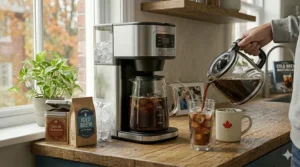
The Amazon Basics 12-Cup Programmable represents Amazon’s house brand attempting to undercut name brands while maintaining acceptable quality. The touch screen interface is surprisingly responsive—a step up from cheap button arrays that feel mushy. Programming is intuitive: tap the clock, set time, tap program, set brew time, done.
The auto shut-off activates after 2 hours, the auto pause function works smoothly for mid-brew pouring, and the removable filter basket simplifies cleanup. The 1.9-quart (1.8-litre) glass carafe includes clear measurement markings, and the drip-free design actually lives up to its name—I’ve experienced zero countertop messes during testing.
What you’re sacrificing versus name brands is primarily warranty confidence and long-term durability data. BLACK+DECKER and Hamilton Beach have decades of reliability tracking; Amazon Basics launched relatively recently. That said, Canadian Amazon.ca reviews trend positive, with buyers in Toronto and Surrey reporting “surprisingly good coffee” and “solid build quality for the price.”
The black and silver aesthetic looks modern enough for contemporary kitchens, and the compact footprint (approximately 22 cm wide × 28 cm tall × 20 cm deep) fits comfortably on crowded counters. Under the Canadian Electrical Code standards, this machine meets all safety requirements for household electrical appliances.
Pros:
- Touch screen interface feels premium for the price
- Amazon’s distribution network ensures fast Canada-wide shipping
- Clean, modern aesthetic fits most kitchen décor
Cons:
- Limited long-term reliability data versus established brands
- Generic design lacks distinctive features
Pricing typically lands in the $40-$60 CAD range on Amazon.ca, making it a solid value for buyers prioritizing Prime shipping and return convenience.
7. Yabano 12-Cup Programmable Coffee Maker
The Yabano represents the absolute floor of acceptable quality in this category—and honestly, it punches well above its weight class. At $30-$45 CAD, this is impulse-purchase territory, yet Canadian buyers report surprisingly capable performance. The programmable timer works reliably, the brew strength control (regular or bold) genuinely affects flavour intensity, and the 2-hour auto shut-off provides essential safety.
The 30-second anti-drip feature allows quick cup-grabbing during brewing without making a mess. The glass carafe holds 60 ounces (1.8 litres), the permanent filter basket is dishwasher-safe, and the LCD display clearly shows current status. Build quality won’t match premium brands—the plastic feels lighter, the buttons slightly less substantial—but for daily coffee brewing, it performs its core function admirably.
Multiple Canadian reviewers mention using this as a cottage or office machine where theft or damage risk makes expensive models impractical. One Alberta buyer wrote: “Bought this for our staff lunchroom. Six months in, still going strong despite heavy daily use.” Another Toronto reviewer noted it’s “shockingly good for the price—brews better coffee than my old $100 machine.”
The key limitation is longevity uncertainty. Will it last 5+ years like a BLACK+DECKER? Probably not. But at this price point, even 18-24 months of reliable service delivers excellent value. Think of it as the coffee maker equivalent of a basic sedan—not fancy, but it gets you where you need to go.
Pros:
- Unbeatable value in the $30-$45 CAD range
- Full feature set despite rock-bottom pricing
- Ideal for secondary locations (cottage, office, basement)
Cons:
- Build quality noticeably lighter than premium brands
- Unknown long-term durability (limited track record)
Available on Amazon.ca for around $35-40 CAD with Prime shipping. Perfect for budget-conscious buyers or those needing an inexpensive backup machine.
How to Choose the Right Coffee Maker for Your Canadian Home
Selecting a budget coffee maker requires balancing several competing priorities, and Canadian buyers face unique considerations beyond what American reviews address. Here’s how to navigate the decision process based on actual usage patterns rather than spec sheet comparisons.
Capacity Matching Your Consumption
A 12-cup coffee maker doesn’t mean you need to drink 12 cups daily—it means you have the option. In Canadian homes, this flexibility matters during long weekends at the cottage when you’re hosting friends, during holiday gatherings, or when you simply want to prep coffee for multiple thermoses before a ski trip. But if you’re a solo drinker brewing one cup each morning, consider whether a smaller 5-cup model or even a single-serve machine better suits your needs. The 12-cup models reviewed here all include small-batch settings that adjust brewing for 1-4 cups, preventing the weak, under-extracted coffee that plagues full-size machines brewing small quantities.
Thermal vs. Glass Carafes
This decision fundamentally impacts your coffee experience. Glass carafes paired with hot plates will scorch coffee after 30-40 minutes, creating increasingly bitter flavours as aromatic compounds break down under sustained heat. Thermal carafes eliminate this issue, keeping coffee at optimal temperature through vacuum insulation. For Canadian households where someone might pour their first cup at 6:30am and their third at 9am while working from home, thermal carafes justify their $15-25 CAD premium. Glass carafes work fine if you consume the pot within 30 minutes or transfer remaining coffee to a separate thermal container.
Programmability and Convenience
The 24-hour programmable timer is non-negotiable for most Canadian families. Load the machine before bed, set it to brew at 6:15am, and wake to fresh coffee—this single feature transforms morning routines, especially during dark winter mornings when leaving bed feels particularly challenging. Auto pause-and-serve functions vary in quality; the best implementations (like Hamilton Beach and Mr. Coffee) create zero mess, while cheaper versions occasionally drip.
Climate Considerations
Canadian winters affect coffee maker performance in ways warm-climate users never experience. Machines sitting on counters near exterior walls or in unheated cottages take longer to heat water when ambient temperature drops below 10°C. The heating element must work harder, potentially extending brew time by 1-2 minutes. This rarely matters for daily home use but can frustrate cottage users expecting quick morning brews in unheated cabins.
Electrical Standards and Safety
All coffee makers sold on Amazon.ca comply with Canadian 120V, 60Hz electrical standards and meet Canadian Electrical Code requirements. Look for machines with UL (Underwriters Laboratories) or CSA (Canadian Standards Association) certification marks, indicating third-party safety testing. The 2-hour auto shut-off featured on most models provides crucial fire prevention—especially important if you’re prone to forgetting whether you turned off the coffee maker before leaving for work.
Maintenance and Replacement Parts
Choose brands with established Canadian presence (BLACK+DECKER, Hamilton Beach, Mr. Coffee) if long-term parts availability matters. Replacement carafes, filter baskets, and water reservoirs are readily available through Amazon.ca or major Canadian retailers like Canadian Tire. Lesser-known brands may require international shipping for replacement parts, turning a $15 carafe replacement into a $40 ordeal with customs fees.
Common Mistakes When Buying Budget Coffee Makers in Canada
Mistake 1: Ignoring Canadian Availability
American coffee maker reviews often recommend models unavailable on Amazon.ca or available only through expensive cross-border shipping. Always verify Canadian availability before falling in love with a specific model. What costs $60 USD on Amazon.com might cost $95 CAD on Amazon.ca after currency conversion, import duties, and shipping—suddenly making it uncompetitive with Canadian-available alternatives.
Mistake 2: Overlooking Total Cost of Ownership
The advertised price is only part of the equation. Factor in replacement filter costs (if using paper filters), descaling solution (needed every 3-6 months depending on water hardness), and potential replacement carafe purchases. Machines with permanent gold-tone filters eliminate ongoing paper filter costs, saving approximately $40-60 CAD annually for daily brewers. However, permanent filters allow more coffee oils through, which some find produces richer flavour while others perceive as muddier taste—this is preference, not quality.
Mistake 3: Undervaluing Thermal Carafes
Budget buyers often gravitate toward the cheapest option, viewing thermal carafes as an unnecessary luxury. In reality, thermal carafes prevent the burnt-coffee taste that ruins the second and third cups from glass carafe machines. If you don’t finish the pot within 30 minutes, you’re essentially wasting coffee—the savings from avoiding wasted coffee can pay for the thermal upgrade within 3-4 months.
Mistake 4: Expecting Café-Quality Espresso
Budget drip coffee makers brew excellent regular coffee but cannot produce genuine espresso. Espresso requires 9+ bars of pressure forcing water through finely-ground, tamped coffee—a process requiring specialized equipment costing $200+ CAD minimum for entry-level machines. If you want lattes and cappuccinos, either invest in a separate espresso machine or adjust expectations to appreciate well-brewed drip coffee.
Mistake 5: Neglecting Water Quality
Even the best coffee maker produces mediocre coffee if you’re using terrible water. Canadian municipal water quality varies dramatically by region. Cities like Vancouver draw from pristine mountain reservoirs requiring minimal treatment, while older municipalities may have pronounced chlorine taste. If your tap water tastes bad plain, it will taste bad as coffee. Use filtered water or invest in models with built-in filtration like the Mr. Coffee JPX37.
Brewing Better Coffee: Optimization Guide for Canadian Users
Water Temperature Matters
Optimal coffee extraction occurs between 90-96°C (195-205°F). Budget coffee makers typically heat water to approximately 93-95°C (200-203°F), which falls within the acceptable range. However, Canadian winter temperatures affect initial water temperature—tap water might be 4-8°C (39-46°F) in January versus 12-15°C (54-59°F) in July. Colder starting temperature means slightly longer heating time, though this rarely exceeds 30-60 seconds difference.
Grind Size Selection
Most budget coffee makers work best with medium grind—similar to granulated sugar texture. Too fine (espresso grind) causes slow drainage and bitter over-extraction; too coarse (French press grind) produces weak, under-extracted coffee. If buying pre-ground coffee, look for “drip” or “auto-drip” grind specifications. For whole bean coffee, invest in a burr grinder ($30-60 CAD) rather than blade grinders that produce inconsistent particle sizes.
Coffee-to-Water Ratios
The Specialty Coffee Association recommends 55 grams of coffee per litre of water (approximately 1:18 ratio). For 12-cup brewing (approximately 1.8 litres), that’s roughly 100 grams of coffee—about 10-12 tablespoons depending on grind and scoop size. Start with this baseline and adjust to taste. Weaker coffee indicates insufficient coffee or too-coarse grind; bitter coffee suggests excessive coffee, too-fine grind, or over-extraction from water sitting too long on grounds.
Maintenance Schedule
Descale monthly if using hard water, every 2-3 months with soft water. White vinegar works perfectly—fill the reservoir with 50/50 vinegar and water, run a full brew cycle, discard, then run 2-3 cycles with plain water to rinse. This removes mineral buildup that reduces heating efficiency and affects taste. Clean the carafe and filter basket after each use; coffee oils accumulate and turn rancid, affecting subsequent brews’ flavour.
Seasonal Storage Tips
For cottage coffee makers stored unheated during Canadian winters, completely drain all water from the reservoir and internal systems before closing for the season. Residual water can freeze, potentially cracking internal components. In spring, run 2-3 water-only cycles before brewing coffee to flush out any dust or stale water.
Coffee Maker Performance in Canadian Winter Conditions
Canadian winters test coffee makers in ways temperate climates never experience. Let’s address the realities of operating these machines in conditions ranging from -30°C exterior temperatures to standard 20°C heated interiors.
Cold Water Impact
Municipal water temperature drops significantly in winter as supply lines run colder. Water entering your home might be 4-6°C versus summer’s 12-15°C. This affects heating time—expect an additional 30-90 seconds for the heating element to reach optimal brewing temperature. Higher-wattage machines (900W+) compensate better than lower-wattage models, though the difference is marginal for most users.
Cottage and Cabin Considerations
Unheated or minimally-heated cottages present unique challenges. If your coffee maker sits in an environment below 10°C, metal and plastic components contract, potentially affecting seal integrity. More critically, any residual water in the reservoir or internal tubing can freeze, potentially cracking components. Always completely drain cottage coffee makers before winter storage, and allow them to reach room temperature before first use in spring.
Energy Efficiency in Cold Climates
Thermal carafes demonstrate their value most clearly in Canadian conditions. Glass carafes on hot plates consume continuous electricity maintaining temperature—typically 300-400 watts sustained over 2 hours equals 0.6-0.8 kWh. At average Canadian electricity rates ($0.12-0.15 per kWh), that’s $0.08-0.12 per brewing session. Thermal carafes eliminate this ongoing consumption, potentially saving $25-35 CAD annually for daily brewers—nearly enough to offset their initial premium.
Budget Coffee Makers vs. Premium Models: What You’re Actually Paying For
Build Quality and Longevity
Premium coffee makers ($150-300 CAD) use thicker plastics, metal housing elements, and reinforced heating components rated for 10+ years of daily use. Budget models ($30-95 CAD) use lighter plastics and components rated for 3-5 years of typical use. This doesn’t mean budget machines fail at year three—many last significantly longer with proper maintenance—but the statistical likelihood of failure increases.
Brewing Precision
High-end machines maintain water temperature within ±2°C throughout the brew cycle; budget models might fluctuate ±5-7°C. For most coffee drinkers, this difference is imperceptible in the final cup, especially when using supermarket pre-ground coffee. Coffee geeks using freshly-roasted, precisely-ground beans may detect subtle extraction differences, but for 90% of Canadian households, budget machines deliver perfectly acceptable coffee.
Feature Set
Premium machines offer WiFi connectivity, voice assistant integration, adjustable water temperature, bloom cycles, and app-based programming. Budget machines provide programmable timers, brew strength selection, and auto shut-off. The core question: Do you need your coffee maker to connect to Alexa, or do you just need coffee ready when you wake up? For most Canadians, the answer justifies budget models.
❓ FAQ
❓ Can I use ground coffee from grocery stores in these machines?
❓ How long do budget coffee makers typically last in Canada?
❓ Are thermal carafes worth the extra $15-25 CAD?
❓ Do these machines work during Canadian power outages?
❓ Can I find replacement carafes for budget models in Canada?
Conclusion
Finding the best coffee maker under $100 CAD in 2026 means balancing capacity, features, and build quality against budget constraints—but as this guide demonstrates, Canadian buyers have access to surprisingly capable machines in this price range. The BLACK+DECKER CM1160B emerges as the all-around value champion for most households, delivering programmable convenience and even extraction at rock-bottom pricing. Coffee enthusiasts seeking customization should consider the Mr. Coffee JPX37 with its brew strength selector, while those prioritizing heat retention without burnt taste will appreciate the BLACK+DECKER Thermal CM2035B.
For maximum features approaching $100 CAD, the Ninja CE251 delivers dual brew styles and adjustable warming plates that compete with mid-range models. Budget-conscious buyers or those furnishing secondary locations can’t go wrong with the Yabano Programmable at $30-45 CAD—it won’t last forever, but it brews perfectly acceptable coffee for the investment.
Remember that the best coffee maker is the one you’ll actually use daily. A $95 machine gathering dust is worth less than a $40 workhorse brewing reliably every morning. Factor in Canadian realities: cold winter mornings make programmable timers essential, thermal carafes justify their premium in work-from-home scenarios, and established brands ensure replacement parts availability through Canadian retailers.
Your perfect cup starts with the right machine, continues with quality beans or grounds, and culminates in proper maintenance. Choose wisely from the options above, invest in decent coffee, descale monthly, and you’ll be enjoying café-quality mornings at home for years to come.
✨ Don’t Miss These Exclusive Deals!
🔍 Take your morning coffee ritual to the next level with these carefully selected products. Click on any highlighted item to check current pricing and availability on Amazon.ca. These machines will help you create authentic café-quality coffee your family will love!
Recommended for You
- 7 Best Travel Single Serve Coffee Makers Canada 2026
- 7 Best Multi Capsule Compatible Coffee Makers Canada 2026
- 7 Best Commercial Cold Brew Maker for Home in Canada (2026 Guide)
Disclaimer: This article contains affiliate links. As an Amazon Associate, I earn from qualifying purchases. If you purchase products through these links, we may earn a small commission at no additional cost to you.
✨ Found this helpful? Share it with your friends! 💬🤗
