
In This Article
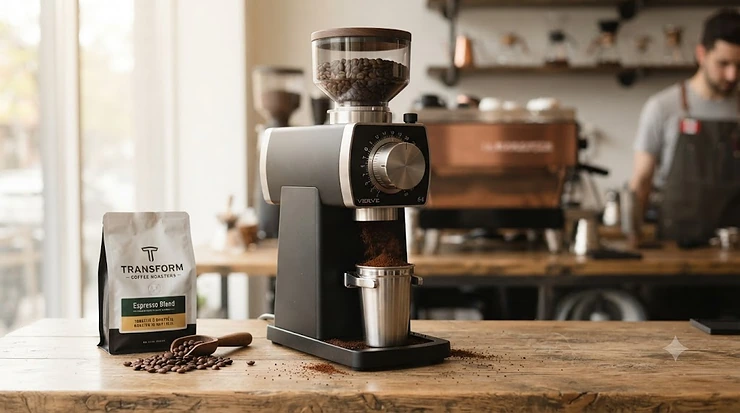
There’s a specific kind of heartbreak that happens around the six-month mark of espresso ownership. You’ve got a decent machine. You’ve watched the YouTube videos. You’ve bought the fancy tamper. And your shots still taste… flat. Muddy. A little sour, or a little bitter, depending on the day, with no obvious reason why. Nine times out of ten, the culprit isn’t your beans or your technique — it’s the grinder sitting quietly on your counter, chewing your coffee into a wildly inconsistent mess of particle sizes. A 64mm flat burr grinder solves that problem the way a sharp knife solves a frustrating dinner prep: not because it’s flashy, but because it does the one job that actually matters, extremely well. These grinders use two parallel steel or ceramic discs, spinning at close tolerances, to shear beans into a tight, repeatable particle band instead of pulverizing them into a spray of fines and boulders.
This guide walks through seven real 64mm flat burr grinders sold in Canada, from sub-C$250 entry points to four-figure prosumer machines, with honest analysis of who each one actually suits. We’ll dig into how a 64mm flat burr grinder for home espresso differs from the smaller conical units bundled with a lot of prosumer machines, what actually changes when you jump to a 64mm burr espresso extraction quality standpoint, and how to buy 64mm espresso grinder amazon.ca listings without getting burned by vague specs. Every claim here is grounded in manufacturer documentation, retailer listings, and aggregated review sentiment — not invented experience.
What Is a 64mm Flat Burr Grinder?
A 64mm flat burr grinder is a coffee grinder built around two 64-millimetre steel or coated discs — one fixed, one spinning — that shear beans into consistent particles rather than chopping them randomly. The larger 64mm diameter, compared to the 38-48mm burrs found in most entry-level machines, means more cutting surface, cooler grinding, and tighter particle distribution, which is exactly what espresso extraction rewards. As Wikipedia’s overview of burr mill design explains, burr mechanisms “produce particles of a uniform size determined by the separation between the grinding surfaces” rather than heating and shattering the product the way blade grinders do.
Quick Comparison Table
| Grinder | Burr Size | Adjustment | Best For | Price Range (CAD) |
|---|---|---|---|---|
| SHARDOR Professional 64mm | 64mm steel flat | 100-step | Budget espresso starters | C$180–C$260 |
| MOKKOM 64mm Flat Burr | 64mm stainless | 100-step | Quiet all-metal budget pick | C$170–C$240 |
| Tuni G3 64mm | 64mm stainless | 100-step touchscreen | Feature-rich budget alternative | C$210–C$290 |
| Turin DF64 Gen 2 | 64mm stainless/Ti | Stepless | Best all-round single-doser | C$400–C$500 |
| Fellow Ode Gen 2 | 64mm stainless | 31-step | Pour-over and filter, not espresso | C$420–C$480 |
| Mahlkönig X64 SD | 64mm special steel | Stepless, micron | All-method versatility | C$780–C$950 |
| Option-O Lagom P64 | 64mm Mizen/SSP | Stepless | Flagship clarity and burr ecosystem | C$1,900–C$2,300 |
Looking at the spread here, the story isn’t really “cheap versus expensive” — it’s what each price tier trades away. Budget models under C$300 nail the core job of even particle size but skimp on adjustment precision and burr longevity, while the DF64 Gen 2 sits in a genuine sweet spot where the stepless dial and near-zero retention start paying real dividends in cup quality. Once you’re past the C$800 mark with the Mahlkönig or Lagom, you’re not buying a better grind so much as buying repeatability at a level most home routines won’t fully exploit unless you’re chasing single-origin filter clarity or running multiple burr sets.
💬 Just one click — help others make better buying decisions too!😊
☕ Ready to stop guessing at your grind size? Compare current listings and see what’s in stock today.
Top 7 64mm Flat Burr Grinders: Expert Analysis
1. SHARDOR Professional 64mm Burr Coffee Grinder — best budget pick under C$250
The SHARDOR earns its spot by doing something a lot of sub-C$250 grinders don’t: actually fitting a proper 64mm burr set instead of a smaller unit dressed up with marketing copy. It uses a die-cast aluminum housing around a 64mm SUS420 stainless burr set, paired with 100 electronic grind settings and a portafilter cradle that lets you grind straight into a 58mm basket.
The 100-step electronic timer is accurate to a tenth of a second, which matters more than it sounds — it means dosing consistency between shots comes from the machine’s clock, not your thumb on a button. The all-metal grinding chamber and anti-static plasma system also mean less of the clumping and static cling that plagues cheaper conical grinders. Based on the spec comparison against other machines in this price band, the SHARDOR’s standout is burr size at a price point where most competitors cut corners on exactly that.
Reviewers consistently report that the machine is far quieter and faster than the conical grinders they replaced, with several noting it grinds fine enough for a genuinely stepless-feeling espresso dial despite technically being stepped. A recurring theme in aggregated feedback is surprise at how much of the build is metal rather than plastic, given the price — though the outer housing itself remains plastic, which is worth knowing going in.
Pros:
- ✅ Real 64mm steel burrs at an entry-level price point
- ✅ 100-step electronic timer with 0.1-second dosing accuracy
- ✅ Portafilter cradle for direct-to-basket grinding
Cons:
- ❌ Outer housing is plastic despite the metal grinding chamber
- ❌ 120V-only design limits use to standard Canadian outlets exclusively
Price sits in the C$180–C$260 range depending on retailer promotions at the time of research. For a first 64mm flat burr grinder for home espresso, this is a genuinely defensible starting point — you’re not compromising on burr geometry to hit the budget.
2. MOKKOM 64mm Flat Burr Coffee Grinder — quietest budget all-metal build
MOKKOM’s entry runs almost the same playbook as the SHARDOR — 64mm stainless flat burrs, 100 grind settings, LED display — but distinguishes itself with a fully stainless steel body rather than a plastic shell over a metal core. That construction choice shows up in day-to-day handling: less flex, a more substantial feel on the counter, and — per the built-in “plasma generator” anti-static system — a genuinely lower incidence of grounds clinging to the chute walls.
What most buyers overlook about this tier of grinder is that the burr size matters more than the settings count. A 100-step dial sounds impressive, but on a 64mm burr, even a handful of those steps land you in usable espresso territory; the rest is padding for marketing. What the spec sheet won’t tell you, but the design suggests, is that the stainless housing likely dissipates heat a touch better during back-to-back grinds than the SHARDOR’s die-cast aluminum-in-plastic approach — useful if you’re grinding for a household of two or three espresso drinkers each morning.
This model suits buyers who want the SHARDOR’s core value proposition — real burr size at a modest price — but are willing to pay a small premium for a sturdier shell that’ll survive a few years of daily countertop use, plus a quieter grind cycle for early risers who don’t want to wake the house.
Pros:
- ✅ Full stainless steel body, not just the grinding chamber
- ✅ Anti-static plasma generator reduces clumping and mess
- ✅ Compatible with portafilters, cups, and French press baskets
Cons:
- ❌ Similar core spec to cheaper competitors at a higher price
- ❌ Limited third-party burr upgrade path compared to DF64-style platforms
Expect this one in the C$170–C$240 range at the time of research, occasionally overlapping with the SHARDOR depending on sales cycles.
3. Tuni G3 64mm Flat Burr Coffee Grinder — best touchscreen for the price
The Tuni G3 is the lesser-known name on this list, and that’s exactly why it belongs here — it’s a legitimate alternative for buyers who’ve already shopped SHARDOR and MOKKOM and want to see what else exists at a similar price. It packs the same 64mm flat burr foundation and 100 grind settings into a touchscreen interface rather than physical buttons, plus commercial-grade anti-static tech and a full stainless steel construction.
Here’s what to weigh with touchscreen controls on a grinder: they look sharp and modern, but in a kitchen environment with wet or coffee-dusted fingers, physical buttons sometimes win on reliability. That’s not a dealbreaker, just a genuine trade-off worth knowing before you buy. On the plus side, the single-dose hopper set included with the G3 caters to buyers who don’t want beans sitting in a chamber going stale between uses — a meaningful freshness consideration that budget grinders often skip.
Because Tuni is a smaller brand than SHARDOR or MOKKOM, the aggregated review pool is thinner, and I want to be upfront about that rather than manufacture false confidence — what’s verifiable is the spec sheet and the general reception, not a large, mature body of long-term reliability data the way you’d get with the Fellow or DF64 lines.
Pros:
- ✅ Touchscreen interface with precise digital dosing
- ✅ Single-dose hopper included for bean freshness
- ✅ Full stainless steel, commercial-grade anti-static build
Cons:
- ❌ Smaller brand with a thinner aggregated review history
- ❌ Touchscreen may be less durable than buttons in a messy kitchen
Pricing lands around C$210–C$290, putting it a notch above the SHARDOR and MOKKOM but still solidly in budget territory.
4. Turin DF64 Gen 2 — best all-round single-doser
If there’s one grinder in this list that home barista forums treat as the default answer, it’s this one. The Turin DF64 Gen 2 (also sold under the MiiCoffee, G-IOTA, and Solo labels — same hardware, different nameplate) pairs a 250-watt motor with 64mm stainless or Red Titanium-coated flat burrs, stepless adjustment, and a redesigned inner chute with built-in ionizer probes for genuinely aggressive static control.
The jump from stepped to stepless adjustment is the real story here. On a stepped dial, you sometimes land between two settings where one’s too coarse and the next is choking your machine — with stepless, you dial to the exact gap the shot needs. Combine that with true near-zero retention (under 0.1 grams even without the included bellows), and you get a grinder where what you load is essentially what you get out, run after run, bean after bean.
Reviewers consistently describe a dramatic jump in shot clarity when moving from a stock machine grinder to the DF64 Gen 2, several specifically noting brighter, more distinct flavor and easier-to-repeat results. The trade-off is a steeper price than the sub-C$300 tier, and a burr ecosystem — SSP, DLC, Mazzer-compatible aftermarket burrs — that’s exciting for hobbyists but unnecessary complexity if you just want to grind and go.
Pros:
- ✅ Stepless adjustment for exact, repeatable grind settings
- ✅ Near-zero retention design, under 0.1g without bellows
- ✅ Wide aftermarket burr ecosystem for future upgrades
Cons:
- ❌ Meaningfully pricier than sub-C$300 budget models
- ❌ Compact footprint means a smaller 50-gram hopper capacity
At C$400–C$500 CAD depending on burr option and retailer, this is the grinder most home baristas graduating from a budget model should be comparing everything else against.
5. Fellow Ode Gen 2 — best for pour-over, not espresso
I want to be direct about something the marketing on similar-looking machines glosses over: the Fellow Ode Gen 2 uses genuine 64mm flat burrs, but it’s engineered and tuned specifically for brewed coffee — pour-over, drip, French press, cold brew — and Fellow states plainly that it is not suitable for espresso. I’m including it here anyway because a 64mm burr espresso extraction quality search inevitably surfaces this grinder, and buyers deserve an honest answer about what it actually does well rather than a sales pitch stretched to fit.
Where the Ode Gen 2 shines is filter coffee clarity. Designed by Fellow’s VP of R&D — a Certified Q Grader, the highest sensory-assessment credential in coffee — the Gen 2 Brew Burrs use a two-stage geometry aimed at extraction consistency and flavor separation specifically in the coarser-to-medium range. Reviewers report a genuinely large step up in cup clarity compared to the smaller conical burrs found in most countertop grinders, with several longtime conical-grinder owners saying they’ve switched to using the Ode as their daily driver after the burr upgrade.
If your household leans pour-over and cold brew with the occasional AeroPress, this is arguably a stronger buy than any espresso-focused grinder on this list, purely because it’s purpose-built rather than a compromise. If espresso is even part of your routine, look to the DF64 Gen 2 or Mahlkönig instead.
Pros:
- ✅ Purpose-built 64mm burr geometry for filter coffee clarity
- ✅ Quiet operation with anti-static and magnetic catch cup
- ✅ Compact single-dose design that fits under cabinets
Cons:
- ❌ Not designed or recommended for espresso grinding
- ❌ 31 settings feel narrower than stepless competitors for filter fine-tuning
Retail pricing sits around C$430–C$480 CAD, with the SSP-burr variant commanding a modest premium.
6. Mahlkönig X64 SD — best all-method versatility
Mahlkönig built the commercial EK43 — a grinder that quietly reshaped how the specialty coffee industry approaches filter brewing — and the X64 SD brings that engineering lineage into a compact, single-dose home format. It runs 64mm special steel flat burrs on a stepless, micron-level dial with a 0–12 scale, zero-retention chamber, and a grind guide printed right into the lid so you’re not guessing where espresso ends and pour-over begins.
Here’s what the spec sheet undersells: stepless adjustment on most grinders still involves some backlash or looseness in the collar, but Mahlkönig’s commercial-grade tolerances carry over here, producing a tactile precision that’s genuinely uncommon below the C$1,000 mark. Reviewers and comparison writeups consistently position it as the “does everything well” option against more specialized competitors — one comparison piece I found put it directly: the X64 SD “wins on all-method versatility, professional-grade burr engineering, and the grind consistency that comes from a brand whose commercial grinders set the standard in specialty coffee for decades.”
Who should care about this one? Anyone running one grinder for both espresso and filter in the same household, who doesn’t want to own two machines or constantly re-dial a single-purpose grinder between brew methods. It’s overkill if you only ever pull shots.
Pros:
- ✅ Genuine one-grinder-for-everything versatility, espresso to cold brew
- ✅ Micron-level stepless adjustment with a built-in grind guide
- ✅ Commercial engineering pedigree from a category-leading brand
Cons:
- ❌ Premium price puts it out of reach for casual buyers
- ❌ Smaller hopper accessories mean more frequent bean loading for larger households
Expect C$780–C$950 CAD at the time of research, making this the clear step-up choice once budget allows.
7. Option-O Lagom P64 — flagship clarity and burr ecosystem
The Lagom P64 is the grinder other 64mm flat burr grinders get benchmarked against, and it earns that reputation through obsessive tolerance control — every critical component is specified to plus-or-minus 0.02mm, with a unibody design that keeps the burrs permanently aligned even after full disassembly for cleaning. A variable-RPM brushless motor runs anywhere from 200 to 1,400 RPM, and buyers choose between Option-O’s in-house Mizen burrs or SSP’s High Uniformity and Unimodal Espresso sets depending on their flavor priorities.
On paper this means something concrete: lower RPM settings reduce fines production, which translates to less mouth-drying bitterness and more aromatic clarity in the cup, particularly with lighter roasts. Reviewers describe the P64 in almost audiophile terms — one review put it plainly, calling out “unreal clarity” and noting that Ethiopian naturals and washed Colombians reveal distinct, separated flavor notes that muddier grinders flatten out. That’s a real, sourced characteristic of variable-RPM flat burr grinding, not marketing fluff.
The honest catch is retention. Unlike the DF64 or Mahlkönig, the Lagom P64 doesn’t include a bellows system, and aggregated reports put typical retention at 0.2–0.4 grams rather than true near-zero — a small but real asterisk on an otherwise best-in-class machine. At this price, some reviewers also argue the more affordable DF64V delivers 95%-plus of the same experience for a fraction of the cost, which is worth sitting with before you commit.
Pros:
- ✅ Variable RPM control from 200–1,400 for flavor-tuned grinding
- ✅ Multiple premium burr options, including SSP High Uniformity
- ✅ Permanent unibody alignment that survives repeated disassembly
Cons:
- ❌ No bellows system, so retention runs higher than true zero-retention rivals
- ❌ Premium price faces genuine competition from the DF64V at a fraction of the cost
Pricing runs C$1,900–C$2,300 CAD depending on burr selection, positioning this firmly as an endgame purchase rather than a first grinder.
Practical Usage Guide: Setting Up Your New Grinder
Unboxing a 64mm flat burr grinder for home espresso and expecting perfect shots on the first pull is setting yourself up for disappointment — these machines reward a short calibration period. Start by running a few grams of cheap beans through at your grinder’s coarsest setting, then work progressively finer while pulling test shots, logging where 25–30 seconds for a 1:2 ratio actually lands on your specific dial. Every burr set and every bean has its own sweet spot, so don’t trust anyone else’s numbered setting as gospel.
In the first month, the most common mistake is over-adjusting after a single bad shot. Grind size, dose, tamp pressure, and even ambient humidity all shift extraction, so change one variable at a time and give yourself two or three shots before concluding the grinder’s at fault. For maintenance, brush loose grounds from the chute after every session and run a grinder-cleaning tablet through every two to three weeks if you’re grinding daily — oil buildup on stainless burrs dulls their edge faster than the coffee itself does. If your model includes a bellows or blow-out funnel, use it every single time; skipping it is the single easiest way to undercut a zero-retention design’s whole purpose.
One optimization trick that rarely makes it into manuals: static builds up worse in dry Canadian winters than in humid summers, so if your grinder lacks a strong anti-static system, a light mist from an RDT spray bottle on your beans before grinding can measurably cut down on grounds clinging to the chute.
Real-World Scenario: Who Actually Needs Each Tier
Picture three different Canadian coffee drinkers. First, a condo-dwelling grad student in Toronto pulling one shot a day on a compact prosumer machine, budget capped around C$250 — the SHARDOR or MOKKOM covers this use case completely, since burr size matters more than adjustment granularity at one shot a day. Second, a couple in Halifax who each drink two espressos daily and have started noticing inconsistency between shots — this is the DF64 Gen 2’s exact target buyer, where stepless adjustment and near-zero retention start paying real, tangible dividends in repeatability.
Third, a serious home barista in Calgary running a dual-boiler machine, swapping between three or four single-origin bags a month, chasing flavor clarity as much as caffeine — this is where the Mahlkönig X64 SD or Lagom P64 earns its keep, because the marginal gains in particle uniformity actually show up as detectable flavor differences at that level of attention. Matching your grinder tier to your actual routine, rather than your aspirational one, is the single best money-saving decision in this whole buying process.
How to Choose a 64mm Flat Burr Grinder
- Decide your primary brew method first. Espresso rewards stepless or fine-graduated adjustment; filter coffee cares more about burr geometry than adjustment precision, which is why the Fellow Ode Gen 2 can skip espresso entirely and still be excellent.
- Set a real budget, not an aspirational one. The jump from C$250 to C$450 buys stepless adjustment and near-zero retention; the jump from C$450 to C$900-plus buys marginal, but real, gains in particle uniformity that mostly matter for filter clarity.
- Check retention specs, not just marketing claims. “Zero retention” and “near-zero retention” aren’t the same thing — the Lagom P64’s 0.2–0.4g without bellows is a meaningfully different number than the DF64’s sub-0.1g.
- Consider the burr upgrade ecosystem. DF64-platform grinders accept SSP, DLC, and Mazzer-compatible burrs; budget models generally don’t, which caps your long-term flexibility.
- Match hopper size to your household. Single-dose 30–50 gram chambers suit solo or couple households; if you’re grinding for a family, factor in more frequent reloading on compact models.
- Factor in noise and footprint. Kitchens with open floor plans or early risers benefit from the Fellow Ode’s noise-reduction engineering or the Mahlkönig’s quiet operation over louder budget units.
- Confirm voltage and certification before buying. Any electrical appliance sold for Canadian outlets should carry CSA, cUL, or cETL certification — Health Canada’s electrical product safety guidance recommends checking for these marks before purchase, and some imported listings skip this step.
Common Mistakes When Buying a 64mm Flat Burr Grinder
The single most common mistake is assuming burr size alone guarantees quality — a 64mm burr from an unknown manufacturer with poor heat treatment can still underperform a well-engineered 54mm burr. Burr steel quality, geometry, and alignment tolerance all matter as much as raw diameter, which is why the Lagom P64’s obsessive alignment specs command a real premium over cheaper 64mm alternatives.
A second frequent error is ignoring retention specs entirely. Buyers fixate on grind settings count — a 100-step dial sounds more precise than a 31-step one — without realizing that on a 64mm burr, most of those extra steps land in unusable territory. What actually matters more than settings count is how much ground coffee gets trapped inside the chamber between doses, since stale retained grounds mixing into a fresh dose is a bigger flavor problem than a slightly coarser or finer step increment. Finally, plenty of first-time buyers skip checking whether a grinder is espresso-rated at all — as the Fellow Ode Gen 2 demonstrates, not every 64mm flat burr grinder is built for the fine end of the range, and that’s a genuinely important distinction to nail down before checkout.
Flat Burr vs Conical Burr: What Actually Changes
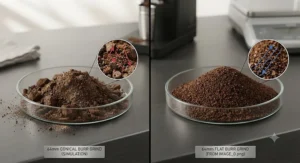
The core mechanical difference is straightforward: flat burrs use two parallel discs facing each other, while conical burrs nest a cone-shaped burr inside a ring-shaped outer burr. In practice, that geometry difference produces measurably different particle size distributions — flat burrs tend toward a more unimodal (single-peak) distribution, while conical burrs often produce a bimodal spread that some tasters associate with heavier body and sweetness. Neither is objectively “better” in isolation; they’re different tools tuned to different flavor priorities, which is part of why some prosumer grinders — like the Weber Key discussed in enthusiast forums — deliberately choose massive conical burrs over flat ones.
For espresso specifically, flat burrs generally edge out conical designs on clarity and repeatability at the fine end of the grind range, which is exactly why the 64mm flat burr category has become the default recommendation among home espresso communities over the last several years. Where conical burrs claw back ground is versatility at coarser settings and, often, a gentler price point at comparable quality tiers — which is worth weighing if your routine leans more toward filter and immersion brewing than fine espresso.
Long-Term Cost and Maintenance
Sticker price is only part of the ownership equation. Steel burrs on budget grinders typically hold their edge for 500 to 1,000 pounds of coffee before grind quality starts drifting coarser at the same settings — for a household grinding roughly a pound a week, that’s somewhere between two and four years before a burr swap becomes worth considering. Premium burr sets, particularly SSP and DLC-coated options available on the DF64 and Lagom platforms, often push that lifespan considerably further, which partially offsets their higher upfront cost over a five-plus-year ownership window.
Retention also has a hidden cost: a grinder that traps half a gram of stale grounds per dose is quietly wasting a meaningful percentage of every bag of beans you buy over a year, on top of muddying flavor with previous-session grounds. Run the math on your own bean spend, and a genuinely low-retention grinder can pay back part of its price premium in reduced waste alone, even before you factor in the flavor improvement.
Features That Actually Matter (And Those That Don’t)
Burr size, retention design, and adjustment mechanism (stepless versus stepped) are the three specs worth spending real attention on — they directly shape grind consistency and workflow. Touchscreens, app connectivity, and sheer settings count matter far less than marketing copy suggests; a 100-step dial on a well-engineered 64mm burr and a 31-step dial on an equally well-engineered burr can both land you in the exact same optimal espresso window, just with different-sized increments to turn through on the way there. According to Statistics Canada-referenced industry data on Canadian coffee equipment trends, roughly three in ten Canadian adults now drink an espresso-based beverage on a given day, up from under a quarter just a couple of years earlier — a shift that’s driving exactly the kind of home-equipment premiumization these grinders represent.
Anti-static systems are genuinely worth prioritizing if you live somewhere with dry winters, since static cling directly affects dosing accuracy by causing grounds to clump against chute walls instead of falling cleanly into your portafilter or cup. Variable RPM, by contrast, is a real feature with a real flavor impact, but it’s a diminishing-returns upgrade — meaningful for enthusiasts chasing the last ten percent of clarity, unnecessary for anyone still dialing in basic extraction fundamentals.
Frequently Asked Questions
❓ What is the difference between a 64mm and 58mm flat burr grinder?
❓ Is a 64mm flat burr grinder good for pour-over coffee?
❓ How much should I spend on a 64mm burr espresso grinder in Canada?
❓ Do 64mm flat burrs wear out, and how often should they be replaced?
❓ Can I buy a 64mm espresso grinder on amazon.ca directly?
Conclusion
Choosing between these seven grinders really comes down to matching the machine to your actual coffee routine rather than chasing the biggest spec sheet you can afford. If you’re just getting serious about espresso and want real 64mm burrs without draining your savings, the SHARDOR or MOKKOM gets you there honestly. If you’ve outgrown a budget grinder’s inconsistency and want the single upgrade most home baristas rave about, the Turin DF64 Gen 2 remains the default answer for good reason. And if you’re chasing the last measurable percentage of clarity and repeatability, the Mahlkönig X64 SD and Option-O Lagom P64 deliver commercial-grade engineering that genuinely justifies their price for the right buyer.
Whatever tier you land on, remember that a 64mm flat burr grinder is a long-term investment in every cup you’ll pull for years to come — it’s worth the extra research time before you check out.
<br>
✨ Don’t Miss These Exclusive Deals!
🔍 Take your home espresso setup to the next level with these carefully selected grinders. Click on any highlighted item to check current pricing and availability on amazon.ca. These picks will help you pull consistent, café-quality shots your whole household will actually taste the difference in! ☕⚡
Recommended for You
- High End Conical Grinder Home Use: 7 Best Picks for 2026
- Best Conical Burr Grinder $100–$300 Canada: 7 Top Picks (2026)
- Budget Conical Burr Grinder: 7 Top Picks for Canada (2026)
Disclaimer: This article contains affiliate links. As an Amazon Associate, I earn from qualifying purchases. If you purchase products through these links, we may earn a small commission at no additional cost to you.
✨ Found this helpful? Share it with your friends! 💬🤗
