
In This Article
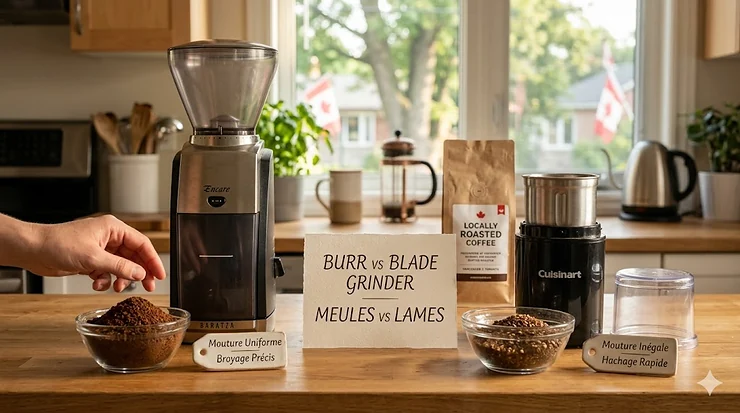
If you’ve ever brewed a pot that tasted bitter in one sip and watery in the next, your grinder is probably the culprit — not your beans. A burr grinder crushes coffee beans between two abrasive surfaces to produce a uniform particle size, while a blade grinder chops beans with a spinning blade, producing a random mix of fine dust and chunky fragments. That inconsistency is the entire reason coffee professionals treat “burr vs blade” as a settled debate rather than a personal preference.
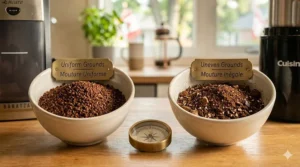
This guide breaks down why that uniformity matters, walks through seven real grinders you can buy on Amazon.ca right now, and gives Canadian-specific buying advice — from how our dry winters affect static cling in your grounds to which certification marks (CSA, cUL, cETL) you should actually look for before you buy any electrical kitchen appliance.
Quick Comparison: Burr vs Blade at a Glance
| Factor | Burr Grinder | Blade Grinder |
|---|---|---|
| Grind consistency | Uniform, adjustable particle size | Inconsistent — dust mixed with chunks |
| Best for | Espresso, pour-over, French press, drip | Casual drip coffee, spices |
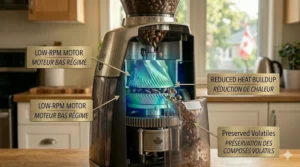
| Heat generated | Low (slower-turning burrs) | Higher (high-speed blade) |
| Typical price (CAD) | ~$60–$320+ | ~$20–$45 |
| Noise level | Low to moderate | Often louder, higher-pitched |
| Longevity | Years, often with replaceable burrs | Shorter lifespan, sealed mechanism |
Looking at the table, the price gap is the main reason blade grinders persist at all — for under $30 CAD, a blade grinder still beats pre-ground coffee for freshness, even if the grind itself is uneven. Burr grinders cost more up front, but the adjustable, consistent grind is what actually lets you dial in espresso, pour-over, or French press separately, which a blade grinder simply can’t do regardless of how carefully you pulse it.
How Burr and Blade Grinders Actually Work
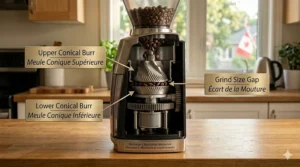
A burr grinder feeds beans between two burrs — either a cone-shaped (conical) burr nested inside a ring, or two parallel flat discs — and the gap between them sets the grind size. Twist the gap tighter and you get fine, powdery espresso grounds; open it up and you get coarse, pebbly grounds for a French press. Because every bean passes through the same fixed gap, the resulting particles land in a tight size range.
A blade grinder works more like a mini blender: a spinning blade chops beans on contact, and however long you hold the button down determines roughly how fine the result is. There’s no fixed gap controlling particle size, so beans near the blade get pulverized into dust while beans at the edges barely get nicked. You end up with a grind that’s both too fine and too coarse at the same time, in the same scoop.
Why Grind Consistency Changes How Your Coffee Actually Tastes
This is the part that turns “burr vs blade” from a marketing claim into a measurable difference. The Specialty Coffee Association’s brewing standards define an ideal extraction window of roughly 18–22% of the coffee’s soluble solids — pull less than that and the cup tastes sour and underdeveloped; pull more and it turns bitter and harsh.
With a blade grinder’s mixed particle sizes, water moves through the bed unevenly: the ultra-fine dust over-extracts almost instantly (contributing bitterness and astringency), while the chunky fragments barely extract at all (contributing sourness and weak body). You taste both problems in the same cup, which is exactly why blade-ground coffee so often comes across as muddled rather than simply “weaker” or “stronger.” A consistent burr grind keeps every particle extracting at roughly the same rate, which is what actually lets you land inside that balanced extraction window — the Specialty Coffee Association publishes the full technical standard if you want to go deeper on the science.
💬 Just one click — help others make better buying decisions too! 😊
✨ Don’t Miss These Picks
Take a closer look at the grinders below — tap any product name to check current pricing and availability on Amazon.ca.
Top 7 Coffee Grinders on Amazon.ca: Expert Picks
1. Baratza Encore — Best All-Round Burr Grinder
The Encore is the grinder most reviewers reach for first when someone asks “just tell me what to buy.” It offers 40 grind settings across a single twist-dial hopper, running from espresso-fine micro-steps up through coarse cold-brew settings, with commercial-grade conical burrs and an 8 oz (227 g) bean hopper. In practice, that range means one machine can realistically serve a household that brews drip in the morning and pour-over on weekends — you’re not buying a second grinder when your taste in brew methods changes. Baratza backs it with a one-year warranty and sells individual replacement parts, which matters in Canada where small-appliance repair shops are thin outside major cities; if a burr wears out in year four, you replace the burr set, not the whole grinder. Lab testers and coffee professionals consistently rank it among the most dependable mid-range conical burr grinders, and it carries a Specialty Coffee Association recognition for grind performance. ✅ Wide grind range for multiple brew methods
✅ Repairable, replaceable parts
✅ Confirmed available on Amazon.ca
❌ Hopper twist dial feels stiff to some users
❌ Not purpose-built for ultra-fine espresso (the ESP variant covers that better)
Price tier: roughly $130–$170 CAD.
Verdict: the safest “buy once” pick for most Canadian home brewers.
2. OXO Brew Conical Burr Coffee Grinder — Best for Small Kitchens
OXO’s conical burr grinder packs 15 grind settings (plus micro-adjustments) into a compact footprint, with a 12 oz UV-blocking hopper that protects beans from light exposure — a small but genuinely useful feature if your coffee station sits near a sunny window, since light degrades roasted beans faster than most people realize. The anti-static stainless steel grounds container is the detail Canadian buyers in particular should care about: low indoor humidity during winter heating season makes ground coffee cling to plastic containers and fly around the counter, and OXO’s static-fighting design noticeably reduces that mess compared to plain plastic bins. One-touch operation remembers your last setting, so there’s no re-dialing every morning.
✅ Compact, fits under most cabinets
✅ Anti-static container helps in dry winter air
✅ Dishwasher-safe parts for easy cleanup
❌ 15 settings is narrower range than the Encore
❌ Less ideal for espresso-fine grinding
Price tier: roughly $100–$140 CAD.
Verdict: great for condo or apartment kitchens with limited counter space.
3. Cuisinart Supreme Grind Automatic Burr Mill (DBM-8) — Best Budget Burr Grinder
This is the grinder that proves you don’t need to spend $150+ CAD to step up from blade grinding. It offers 18 grind settings with a cup-selector dial (4 to 18 cups) and an automatic shutoff timer, so you set it and walk away instead of holding a button. The trade-off, and reviewers are consistent on this, is that its burr set produces noticeably less precise results at the very finest settings — it’s a solid performer for drip and French press, but it won’t get you a true espresso-fine grind. For a household that drinks drip coffee daily and only occasionally wants espresso, that’s a fair compromise; for a dedicated espresso habit, it’s a real limitation.
✅ Genuinely affordable entry into burr grinding
✅ Auto-shutoff timer, hands-free
✅ Widely available across Canadian retailers and Amazon.ca
❌ Struggles at the finest (espresso) settings
❌ Runs louder than premium models
Price tier: roughly $60–$90 CAD.
Verdict: the best “first burr grinder” if espresso isn’t your main brew method.
4. Fellow Ode Gen 2 — Best Premium Pick for Pour-Over and Filter Coffee
The Ode Gen 2 uses 64 mm flat burrs (rather than conical) across 31 settings, and flat burrs tend to produce a slightly more uniform particle size distribution than conical burrs at the same price point — which matters most for filter methods like pour-over, where evenness directly affects clarity in the cup. It’s a single-dose grinder, meaning it retains very little leftover coffee inside the chamber between grinds, so you’re not tasting yesterday’s stale grounds mixed into today’s fresh beans. Coffee gear reviewers note it favours the coarser end of the spectrum, making it a better match for drip, pour-over, French press, and cold brew than for fine espresso work.
✅ Excellent uniformity for filter coffee
✅ Single-dose design minimizes stale leftover grounds
✅ Quiet, anti-static operation
❌ Premium price for a non-espresso-focused grinder
❌ Larger footprint than entry-level models
Price tier: roughly $280–$330 CAD.
Verdict: worth it specifically if pour-over or batch filter coffee is your main brew method, not your only one.
5. KRUPS Precision Burr Coffee Grinder — Best Entry-Level Burr Option
If the Cuisinart DBM-8 is still a stretch, KRUPS offers a genuinely budget-friendly route into burr grinding with 12 settings, an 8 oz capacity, a 110W motor, and auto-stop functionality. It’s positioned by the maker for drip, French press, espresso, pour-over, and cold brew — in reality, treat “espresso” loosely here; like most sub-$100 burr grinders, it can approximate a fine grind but won’t match the consistency of a dedicated espresso grinder like the Encore ESP. Still, stepping from any blade grinder to this is a noticeable upgrade in cup clarity.
✅ Lowest price point among true burr grinders on this list
✅ Auto-stop for hands-free operation
✅ Easy-clean stainless components
❌ Narrower adjustment range (12 settings vs. 40 on the Encore)
❌ Espresso claims should be taken with a grain of salt
Price tier: roughly $60–$80 CAD.
Verdict: a sensible upgrade if budget is the deciding factor and espresso isn’t the priority.
6. Hamilton Beach Custom Grind — Best Hands-Free Blade Grinder
For readers who’ve decided a blade grinder still fits their budget or simplicity needs, Hamilton Beach’s Custom Grind is the more thoughtful option in that category. It offers hands-free, one-press operation with auto shutoff, an adjustable knob that controls grind time (and therefore roughly how fine the result is), and a removable stainless steel chamber rated for 4 to 14 cups. It won’t deliver burr-level consistency — no blade grinder can — but the auto-shutoff and removable chamber solve two of the most common blade-grinder annoyances: holding a button down and scrubbing static-clung grounds out of a fixed bowl.
✅ True hands-free operation, unlike most blade grinders
✅ Removable chamber for easier cleanup
✅ Confirmed available on Amazon.ca
❌ Grind consistency is inherently limited by the blade design
❌ Not suited for espresso or precise pour-over work
Price tier: roughly $30–$45 CAD.
Verdict: the most livable blade grinder if you’re not ready to spend burr-grinder money yet.
7. Cuisinart One-Touch Coffee Bean & Spice Grinder (DCG-20BKN) — Most Affordable Dual-Purpose Option
This compact blade grinder holds 2.5 oz (about 70 g) of beans, enough for roughly 12 cups, and includes a safety interlock so the blades only spin with the lid properly seated — a genuinely useful safety detail for households with kids in the kitchen. Its dual identity as a spice grinder is the real selling point: if you’re not ready to commit counter space to a dedicated burr grinder, this one earns its spot by pulling double duty grinding peppercorns, flaxseed, and other spices when it’s not on coffee duty.
✅ Doubles as a spice/herb grinder
✅ Safety interlock lid
✅ Lowest price point on this list
❌ Same grind-consistency limitations as any blade grinder
❌ Small 70 g capacity means more frequent refills for larger households
Price tier: roughly $20–$35 CAD.
Verdict: fine as a starter unit or secondary spice grinder, not as your only coffee grinder if quality is the goal.
Top Picks Compared
| Grinder | Type | Settings | Best For | Price Tier (CAD) |
|---|---|---|---|---|
| Baratza Encore | Conical burr | 40 | All-round daily use | $130–$170 |
| OXO Brew Conical Burr | Conical burr | 15 + micro | Small kitchens | $100–$140 |
| Cuisinart DBM-8 | Burr | 18 | Budget burr, drip/French press | $60–$90 |
| Fellow Ode Gen 2 | Flat burr | 31 | Pour-over, filter coffee | $280–$330 |
| KRUPS Precision | Burr | 12 | Lowest-cost burr entry | $60–$80 |
| Hamilton Beach Custom Grind | Blade | Variable (time-based) | Hands-free, casual brewing | $30–$45 |
| Cuisinart DCG-20BKN | Blade | Variable (time-based) | Coffee + spice dual use | $20–$35 |
Lined up this way, the price-to-consistency trade-off becomes obvious: every burr grinder on this list, even the cheapest (KRUPS at $60–$80 CAD), delivers more usable grind control than either blade grinder, but the two blade options remain the only choices under $50 CAD. If your budget caps out below $50, a blade grinder with auto-shutoff (Hamilton Beach) is a more realistic recommendation than stretching for a burr grinder you can’t actually afford yet — better to grind fresh with a blade grinder than to keep buying pre-ground coffee while you save up.
Burr vs Blade in Real Canadian Kitchens
Three Canada-specific factors are worth planning around before you buy.
Winter static and dry indoor air. Once the furnace kicks on for the season, indoor humidity in most Canadian homes drops well below summer levels, and static cling in ground coffee gets noticeably worse — you’ll see grounds jumping to the sides of a plastic bin or clinging to your scoop. Grinders with anti-static stainless containers (the OXO and Fellow Ode on this list both feature this) handle that better than grinders with plain plastic bins.
Certification marks matter more than the brand name. Any electrical appliance sold in Canada, including coffee grinders, should carry a CSA, cUL, or cETL certification mark, confirming it’s been independently tested against Canadian electrical safety standards. Health Canada explicitly warns against buying or using electrical products without one of these marks, since uncertified or counterfeit units can pose shock or fire risks. Check the product listing or the unit itself for one of these marks before you buy, regardless of which grinder you choose.
Cross-border pricing reality. Canadian retail prices for small appliances often run higher than US listings for the same model, partly due to exchange rate and import costs. That’s a reasonable trade-off against the customs delays, cross-border warranty headaches, and potential duty charges that come with ordering from Amazon.com directly to a Canadian address — buying through Amazon.ca keeps the warranty and return process straightforward.
How to Choose Between a Burr Grinder and a Blade Grinder
- Identify your primary brew method first. Espresso and pour-over both reward grind precision heavily; French press and basic drip are more forgiving, which is the main reason blade grinders persist at all for casual drip drinkers.
- Set a realistic budget tier, not a model. Decide whether you’re shopping in the sub-$50 (blade), $60–$150 (entry-to-mid burr), or $250+ (premium burr) range before you start comparing specific products — it narrows the field fast.
- Check the certification mark. Look for CSA, cUL, or cETL on the listing before anything else; an uncertified appliance isn’t worth the savings.
- Match capacity to your household. A single person making one pour-over a day doesn’t need an 18-cup hopper; a family running a drip machine every morning will refill a small hopper constantly.
- Weigh noise and counter space against where it’ll actually live. A grinder that’s loud at 6 a.m. in a small condo kitchen open to the living room is a different problem than the same grinder in a detached house.
- Decide if you need single-dose or large-hopper design. Single-dose grinders (like the Fellow Ode) minimize stale leftover grounds but require measuring beans each time; large-hopper grinders are more convenient for daily, repetitive brewing.
- Confirm replacement parts exist before buying premium. If you’re spending $200+ CAD, check that the manufacturer sells replacement burrs — that’s what actually determines whether the grinder lasts five years or fifteen.
Common Mistakes When Buying a Coffee Grinder
The most frequent mistake is buying based on grind-setting count alone — a grinder advertising “60 settings” isn’t automatically better than one with 15 if the burr quality and motor are weaker; settings count measures granularity, not quality. The second is assuming any burr grinder under $80 CAD will handle true espresso-fine grinding well; most budget burr grinders approximate it rather than nail it, and espresso specifically rewards spending more. The third, Canada-specific mistake is skipping the certification-mark check entirely because a listing looks legitimate — third-party marketplace sellers on Amazon.ca aren’t automatically held to the same standards as items sold and shipped by Amazon itself, so it’s worth a few extra seconds to confirm.
Maintenance and Long-Term Cost in Canada
Burr grinders justify their higher upfront price through lower replacement frequency: a well-maintained conical burr set on a grinder like the Encore can last years of daily home use before the burrs dull enough to need replacing, and most major brands sell replacement burr sets rather than requiring you to buy a whole new unit. Blade grinders don’t offer that path — the blade assembly is typically sealed into the unit, so once it dulls or the motor weakens, the entire grinder gets replaced. Over a five-year span, a $150 CAD burr grinder with a $25–$40 CAD burr replacement partway through often works out cheaper per cup than replacing a $30 CAD blade grinder two or three times in the same period, on top of producing a noticeably better cup the whole time. Basic upkeep matters too: brushing out retained grounds weekly prevents stale coffee oils from tainting fresh grinds, and wiping down hoppers prevents oil buildup that’s more visible on stainless steel during the bright, low-angle winter sun many Canadian kitchens get through south-facing windows.
✨ Ready to Upgrade Your Morning Coffee?
Check current pricing and availability on Amazon.ca for any of the picks above — listings and prices change frequently, so it’s worth comparing before you buy.
Canadian Disclosure and Safety Standards Worth Knowing
If you’re publishing affiliate content like this yourself, two Canadian-specific compliance points are worth knowing. First, Ad Standards’ Influencer Marketing Disclosure Guidelines (overseen alongside the Competition Bureau) now explicitly require disclosure of affiliate links using clear language such as “#affiliate” or “#CommissionEarned,” placed before the link itself rather than buried at the bottom of the page. Second, Canada’s Competition Act requires that any product testimonial or review reflect a genuine, current opinion — a rule worth keeping in mind if you’re tempted to present AI-assisted research as first-hand product testing it isn’t.
For consumer safety, Health Canada’s guidance is equally direct: don’t buy or use any electrical product, including a coffee grinder, that doesn’t carry a CSA, cUL, or cETL mark, since uncertified units bypass the testing that’s supposed to catch shock and fire risks before a product reaches your counter.
FAQ
❓ Is a burr grinder really worth it over a blade grinder?
❓ Which grinder should I buy for home use, burr or blade?
❓ Does a blade grinder ruin coffee?
❓ What's a good grind size chart reference for different brew methods?
❓ Do coffee grinders sold on Amazon.ca ship across Canada, including rural and northern areas?
Recommended for You
- Best Burr Coffee Grinder Canada 2026: Top 7 Picks Reviewed
- How to Fix Weak French Press Coffee: 7 Expert Fixes (Canada 2026)
- Best 7 Eco-Friendly Manual Coffee Makers in Canada 2026 (Zero Waste)
Disclaimer: This article contains affiliate links. As an Amazon Associate, earns from qualifying purchases. If you purchase products through these links, we may earn a small commission at no additional cost to you.
✨ Found this helpful? Share it with a friend who’s still drinking pre-ground coffee! 💬
