In This Article
Let’s be honest — you’ve done the mental math a hundred times. Two lattes a day from your neighbourhood café, multiply by 365 days, and you’re looking at well over $3,000 CAD a year just in coffee runs. And that’s before factoring in the tip jar, the parking, or the fact that you’re standing in line at 7 a.m. in a February windchill that feels like -25°C. At some point, the calculation stops being about convenience and starts being about sanity.
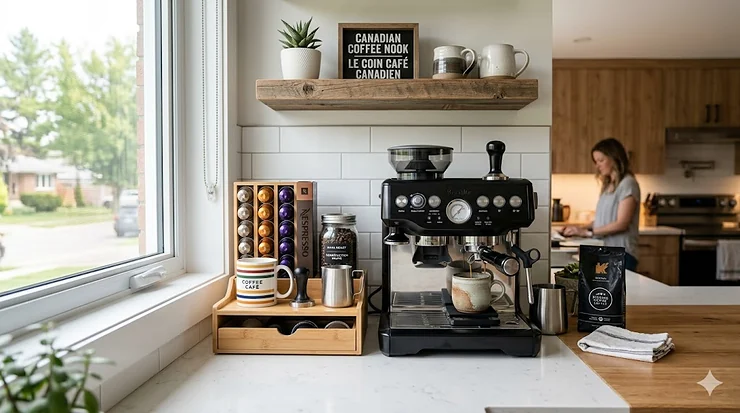
An all-in-one coffee station changes that equation entirely. We’re not talking about a basic drip machine tucked beside the toaster. A true all-in-one coffee station — what some call a complete coffee center or comprehensive brewing station — integrates a built-in burr grinder, a high-pressure espresso system, a milk frother, and often drip coffee and cold brew capability into a single countertop appliance. It’s a coffee shop at home, without the lineup, the markup, or the commute.
For Canadians specifically, this category has exploded. According to Statistics Canada, coffee availability per capita reached over 107 litres per person annually by 2023 — a record high. The Canadian coffee market generates billions in revenue every year, and a growing number of households are redirecting part of that spend toward premium home equipment. With specialty and cold coffee drinks continuing to surge, especially among millennials and Gen Zs, the multi-beverage system category is hotter than ever.
So what makes a great all-in-one coffee station for Canadian buyers in 2026? How does a machine hold up during a long Saskatchewan winter when cold temperatures affect motor performance and descaling cycles? Which models ship directly from Amazon.ca, qualify for Prime, and come with bilingual packaging as required by Canadian labelling law? And critically — which ones actually justify their price tag in CAD, not just USD?
I’ve spent considerable time researching and analyzing the top options available right now on Amazon.ca, focusing on real-world Canadian user feedback, long-term reliability, and honest value assessment. Here’s everything you need to know.
Quick Comparison: Top All-in-One Coffee Stations on Amazon.ca (2026)
| Machine | Type | Grinder | Milk System | Best For | Price Range (CAD) |
|---|---|---|---|---|---|
| Ninja Luxe Café Premier ES601C | Semi-auto espresso + drip + cold brew | Built-in conical burr | Hands-free dual froth | All-around value | $500–$650 |
| Breville Barista Express Impress BES876 | Semi-auto espresso | Integrated conical burr | Steam wand | Espresso craft enthusiasts | $850–$1,000 |
| De’Longhi Magnifica Evo ECAM290 | Super-auto | Built-in conical burr | Manual frother | Easy daily use | $650–$800 |
| De’Longhi Magnifica Start ECAM22080 | Super-auto | Built-in grinder | Auto frother | Beginners & small kitchens | $450–$600 |
| Philips 3300 LatteGo EP3341/50 | Super-auto | Ceramic burr | LatteGo system | Quiet use, easy cleaning | $700–$900 |
| De’Longhi La Specialista Touch | Semi-auto | Integrated burr | Steam wand | Premium espresso + cold brew | $1,000–$1,200 |
| De’Longhi Rivelia | Super-auto | Dual bean burr | Auto frother | Compact premium households | $1,100–$1,400 |
What this table tells you: There’s a genuine split here between semi-automatic machines (you grind, tamp, and brew with guidance) and super-automatic machines (press one button, walk away with a latte). For most Canadian households looking for a coffee shop at home experience with zero fuss, super-automatics like the Magnifica Evo or Philips 3300 win on daily convenience. If you want to develop barista skills and enjoy the process, the Ninja Luxe Café or Breville Barista Express Impress will be far more rewarding.
💬 Just one click — help others make better buying decisions too! 😊
✨ Don’t Miss These Exclusive Deals!
🔍 Take your home coffee game to the next level with these carefully selected machines. Click on any highlighted product to check current pricing and availability on Amazon.ca. These comprehensive brewing stations will help you recreate your favourite café drinks every single morning!
Top 7 All-in-One Coffee Stations: Expert Analysis for Canadian Buyers
1. Ninja Espresso Machine Luxe Café Premier ES601C (Canadian Version)
The Ninja Luxe Café Premier is arguably the most impressive entry in the coffee bar machine with grinder category to arrive in Canada in recent memory — and the fact that there’s a dedicated Canadian version (ES601C) with bilingual labelling and CSA-compliant voltage says a lot about Ninja’s commitment to this market.
What sets this machine apart is its Barista Assist Technology, which actively guides you through grind size selection and dosage using a built-in scale. The conical burr grinder has 25 settings, and unlike older machines that simply grind for a set amount of time (leaving you guessing if you got enough coffee), the Ninja doses by weight. In practice, this means your espresso shots are consistent from the very first pull — something that normally takes weeks of trial-and-error on competing machines. It’s genuinely useful for Canadian winters, too: cold ambient temperatures affect how beans flow and grind, and the weight-based system compensates automatically.
Beyond espresso, the ES601C brews drip coffee, cold-pressed espresso, and rapid cold brew — seven drink styles in total — making it a true multi-beverage system. The hands-free dual froth system handles both steamed milk and cold foam without you holding a pitcher. For households where one person wants a latte and another wants an iced Americano, this machine handles it all in one session without re-configuration.
Canadian reviewers consistently highlight how intuitive the setup process is, especially for first-time espresso machine owners. CoffeeGeek, one of the most respected specialty coffee review sites, awarded it a Best in Class designation in their 2026 evaluation.
✅ 25-setting conical burr grinder with weight-based dosing
✅ Hands-free dual frother (dairy and non-dairy compatible)
✅ Canadian version available with CSA compliance and bilingual packaging
❌ Footprint is wider than most machines — measure your counter before ordering
❌ Does not pull true 9-bar espresso; shots use a slightly lower pressure profile than traditional machines
Price range: around $500–$650 CAD. For a machine that replaces a grinder, espresso maker, drip brewer, and cold brew system, this is exceptional value.
2. Breville the Barista Express Impress BES876BSS
There’s a reason the Breville Barista Express line has been Canada’s go-to comprehensive brewing station for over a decade, and the Impress iteration refines everything that made the original great. The key addition is the Impress Puck System — a built-in tamping arm that tamps your grounds to a consistent 10 kg of pressure with a single lever press. That single feature eliminates one of the most common beginner mistakes in espresso brewing.
The integrated conical burr grinder has 30 settings and a dose-trimming function that catches excess grounds before they reach the portafilter. Combined with the ThermoJet heating system (it reaches brewing temperature in 3 seconds from cold start), this machine eliminates virtually every variable that causes bad espresso. The 54mm portafilter delivers the classic semi-automatic brewing experience that serious coffee lovers in Canada’s urban centres — think the specialty coffee culture of Vancouver’s Commercial Drive or Toronto’s Kensington Market — have come to love.
What most buyers overlook about the Impress is the learning curve — or lack thereof. While it’s classified as semi-automatic, the assist features make it feel almost as effortless as a super-auto for daily use, yet give you full control over extraction time and grind when you want to get nerdy on a weekend. It ships from Amazon.ca, is Prime-eligible, and is stocked in both brushed stainless and damson blue finishes.
The steam wand requires manual technique, which is a genuine skill-builder but also a genuine inconvenience on a rushed Tuesday morning.
✅ Impress tamping system for consistent puck prep
✅ ThermoJet heating — 3 second heat-up from cold
✅ Premium build quality; Canadian reviewers report 5+ year lifespans
❌ Manual steam wand requires practice to master
❌ Higher CAD price point; Breville pricing in Canada typically runs 15–20% above US equivalents
Price range: around $850–$1,000 CAD. Worth every cent for espresso enthusiasts who want a machine that grows with their skills.
3. De’Longhi Magnifica Evo ECAM29084SB (with Auto LatteCrema)
If there’s a single machine that best captures the “coffee shop at home” promise for the average Canadian household, it’s the Magnifica Evo with LatteCrema. You load beans, add milk to the carafe, press one button, and a perfectly layered latte appears. That’s it. No grinding, no tamping, no milk-frothing technique required. For a household of three or four people with different drink preferences — one espresso, one cappuccino, one Americano — this machine handles the morning rush with zero stress.
The built-in conical burr grinder has 13 settings, and the LatteCrema System produces genuinely impressive milk foam — consistent, silky, and well-aerated even with oat milk, which Canadian households are adopting at a high rate. The auto-clean function for the milk circuit is a practical necessity for Canadian buyers: busy families don’t have time to disassemble milk frothing systems every day, and a machine that skips cleaning cycles develops bacterial buildup quickly. The Evo handles this automatically.
One practical note for Canadians in hard-water regions (much of Southern Ontario and the Prairie provinces): the Evo’s descaling alert system is well-calibrated, but plan on descaling every 3–4 months given Canadian municipal water hardness levels. The machine uses De’Longhi’s proprietary EcoDecalk descaler, readily available on Amazon.ca.
With over 2,500 reviews on Amazon.ca and a consistent 4.2-star rating, this is one of the most-reviewed coffee machines in the Canadian market.
✅ True one-touch latte, cappuccino, and espresso — press and walk away
✅ LatteCrema auto frother works well with non-dairy alternatives
✅ Auto-clean milk circuit — essential for busy households
❌ 13 grind settings is fewer than semi-auto competitors; fine-tuning espresso extraction is limited
❌ Bean hopper holds about 250g — light users may find it adequate, but serious coffee drinkers will refill frequently
Price range: $650–$800 CAD. The sweet spot of the super-automatic category in Canada right now.
4. De’Longhi Magnifica Start ECAM22080SB
The Magnifica Start is De’Longhi’s entry point into the super-automatic category, and for Canadian buyers who are new to bean-to-cup machines or working within a tighter budget, it’s one of the most sensible choices on Amazon.ca. Don’t let the lower price fool you into thinking you’re getting a lesser experience — the Start produces real espresso from freshly ground beans, automatically steams milk for lattes and cappuccinos, and fits under standard Canadian kitchen cabinets without issue.
The key practical difference between the Start and the higher-end Evo with LatteCrema is the milk system. The Start uses a manual frother — you hold the wand yourself. It’s a small learning curve (about a week’s worth of morning practice), but once you dial it in, you’ll produce foam that’s arguably more satisfying because you made it yourself. For Canadian buyers who aren’t interested in paying for automation they don’t need, this is where to save money.
It draws 1,450W at 120V (North American standard, CSA-compliant), fits on a 30 cm (12 inch) counter depth, and weighs under 9 kg (20 lbs) — light enough to move if you’re re-configuring your kitchen layout. This makes it ideal for Toronto and Vancouver condo dwellers where counter real estate is genuinely precious.
Canadian users frequently mention the fast setup time — typically under 15 minutes from unboxing to first espresso — as a major advantage over more complex machines.
✅ Genuine bean-to-cup experience at the most accessible CAD price point
✅ Compact footprint for small Canadian kitchens and condos
✅ One-touch latte (with assisted frother) once you learn technique
❌ Manual frother requires practice; less ideal for hands-off mornings
❌ Fewer beverage programs compared to mid-range models
Price range: around $450–$600 CAD. Excellent value for first-time bean-to-cup buyers in Canada.
5. Philips 3300 Series LatteGo EP3341/50
The Philips 3300 LatteGo consistently earns praise as the quietest fully automatic machine in this price category — a claim backed by Philips’ SilentBrew certification, which reduces grinding noise by approximately 40% compared to the previous 3200 series. In a Canadian open-concept condo or a house where the coffee station sits near the bedroom hallway, this is a genuinely meaningful feature at 6 a.m.
The LatteGo milk system is what truly distinguishes Philips machines. It’s a two-part design with no internal tubes — you rinse it under the tap in about 10 seconds, and that’s your cleaning done. Competing milk circuits from De’Longhi and Breville require either auto-cleaning cycles or more involved disassembly. For Canadians who want a coffee espresso latte machine that disappears into the morning routine with as little friction as possible, the LatteGo design is genuinely excellent.
The 100% ceramic grinder with 12 settings is a long-life component — ceramic burrs maintain their sharpness far longer than steel burrs, which matters if you’re grinding 2–3 times daily. The AquaClean water filter reduces descaling frequency significantly, a meaningful benefit in hard-water markets like Calgary, Winnipeg, and most of the GTA.
Philips’ own data names the 3300 series the No.1 super-automatic espresso machine in combined US and Canadian sales — which tells you something about its mass-market appeal, even if it doesn’t tell you everything about its espresso quality (which is genuinely good, if not as nuanced as the Breville).
✅ SilentBrew grinder — significantly quieter than competitors
✅ LatteGo milk system cleans in 10 seconds — the simplest milk circuit in this category
✅ Ceramic burr grinder for long-term durability
❌ Iced coffee function is underwhelming; cold brew enthusiasts should look elsewhere
❌ Milk foam texture is consistent but not as refined as the De’Longhi LatteCrema system
Price range: $700–$900 CAD. A strong all-arounder for households that value quiet mornings and easy cleanup.
6. De’Longhi La Specialista Touch EC9355
The De’Longhi La Specialista Touch occupies a fascinating position in the market: it’s a semi-automatic machine with enough guided features to satisfy beginners, but enough manual control to satisfy advanced home baristas. The built-in sensor grinder has MyBean technology that detects the density of your specific beans and auto-adjusts the grind — a feature you won’t find on anything else in this price range.
Ten beverage presets cover espresso, long black, hot water, cappuccino, flat white, latte macchiato, cold brew, and iced coffee. The cold extraction technology (borrowed from De’Longhi’s higher-end Primadonna line) brews espresso at lower temperatures, producing a sweeter, less acidic cold base that’s genuinely impressive. For Canadian summers — yes, we do have them, and they get hot — cold brew capability makes this machine a year-round appliance rather than a seasonal one.
The award-winning Italian design is worth noting because it’s not just aesthetic marketing: the compact form factor has been genuinely engineered to fit standard North American counter depths, and the controls are intuitive enough that bilingual instructions barely matter — you’ll figure it out by touch in the first session. It’s fully available on Amazon.ca and ships Prime.
This is a machine for the buyer who has outgrown a basic espresso maker and wants to learn, without abandoning the guardrails that prevent bad shots.
✅ MyBean technology auto-adjusts grind for your specific beans
✅ Cold extraction technology for genuine iced espresso and cold bre
✅ 10 drink presets covering hot and cold beverages
❌ Premium CAD price; among the more expensive semi-automatic options on Amazon.ca
❌ The steam wand, while excellent, requires manual milk technique
Price range: $1,000–$1,200 CAD. For the serious home barista ready to invest in an Italian-engineered centrepiece.
7. De’Longhi Rivelia EXAM440.55.B
The Rivelia is De’Longhi’s most sophisticated compact super-automatic, and its defining feature is the Bean Switch System — two separate bean hoppers, so you can keep a dark roast for espresso and a medium roast for drip-style long blacks simultaneously, switching between them automatically. For households with different coffee preferences between partners or family members, this is genuinely transformative.
The machine handles over a dozen beverages automatically, including hot and iced lattes, cappuccinos, flat whites, and Americanos. The compact Italian design is noticeably smaller than the Magnifica line despite its feature set, making it ideal for smaller Canadian kitchen footprints. It’s fully bilingual out of the box, meeting Canada’s Consumer Packaging and Labelling Act requirements without any modification.
Where the Rivelia earns its premium price is long-term value: the dual-bean system eliminates the need to swap beans or clean out the hopper when preferences change, which over a machine lifespan of 7–10 years represents real convenience savings. Canadian buyers who invest at this tier tend to keep these machines for a decade, making the CAD cost-per-cup extremely competitive with any alternative.
For an urban professional household in Calgary or Ottawa that drinks a variety of specialty beverages and values a clean, sophisticated counter aesthetic, this is the best comprehensive brewing station on the list.
✅ Dual bean hoppers — two different coffee types simultaneously
✅ Compact form despite premium feature set; ideal for urban Canadian kitchens
✅ Long-term reliability; designed for 7–10 year lifespan
❌ Highest price bracket on this list; investment-grade purchasing decision
❌ Super-automatic experience means less manual control for espresso purists
Price range: $1,100–$1,400 CAD. Worth it for premium households that drink a wide variety of specialty beverages.
Setting Up Your Coffee Bar Machine with Grinder: A Practical Guide for Canadian Homes
Getting the most out of your new all-in-one coffee station takes a bit of front-end setup that most instruction manuals gloss over. Here’s what actually matters in a Canadian context.
First 48 Hours: Break-In Protocol Every bean-to-cup machine performs better after the grinder has processed about 200g of beans. Run a few dummy shots (grind and brew without drinking the result) before you start dialling in your espresso. The grinder burrs sharpen and seat properly during this break-in, and your first “real” shots will taste noticeably better than shots one through three.
Water Matters More Than You Think Canadian municipal water hardness varies dramatically — Vancouver’s water is among the softest in North America, while most of Southern Ontario, Calgary, and Winnipeg sit in hard-to-very-hard territory. Hard water deposits calcium scale inside your machine’s boiler and thermoblock rapidly, degrading both heating efficiency and flavour. Use your machine’s built-in water hardness setting (all modern machines have this) and set it accurately using a test strip — inexpensive strips are available at most Canadian hardware stores and pharmacies. In hard-water cities, activate your AquaClean or descaling reminders to trigger more frequently, not less.
Cold-Weather Tip for Canadians If your kitchen drops below 15°C overnight (common in older Canadian homes or poorly insulated spaces during January–February), let your machine run a warm-up cycle before brewing. Cold internal temperatures cause super-automatic machines to produce under-extracted, watery espresso in the first cycle. Most machines warm up in 1–2 minutes — the few seconds you invest here prevents a wasted shot and a disappointing morning.
Bean Storage in Canadian Climates Freeze-thaw cycling is real. Don’t store beans in a pantry that experiences temperature swings — the moisture from condensation degrades beans quickly. A sealed, opaque canister at consistent room temperature is ideal. Many Canadian coffee lovers batch-freeze beans in single-week portions in the winter, removing one portion at a time and letting it come to room temperature before grinding.
Cleaning Cadence Super-automatic machines with auto-rinse cycles should still have their milk circuits manually cleaned weekly and their drip trays emptied every 2–3 days. Setting a phone reminder for weekly maintenance takes 4 minutes and extends machine lifespan by years.
Which All-in-One Coffee Station Matches Your Canadian Lifestyle?
Not every machine is right for every household. Let me walk through three specific Canadian user profiles and match each to the right choice.
Profile A: The Toronto Condo Dweller You’re in a 650 sq ft condo in Liberty Village. Counter space is at a premium, you make 2 drinks in the morning before heading to the office, and you want zero mess and zero learning curve. The right choice is the De’Longhi Magnifica Start ECAM22080SB — compact, quiet enough for thin-walled condo living, and genuinely effortless once you practice the frother for a week. Budget: around $450–$600 CAD, which you’ll recover in less than four months versus daily café visits.
Profile B: The Calgary Family of Four Four people, all with different drink preferences — one double espresso, one flat white, one Americano, one hot chocolate (fine, almost everyone). You need volume, reliability, and a milk system that isn’t a daily chore to clean. The right choice is the De’Longhi Magnifica Evo ECAM29084SB or the Philips 3300 LatteGo. The Philips LatteGo’s 10-second milk rinse makes multi-drink mornings genuinely fast. Calgary’s very hard water makes the AquaClean filter a meaningful advantage — budget $700–$900 CAD plus $30–$40 per year for descaler.
Profile C: The Vancouver Coffee Enthusiast You’ve done pour-overs, you’ve owned a Nespresso (and outgrown it), and you want to develop real espresso technique without spending $3,000 on a La Marzocco setup. Vancouver’s soft water means your machine will scale slowly, extending maintenance intervals. The right choice is the Ninja Luxe Café Premier ES601C or the Breville Barista Express Impress BES876 — both reward the curious learner. The Ninja’s Barista Assist Technology teaches you the fundamentals; the Breville gives you more control once you’ve mastered the basics. Budget: $500–$1,000 CAD depending on how seriously you want to pursue the craft.
How to Choose the Right All-in-One Coffee Station in Canada: 7 Essential Criteria
Choosing a coffee espresso latte machine for the Canadian market involves a few considerations that global buying guides tend to skip. Here’s a practical framework:
- Decide: Semi-Auto vs. Super-Auto. Semi-automatic machines (Breville, Ninja Luxe Café, La Specialista) require you to participate in the brewing process — grinding, tamping, pulling shots. Super-automatics (Magnifica, Philips LatteGo, Rivelia) do everything at one button press. Neither is objectively better; they suit different types of people.
- Count Your Daily Drinks. If you’re making 4 or more beverages per morning, prioritize machines with a large water tank (1.8L minimum) and a milk carafe system rather than a steam wand. Refilling water mid-session defeats the purpose of a complete coffee center.
- Assess Your Water Hardness. This is Canada-specific and critically under-discussed. Check your municipal water report or buy a test strip. If you’re in hard-water territory (most of the Prairies, Southern Ontario), prioritize machines with AquaClean filters or accessible descaling cycles. Neglecting this is the leading cause of premature machine failure.
- Measure Your Counter. Most all-in-one coffee stations are 35–45 cm (14–18 inches) deep and 25–40 cm (10–16 inches) wide. Measure your available counter space and clearance above the machine (you’ll need at least 15 cm for the bean hopper lid to open).
- Check Amazon.ca Availability and Shipping. Not all coffee machines ship equally across Canada. Prime-eligible machines arrive faster, which matters for seasonal gifting (Canadian Christmas shopping often peaks in late November). Buyers in northern communities or remote areas should confirm delivery estimates before purchasing.
- Evaluate the Milk System. For families who primarily drink lattes and cappuccinos, the milk system is more important than the espresso system. Auto-frother carafe systems (LatteCrema, LatteGo) are more convenient but harder to clean deeply. Manual steam wands are more versatile but require skill.
- Think Total Cost of Ownership in CAD. The machine price is only part of the equation. Factor in: quality beans ($20–$40 CAD per 340g bag, 2–3 bags per month for an average household), descaler ($15–$25 CAD every 3–4 months), and replacement filters where applicable. A $700 machine with low ongoing costs often beats a $500 machine with expensive proprietary consumables.
All-in-One Coffee Station vs. Separate Component Systems: A Real Comparison
Many Canadian buyers come to this category having been told by enthusiast communities that “separates are always better” — a separate grinder, a separate espresso machine, a separate milk frother. Let’s look at this honestly.
| Factor | All-in-One Station | Separate Components |
|---|---|---|
| Counter Space | 1 appliance footprint | 2–4 appliance footprints |
| Total Cost (entry-level) | $450–$700 CAD | $800–$1,500+ CAD |
| Espresso Quality (high-end) | Excellent (Breville, La Specialista) | Potentially superior |
| Convenience | Very high | Moderate |
| Maintenance | Integrated cycles | Multiple devices to maintain |
| Canadian Availability | Broad on Amazon.ca | Variable |
| Upgrade Path | Replace entire unit | Upgrade components individually |
Here’s the honest analysis: for the vast majority of Canadian households, a quality all-in-one coffee station delivers 90–95% of the espresso quality of a comparable separate component system at 60% of the cost and counter space. The gap in shot quality between a Breville Barista Express Impress and a dedicated prosumer espresso machine with a separate grinder is real — but it’s a gap most people will only notice if they’re already drinking exceptional espresso daily and have calibrated their palate accordingly. For the Canadian buyer who wants a coffee shop at home experience without a barista’s level of obsession, an all-in-one wins on every practical metric.
The one scenario where separates genuinely win: if you drink exclusively espresso with no milk drinks, and you want to pursue extraction quality as a hobby. In that case, a dedicated espresso machine and grinder allow independent upgrades as your skills develop.
Common Mistakes Canadians Make When Buying a Coffee Station
Using tap water without checking hardness. This is the single most damaging mistake in the Canadian context. Calgary’s water has a hardness rating of approximately 170 mg/L — six times harder than Vancouver’s. Running hard water without a filter or proper descaling cadence will cause irreversible scale deposits inside the boiler within 12–18 months of regular use, voiding warranties and degrading espresso temperature stability.
Buying a machine calibrated for 220V. Some international models sold through grey-market channels are designed for European 220V power and will underperform — or fail — on Canadian 120V electrical systems. Always verify that the machine you purchase from Amazon.ca is a North American version with CSA certification (the Canadian equivalent of UL listing). Machines sold by Amazon.ca directly or by listed Canadian sellers will be correct; be cautious of third-party marketplace sellers without established Canadian seller ratings.
Ignoring the grinder type. Not all built-in grinders are equal. A blade grinder produces inconsistent particle sizes that lead to simultaneously over-extracted and under-extracted espresso — bitter, sour, and hollow all at once. Every machine on this list uses burr grinders (conical or flat), which produce consistent particle size and are the minimum standard for quality espresso. If you see a machine advertising a “built-in grinder” at a very low price, confirm it’s a burr grinder before purchasing.
Expecting espresso machine performance from a budget drip-espresso combo. Several machines under $200 CAD on Amazon.ca claim to be “all-in-one” coffee stations but are essentially drip machines with an espresso basket attached and no real pressure system. Genuine espresso requires 9-bar extraction pressure. If the product specs don’t mention bar pressure at all, it’s not making real espresso.
Neglecting the warm-up. Especially relevant for Canadian winters: cold machines need 2–3 minutes to reach stable brewing temperature. Running a blank flush cycle (hot water through the group head with no coffee) before your first shot ensures temperature stability and dramatically improves consistency.
Long-Term Cost & Maintenance of a Coffee Station in Canada
The economics of a home all-in-one coffee station are genuinely compelling for Canadians, and they deserve an honest breakdown in CAD.
Break-Even Analysis The average Starbucks latte in Canada costs approximately $7.50–$9.00 CAD in major cities. Two lattes per day = roughly $5,500–$6,500 CAD per year for a household of two. A mid-range all-in-one coffee station ($700 CAD) with monthly bean spend ($60–$80 CAD) and quarterly maintenance costs ($15–$25 CAD) runs approximately $900–$1,060 CAD per year all-in. That’s a break-even at roughly three months of daily use. Every coffee you make at home after that is 85–90% cheaper than buying it out.
5-Year Total Cost of Ownership
| Item | Annual Cost (CAD) | 5-Year Total (CAD) |
|---|---|---|
| Machine (amortized at $700, 5-yr life) | $140 | $700 |
| Coffee beans (2 people, daily) | $720–$960 | $3,600–$4,800 |
| Descaler | $60–$100 | $300–$500 |
| Filters (AquaClean type) | $30–$50 | $150–$250 |
| Total | ~$950–$1,250 | ~$4,750–$6,250 |
Versus café equivalent for two people at two drinks per day: approximately $27,000–$32,000 CAD over 5 years. The all-in-one station pays for itself in about 3 months and saves over $20,000 in five years. When framed that way, spending $1,200 CAD on a De’Longhi La Specialista Touch instead of $700 on a Magnifica Start is easily justified — the incremental cost amortizes to less than $2 per week.
Maintenance Realities All machines in this category will eventually need descaling (every 3–6 months depending on water hardness), cleaning tablets (monthly), and potentially a group head gasket replacement every 2–3 years ($15–$30 CAD part, easy DIY). De’Longhi, Breville, and Philips all have authorized Canadian service centres — check before buying if you live outside a major urban centre, as in-person service availability varies by province.
✨ Don’t Miss These Exclusive Deals!
🔍 Your ideal coffee shop at home is just one click away. Visit Amazon.ca to check current pricing and availability on any of the comprehensive brewing stations reviewed above. Canadian Prime members get free shipping — no minimum required!
FAQ: All-in-One Coffee Stations in Canada
❓ What is the best all-in-one coffee station available on Amazon.ca in 2026?
❓ Do all-in-one coffee machines with grinders work well in Canadian winters?
❓ Is free shipping available on coffee machines from Amazon.ca?
❓ Do I need a CSA-certified coffee machine in Canada?
❓ How much does it cost per cup to make espresso at home with a complete coffee center?
Conclusion: Your Coffee Shop at Home Awaits
The Canadian coffee market is sophisticated, the winters are long, and the café lineups are very real. An all-in-one coffee station isn’t a luxury purchase — it’s a practical investment that pays for itself in weeks, saves thousands of dollars over years, and genuinely elevates your daily routine.
The right machine depends on you. If you want the convenience of a super-automatic, the De’Longhi Magnifica Evo ECAM29084SB or the Philips 3300 LatteGo will transform your mornings with minimal effort. If you want to develop real barista skills and enjoy the process, the Ninja Luxe Café Premier ES601C or the Breville Barista Express Impress BES876 will reward every minute you put in. And if you’re ready to invest in a machine that grows with your household for a decade, the De’Longhi Rivelia or La Specialista Touch represent the best of Italian engineering available on Amazon.ca.
According to Statistics Canada, Canadians have access to over 107 litres of coffee per person annually — we clearly take this seriously. It only makes sense that the place we make most of it deserves a proper setup.
Do your measurements, check your water hardness, and choose a machine that matches your actual lifestyle — not just the one that looks best in the Instagram kitchen of someone who clearly doesn’t have kids or a commute. Any of these seven comprehensive brewing stations will outperform the alternative of driving to a café in February at 7 a.m.
✨ Don’t Miss These Exclusive Deals!
🔍 Ready to build your dream coffee bar? Click any highlighted product name in this guide to check live pricing and stock on Amazon.ca. Whether you’re after a coffee bar machine with grinder or a complete coffee center for the whole family, Amazon.ca has you covered — with Prime shipping across Canada!
Recommended for You
- Best 7 Affordable Grind and Brew Coffee Maker Canada 2026
- Best Cuisinart Grind and Brew Coffee Makers in Canada 2026
- Coffee Espresso Combo vs Separate Machines: 7 Best Picks Canada 2026
Disclaimer: This article contains affiliate links. As an Amazon Associate, I earn from qualifying purchases. If you purchase products through these links, we may earn a small commission at no additional cost to you. Prices in CAD are approximate ranges based on research conducted at the time of writing and are subject to change — always verify current pricing on Amazon.ca before purchasing.
✨ Found this helpful? Share it with your friends! 💬🤗
