
In This Article
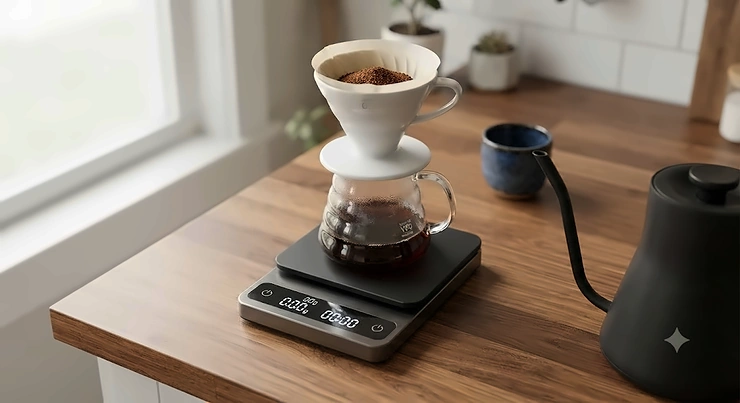
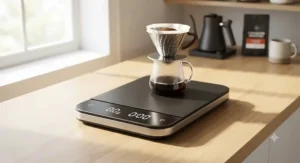
A pour over scale with timer is a digital coffee scale that reads weight to 0.1 gram while running a stopwatch on the same display, so you can track your dose, your water, and your brew time in one glance. It turns pour-over from a guessing game into a repeatable recipe — and it’s the single piece of gear most likely to fix a cup that tastes different every morning.
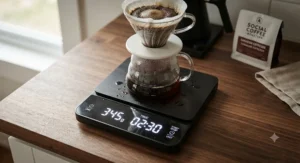
Here’s the uncomfortable truth about hand-poured coffee. The kettle, the dripper, the fancy single-origin beans? They matter. But none of them can tell you that you dumped 60 grams of water into the bloom instead of 40, or that your “three-minute” brew actually wrapped at 2:15 because you poured like you were putting out a fire. A scale with a built-in clock can.
Think of it like a speedometer and odometer bolted together. Weight tells you how far you’ve gone. Time tells you how fast you got there. Pour-over lives or dies on both.
Newer scales push further, adding live flow-rate readouts in grams per second — a feature that used to be reserved for C$250-plus gear and now shows up in the mid-range. That shift is exactly why this guide exists. If you’re new to the method itself, the Wikipedia overview of drip coffee brewing is a tidy primer on how gravity-fed extraction works before you get into gram-level detail.
Below you’ll find seven real scales sold to Canadian buyers, from a sub-C$50 workhorse to app-connected flagships, analysed on precision, response speed, battery life, and the two skills a timer actually helps you master: bloom phase timing and drip-rate consistency. Everything here is based on published specs and aggregated review sentiment — no invented star ratings, no pretend test lab.
Quick Comparison Table: Pour Over Scales With Timer at a Glance
| Scale | Best For | Flow Rate Display | Power | Approx. Price (CAD) |
|---|---|---|---|---|
| Greater Goods Coffee Scale with Timer | Budget buyers wanting 0.1g + timer | No | AAA batteries | C$35–C$50 range |
| Hario V60 Drip Scale | Classic V60 and Chemex routines | No | AAA batteries | C$55–C$75 range |
| Timemore Black Mirror Basic 2 | Best value with flow rate | Yes | Rechargeable USB-C | C$70–C$95 range |
| Timemore Black Mirror Basic 3 | Ratio tracking on a mid budget | Yes | Rechargeable USB-C | C$80–C$110 range |
| Bookoo Themis Ultra | Waterproof, data-driven brewers | Yes | Rechargeable USB-C | C$150–C$200 range |
| Fellow Tally Pro | Guided ratio brewing, design lovers | No | Rechargeable USB-C | C$230–C$280 range |
| Acaia Pearl (2021) | Pros who want pour-guide visuals | Yes | Rechargeable USB-C | C$220–C$290 range |
Read the “Flow Rate Display” column first — it’s the quiet dividing line in this market. The Greater Goods Coffee Scale with Timer and Hario V60 Drip Scale give you weight and time, which is all a beginner genuinely needs, while the Timemore Black Mirror Basic 2 is the cheapest pick here that also tells you how fast you’re pouring. Notice, too, that the priciest scale isn’t automatically the best-equipped: the Fellow Tally Pro skips live flow rate entirely, so you’re paying for its guided BrewAssist mode and build rather than raw brewing data.
💬 Just one click — help others make better buying decisions too!😊
Top 7 Pour Over Scales With Timer: Expert Analysis
The lineup below climbs from budget to premium. Every pick reads to 0.1 gram and runs a timer; what separates them is response speed, power source, flow-rate tracking, and how much the scale does for you automatically.
1. Greater Goods Coffee Scale with Timer — cheapest route to 0.1g brewing
This is the scale that proves you don’t need to spend triple digits to weigh coffee properly. The Greater Goods Coffee Scale with Timer pairs 0.1g precision with a 3 kg (6.6 lb) capacity and a removable silicone cover that shields the surface from kettle drips.
That 3 kg ceiling is more useful than it sounds. A glass carafe, a ceramic dripper, and 500 g of water can easily top 1.5 kg together — so you’ll never max out mid-brew, even with a big Chemex batch. The backlit display and six weighing units also make it a respectable everyday kitchen scale when coffee’s done.
Who’s it for? Anyone learning ratios who wants a timer without paying for automation. Based on the spec comparison, you give up auto-start timing and flow rate, meaning you’ll tap the timer yourself at the first pour — a small habit, not a deal-breaker. It’s also sold directly on amazon.ca in several colourways, which simplifies returns.
Reviewers consistently praise the accuracy-for-price ratio and the protective silicone mat, while a recurring complaint is that the timer and tare buttons feel slower and less crisp than rechargeable premium scales.
Pros:
- ✅ 0.1g precision at a genuinely budget price
- ✅ 3 kg capacity handles large carafes easily
- ✅ Silicone cover protects against spills and heat
Cons:
- ❌ Manual timer start, no auto mode
- ❌ Disposable batteries add a small recurring cost
In the C$35–C$50 range, the Greater Goods Coffee Scale with Timer is the smartest first scale for most Canadian pour-over beginners.
2. Hario V60 Drip Scale — the time-tested pour-over classic
If a coffee scale could have a pedigree, this would be it. The Hario V60 Drip Scale was built by the company behind the V60 cone, and its footprint is sized specifically for a dripper sitting on a server.
On paper it reads 2 g to 2 kg at 0.1g increments, with accuracy published at ±0.2g under 200 g, a timer that runs to 100 minutes, and a five-minute auto-off. Two AAA batteries deliver roughly 80 hours of use — for a one-cup-a-day brewer, that’s months between swaps. Response time sits under one second, which is fast enough to catch a heavy-handed pour before it ruins your ratio.
Here’s what to weigh: the timer won’t start itself, and the scale is grams-only. For pour-over purists who measure everything in grams anyway, that second point is a non-issue. It’s also physically too large for most espresso drip trays, so treat it as a dedicated hand-brew tool.
Aggregated reviews describe it as one of the cheapest scales to combine 0.1g precision with a built-in timer, with users most often citing battery dependence and the manual timer as the trade-offs.
Pros:
- ✅ Footprint made for V60 and Chemex setups
- ✅ Sub-second response keeps pours under control
- ✅ Around 80 hours of use per battery set
Cons:
- ❌ Timer requires a manual tap every brew
- ❌ Too big for espresso machine drip trays
Typically in the C$55–C$75 range, the Hario V60 Drip Scale is fair value for brewers who want proven simplicity over extra modes.
3. Timemore Black Mirror Basic 2 — best value with live flow rate
This is where a pour over scale with timer starts coaching you, not just counting. The Timemore Black Mirror Basic 2 adds a live grams-per-second flow readout and an auto-timer that starts when it senses weight — two features that, a few years ago, lived almost exclusively on C$250 scales.
The specs back the reputation: 2 kg capacity, 0.1g resolution, a 1,600 mAh rechargeable battery over USB-C, and a 130 × 152 × 26 mm body weighing about 420 g with its silicone pad. The auto-off waits three minutes when idle but stretches to 15 minutes while the timer runs, so it won’t shut down during a slow Kalita drawdown. That’s a thoughtful detail the spec sheet undersells.
What most buyers overlook: flow rate is the missing link for drip-rate consistency. Seeing “4.2 g/s” on screen tells you instantly whether you’re pouring gently or flooding the bed. For intermediate brewers trying to replicate a café recipe, this is the most important upgrade on the list.
Reviewers consistently call the design beautiful and the pour-over size ideal, though some note the display response could be snappier and the body is too large for espresso trays.
Pros:
- ✅ Live flow rate at a mid-range price
- ✅ Auto-timer starts on first pour
- ✅ Rechargeable USB-C skips battery purchases
Cons:
- ❌ Display response trails premium competitors slightly
- ❌ Too wide for most espresso drip trays
In the C$70–C$95 range, the Timemore Black Mirror Basic 2 delivers the best features-per-dollar of any pick here.
4. Timemore Black Mirror Basic 3 — ratio mode for recipe followers
The Timemore Black Mirror Basic 3 takes everything the Basic 2 does and adds a brew-ratio readout, calculating your coffee-to-water ratio in real time as you pour. For anyone chasing a precise 1:16, that removes the last bit of mental maths from the routine.
It also brings dedicated pour-over and espresso modes plus a manual mode, auto-tare, live flow rate, and USB-C charging in a slimmer, lower-profile body. In practice, ratio mode means you dose 15 g, tare, and simply pour until the screen reads 1:16 — no calculator, no scribbled notes. Reviewers describe measurements as stable and the timer as predictable, which is exactly what you want from a tool you’ll use half-awake at 6:30 a.m.
Honest analysis: this is an incremental upgrade over the Basic 2 rather than a leap. If you already weigh with confidence and don’t care about ratio display, the older model covers most of the same ground. If you’re still learning, ratio mode is a genuinely helpful set of training wheels.
Aggregated review sentiment highlights reliability, a short learning curve, and a clean matte finish, while the most common gripe is that touch controls can be finicky with wet hands.
Pros:
- ✅ Real-time brew ratio removes mental maths
- ✅ Separate pour-over and espresso modes
- ✅ Slim, low-profile rechargeable design
Cons:
- ❌ Touch controls struggle with wet fingers
- ❌ Modest upgrade over the Basic 2
In the C$80–C$110 range, the Timemore Black Mirror Basic 3 suits recipe-driven brewers who value ratio tracking.
5. Bookoo Themis Ultra — IP67 waterproofing for messy brew bars
Most coffee scales tolerate a splash. The Bookoo Themis Ultra is rated IP67, meaning it’s built to survive the kind of kettle overflow that quietly kills cheaper scales from the inside out.
Its spec sheet reads like a data nerd’s wishlist: 2,000 g capacity at 0.1g, a 2,000 mAh USB-C battery rated for up to 72 hours per charge, and four modes — weight, flow, ratio, and auto. Flow mode shows timer, weight, and grams per second at once, while auto mode tares and starts timing the moment liquid lands. Bluetooth links to the Bookoo app plus third-party tools like Beanconqueror, so you can log and graph pours over time.
Who should care? Brewers who treat pour-over like a lab experiment, and anyone whose counter doubles as a splash zone. At 127 × 112 × 18 mm it’s compact, which suits smaller drippers but can feel snug under wide Chemex bases. Availability on amazon.ca can fluctuate, so check current listings.
Reviewers praise the waterproofing, fast response, and battery life, while common complaints include touch buttons misreading wet fingers, occasional phantom readings, and no timer in plain weight mode.
Pros:
- ✅ IP67 rating shrugs off spills
- ✅ Up to 72 hours per charge
- ✅ App logging with third-party integrations
Cons:
- ❌ Touch buttons misread wet fingers occasionally
- ❌ Compact platform feels tight for large brewers
In the C$150–C$200 range, the Bookoo Themis Ultra is strong value for data-hungry brewers who want durability.
6. Fellow Tally Pro — guided BrewAssist for design-first kitchens
The Fellow Tally Pro is the scale you buy when you want the counter to look like a magazine spread and the maths done for you. Its BrewAssist mode calculates how much water to pour based on your dose and chosen ratio, then counts you there.
It weighs up to 2,500 g at 0.1g, runs about 13 hours per USB-C charge, and measures roughly 17.5 × 15 × 3.3 cm (6.9 × 5.9 × 1.3 in). The OLED display is crisp at odd viewing angles, and the water-resistant build handles normal drips. The extra 500 g of capacity over most rivals gives breathing room for heavy ceramic servers.
Now the honest part. Independent reviews flag the lack of live flow-rate monitoring as its most glaring omission at this price, alongside no companion app and a timer you start manually. So you’re paying for design, build, and guided ratios — not for drip-rate data.
Aggregated review sentiment praises the striking design, simple three-mode operation, and BrewAssist, while the most repeated criticism is that the price feels hard to justify given the missing flow rate and app.
Pros:
- ✅ BrewAssist calculates water targets automatically
- ✅ 2.5 kg capacity suits heavy servers
- ✅ Crisp OLED display and premium finish
Cons:
- ❌ No live flow-rate readout
- ❌ Shorter battery life than several rivals
In the C$230–C$280 range, the Fellow Tally Pro makes sense mainly for buyers prioritising aesthetics and guided brewing.
7. Acaia Pearl (2021) — pro-grade speed with visual pour guides
Café baristas have trusted Acaia for years, and the Acaia Pearl (2021) shows why. Its flow-rate indicator visualises pour speed from 0.5 g/s up to 11 g/s, turning drip-rate consistency into something you can literally see.
Capacity is 2 kg, with 0.1g resolution up to 1 kg (switching to 0.5g above that unless you adjust it). The 1,100 mAh battery runs about 30 hours with Bluetooth on and recharges via USB-C in roughly 3.5 hours. Boot time is under 0.4 seconds — you’ll never wait for it to wake. Five modes include Auto Start Pour Over and Beverage Mode with ratio calculations, all on a 16 cm square, 3.2 cm tall platform big enough for any home dripper.
The analytical take: this is the pick for someone who already knows why they want a premium scale. Its hardware is widely regarded as excellent, and the wide platform makes it the most pour-over-friendly flagship here.
Reviewers consistently rate the speed, accuracy, and pour guides highly, but a well-known complaint is that Acaia’s companion apps are clunky, with Android connectivity drawing the most criticism.
Pros:
- ✅ Visual flow guide from 0.5 to 11 g/s
- ✅ Near-instant 0.4-second boot time
- ✅ Wide 16 cm platform fits any dripper
Cons:
- ❌ Companion app experience is frequently criticised
- ❌ Resolution drops to 0.5g above 1 kg by default
In the C$220–C$290 range, the Acaia Pearl (2021) is a long-term investment for serious brewers who’ll use every mode.
Full Spec Comparison: All 7 Scales Side by Side
| # | Scale | Capacity | Battery | Auto Timer | Ratio Mode | Best For |
|---|---|---|---|---|---|---|
| 1 | Greater Goods Coffee Scale with Timer | 3 kg | AAA | No | No | Budget beginners |
| 2 | Hario V60 Drip Scale | 2 kg | 2× AAA (~80 h) | No | No | Classic V60 routines |
| 3 | Timemore Black Mirror Basic 2 | 2 kg | 1,600 mAh | Yes | No | Flow rate on a budget |
| 4 | Timemore Black Mirror Basic 3 | 2 kg | Rechargeable | Yes | Yes | Recipe followers |
| 5 | Bookoo Themis Ultra | 2 kg | 2,000 mAh (~72 h) | Yes | Yes | Waterproof data tracking |
| 6 | Fellow Tally Pro | 2.5 kg | ~13 h | No | Yes (BrewAssist) | Guided brewing, design |
| 7 | Acaia Pearl (2021) | 2 kg | 1,100 mAh (~30 h) | Yes | Yes | Pro-level pour guides |
The table exposes a pattern that marketing copy hides: capacity barely changes across price tiers, so you’re never really paying for “more scale.” The money goes toward automation (auto timers and ratio maths), rechargeable power, and flow-rate data. The two Timemore models deliver most of that automation for under C$110, while the Bookoo Themis Ultra and Acaia Pearl (2021) justify their premiums with waterproofing, battery endurance, and faster response.
Practical Usage Guide: Bloom Phase Timing, Step by Step
Owning a pour over scale with timer is half the battle. Here’s how to put it to work on day one.
1. Set up on a flat, solid surface. A textured placemat or a wobbly cutting board can skew readings by a gram. Power on and let the display settle at zero.
2. Tare your brewer. Place the dripper, rinsed filter, and server on the platform, then press tare. Add ground coffee — say 15 g for a single cup — and tare again, so the scale now tracks water only. If you have a ratio mode, like on the Timemore Black Mirror Basic 3, this is where it earns its keep.
3. Start the clock with the bloom. Pour roughly two to three times your coffee’s weight in water — 30 to 45 g for a 15 g dose — and start the timer (or let an auto-timer do it). Bloom phase timing typically runs 30 to 45 seconds; fresher beans release more carbon dioxide and bubble more vigorously, so they may want the longer end.
4. Pour in stages. After the bloom, pour in slow spirals to around 150 g by the 1:15 mark, then to your target (240 g for 1:16) by roughly 1:45–2:00.
5. Note the drawdown. Write down when the bed finishes draining. Total times around 2:45–3:30 are a common target for a single V60 cup, but your grinder matters more than any rule.
Maintenance schedule: wipe the platform after every brew, charge rechargeable scales weekly, and check calibration monthly with a known weight.
First-30-days mistake: forgetting the second tare after adding coffee. It silently inflates your water reading by 15 g and makes every ratio wrong.
Real-World Scenarios: Which Scale Fits Your Brewing Life?
Specs are easier to judge with a person attached. Here are three realistic Canadian brewer profiles.
The Montréal apartment beginner. One cup before the metro, a small galley kitchen, and a budget that also has to cover a grinder. The Greater Goods Coffee Scale with Timer fits neatly: 0.1g accuracy, a timer for bloom phase timing, and a price that leaves room for decent beans. Budget: under C$50. Frequency: daily, single cup. The silicone cover is a bonus when the kettle drips on a crowded counter.
The Calgary weekend hobbyist. Saturday mornings are for pour-over experiments, and you’ve noticed the same beans taste wildly different week to week. That’s a drip-rate consistency problem, and it’s exactly what the flow readout on the Timemore Black Mirror Basic 2 is designed to expose. Budget: C$70–C$95. Frequency: two to four dedicated brews a week. If you like following published recipes, stepping up to the Timemore Black Mirror Basic 3 adds live ratio tracking.
The Vancouver home-barista data logger. You own a burr grinder with fine adjustment, log every brew, and alternate between V60 and espresso. The Bookoo Themis Ultra gives you IP67 protection, 72-hour battery life, and app logging; the Acaia Pearl (2021) trades waterproofing for a wider platform and visual pour guides. Budget: C$150–C$290. Frequency: multiple brews daily.
The common thread? Match the scale to how often you brew and how much data you’ll actually use. A C$250 scale running a once-a-week French press is expensive furniture.
✨ Don’t Miss These Exclusive Deals! 🔍
Take your pour-over routine to the next level with these carefully selected scales. Click on any highlighted item to check current pricing and availability. These tools will help you create café-quality cups your whole household will love!
Problem → Solution: Fixing Drip-Rate Consistency and Other Headaches
Even the best pour over scale with timer can’t fix technique on its own, but it can diagnose it. Here are five common problems and how to solve them.
Problem: Brews finish too fast and taste sour. Usually you’re pouring too quickly, channelling water through the bed. Solution: watch the flow readout on the Timemore Black Mirror Basic 2 or Acaia Pearl (2021) and aim for a steady, moderate rate — many home recipes land somewhere around 4–6 g/s — rather than bursts.
Problem: Drawdown times vary by 30+ seconds between identical recipes. That’s the classic drip-rate consistency failure. Solution: pour to fixed weight checkpoints at fixed times (e.g., 150 g at 1:15) and keep your kettle spout height steady. If times still wander, your grinder, not your pouring, is likely the variable.
Problem: The bloom barely bubbles. Stale beans or water that’s too cool. Solution: use beans within a few weeks of roast and water just off the boil. Bloom phase timing won’t rescue degassed coffee.
Problem: Touch buttons ignore wet fingers. Common on the Bookoo Themis Ultra and Timemore Black Mirror Basic 3. Solution: keep a dry towel by the scale and tap with a dry knuckle.
Problem: The scale shuts off mid-brew. Solution: check the auto-off setting; the Timemore Black Mirror Basic 2 extends to 15 minutes while its timer runs, while battery models like the Hario V60 Drip Scale reset after five idle minutes.
How to Choose a Pour Over Scale With Timer
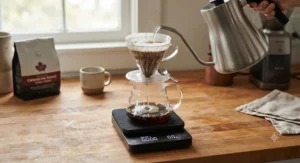
Cut through the marketing with these seven criteria, roughly in order of importance:
- 0.1g resolution. Non-negotiable for single-cup doses of 12–20 g, where one gram shifts your ratio noticeably.
- Response speed. A lag of more than a second means you’ll overshoot targets during fast pours. The Hario V60 Drip Scale and Acaia Pearl (2021) are strong here.
- Timer behaviour. Manual timers work fine; auto-start timers remove one more thing to juggle and make bloom phase timing effortless.
- Flow-rate display. The single biggest aid to drip-rate consistency. Worth it if you brew more than a few times a week.
- Power source. Rechargeable USB-C scales cost more upfront but eliminate batteries; AAA models are cheaper to buy.
- Platform size. Measure your dripper and server. Compact scales like the Bookoo Themis Ultra can feel tight under big Chemex bases.
- Water resistance. Pour-over is wet work. An IP rating or silicone cover extends the life of the internals.
Rank those against your habits and budget, and the right scale usually becomes obvious within minutes. Most first-time buyers only truly need the first three; the rest are upgrades.
Coffee Scale With Timer vs Without Timer: Is the Clock Worth It?
This is the question most shoppers ask before buying, so let’s settle coffee scale with timer vs without timer properly.
| Factor | Scale With Timer | Scale Without Timer (+ Phone) |
|---|---|---|
| Bloom tracking | Time and weight on one screen | Two devices, split attention |
| Workflow | One-handed, kettle in the other | Juggling a wet phone |
| Auto-start options | Available on many models | Not possible |
| Flow rate | Often included mid-range and up | Never included |
| Cost | C$35 and up | Often under C$30 |
| Best For | Pour-over, espresso, recipe tracking | Baking, occasional drip coffee |
The table makes the trade clear: a timer-less scale is cheaper, but pour-over is fundamentally a timed process. Juggling a phone stopwatch while holding a gooseneck kettle is how bloom times drift and phones end up splashed.
Where coffee scale with timer vs without timer gets interesting is the price gap. A basic kitchen scale might run C$15–C$30, while the Greater Goods Coffee Scale with Timer starts in the mid-C$30s. That roughly C$15 premium buys an integrated clock and, just as importantly, 0.1g resolution, which many cheap kitchen scales lack. For French press or batch drip, a timer-less 1g scale plus a kitchen timer is perfectly adequate. For hand-poured V60, Kalita, or Chemex, the integrated clock pays for itself in consistency within weeks.
Bloom Phase Timing: Why the First 45 Seconds Decide the Cup
Freshly roasted coffee is full of trapped carbon dioxide. When hot water first hits the grounds, that gas rushes out — the bubbling, swelling “bloom.” If you keep pouring during this phase, the escaping gas pushes water away from the grounds and extraction becomes uneven.
Bloom phase timing is simply giving that gas room to escape before the main pour. Most recipes use two to three times the coffee’s weight in water and wait 30 to 45 seconds. A scale is what makes this repeatable: “a splash of water” can easily vary from 25 g to 70 g, while “40 g on the scale” is 40 g every morning.
Why the timer specifically? Because 30 seconds and 60 seconds produce different cups, and humans are terrible at estimating short intervals while concentrating on a pour. An auto-start timer, like those on the Timemore Black Mirror Basic 2 and Bookoo Themis Ultra, begins counting the instant water lands — removing the most common source of human error.
A few nuances worth knowing:
- Very fresh beans (under a week from roast) often benefit from 45 seconds or more.
- Older beans bloom weakly; shortening the bloom won’t hurt much.
- Darker roasts tend to degas faster and bubble more at first.
- Stirring or swirling the bloom helps saturate dry pockets.
Treat 35 seconds as a starting point, then adjust in 5-second steps while keeping everything else fixed.
Drip-Rate Consistency: What Flow-Rate Readouts Actually Tell You
If bloom phase timing is the opening, drip-rate consistency is the rest of the performance. It describes how evenly water enters the brew bed over time — and it’s the variable most home brewers never measure.
Pouring too fast raises the slurry level, agitates the grounds, and can push water through channels. Pouring too slowly lets the bed cool and extends contact time. Either way, the cup changes. Two brews with identical dose, water weight, and total time can still taste different if one was poured in two big dumps and the other in a steady stream.
That’s what flow-rate displays solve. The Acaia Pearl (2021) visualises a range from 0.5 to 11 g/s, while the Timemore Black Mirror Basic 2, Timemore Black Mirror Basic 3, and Bookoo Themis Ultra show a live grams-per-second number. Instead of feeling your way through a pour, you get instant feedback, the way a cyclist uses a cadence sensor to hold an even rhythm.
Without a flow readout, you can still build drip-rate consistency the old-fashioned way: hit weight checkpoints at set times. If 150 g should land at 1:15, the timer tells you whether you’re ahead or behind. It’s cruder, but it works on the Greater Goods Coffee Scale with Timer or Hario V60 Drip Scale just fine.
Based on the spec comparison, flow rate isn’t essential for beginners — it becomes valuable once you’re chasing repeatability across dozens of brews.
Features That Actually Matter (And Those That Don’t)
Genuinely matter: 0.1g resolution, sub-second response, a reliable tare, a timer you can see mid-pour, and a platform that fits your brewer. These affect every single cup.
Matter once you’re hooked: live flow rate, auto-start timing, and ratio mode. They’re the difference between “good coffee” and “the same good coffee every time.” The two Timemore scales are the most affordable way into this tier.
Mostly marketing: 0.01g readings for pour-over (useful for espresso tweaks, overkill for a 15 g pour-over dose), six-plus measurement units, colour-changing displays, and ultra-thin profiles. None of these improve extraction.
It depends: Bluetooth apps. If you log recipes obsessively, integrations like the Bookoo Themis Ultra‘s support for third-party apps are genuinely useful. If you just want tasty coffee, an app is one more thing to update — and even the excellent Acaia Pearl (2021) draws criticism for its software.
One overlooked feature deserves a mention: the auto-off timer. A scale that shuts down after three minutes during a slow Chemex brew is maddening. Check how long a model stays awake with the timer running before you buy.
Common Mistakes When Buying a Pour Over Scale With Timer
Buying espresso-sized for pour-over. Tiny scales built for drip trays often can’t fit a Chemex or a wide server, and small displays hide under the brewer.
Assuming price equals features. The Fellow Tally Pro costs more than the Timemore Black Mirror Basic 3 yet lacks live flow rate. Read the feature list, not the price tag.
Ignoring response lag. A scale that updates slowly lets you overshoot by 10–20 g during a quick pour. Look for reviews that mention “fast” or “instant” response.
Forgetting the power-source math. AAA scales look cheaper, but a daily brewer will buy batteries for years. Rechargeables flip the long-term equation.
Skipping water resistance. Pour-over involves boiling water next to electronics. A silicone cover or IP rating is cheap insurance.
Overbuying before learning technique. A C$280 scale won’t fix a blade grinder. If budget is tight, spend on a burr grinder first and pair it with the Greater Goods Coffee Scale with Timer.
Not checking the platform. Measure your dripper’s base diameter; some brewers overhang compact scales and block the display.
Accuracy, Standards & Caffeine: What Canadian Brewers Should Know
In Canada, commercial weighing devices — the scale at a grocery deli counter, for instance — are regulated by Measurement Canada under the Weights and Measures Act. Home coffee scales generally aren’t certified the same way, so the “0.1g accuracy” printed on the box is a manufacturer claim, not a government-verified one.
That’s not a reason for suspicion; it’s a reason to test. A quick home check uses coins: post-2000 Canadian nickels weigh a consistent 3.95 g each, so ten should read about 39.5 g. If your scale is off by more than a few tenths of a gram, recalibrate using the manual’s procedure or return it within the window.
Consistency also matters for your health budget, not just your taste buds. A scale shows exactly how much coffee you’re brewing, which makes it easier to keep your caffeine intake predictable. Health Canada’s guidance on caffeine in foods sets out recommended maximum daily intakes for healthy adults and more cautious limits for pregnant people and children. Because caffeine content scales with dose, weighing 15 g instead of eyeballing “two big scoops” keeps each cup’s strength — and your daily total — steady.
Finally, electrical safety: choose chargers and cables from reputable sources, and look for recognised certification marks such as CSA or cUL on any separate USB wall adapter you plug in overnight.
Long-Term Cost & Maintenance: Value Over Five Years
| Tier | Price Range (CAD) | What You Get | Example Pick | Best For |
|---|---|---|---|---|
| Budget | C$35–C$75 | 0.1g, manual timer, AAA power | Greater Goods Coffee Scale with Timer | Learning the basics |
| Mid-range | C$70–C$110 | Flow rate, auto timer, rechargeable | Timemore Black Mirror Basic 2 | Consistency seekers |
| Premium | C$150–C$290 | Waterproofing, apps, pro response | Acaia Pearl (2021) | Daily data-driven brewing |
The value sweet spot sits squarely in the middle tier. Spread over five years of daily brewing — roughly 1,800 cups — even a C$95 Timemore Black Mirror Basic 2 works out to about five cents per cup, and it removes battery purchases entirely. Premium scales make sense when their extra durability (like the Bookoo Themis Ultra‘s IP67 rating) or response speed matches how hard you’ll use them.
Battery models carry a hidden, recurring cost. The Hario V60 Drip Scale gets around 80 hours per pair of AAAs — great for one cup a day, but a multi-brew household will replace batteries several times a year. Rechargeable lithium-ion cells avoid that, though they gradually lose capacity after a few hundred cycles.
When batteries do die, don’t toss them in the trash. Call2Recycle Canada’s household battery program lists drop-off locations across provinces for both single-use AAAs and rechargeable cells.
Maintenance is refreshingly simple: wipe after every brew, never submerge unless the scale is rated for it, store it away from the stove’s heat, and recalibrate monthly. Do that and a mid-range scale should comfortably outlast your next grinder upgrade.
Frequently Asked Questions
❓ Is a pour over scale with timer worth it for beginners?
❓ Which coffee scale has flow rate under C$100 in Canada?
❓ Can I use a pour-over coffee scale for espresso?
❓ Should I buy a rechargeable or battery coffee scale?
❓ Is the Acaia Pearl better than the Fellow Tally Pro?
Conclusion
A pour over scale with timer is the most cost-effective upgrade in pour-over brewing. It won’t choose your beans or grind them, but it will tell you — precisely — how much water went in, how fast, and for how long. That’s the information every other adjustment depends on.
For most Canadian beginners, the Greater Goods Coffee Scale with Timer or the Hario V60 Drip Scale covers the essentials: 0.1g readings and a clock you can trust for bloom phase timing. Once you’re chasing drip-rate consistency, the Timemore Black Mirror Basic 2 is the standout value, adding flow rate and auto-timing without a premium price, while the Timemore Black Mirror Basic 3 layers in real-time ratios for recipe followers.
At the top end, the Bookoo Themis Ultra suits messy, data-hungry brew bars; the Fellow Tally Pro rewards design lovers who want guided brewing; and the Acaia Pearl (2021) remains the benchmark for speed and visual pour guidance.
The best scale isn’t the most expensive one. It’s the one whose features you’ll use every single morning. Pick the tier that matches your habits, weigh everything for two weeks, and taste the difference consistency makes.
✨ Ready to brew the same great cup twice? Tap any highlighted scale to check current pricing and availability — tomorrow’s pour-over is waiting! ☕🔥
Recommended for You
- Espresso Dosing Scale For Home Baristas: 7 Best Picks (2026)
- 7 Best Coffee Scale for Pour Over Picks in Canada (2026 Guide)
- 7 Best Coffee Scales for Beginners in Canada (2026 Guide)
Disclaimer: This article contains affiliate links. As an Amazon Associate, I earn from qualifying purchases. If you purchase products through these links, we may earn a small commission at no additional cost to you.
✨ Found this helpful? Share it with your friends! 💬🤗
