
In This Article
There’s a moment every home barista hits. You’ve got the machine dialled in, you’ve read every extraction guide on the internet, and your shots are… fine. Not bad. Just fine. Nine times out of ten, the bottleneck isn’t your technique or your beans — it’s the grinder squatting under your cabinet, chewing through coffee with burrs the size of a hockey puck instead of a dinner plate. That’s where an 83mm flat burr grinder earns its keep. These machines use burr sets nearly one-third larger than the 64mm standard found in most prosumer grinders, and that extra surface area changes the physics of grinding in ways you can actually taste.
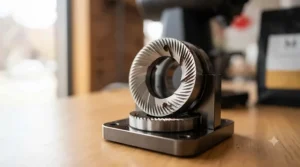
An 83mm flat burr grinder is a coffee grinder built around a pair of parallel, ring-shaped grinding discs measuring 83 millimetres across, historically the workhorse size for commercial espresso machines across Italy and, increasingly, home setups. This design descends from the same burr mill mechanism that’s been used to grind grain and coffee for centuries — two abrasive discs crushing material between them rather than chopping it like a blade. Because the burrs are larger, they spin slower for the same output, which means less heat transfer into the coffee and a noticeably more uniform particle size than smaller burr sets typically deliver.
Here’s the thing worth sitting with before you spend a small fortune: bigger burrs aren’t automatically better burrs, and the 83mm category spans everything from a $600 single-dose hobby grinder to a $3,500 café workhorse. Some 83mm designs are genuinely a decade ahead of their smaller siblings. Others are simply “bigger” without being meaningfully better engineered. We dug through real spec sheets, aggregated review sentiment, and side-by-side comparisons to help you tell the difference, and we’re not going to pretend every model on this list deserves a spot on your counter for the same reasons. Caffeine habits matter here too — Health Canada’s general daily caffeine guidance is worth a glance if you’re about to start pulling two or three shots a day instead of one.
This guide covers seven real 83mm flat burr grinders, from a scrappy $600 single-doser to a genuine commercial workhorse, with honest analysis of who each one actually suits — not just what the spec sheet says.
What Is an 83mm Flat Burr Grinder? Quick Comparison
Before the deep dives, here’s the lay of the land. All seven models below use genuine 83mm flat burr sets; the differences come down to motor power, workflow design, and whether they’re built for a single household or a Saturday-morning rush of forty customers.
| Grinder | Burr Speed | Best For | Price Range (CAD) |
|---|---|---|---|
| Turin DF83 | ~1,400 RPM | Budget entry into big burrs | Under C$900 |
| MiiCoffee DF83 Gen 2 | ~1,400 RPM | Upgraded budget, home use | C$900–C$1,050 |
| Turin DF83V | 300–1,800 RPM (variable) | Tinkerers, mixed brew methods | C$950–C$1,250 |
| Niche Duo | ~1g/sec (espresso burrs) | Dual-purpose espresso and filter | C$1,300–C$1,600 |
| Mazzer Major | 1,400–1,600 RPM | Small commercial, serious home use | C$2,300–C$2,800 |
| Fiorenzato F83E Pro | 1,350–1,550 RPM | High-volume café, GBW workflow | C$3,000–C$3,600 |
| Ceado E37S | 1,700 RPM | Premium café, quietest of the bunch | C$3,300–C$4,000 |
A pattern jumps out immediately: price climbs less because the burrs get “more 83mm” — they’re all 83mm — and more because of motor quality, dosing precision, retention control, and the kind of daily volume the chassis was engineered to survive. The Turin DF83 and Ceado E37S share an identical burr diameter, but one is built to grind eighteen grams before your coffee cools and the other is built to grind eighteen grams four hundred times a day for a decade without flinching. That distinction should drive your decision far more than the “83mm” label itself.
💬 Just one click — help others make better buying decisions too!😊
💬 Bookmark this table — you’ll want to scroll back to it once you’ve read the full breakdown below.
Top 7 83mm Flat Burr Grinders: Expert Analysis
1. Turin DF83 — best entry point into big-burr grinding
The Turin DF83 is the grinder that made 83mm burrs accessible to people who don’t run a café. Before it existed, stepping up to this burr size meant spending Mazzer Major money; the DF83 broke that barrier by pairing the same-diameter burrs with a much simpler, single-dose-only chassis.
Its 83mm stainless steel burrs spin at roughly 1,400 RPM and, based on the spec comparison against smaller 64mm units, grind an 18-gram espresso dose in five to six seconds — noticeably faster than most 64mm competitors, which typically need eight to ten. The stepless micrometric adjustment collar and included graduated dial mean you’re not guessing at settings every time you switch beans, and the low-retention chute keeps grounds from lingering between doses.
This is the grinder for someone graduating from a Baratza Encore or a cheap conical who wants to feel what real burr size does to clarity, without committing to a four-figure purchase. It’s not the grinder for someone who already owns a 64mm flat burr grinder and expects a night-and-day flavour transformation; the improvement is real but incremental, not revelatory. Reviewers consistently report that the stock burrs need a proper seasoning period — expect the first pound or two of beans to taste a bit flat before the grind quality settles in.
Aggregated buyer feedback on this model is largely positive, with recurring praise for the fluffy, clump-free grind and recurring complaints about grounds occasionally backing up in the exit chute on very first use, a quirk several forum threads describe as fixable with a quick clean and reseat of the chute assembly.
Pros:
- ✅ Genuine 83mm burrs at a fraction of commercial pricing
- ✅ Fast grind speed for the price bracket
- ✅ Stepless adjustment with a graduated reference dial
Cons:
- ❌ No hopper included for continuous-use setups
- ❌ Early units report occasional chute clogging out of the box
At under C$900, the Turin DF83 delivers commercial-grade burr geometry at a genuine home-hobbyist price, and the value case is hard to argue with if you’re single-dosing anyway.
2. MiiCoffee DF83 Gen 2 — best upgraded burrs for the money
The MiiCoffee DF83 Gen 2 takes the same core chassis concept as the standard DF83 and swaps in Red Titanium-coated burrs, a declumper, and an ionizer for static reduction — three upgrades that matter more in daily use than they sound like on a spec sheet.
The Red Ti coating on the 83mm burrs isn’t just cosmetic; titanium-based coatings run harder and cooler than raw stainless steel, translating to reduced heat transfer during the grind and a longer service life before the edges dull. Paired with the built-in ionizer, static cling — the bane of every single-dose grinder owner who’s ever watched grounds fly everywhere except the portafilter — drops noticeably.
Based on the spec comparison with the base-model DF83, this is the version to buy if you’re willing to spend roughly C$150–C$250 more for meaningfully better burr longevity and a cleaner workflow, rather than treating the ionizer and declumper as gimmicks. It suits someone who has already decided on the DF83 platform and wants the “nice to have” quality-of-life package bundled in rather than purchased piecemeal later as aftermarket upgrades.
Reviewers who’ve owned both the original DF64 line and this DF83 Gen 2 report that espresso shots taste noticeably better with the Red Ti burr set, and that the declumper genuinely reduces the need for a separate WDT tool. A recurring theme in aggregated feedback is that the power switch design feels like an afterthought on an otherwise well-considered machine — a cosmetic gripe more than a functional one.
Pros:
- ✅ Red Ti burr coating improves longevity over stock steel
- ✅ Built-in ionizer meaningfully cuts static and mess
- ✅ Declumper reduces need for separate WDT tools
Cons:
- ❌ Premium over base DF83 isn’t dramatic in blind taste tests
- ❌ Power switch placement draws consistent minor criticism
If you’re going to own a DF83-platform grinder for years, the modest upcharge for the Gen 2’s burr and static upgrades is one of the better value additions in this whole category.
3. Turin DF83V — best variable-speed pick for mixed brewing
The Turin DF83V takes the DF83 formula and adds a genuinely useful feature most grinders in this price range skip entirely: variable RPM control, adjustable from roughly 300 to 1,600 RPM through a brushless 680-watt motor.
What does variable speed actually buy you in practice? Based on the spec comparison, slower RPMs reduce the heat generated during grinding, which matters most with lighter, denser roasts where you’re trying to preserve delicate aromatics rather than blast through them. Faster settings handle darker, oilier roasts more efficiently without stalling. The DF83V also adds an auger-fed bean chamber that controls the rate beans drop into the burrs — engineered specifically to reduce “popcorning,” the annoying bounce-around effect that throws off consistency on straight-drop single-dose grinders.
This is the grinder for the person who brews both espresso and pour-over from the same machine and actually wants to tune grind character to roast level, not just grind size. It is arguably overkill for someone who drinks the same medium-roast blend every single morning and has no interest in experimenting — for that buyer, the standard DF83 does the same core job for roughly C$250 less.
Owner reviews are largely enthusiastic, particularly around the ion generator’s effect on static and the “fast and furious” feel of the grind cycle, though a handful of buyers flagged the DF83V as needing a slightly longer burr break-in period than the standard model before flavour clarity peaks.
Pros:
- ✅ True variable RPM from 300 to 1,600, unusual at this price
- ✅ Auger-fed chamber reduces popcorning and improves consistency
- ✅ Built-in plasma generator noticeably cuts static
Cons:
- ❌ Learning curve to find your preferred RPM per roast
- ❌ Meaningfully pricier than the fixed-speed DF83
For anyone who treats grind speed as a flavour variable rather than a fixed setting, the DF83V is the most flexible tool in the sub-C$1,300 large-burr category.
4. Niche Duo — best dual-purpose burr-swapping design
The Niche Duo takes a completely different approach to the “one grinder for everything” problem: instead of one compromise burr set, it ships with two dedicated 83mm Mazzer flat burr sets — one tuned specifically for espresso, one for filter — that swap out via a tool-free carrier system in under a minute.
Based on the spec comparison against multi-purpose burr grinders, dedicated burr geometry consistently outperforms compromise geometry within its intended brew method, and the Niche Duo’s design philosophy leans entirely into that principle rather than fighting it. Retention sits at roughly 1.6 grams total and under 0.2 grams for single-dose accuracy — genuinely impressive figures for burrs this large, achieved without bellows or knockers, which is where a lot of competing 83mm designs still lean on mechanical assistance.
This suits the buyer who genuinely rotates between espresso mornings and filter afternoons and doesn’t want to own two grinders to do it well. It is a frustrating purchase for anyone who plans to use one burr set for both brew methods interchangeably; aggregated owner feedback consistently describes cross-using either burr set outside its designed purpose as “painful and ineffective,” so budget for both burr sets from day one rather than adding the second later.
Reviewers who’ve moved over from the smaller Niche Zero conical describe a real jump in clarity and flavour separation, with the acidity coming across as more integrated and less one-note on the flat burrs, at the cost of slightly more audible operation than the Zero.
Pros:
- ✅ Two dedicated 83mm burr sets, purpose-built per brew method
- ✅ Exceptionally low retention for burrs this size
- ✅ Signature Niche single-dose workflow and consistency
Cons:
- ❌ Using one burr set for both methods gives disappointing results
- ❌ Noticeably louder than the smaller Niche Zero
If your coffee habits genuinely span espresso and filter in the same week, the Niche Duo’s dual-burr approach solves a real problem most single-burr 83mm grinders simply paper over.
5. Mazzer Major — best small-commercial workhorse
The Mazzer Major has been the reference point for mid-volume café grinding for decades, and its 83mm flat burrs, OEM part number 251A, remain the benchmark that aftermarket burr makers still measure their own 83mm sets against.
Running at 1,400 RPM (50Hz) to 1,600 RPM (60Hz) off a 650-watt motor, the Major is engineered for stepless micrometric adjustment with a memory-track system that indexes your grind setting — a genuinely practical feature if multiple people in a household or small shop share the same grinder and keep nudging the dial. What the spec sheet won’t tell you, but real-world use makes obvious, is that the doser-free, on-demand design and 3.5-pound hopper capacity mean this machine is built to disappear into a busy morning rush rather than demand babysitting between shots.
This is the right call for a home espresso obsessive who wants genuine commercial durability and doesn’t mind the roughly 20-kilogram footprint and hopper-based workflow, or for a small café, food truck, or office kitchen doing moderate daily volume. It is the wrong call for anyone chasing single-dose precision or a compact countertop presence; the Major is built to be loaded once and ground from repeatedly, not measured out bean-by-bean.
Long-standing aggregated commentary across coffee forums consistently describes the Major’s stock 151/251A burrs as “forgiving” — producing a wide usable espresso range that’s easy to dial in even for less experienced grinders, which likely explains why it remains a default recommendation for buyers stepping up from prosumer gear into genuinely commercial equipment.
Pros:
- ✅ Decades-proven 83mm burr geometry, widely regarded as forgiving
- ✅ Memory-track adjustment for multi-user households or shops
- ✅ Genuinely commercial-grade durability and daily-volume capacity
Cons:
- ❌ Large, heavy footprint compared to home single-dosers
- ❌ Hopper-based design isn’t ideal for single-dose precision
For anyone who has outgrown home-grade gear and wants proven commercial durability without stepping all the way up to café-flagship pricing, the Mazzer Major remains one of the most credible choices in this category.
6. Fiorenzato F83E Pro — best for high-volume café throughput
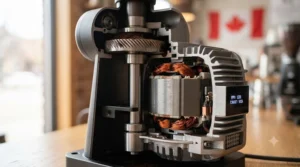
The Fiorenzato F83E Pro is built around a straightforward premise: bigger volume calls for bigger burrs, and this 650-watt, 83mm flat burr grinder is engineered specifically to survive sustained rush-hour bursts without the thermal drift that plagues smaller motors under heavy load.
Its Dark-T coated M340 steel burrs are rated for roughly 900 kilograms of throughput per burr set — extendable to around 4,500 kilograms across five coating cycles — spinning at 1,350 to 1,550 RPM depending on regional power supply, and producing 3.1 grams per second at espresso grind. Based on the spec comparison against uncoated commercial burrs, that titanium-aluminum-carbon-nitride coating is doing real mechanical work, not just marketing: coated burrs documented in lab testing outlast standard steel burrs by roughly five times, which matters enormously in an environment grinding six-plus kilograms of coffee daily.
The detachable grinding chamber, released via two simple levers, is the feature that separates this from home-oriented 83mm grinders — a barista who needs to clear a jam or deep-clean mid-shift can do it in seconds rather than shutting the machine down for a full teardown. This is the grinder for a genuinely busy independent café or restaurant program, not a home kitchen; the digital CapSense dosing and PUQpress M4 tamper compatibility signal a workflow built around multiple baristas serving dozens of drinks per hour, features that go entirely unused in a household of two.
Aggregated commercial buyer sentiment is strongly positive on the burr longevity claims specifically, with several equipment resellers noting the titanium coating’s resistance to corrosion and wear as a recurring reason cafés choose Fiorenzato over cheaper commercial alternatives with shorter burr replacement cycles.
Pros:
- ✅ Titanium-coated burrs rated for roughly 5x standard burr lifespan
- ✅ Detachable grinding chamber for fast mid-shift maintenance
- ✅ Built specifically to sustain peak rush-hour throughput
Cons:
- ❌ Significant overkill and expense for home-only use
- ❌ 15-kilogram, café-scale footprint doesn’t suit small kitchens
For a specialty café or restaurant grinding several kilograms daily, the F83E Pro’s burr longevity math alone can justify the premium over cheaper commercial alternatives within a couple of years of service.
7. Ceado E37S — best premium all-rounder, quietest in its class
The Ceado E37S has earned an informal nickname among Italian espresso equipment circles as “The King,” and after digging through its engineering, it’s not hard to see why: this is the grinder that manages to combine massive 83mm burrs, a 500-watt motor, and genuinely library-quiet operation — Ceado claims roughly 30% quieter than comparable machines, and independent testing places it around 60–65 decibels, quiet enough to hold a normal conversation beside it while it’s running.
Its Steady Lock burr system mechanically maintains a constant burr-to-burr distance regardless of thermal expansion during a busy shift, which is the mechanism behind the E37S’s reputation for producing what reviewers describe as a controlled, repeatable bimodal particle distribution — meaning shot-to-shot consistency holds up even when your dose or tamp technique wavers slightly. At 83mm burrs and roughly 1,700 RPM, it grinds an 18-gram double dose in five to six seconds, and Ceado’s anti-clogging sealed-thread design keeps the stepless worm-gear adjustment mechanism free of the coffee-oil buildup that eventually gums up cheaper adjustment collars.
This is the grinder for a serious home espresso setup that will run daily for decades, or a boutique café that values quiet operation as much as raw throughput — a genuine consideration in open-concept shops where a screaming grinder competes with conversation. It is not the grinder for someone single-dosing; the E37S is a hopper-fed, on-demand design, and its retention of roughly half a gram, while excellent for a hopper grinder, will frustrate anyone accustomed to near-zero single-dose retention on machines like the Niche Duo.
Aggregated owner sentiment is remarkably consistent across multiple retailers’ review sections: repeated praise for quiet operation, clean grounds with no clumping or static, and precise dial-in, with the most common critique being that dedicated single-dose users will want to pair it with an aftermarket dosing funnel to manage the small amount of chute retention.
Pros:
- ✅ Among the quietest 83mm grinders on the market at 60–65 dB
- ✅ Steady Lock system holds grind consistency under thermal stress
- ✅ Sealed anti-clog threads keep stepless adjustment smooth for years
Cons:
- ❌ Hopper-based, not ideal for strict single-dose workflows
- ❌ Premium pricing near the top of the entire 83mm category
If quiet, repeatable, decades-durable espresso grinding matters more to you than single-dose purity, the Ceado E37S is about as close to a “buy it once” answer as this category offers.
Practical Usage Guide: Setting Up Your 83mm Flat Burr Grinder Right
Getting an 83mm flat burr grinder home is only half the job — the first thirty days determine whether you actually experience the upgrade you paid for. Start with seasoning: new burrs, even pre-seasoned ones, benefit from running two to five pounds of cheap, unremarkable beans through them before you trust the machine with your good coffee. Skipping this step is the single most common reason first-week reviews complain about muted or metallic-tasting shots.
Next, zero your grind setting properly rather than trusting factory calibration. Run the burrs until they just barely touch (you’ll hear a faint grinding sound), back off slightly, and mark that point as your true zero — several models, including the Niche Duo, ship with factory pre-zeroing that owners describe as noticeably off. From there, dial toward espresso-fine in small increments rather than large jumps; 83mm burrs are fast, so overshooting your target grind size wastes more beans per mistake than it would on a slower 58mm home grinder.
Maintenance on an 83mm grinder is lighter than you’d expect given the burr size: brush the upper and lower burr faces weekly if you’re grinding daily, and do a full burr-carrier removal and blow-out with compressed air roughly once a month. Static is the most common early frustration across every single-dose model on this list — a quick RDT spritz (a few drops of water on your beans before grinding) or a grinder-specific ionizer accessory solves it almost entirely, and it’s a five-dollar habit that solves what feels like an expensive problem.
Real-World Scenarios: Who Actually Needs This Grinder Size
The apartment upgrader. Maria pulls two shots each morning before work, currently on a 58mm conical she bought used three years ago. Her budget tops out around C$900, and she has zero interest in filter coffee. The Turin DF83 or MiiCoffee DF83 Gen 2 fits her perfectly: genuine 83mm clarity, single-dose simplicity, and no features she’ll never touch.
The dual-brew household. James and his partner split their mornings between espresso and pour-over depending on who’s cooking breakfast, and they’ve been frustrated by compromise burr sets that do neither job particularly well. The Niche Duo’s dedicated burr-swap system directly solves their actual problem, and the roughly C$1,400 price is easily justified against buying two separate grinders.
The weekend café operator. Priya runs a small coffee cart at farmers’ markets on weekends, serving forty to sixty espresso-based drinks across a four-hour shift, and her current 64mm home grinder overheats by hour two. The Mazzer Major’s genuine commercial-duty motor and hopper-based workflow are built for exactly this kind of sustained, unattended-adjustment use, at a price point still well below full café-flagship equipment like the Fiorenzato or Ceado.
Problem → Solution: Fixing the Most Common 83mm Grinder Complaints
Grounds backing up in the exit chute on a new grinder is almost always a seasoning or alignment issue rather than a defect — remove the chute assembly, clean out any factory residue, and reseat it before assuming you received a faulty unit. Static cling scattering grounds across your counter is best solved with a light RDT spritz on your beans pre-grind, or a dedicated ionizer accessory if you’re grinding several times daily and don’t want to spritz every time.
Inconsistent shot quality despite a locked-in grind setting is often a burr-seasoning problem in disguise, particularly on grinders under two months old; give the burr set another pound or two of practice beans before troubleshooting your espresso technique. Excessive noise on hopper-fed models is sometimes a loose burr carrier rather than inherent motor volume — a quick check and retightening with the included tool, as documented in Niche Duo owner threads, frequently resolves what initially seemed like a design flaw. Finally, if your dose weight drifts shot to shot on a timed-dosing grinder, check your bean freshness first; stale, degassed beans flow differently through the burr chamber than fresh-roasted coffee and can throw off timed-dose accuracy even when the grinder itself is functioning correctly.
How to Choose an 83mm Flat Burr Grinder
- Match burr speed philosophy to your beans. Fixed-speed grinders like the standard DF83 or Mazzer Major are simpler and cheaper; variable-speed models like the DF83V matter most if you regularly switch between light and dark roasts.
- Decide single-dose versus hopper-fed early. This single choice eliminates half the list immediately — single-dosers (DF83, DF83V, Niche Duo) suit low-volume precision use, while hopper-fed models (Mazzer Major, Fiorenzato F83E, Ceado E37S) suit sustained daily volume.
- Weigh noise against your living situation. An open-plan apartment with a 6 a.m. espresso habit and a sleeping partner should lean toward the Ceado E37S’s quieter operation over louder alternatives.
- Budget for burrs, not just the grinder. Upgraded burr coatings (Red Ti, Dark-T, SSP) add real longevity and often flavour clarity — factor an eventual upgrade into your total cost of ownership rather than treating stock burrs as permanent.
- Consider your actual brew method mix. If you brew filter coffee even occasionally, a dual-burr design like the Niche Duo avoids the compromise inherent in single-burr-set grinders trying to do both jobs.
- Check your counter and cabinet clearance. Hopper-based commercial units can exceed 45 centimetres tall with the hopper attached; measure before falling in love with the Fiorenzato or Ceado spec sheet.
- Read aggregated review sentiment, not just marketing copy. Every manufacturer calls their burrs “precision engineered” — real owner threads on forums and retailer review sections reveal the actual quirks, like chute clogging or factory mis-calibration, that spec sheets never mention.
83mm Flat Burr Grinders vs 64mm Flat Burr Grinders
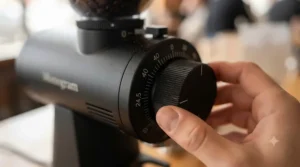
The most common upgrade path in home espresso is 64mm to 83mm, and the honest answer to “is it worth it” is: it depends what you’re chasing. Larger 83mm burrs rotate more slowly for equivalent output, which reduces frictional heat and helps preserve the more volatile aromatic compounds in lighter roasts — a real, measurable difference, not marketing fluff. Grind speed also improves meaningfully; most 83mm grinders on this list dispatch an 18-gram dose in five to six seconds, versus eight to ten seconds typical of a comparable 64mm unit.
| Factor | 83mm Flat Burr | 64mm Flat Burr | Best For |
|---|---|---|---|
| Grind speed (18g dose) | ~5–6 seconds | ~8–10 seconds | High-volume: 83mm |
| Heat generation | Lower at equal output | Higher at equal output | Light roasts: 83mm |
| Typical price floor | ~C$600+ | ~C$300+ | Tight budgets: 64mm |
| Counter footprint | Larger | More compact | Small kitchens: 64mm |
The catch, and it’s a real one debated at length on enthusiast forums, is that 83mm burr geometry as a category hasn’t always kept pace with the burr engineering refinements seen in newer 64mm and 80mm designs — some forum commentary argues 83mm burrs are simply an older, more widespread standard rather than an inherently superior one. In practice, that means the quality of the specific 83mm grinder matters more than the burr diameter alone; a well-engineered 64mm grinder from a reputable maker can outperform a poorly executed 83mm unit. Choose based on the models reviewed above, not the number on the spec sheet in isolation.
✨ Ready to feel the difference for yourself? Compare the seven models above against your current setup and see where the upgrade actually pays off.
Common Mistakes When Buying a Large Flat Burr Grinder
The single biggest mistake is buying based on burr size alone without checking whether the grinder is single-dose or hopper-fed — these are fundamentally different workflows, and mismatching one to your actual habits (say, buying a hopper grinder when you only ever make one cup) leads to daily friction that no amount of grind quality fixes. A close second is underestimating counter clearance; several 83mm hopper models exceed 40 centimetres in height with the hopper attached, and returns due to cabinet clearance issues are a recurring theme across retailer support pages.
Buyers also frequently skip budgeting for burr replacement or upgrade cycles, treating the grinder’s sticker price as the total cost of ownership when steel burrs in daily home use typically need replacement or resharpening within three to five years. Finally, a subtler mistake: assuming louder automatically means more powerful, or quieter automatically means weaker. The Ceado E37S disproves this directly, pairing genuinely quiet operation with commercial-grade 500-watt output through motor isolation engineering rather than by simply running the motor at a gentler pace.
What to Expect: Real-World Performance From 83mm Burrs
Spec sheets talk about RPM and wattage; your actual morning experience is quieter and more tactile than that. Expect the grind itself to feel and sound different from a smaller burr grinder — a lower-pitched hum rather than a high whine, and grounds that fall in a noticeably fluffier pile rather than clumping. Expect your first few shots after switching from a smaller burr grinder to taste cleaner and more separated in flavour, particularly with lighter, more acidic roasts where clarity differences are easiest to detect.
Expect a genuine learning curve on stepless adjustment collars if you’ve only used click-stop grinders before; there’s no “setting 12,” just a dial that moves continuously, so mark your preferred positions with a paint pen or piece of tape during your first few weeks. And expect retention figures on spec sheets to represent best-case scenarios — real-world retention creeps up slightly as burrs age and coffee oils build up in the chamber, which is exactly why the monthly deep-clean habit described earlier in this guide matters more with 83mm grinders than it might seem on day one.
83mm Flat Burr Grinder for Home Use: Where the Line Actually Sits
There’s a persistent myth that any 83mm grinder is automatically “too commercial” for a kitchen. That’s not quite right. Single-dose models built around 83mm burrs — the Turin DF83, DF83V, MiiCoffee Gen 2, and Niche Duo — were engineered from the ground up for household use, with compact footprints, no hopper requirement, and low-retention chutes designed around grinding one dose at a time rather than serving a queue of customers. These genuinely belong on a home counter, and treating them as “overkill” ignores how much the flavour clarity gain matters to someone drinking two or three cups daily for years.
Where the line gets real is with hopper-fed, hopper-based commercial units like the Mazzer Major, Fiorenzato F83E Pro, and Ceado E37S. These can absolutely live in a home kitchen — plenty of serious enthusiasts run a Mazzer Major at home — but the features you’re paying for (sustained high-volume throughput, multi-user memory settings, rush-hour thermal stability) go largely unused by a household of two grinding twenty grams a day. If that’s your situation, the Fiorenzato and Ceado in particular represent a genuine mismatch between what you’re paying for and what you’ll use, even though nothing stops you from owning one.
Commercial-Grade Grinder for Home Use: Is It Overkill?
The honest answer is “sometimes, and it depends what you’re actually optimizing for.” If your priority is grind quality and consistency alone, a well-chosen single-dose 83mm grinder like the Niche Duo delivers commercial-calibre results without commercial-calibre daily wear. If your priority includes longevity measured in decades rather than years, and you have the counter space and budget, a Mazzer Major or Ceado E37S bought for home use isn’t wasteful — it’s simply buying once instead of buying twice.
Where it tips into genuine overkill is burr-coating technology built for café throughput, like the Fiorenzato F83E Pro’s five-times-lifespan Dark-T coating rated for 900-plus kilograms per burr set. A household grinding roughly seven kilograms of coffee a year would take well over a century to exhaust that burr life — you’re paying a meaningful premium for durability you’ll functionally never approach. For most home buyers, the Mazzer Major or Ceado E37S sit at the genuine sweet spot between commercial-grade engineering and realistic home usage, while the Fiorenzato is better reserved for an actual business.
Long-Term Cost & Maintenance of 83mm Grinders
Sticker price is only the opening bid in total cost of ownership. Budget roughly C$150–C$300 for an eventual burr upgrade or replacement within three to five years of daily use, more if you’re grinding for a small business rather than a household. Electricity draw is genuinely negligible across this entire category — even the 680-watt DF83V motor runs for mere seconds per dose, amounting to pennies a month in most Canadian electricity markets.
Where cost differences actually compound is in burr longevity math. The Fiorenzato F83E Pro’s titanium-coated burrs, rated around five times the lifespan of standard steel, can mean avoiding one or two replacement cycles over a decade of café use — a genuine ROI case in a commercial setting grinding kilograms daily, even though that same math doesn’t apply to a home user grinding grams. On the flip side, entry-level models like the Turin DF83 use uncoated stainless burrs that will likely need replacement sooner in heavy use, but at a replacement cost low enough that the total lifetime expense often still lands below a single premium coated burr set. Run the numbers against your actual grinding volume, not the manufacturer’s marketing claims, before assuming the pricier coating pays for itself.
Features That Actually Matter (And Those That Don’t)
Genuinely matters: burr coating quality and documented lifespan claims, retention figures under real single-dose conditions rather than lab-ideal numbers, and motor thermal stability during back-to-back grinding — all three directly affect flavour and daily frustration. Stepless adjustment matters enormously if you experiment with roast levels; it matters far less if you dial in once and never touch the setting again.
Doesn’t matter nearly as much as marketing suggests: touchscreen displays, which look impressive but rarely outperform a well-designed physical dial for actual workflow speed; programmable dosing recipes, genuinely useful in a multi-barista café and almost entirely unused by a single home user who always makes the same drink; and RPM figures in isolation, since a well-engineered 1,400 RPM motor can outperform a poorly cooled 1,700 RPM one in sustained use. Read past the feature list to what a feature actually changes about your morning, not whether it sounds advanced on a spec sheet.
Safety, Certification, and Compliance for Canadian Buyers
Before you plug in any imported grinder — and a meaningful share of the models above ship direct from U.S. or overseas retailers — check for a recognized Canadian certification mark. Health Canada’s guidance is explicit: always check for CSA, cUL, or cETL certification marks before purchasing any electrical product that plugs into an outlet, since these marks confirm the product has been assessed against Canadian national safety standards, unlike a US-only UL mark, which carries no standing under Canadian provincial electrical codes. This matters more with grinders imported through smaller specialty retailers, where certification documentation isn’t always as visible as it is on mainstream Canadian marketplace listings.
Voltage compatibility is the second practical check: most of the grinders above ship in 110–120V configurations suited to Canadian outlets, but models sourced through international retailers occasionally arrive configured for 220–240V, requiring a step-down transformer that adds both cost and a small efficiency loss. Confirm your specific unit’s voltage and included plug type before ordering, particularly for direct-import grinders that don’t route through a Canadian distributor.
High-Volume Coffee Grinder Needs: When Espresso Shop Quality Actually Matters
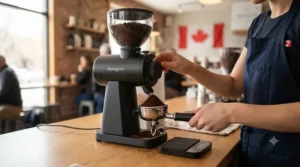
If you’re weighing this purchase for anything beyond a single household — a small café, an office break room serving a dozen colleagues, or a weekend market stall — the calculus shifts meaningfully. Espresso shop quality grinding isn’t primarily about burr size at that point; it’s about sustained thermal stability across dozens of consecutive doses, which is precisely where the Fiorenzato F83E Pro and Ceado E37S earn their commercial pricing. A grinder built for home single-dosing, run at café volume, will show its limits through motor heat and burr wear far faster than its spec sheet suggests, because those numbers are typically measured under intermittent, not sustained, use.
The practical threshold worth watching: once you’re grinding more than roughly one kilogram of coffee daily, sustained thermal performance starts mattering more than any other single spec on the sheet, and that’s the point where a genuine commercial 83mm grinder like the Mazzer Major stops being optional and becomes the only sensible choice. This shift toward home and small-business espresso investment tracks a broader pattern the Coffee Association of Canada has documented for years: espresso-based drinks now make up a rising share of what Canadians drink daily, pushing demand for equipment that used to live exclusively behind a café counter.
Frequently Asked Questions
❓ Is an 83mm flat burr grinder better than a 64mm grinder for espresso?
❓ How much does a good 83mm flat burr grinder cost in Canada?
❓ Can I use an 83mm flat burr grinder at home, or is it only for cafés?
❓ How long do 83mm flat burrs last before needing replacement?
❓ Do 83mm grinders work for filter coffee, not just espresso?
Conclusion
The jump to an 83mm flat burr grinder is one of the more genuinely meaningful upgrades available in home espresso, but “genuinely meaningful” doesn’t mean “one-size-fits-all.” A Turin DF83 and a Ceado E37S share a burr diameter and almost nothing else about their intended life — one is a scrappy weekend project for someone chasing clarity on a budget, the other is a decade-plus investment engineered for volume and quiet operation. The Niche Duo solves a real dual-brew-method problem most single-burr grinders paper over, while the Mazzer Major and Fiorenzato F83E Pro exist for people whose grinding needs have genuinely outgrown home-hobbyist scale.
What all seven share is the underlying physics that makes 83mm burrs worth considering in the first place: slower rotation, lower heat, faster throughput, and — assuming the rest of the engineering holds up its end of the bargain — a cleaner cup. Match the specific model to your actual daily habits rather than chasing the biggest spec on the sheet, and the upgrade pays for itself in flavour long before it pays for itself in resale value.
✨ Ready to pick the right 83mm flat burr grinder for your setup?
Revisit the comparison table, match your brew habits to the scenarios above, and make the call with real specs behind you instead of marketing copy. 💬☕
Recommended for You
- 64mm Flat Burr vs Conical Burr: 7 Grinders Ranked for 2026
- 64mm Flat Burr Grinder: 7 Best Picks for Canadian Baristas (2026)
- High End Conical Grinder Home Use: 7 Best Picks for 2026
Disclaimer: This article contains affiliate links. As an Amazon Associate, I earn from qualifying purchases. If you purchase products through these links, we may earn a small commission at no additional cost to you.
✨ Found this helpful? Share it with your friends! 💬🤗
