
In This Article
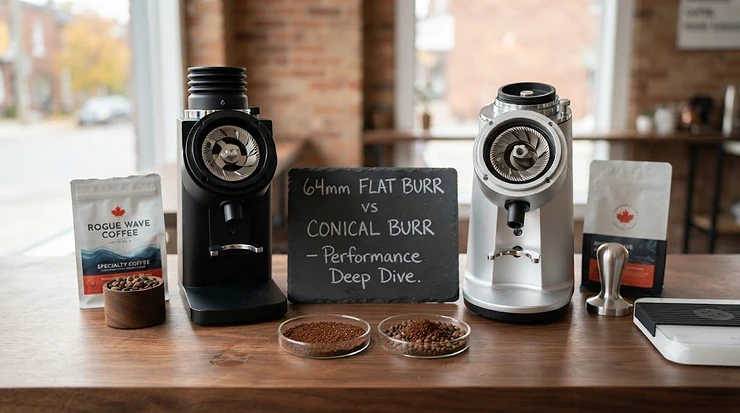
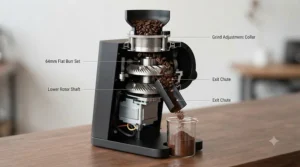
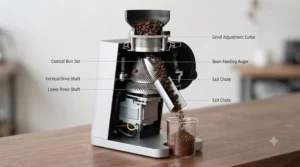
Somewhere between your third espresso shot of the week and your fifth trip down a coffee forum rabbit hole, the question always shows up: 64mm flat burr vs conical burr — does it actually matter, or is this just gear-nerd noise? Here’s the short answer, since Google likes short answers: a flat burr uses two ring-shaped cutting surfaces that shear beans between them, producing a tighter, more uniform particle size, while a conical burr uses a cone-shaped burr nested inside a ring, crushing and cutting beans in a way that tends to produce more body and sweetness with slightly less clarity. Neither is objectively “better” — they’re different tools tuned for different priorities in the cup.
This matters more than most spec sheets let on. Burr geometry shapes how evenly your coffee grinds, how much heat gets generated during grinding, and ultimately, whether your espresso tastes bright and articulate or round and syrupy. If you’ve ever pulled a shot that tasted muddled despite doing everything “right” — correct dose, correct time, decent beans — the grinder was very possibly the missing variable, not your technique.
Home espresso has genuinely taken off across the country too — espresso-based drinks are on the rise among Canadian coffee drinkers, and a good grinder is consistently the piece of gear that separates a decent home shot from a genuinely café-quality one. We dug into real specs, aggregated review sentiment, and side-by-side comparisons across seven actual grinders sold in Canada, spanning honest budget picks up through prosumer machines that cost as much as a decent espresso machine. Whether you’re chasing the cleanest possible flat burr grind or you want that classic conical sweetness in your cup, this guide breaks down what the burr shape actually does, which grinder fits which kind of coffee drinker, and where your money is genuinely well spent versus where you’re just paying for a badge.
Quick Comparison Table
| Grinder | Burr Type & Size | Best For | Price Range (CAD) |
|---|---|---|---|
| Breville Smart Grinder Pro | Conical, 40mm | Budget all-rounder, drip + espresso | Under C$300 |
| TIMEMORE Sculptor 064S | Flat, 64mm | Entry into 64mm flat burr territory | C$300-C$400 range |
| Turin DF64 Gen 2 | Flat, 64mm | Best value single-dose flat burr | C$400-C$500 range |
| Baratza Sette 270 | Conical, 40mm | Fast, timer-based espresso dosing | C$450-C$550 range |
| Fellow Ode Gen 2 | Flat, 64mm | Filter and pour-over clarity | C$350-C$450 range |
| Eureka Mignon Specialita | Flat, 55mm | Quiet, hopper-fed daily espresso | C$500-C$650 range |
| Niche Zero | Conical, 63mm | Premium single-dose sweetness | C$800-C$950 range |
At a glance, the split isn’t just flat versus conical — it’s also single-dose versus hopper-fed, and espresso-only versus do-it-all. Reviewers consistently note that the two 64mm flat burr grinders here (the DF64 Gen 2 and the Timemore Sculptor) punch well above their price for grind uniformity, while the Niche Zero commands a premium specifically for its conical sweetness and near-zero retention. If your budget caps out under C$400, the burr shape question gets simpler fast, since your real choice is between the Breville’s conical convenience and the Timemore’s flat burr clarity.
💬 Just one click — help others make better buying decisions too!😊
Top 7 Grinders: Expert Analysis
1. Breville Smart Grinder Pro — best budget conical for mixed brewing
The Smart Grinder Pro remains one of the most recommended entry-level grinders in Canada for a simple reason: it does drip, French press, and espresso reasonably well without demanding a burr-geometry PhD to operate.
Its 40mm conical burrs run at a lower speed than most flat burr competitors, which keeps heat transfer down and reduces the risk of scorching delicate light roasts. The 60-step grind adjustment covers everything from coarse cold brew to fine espresso, though “fine espresso” here is more approximate than precise — this isn’t a grinder built to chase micron-level consistency.
Based on the spec comparison with flat burr rivals in this list, the Smart Grinder Pro trades some clarity and uniformity for versatility and ease of use. It’s the grinder for someone who brews five different ways in one week, not the grinder for someone chasing competition-level espresso extraction. Reviewers consistently report that the LCD timer and dose-control presets make daily use painless, while a recurring complaint in user reviews is that grind consistency drops noticeably at the finest espresso settings compared to purpose-built single-dose machines.
Pros:
- ✅ Handles espresso, drip, and French press competently
- ✅ Digital timer with dose memory for consistency
- ✅ Widely available with accessible replacement parts
Cons:
- ❌ Grind consistency softens at the finest espresso settings
- ❌ Plastic hopper and body feel less premium than the price suggests
At around C$250-C$300, the Smart Grinder Pro is the sensible starting point if you’re not yet sure espresso is your permanent hobby, and it holds its value as a household all-purpose grinder even after you upgrade.
2. TIMEMORE Sculptor 064S — best entry into 64mm flat burr grinding
The Sculptor 064S is what happens when a well-regarded hand-grinder brand builds an electric single-doser around the same 64mm flat burr format used by grinders costing hundreds more.
Its stainless steel flat burrs deliver a genuinely tight particle distribution for the price bracket, and the stepless adjustment collar means you’re not locked into awkward “click” jumps between grind sizes. What most buyers overlook about this model is that it’s one of the few sub-C$400 grinders offering true single-dose workflow with minimal retention, rather than the compromise hopper-and-scrape setup common at this price.
Aggregated review sentiment on this grinder skews positive for cup clarity, with reviewers frequently comparing its espresso output favourably against machines nearly double its price. A common complaint in user reviews is that the anti-static performance is inconsistent, leading to some static cling in the catch cup during dry winter months — a minor annoyance, not a dealbreaker.
Pros:
- ✅ True 64mm flat burrs at a genuinely accessible price
- ✅ Stepless grind adjustment for fine-tuning espresso
- ✅ Compact footprint suits small kitchens
Cons:
- ❌ Static cling in the grounds cup during dry conditions
- ❌ Smaller motor than premium 64mm competitors, slower on coarse grinds
Priced in the C$300-C$400 range, this is the clearest argument that 64mm flat burr grinder worth it doesn’t have to mean spending C$800.
3. Turin DF64 Gen 2 — best value single-dose flat burr grinder
If there’s one grinder responsible for making 64mm flat burrs a mainstream home-espresso conversation, it’s this one. Flat burrs generally produce a tighter, more evenly clustered particle distribution than conical burrs, which tend to produce more spread with distinct clumps of fine and coarse particles, and the DF64 Gen 2 puts that theory to work at a price that undercuts nearly everything else with comparable burr size.
The 250-watt motor spins the 64mm burrs fast enough to grind a double-shot dose in well under fifteen seconds, and the bellows-based retention system means almost nothing gets left behind between doses. Here’s what to weigh: the stock burrs are good, not exceptional, but the format is industry-standard 64mm, so upgrading to premium aftermarket burrs later is genuinely straightforward rather than theoretical.
Reviewers consistently note that out-of-the-box grind quality already rivals grinders costing considerably more, though a recurring theme in feedback is that stock burr alignment can be slightly off and benefits from a quick at-home adjustment. Build quality gets generally strong marks, with the main criticism aimed at the plastic bellows cover, which some owners replace with an aftermarket silicone version.
Pros:
- ✅ Genuine 64mm flat burrs at a disruptive price point
- ✅ Fast grind speed with low single-dose retention
- ✅ Broad aftermarket burr compatibility for future upgrades
Cons:
- ❌ Stock burr alignment sometimes needs minor at-home tuning
- ❌ Plastic bellows cover feels cheap relative to the metal body
In the C$400-C$500 range, this is the grinder most often cited as the benchmark for “how much 64mm flat burr grinder do I actually need,” and for many home baristas, the honest answer is “not much more than this.”
4. Baratza Sette 270 — best fast conical for timer-based espresso
Baratza built its reputation on serviceable, repairable grinders, and the Sette 270 applies that philosophy to a straight-through conical design where the outer burr rotates around a fixed inner cone.
The 40mm conical burrs are smaller than the flat burr grinders on this list, but the straight-through mechanism nearly doubles usable grinding surface area for its size, which is why it grinds an 18-gram espresso dose in roughly eleven to twelve seconds — genuinely fast for a conical grinder. Three programmable timer presets mean you can save separate settings for ristretto, standard, and lungo pulls without re-dialing every morning.
Based on the spec comparison with pricier single-dose grinders here, the Sette 270 trades outright grind uniformity for workflow speed and repeatability, which matters enormously if mornings are rushed. Reviewers consistently praise the fluffy, low-clump texture the straight-through design produces, while a common thread in feedback is that the mostly-plastic exterior feels underbuilt relative to its price, even though the internal mechanism is genuinely well engineered.
Pros:
- ✅ Very fast grind speed thanks to straight-through design
- ✅ Three programmable timer presets for consistent dosing
- ✅ Backed by Baratza’s strong repairability and parts support
Cons:
- ❌ Plastic exterior feels less premium than the internal engineering
- ❌ Hopper-based workflow adds more retention than true single-dosers
Landing in the C$450-C$550 range, the Sette 270 is the pick for anyone who values speed and repeatable dosing over squeezing out the last percentage point of grind uniformity.
5. Fellow Ode Gen 2 — best flat burr grinder for filter and pour-over clarity
Fellow designed the Ode Gen 2 specifically to fix what the original Ode got criticized for: fines management on lighter, filter-style grinds. It still uses 64mm flat burrs, but the burr geometry is cut for coarser, more filter-friendly particle sizes rather than espresso-fine.
That’s the key distinction reviewers and buyers should understand here — this is a 64mm flat burr grinder, but it isn’t optimized the same way as the DF64 or Specialita for pulling shots. What most buyers overlook is that Fellow explicitly designed this burr set to reduce the fine-particle “dust” that muddies pour-over clarity, which flat burrs are otherwise sometimes criticized for producing in filter applications.
Aggregated review sentiment is strongly positive for pour-over and drip use, with reviewers repeatedly highlighting how much cleaner and brighter their filter coffee tastes compared to conical alternatives at a similar price. A recurring complaint is that while an espresso kit conversion exists, out-of-the-box this isn’t the grinder for a household focused primarily on shots.
Pros:
- ✅ 64mm flat burrs purpose-cut for filter-coffee clarity
- ✅ Quiet, low-vibration operation suited to early mornings
- ✅ Sleek, compact design that fits small counters
Cons:
- ❌ Not optimized out-of-the-box for fine espresso grinding
- ❌ Espresso capability requires an optional accessory kit
At C$350-C$450, the Ode Gen 2 answers a slightly different version of the flat burr sweetness espresso question — it’s less about espresso sweetness and more about filter-coffee transparency, which is worth knowing before you buy.
6. Eureka Mignon Specialita — best quiet daily-driver flat burr espresso grinder
The Mignon Specialita takes a different approach to flat burrs: instead of chasing the largest possible burr diameter, Eureka builds a 55mm flat burr set into a hopper-fed grinder engineered around quiet, repeatable, everyday espresso use.
The touchscreen timer interface handles dosing, and the stepless micrometric adjustment collar lets you make genuinely tiny grind-size changes — useful given how sensitive espresso extraction is to grind size drift day to day. On paper this means slightly slower grinding than the 64mm competitors here, since smaller burrs cover less surface area per rotation, but in practice the difference in everyday dial-in speed is minor.
Reviewers consistently single out the Specialita’s low noise level as a standout feature, frequently describing it as one of the quietest flat burr grinders available at this tier, which matters if you’re grinding before the rest of the household wakes up. A common complaint in aggregated feedback is that retention runs higher than true single-dose grinders, so bean-switching enthusiasts may find themselves purging more grounds than they’d like.
Pros:
- ✅ Genuinely quiet operation for early-morning grinding
- ✅ Touchscreen timer with precise stepless adjustment
- ✅ Compact, well-built body that suits smaller kitchens
Cons:
- ❌ Higher retention than single-dose-focused competitors
- ❌ Smaller 55mm burrs grind more slowly than 64mm rivals
In the C$500-C$650 range, the Specialita is best understood as the answer to which burr shape is better for espresso when your top priority is quiet, consistent, low-effort daily use rather than maximum single-dose freshness.
7. Niche Zero — best premium conical burr grinder for espresso sweetness
The Niche Zero earned cult status by putting genuine 63mm Mazzer-sourced conical burrs — the same burrs used in commercial Mazzer Kony grinders — into a compact, single-dose home unit with claimed near-zero retention.
Because the burrs spin slower than most flat burr competitors, heat transfer into the coffee stays low, which reviewers and independent testers alike connect to the grinder’s reputation for producing shots with more perceived body and sweetness. Extensive owner testing consistently describes the resulting espresso as rich-bodied with pronounced sweetness and strong shot-to-shot consistency once the dial is set. That’s a meaningful, honest distinction from the flat burr grinders on this list: this is where conical vs flat burr crema and mouthfeel differences become genuinely noticeable in the cup, not just theoretical.
Here’s what the spec sheet won’t tell you, but user reports consistently confirm: the stepless dial makes micro-adjustment satisfying but occasionally fiddly compared to click-based systems, and availability has historically run tight, with wait times stretching for popular colourways. Reviewers overwhelmingly praise build quality and cup consistency, while the most consistent criticism across aggregated feedback is straightforward — it’s genuinely expensive for a single-purpose home grinder.
Pros:
- ✅ Commercial-grade 63mm conical burrs sourced from Mazzer
- ✅ Near-zero retention with a true single-dose workflow
- ✅ Exceptional shot-to-shot consistency once dialled in
Cons:
- ❌ Premium pricing relative to comparable flat burr alternatives
- ❌ Stepless adjustment can feel fiddly for fine espresso tuning
At C$800-C$950, the Niche Zero isn’t for everyone, but for a single-drink household that values sweetness and near-zero waste over raw grind speed, it remains the clearest example of what dedicated conical burr engineering can deliver.
Practical Usage Guide: Setting Up Your New Grinder Right
Whichever burr shape you land on, the first thirty days determine whether your grinder performs like the reviews promised or leaves you wondering what the hype was about. This matters more now than ever, since the home brewing boom has permanently reshaped how specialty coffee is consumed, with roasters increasingly designing coffee specifically for careful home extraction rather than café-only profiles. Start by running a small batch of cheap, uniform beans through the grinder before your good coffee ever touches the hopper — this clears manufacturing dust and lets you find your rough grind-size zone without wasting specialty beans on dial-in guesswork.
For single-dose flat burr grinders like the DF64 Gen 2 or Timemore Sculptor, invest five minutes in learning proper RDT (ratio dosing technique, essentially a light water mist on beans before grinding) — it meaningfully cuts static clumping in the catch cup. For hopper-fed machines like the Specialita or Breville, set a reminder to purge and clean the burr chamber every one to two weeks if you switch bean origins often, since retained grounds from a previous bag will taint fresh flavour more than most people expect.
The most common first-month mistake, across every grinder in this guide, is over-adjusting the grind size after a single bad shot. Coffee extraction has enough variables — bean freshness, dose weight, tamping pressure, water temperature — that changing your grind setting should be a last resort, not a first reaction. Give any adjustment at least two full shots before deciding whether it actually helped.
Real-World Scenarios: Which Grinder Fits Your Coffee Life
If you’re a university student in a shared apartment brewing one espresso before an 8 a.m. class, the TIMEMORE Sculptor 064S or Breville Smart Grinder Pro make more sense than a Niche Zero — you need reliability and a manageable footprint, not commercial-grade sweetness you won’t have time to appreciate anyway. If you’re a household of two espresso drinkers who each want a slightly different roast profile some mornings, the DF64 Gen 2’s single-dose workflow and fast bean-swapping become genuinely valuable rather than a nice-to-have.
For the home barista who brews both pour-over on weekends and espresso on weekdays, pairing priorities matters more than chasing one “best” burr shape — the Fellow Ode Gen 2 for filter clarity alongside a dedicated espresso grinder is a defensible two-grinder strategy, though admittedly not a cheap one. And for the enthusiast who has already tried a sub-C$500 grinder and knows, with certainty, that this hobby isn’t going anywhere, the Niche Zero or Eureka Mignon Specialita reward that commitment with a noticeably more consistent, sweeter cup day after day.
Buyer’s Decision Framework
If your budget caps under C$400 and you brew multiple methods, choose a conical hopper grinder like the Breville Smart Grinder Pro, because versatility matters more than burr-shape purity at this price. If your budget caps under C$400 but espresso is your only priority, choose the TIMEMORE Sculptor 064S, because true 64mm flat burrs at this price outperform conical alternatives for espresso clarity.
If you want the best value 64mm flat burr grinder available in Canada without compromise, choose the Turin DF64 Gen 2, because its price-to-performance ratio remains unmatched among single-dose flat burr options. If quiet, hands-off daily espresso matters more than single-dose freshness, choose the Eureka Mignon Specialita. If sweetness, body, and near-zero retention justify a genuine investment, choose the Niche Zero — it’s the clearest expression of what dedicated conical burr engineering delivers.
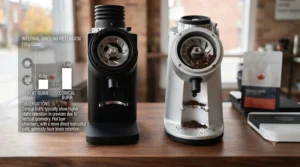
Flat Burr vs Conical Burr: The Real Taste Difference
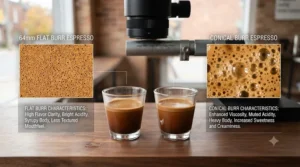
The flat burr vs conical taste difference isn’t marketing spin — it comes down to how each burr grinder geometry shears beans and how that particle distribution behaves during extraction. Flat burrs, spinning between two parallel ring-shaped surfaces, tend to produce a tighter, more unimodal particle size, which generally reads in the cup as brighter, more articulate acidity and clearer separation of individual flavour notes.
Conical burrs, by contrast, crush and cut in a way that produces a wider particle distribution with more fine and coarse particles alongside the target size. What most buyers overlook about that “wider distribution” is that it isn’t automatically worse — it’s a different extraction profile. Those extra fines and boulders tend to extract at different rates, and the net effect reviewers consistently describe is more perceived body, more sweetness, and a rounder, softer overall mouthfeel, at some cost to top-end clarity.
Neither profile is a flaw. If you’re chasing single-origin transparency — tasting the actual difference between an Ethiopian and a Colombian lot — flat burr sweetness espresso setups tend to reveal that more readily. If you want a forgiving, comforting, crowd-pleasing shot that holds up well in milk drinks, conical burr grinders like the Niche Zero consistently earn praise for exactly that quality.
Benefits vs Traditional Blade Grinders
| Factor | Burr Grinder (Flat or Conical) | Traditional Blade Grinder |
|---|---|---|
| Particle consistency | High — uniform sizing | Low — random chopping |
| Espresso suitability | Excellent | Poor to unusable |
| Heat generation | Low to moderate | High, risk of scorching |
| Best For | Espresso, pour-over, French press | Rarely recommended today |
This table exists mostly to close the door on a question we still see in comment sections: no, a blade grinder cannot substitute for either burr type here. Reviewers and coffee scientists alike agree that inconsistent particle sizing from blade grinders leads directly to uneven extraction — some grounds over-extracted and bitter, others under-extracted and sour, often in the same cup. If you’re investing in good beans, a burr grinder of either shape is the non-negotiable first upgrade, well ahead of a fancier espresso machine.
✨ Don’t Miss These Exclusive Deals!
🔍 Take your home espresso setup to the next level with these carefully selected grinders. Click on any highlighted item to check current pricing and availability. These tools will help you pull consistently great shots your whole household will actually enjoy!
How to Choose Between a 64mm Flat Burr and a Conical Burr Grinder
- Identify your primary brew method first. If espresso dominates your routine, prioritize grinders with fine, stepless adjustment regardless of burr shape.
- Decide how much you value sweetness versus clarity. Conical burrs skew toward sweetness and body; flat burrs skew toward clarity and origin transparency.
- Weigh single-dose versus hopper-fed workflows. Single-dosers minimize retention and waste but demand more manual weighing each session.
- Check upgrade potential. True 64mm flat burr grinders like the DF64 Gen 2 accept a wide range of aftermarket burrs; smaller or proprietary burr sizes limit that path.
- Account for noise tolerance. If you’re grinding before others wake up, prioritize models like the Specialita that reviewers describe as notably quiet.
- Set a realistic total budget. Factor in a basic scale and tamper alongside the grinder — a great grinder paired with inconsistent dosing still produces inconsistent shots.
- Read aggregated reviews for your specific bean style. Light, fruity single-origins reward flat burr clarity more visibly than dark, oily blends do.
Common Mistakes When Buying a Burr Grinder
The single most common mistake is buying based on burr size alone, assuming “64mm beats 55mm” in every scenario — burr size is one input among several, and a well-engineered 55mm flat burr set like the Specialita’s can outperform a poorly aligned larger burr. A close second is underestimating retention: buyers focused entirely on grind quality sometimes end up with a hopper-fed grinder that wastes several grams of stale coffee every time they switch beans, quietly costing more over a year than the price difference toward a single-dose model would have.
Another frequent misstep is ignoring noise levels entirely until the grinder is already running at 6 a.m. in a shared living space. And finally, many first-time buyers skip budgeting for basic accessories — a decent scale, a proper tamper, distribution tools — then wonder why their expensive new 64mm flat burr grinder isn’t producing café-quality shots on its own. The grinder is necessary but not sufficient.
What to Expect: Real-World Performance
Spec sheets rarely translate directly into lived experience, so here’s the honest, everyday version. A well-aligned 64mm flat burr grinder like the DF64 Gen 2 will typically grind an 18-gram double shot in ten to fifteen seconds, with a texture that looks and feels notably more uniform than a blade grinder’s output — almost powder-fine and consistent when viewed closely. Conical grinders like the Niche Zero run slower, often closer to fifteen to eighteen seconds for the same dose, trading a bit of speed for lower heat transfer.
In the cup, the difference is subtler than marketing copy suggests but real once you’re tasting side by side. Flat burr shots tend to hit with brighter acidity up front and a cleaner finish; conical burr shots tend to feel rounder and sweeter through the middle of the sip, with slightly less defined edges between flavour notes. Neither is wrong — this is genuinely closer to a preference question than a quality question once you’re comparing grinders in the same price tier.
64mm Flat Burr Grinder: Is It Actually Worth It?
Given that a genuine 64mm flat burr grinder like the DF64 Gen 2 can now be had for roughly the same price as many mid-tier 40mm conical models, the honest answer to 64mm flat burr grinder worth it is: for most espresso-focused home baristas, yes. Larger flat burrs generally grind faster and cooler per gram than smaller burrs at equivalent RPM, and the format’s popularity means aftermarket burr upgrades are genuinely accessible rather than a specialty-shop hunt.
That said, “worth it” depends heavily on what you’re comparing against. If your realistic alternative is a well-regarded smaller flat burr or a genuinely excellent conical grinder like the Niche Zero, burr size alone won’t settle the decision — burr quality, motor consistency, and retention design matter just as much. The 64mm format’s real advantage shows up most clearly in speed and future upgrade headroom, not necessarily in day-one cup quality versus every competitor.
Long-Term Cost & Maintenance
A burr grinder’s total cost of ownership extends well past the sticker price, and this is where flat and conical burrs diverge again. Flat burrs generally show wear more gradually and, in standard 64mm formats, are inexpensive and easy to replace when they eventually dull — usually somewhere between 500 and 1,000 pounds of coffee for home use, though heavy daily use can shorten that window. Conical burrs, particularly commercial-sourced sets like the Niche Zero’s, are often prized specifically for outlasting comparable flat burr sets, but replacement costs run higher when that day eventually comes.
Maintenance itself is straightforward across every grinder on this list: a monthly brush-down of the burr chamber, occasional use of grinder-cleaning tablets for oily beans, and periodic burr alignment checks on flat burr models. Budget roughly C$60-C$120 CAD annually for cleaning supplies and eventual small parts across most of these grinders — a modest add-on relative to the grinder’s purchase price, but one that’s easy to forget when comparing sticker prices alone.
Features That Actually Matter (And Those That Don’t)
Stepless micro-adjustment genuinely matters for espresso, since even a fraction-of-a-millimetre shift in grind size can push a shot from sour to balanced to bitter. Low retention genuinely matters if you switch beans often, since stale leftover grounds contaminate the next dose’s flavour more than most buyers expect going in. Burr size, on its own, matters less than marketing implies — it correlates with speed and heat management, but it isn’t a direct proxy for cup quality once you’re comparing well-engineered grinders within a similar price bracket.
Touchscreen interfaces and app connectivity, meanwhile, are genuinely pleasant but rarely decisive — reviewers who own both simple dial-based grinders and app-connected ones consistently report that the actual cup quality difference comes down to burr geometry and alignment, not the control panel. If a grinder’s marketing leans heavily on its display and light show rather than its burr specs, that’s worth noticing.
Safety and Certification: What to Check Before You Buy
Any electric grinder you plug in at home should carry a recognized Canadian certification mark. Health Canada advises that consumers should always check for certification marks such as CSA, cUL, or cETL before purchasing electrical products, since these marks confirm the product has been assessed against the required Canadian national safety standard — and counterfeit or uncertified units, increasingly common with lesser-known imported grinders, can pose real electrical hazards. Every grinder featured in this guide is sold through established retail channels carrying appropriate certification, but it’s a habit worth applying to any future coffee gear purchase, especially smaller import-only brands.
Beyond electrical certification, basic grinder safety is common sense: unplug before disassembling for cleaning, keep the burr chamber clear of foreign objects (a stray stone in a bag of beans can chip a burr), and follow the manufacturer’s guidance on bean oiliness if you’re grinding darker, oilier roasts regularly.

Frequently Asked Questions
❓ Is a flat burr better than a conical burr for espresso?
❓ Do 64mm burrs grind faster than smaller burrs?
❓ Why is the DF64 Gen 2 so much cheaper than the Niche Zero?
❓ Can I upgrade the burrs on a budget grinder later?
❓ How often should I clean my burr grinder?
Conclusion
The 64mm flat burr vs conical burr debate isn’t really about crowning one design the winner — it’s about matching burr geometry to the coffee experience you actually want. Flat burrs, especially in the increasingly accessible 64mm format led by grinders like the Turin DF64 Gen 2, reward drinkers chasing clarity, origin transparency, and speed. Conical burrs, exemplified at the top end by the Niche Zero, reward drinkers who prioritize sweetness, body, and a forgiving, consistent cup.
Budget plays its part too. You don’t need to spend C$800-plus to get a legitimately good grinder in either category — the TIMEMORE Sculptor 064S and Breville Smart Grinder Pro both prove that solid grinding is available well under C$400 if you’re realistic about which trade-offs matter to you. Wherever you land, the upgrade from a blade grinder (or an inconsistent hopper grinder) to any well-built burr grinder on this list will be the single biggest improvement you can make to your home espresso, full stop.
Recommended for You
- 64mm Flat Burr Grinder: 7 Best Picks for Canadian Baristas (2026)
- High End Conical Grinder Home Use: 7 Best Picks for 2026
- Best Conical Burr Grinder $100–$300 Canada: 7 Top Picks (2026)
Disclaimer: This article contains affiliate links. As an Amazon Associate, I earn from qualifying purchases. If you purchase products through these links, we may earn a small commission at no additional cost to you.
✨ Found this helpful? Share it with your friends! 💬🤗
