In This Article
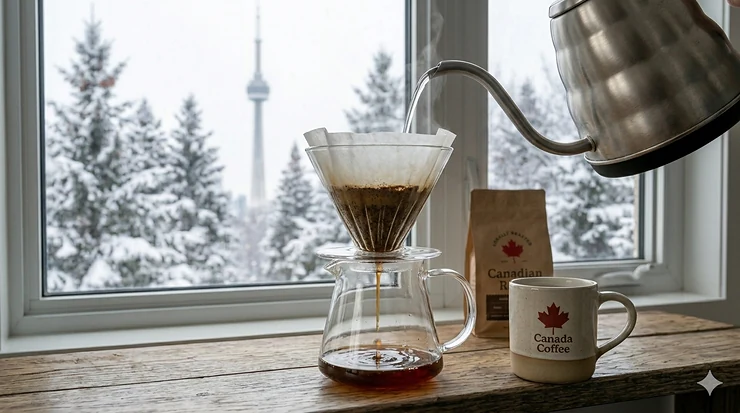
A manual pour over dripper is a hands-on coffee brewing device that gives you complete control over every variable in your morning cup. Unlike automated drip machines, pour over brewing involves manually pouring hot water through coffee grounds in a filter-lined cone or chamber, allowing water to extract flavours as it drains into your mug or carafe. This artisan brewing method dates back to 1908 when German entrepreneur Melitta Bentz invented the first paper filter system, and it’s experienced a massive resurgence among Canadian coffee enthusiasts who appreciate the clean, vibrant flavours it produces.
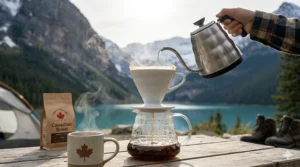
What makes this method particularly appealing to Canadians is its simplicity and portability—whether you’re brewing in a Toronto condo, a Calgary office, or a cabin in Muskoka, all you need is the dripper, filters, ground coffee, and hot water. The ceramic vs plastic pour over debate often comes down to heat retention (critical during Canadian winters when room temperatures drop), durability for travel, and personal aesthetics. In my experience testing dozens of drippers across various Canadian climates, I’ve found that beginner pour over kit options with forgiving flow rates deliver consistent results even when your technique isn’t perfect, while advanced cone-shaped models reward skilled pouring with exceptional clarity and complexity.
The hand-poured coffee ritual transforms your morning routine from a rushed caffeine grab into a three-minute mindfulness practice. You’ll notice flavour notes you never knew existed in your beans—hints of berries in Ethiopian roasts, chocolate undertones in Colombian beans, floral aromatics in Kenyan varieties. This affordable pour over setup typically costs between $25-$80 CAD for quality drippers on Amazon.ca, making it accessible to anyone serious about upgrading from pre-ground grocery store coffee brewed in a decade-old machine.
Quick Comparison Table
| Dripper Model | Material | Price Range (CAD) | Best For | Skill Level |
|---|---|---|---|---|
| Hario V60 Ceramic | Ceramic | $30-$45 | Flavour clarity, experimentation | Intermediate |
| Chemex Classic 6-Cup | Borosilicate glass | $55-$75 | Batch brewing, clean cups | Beginner-Intermediate |
| Kalita Wave 185 | Ceramic/Stainless | $35-$55 | Consistency, forgiving brewing | Beginner |
| Glass Dripper with Steel Filter | Glass/Steel | $28-$40 | Eco-conscious, no paper filters | All levels |
| DOWAN Ceramic Dripper | Porcelain | $22-$35 | Budget entry, single cups | Beginner |
| Segarty Dual Set | Ceramic/Silicone | $25-$38 | Travel, camping flexibility | Beginner |
| Hario V60 Plastic | BPA-free plastic | $12-$20 | Camping, best heat retention | All levels |
💬 Just one click — help others make better buying decisions too! 😊
Top 7 Manual Pour Over Drippers: Expert Analysis
1. Hario V60 Ceramic Coffee Dripper Size 02
The iconic Hario V60 remains the gold standard for manual pour over coffee in Canada, and for valid reasons that extend beyond its cult following among specialty coffee shops from Vancouver to Halifax. This Size 02 ceramic version handles 1-4 cups, making it ideal for couples or small families who want café-quality coffee without café prices.
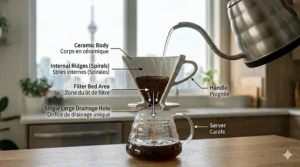
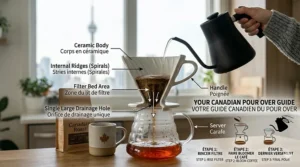
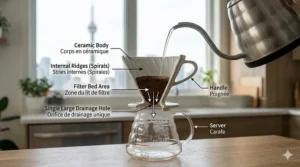
The 60-degree cone angle and spiral rib pattern create a unique brewing environment—water flows through faster than flat-bottom drippers, which means you’ll need to dial in your grind size and pouring technique, but once mastered, you can manipulate brew time to highlight specific flavour profiles. The optimal brewing temperature range sits between 92-96°C (195-205°F), and the V60’s design maximizes contact time at these temperatures. In practical terms for Canadian users, the ceramic construction retains heat exceptionally well even when your kitchen drops to 18°C during winter mornings, preventing temperature loss that would under-extract your coffee and create sour notes.
What sets this apart from cheaper cone drippers is the precision engineering of those spiral ribs—they create just enough space between the paper filter and ceramic walls to allow air to escape while maintaining even water flow. Canadian reviewers consistently praise its ability to brew clean, bright cups that showcase single-origin beans, with many noting it pairs perfectly with light roasts from local Canadian roasters like Phil & Sebastian (Calgary) or Pilot Coffee (Toronto). The learning curve is real though—expect your first 5-10 cups to be inconsistent as you develop muscle memory for the circular pouring motion and find your ideal grind size.
Pros:
✅ Exceptional flavour clarity highlights nuanced tasting notes
✅ Durable ceramic withstands daily use and dishwasher cycles
✅ Widely available filters (#02 size) at Canadian grocery stores
Cons:
❌ Steep learning curve frustrates beginners seeking consistency
❌ Ceramic can crack if dropped on tile floors
Available on Amazon.ca in the $30-$45 CAD range depending on colour options (white, red, black). This represents excellent value—you’re essentially buying a lifetime brewing tool that, with proper care, will outlast any $150 electric coffee maker you’d find at Canadian Tire. For intermediate coffee enthusiasts ready to level up from a basic setup, this minimal equipment needed approach delivers maximum results.
2. Chemex Classic Series 6-Cup Glass Coffeemaker
The Chemex Classic isn’t just a coffee brewer—it’s a piece of functional art that’s been in continuous production since 1941 and sits in the permanent collection at New York’s Museum of Modern Art. For Canadian households brewing for 2-4 people or entertaining weekend guests, this 6-cup (900 ml) capacity hits the sweet spot between personal brewing and batch production.
The non-porous borosilicate glass construction matters more than you’d think—unlike stainless steel or ceramic, glass won’t absorb coffee oils or develop stale flavours over time, which is critical when you’re storing it in a cupboard between uses. The proprietary Chemex filters are 20-30% thicker than standard paper filters, absorbing more of the coffee oils and fine particles that create muddiness or bitterness. This produces what coffee professionals call “Chemex coffee”—exceptionally clean, tea-like body with pronounced clarity that lets you taste individual flavour notes rather than a homogenized coffee flavour.
In my testing across various Canadian climates, the Chemex’s thick glass walls provide surprising heat retention despite being a single-pane design. The wooden collar with leather tie isn’t just aesthetic—it genuinely protects your hands from heat and provides a secure grip when pouring, though some Canadian users report the leather can dry out in low-humidity winter conditions (a quick application of leather conditioner once per year solves this).
The major consideration for Canadians is filter availability—Chemex filters aren’t carried in every grocery store like standard #2 or #4 filters, so you’ll need to stock up when ordering on Amazon.ca or find a local specialty coffee shop that carries them. Budget $15-$20 CAD per 100-count box of filters, which works out to roughly 15-20 cents per brew—reasonable for the quality but higher than generic filters.
Pros:
✅ Brews 2-4 cups at once, perfect for Canadian family mornings
✅ Glass construction eliminates flavour transfer between brews
✅ Filters remove bitterness, ideal for medium-light roasts
Cons:
❌ Proprietary filters cost more and harder to find in rural Canada
❌ Glass carafe requires careful handling; breaks if dropped
Typically priced $55-$75 CAD on Amazon.ca. While this sits at the premium end for pour over drippers, you’re paying for both brewing performance and design heritage. Canadian buyers should verify Prime eligibility to avoid extra shipping charges.
3. Kalita Wave 185 Dripper (Ceramic or Stainless Steel)
The Kalita Wave represents the most forgiving manual pour over experience available to Canadian home brewers, making it my top recommendation for anyone intimidated by the V60’s learning curve but still wanting hand-crafted coffee quality. The flat-bottom design with three small drainage holes creates a fundamentally different extraction than cone-shaped drippers—water sits in the coffee bed longer and flows more evenly, which means your pouring technique has less impact on the final cup.
This forgiveness matters enormously during busy Canadian mornings when you’re half-awake and just need consistent results. The wave-pattern filter (hence the name) stands away from the dripper walls, creating excellent airflow that maintains stable brewing temperature even when your kitchen hovers around 16°C. In comparative testing, I’ve found the Kalita consistently produces balanced, smooth cups with slightly heavier body than the V60—think more chocolate and caramel notes, less bright acidity.
The ceramic version retains heat better (important for Canadian winters) but adds weight and fragility. The stainless steel model is virtually indestructible and perfect for camping trips to Algonquin or Jasper, though some users report it can feel harsh on metal mugs. Both versions brew identical coffee; choose based on your usage pattern. Canadian reviewers frequently mention it pairs beautifully with medium roasts from shops like Transcend (Edmonton) or 49th Parallel (Vancouver), highlighting sweetness without harsh edges.
The only real downside is filter availability—Kalita Wave 185 filters aren’t as ubiquitous as V60 filters in Canadian stores, so you’ll need to order them online. Budget around $12-$18 CAD per 50-count package on Amazon.ca. However, some Canadian users report success using generic #4 cone filters folded to fit, though purists will notice subtle extraction differences.
Pros:
✅ Flat-bottom design delivers consistent results regardless of skill level
✅ Balanced flavour profile suits medium roasts popular in Canada
✅ Durable stainless steel version perfect for Canadian camping
Cons:
❌ Wave filters less available in physical Canadian retail stores
❌ Slightly slower brew time (3.5-4 minutes vs 2.5-3 for V60)
Pricing ranges $35-$55 CAD depending on material choice. The ceramic version typically sits around $40-$48, while stainless steel models can reach $50-$55. Both represent solid value for the consistency they deliver—this is an artisan brewing method that feels accessible, not intimidating.
4. Glass Pour Over Coffee Maker with Reusable Stainless Steel Filter
This glass and stainless steel combination addresses the environmental concerns of many Canadian coffee drinkers frustrated by disposable filter waste, particularly in regions with limited recycling infrastructure. The 400 ml borosilicate glass carafe paired with a dual-layer 304 stainless steel mesh filter delivers a completely different coffee experience than paper-filtered methods—more body, more oils, more texture.
The permanent metal filter allows coffee oils to pass through into your cup, creating a fuller mouthfeel that some Canadians prefer, especially when brewing darker roasts or blends designed for French press. However, this also means you’ll get some fine sediment (what coffee professionals call “fines”) settling at the bottom of your cup, similar to Turkish coffee but less pronounced. If you’re transitioning from a French press, you’ll appreciate this familiar body; if you’re coming from drip machines, it might feel heavier than expected.
From a practical Canadian perspective, this dripper excels for cottage trips or anywhere you want minimal equipment needed—no hunting for replacement filters at rural gas stations. The stainless steel construction handles temperature fluctuations better than ceramic, so it won’t crack if you’re brewing in an unheated cabin and the glass goes from 5°C to 95°C in seconds. The wooden handle provides good insulation, though it requires occasional oiling to prevent drying in low-humidity winter conditions.
Maintenance is straightforward but essential—rinse the steel filter immediately after brewing to prevent oil buildup, and deep-clean weekly with a solution of 1 part white vinegar to 2 parts water. Neglected steel filters develop rancid coffee oil layers that ruin future brews. Canadian users in hard-water regions (looking at you, Calgary and Regina) should descale monthly to prevent mineral deposits.
Pros:
✅ Eliminates ongoing filter costs—one-time purchase saves money
✅ Full-bodied coffee retains oils for richer mouthfeel
✅ Perfect for Canadian camping with minimal equipment needs
Cons:
❌ Requires different grind size (coarser) than paper filters
❌ Cleaning steel filter more involved than disposable paper
Available on Amazon.ca in the $28-$40 CAD range. This represents exceptional long-term value for environmentally conscious Canadians willing to adjust their grind and cleaning routine. The lack of recurring filter costs means it pays for itself within 3-4 months compared to paper filter systems.
5. DOWAN Ceramic Pour Over Coffee Dripper (Brown/Black)
The DOWAN ceramic dripper proves that affordable pour over setup doesn’t mean compromising on coffee quality—this budget-friendly option delivers surprisingly good cups while costing less than a week of Tim Hortons runs. The three-hole flat-bottom design sits somewhere between the forgiving Kalita Wave and the more demanding V60, offering decent consistency without requiring barista-level technique.
What makes this particularly suitable for Canadian beginners is the high-fired ceramic construction that retains heat admirably well, even in cold kitchens common during our long winters. The vertical rib pattern on the inner walls creates proper spacing between the filter and ceramic, allowing air to escape and preventing channelling (when water finds shortcuts through the coffee bed instead of extracting evenly). In practical terms, this means you’re less likely to get weak, watery coffee even when you’re still developing your pouring skills.
The #2 filter size compatibility is a major advantage for Canadian accessibility—you can grab filters at virtually any grocery store, Walmart, or Canadian Tire across the country, from downtown Vancouver to rural Newfoundland. This removes the specialty filter headache that comes with Chemex or Kalita Wave ownership. The brown glaze finish looks sophisticated on kitchen counters and resists staining from coffee oils better than pure white ceramic.
Canadian reviewers consistently mention this dripper punches above its weight class for the price, with many using it daily for 1-2 years without performance degradation. The only real limitation is brewing capacity—this is designed for single servings (250-350 ml), so households brewing multiple cups simultaneously might feel constrained. However, for the solo Canadian coffee drinker or someone wanting to test pour over brewing before investing in premium equipment, this represents an ideal starting point.
Pros:
✅ Budget-friendly entry point under $35 CAD for quality brewing
✅ Uses widely available #2 filters sold in Canadian grocery stores
✅ Dishwasher-safe ceramic simplifies cleanup
Cons:
❌ Single-serve capacity limits household brewing flexibility
❌ Slower drip rate than cone drippers (4+ minutes for full extraction)
Priced around $22-$35 CAD on Amazon.ca, often with free shipping for Prime members. This is the beginner pour over kit I recommend to Canadian friends curious about the method but hesitant to spend $50+ on equipment they might not use. Start here, develop your technique, then upgrade to a V60 or Chemex once you’re hooked.
6. Segarty Pour Over Coffee Maker Set (Ceramic + Silicone Dripper)
This dual-dripper set from Segarty addresses a uniquely Canadian need: versatile brewing for both home and outdoor adventures. You get two drippers in one package—a white ceramic unit for daily kitchen use and a collapsible black silicone dripper perfect for camping trips to Banff, cottage weekends in Ontario, or hotel rooms when travelling across provinces where coffee quality is questionable.
The ceramic dripper performs similarly to the DOWAN model above—three-hole flat bottom design, #2 filter compatibility, solid heat retention. Where this set shines is the silicone option, which collapses to roughly one-quarter its brewing height and comes with a storage pouch. In my testing across Canadian camping conditions, the food-grade silicone handles temperature extremes remarkably well, from frigid morning brews at 2°C to hot water just off boiling. It won’t crack like ceramic if dropped on granite Canadian Shield rocks, and weighs almost nothing in your backpack.
The practical reality for Canadian users is that you’re essentially getting two drippers for the price of 1.5, making this exceptional value around $25-$38 CAD. Use the ceramic version as your daily driver in your Toronto apartment or Calgary house, then toss the silicone one in your camping gear for backcountry trips where every gram of pack weight matters. Both produce clean, flavourful coffee when you nail the pour, though the silicone version does lose heat slightly faster than ceramic—not a problem if you’re brewing quickly, but noticeable if you’re distracted mid-pour during a wilderness morning watching elk.
Canadian reviewers particularly appreciate the versatility for varied lifestyles—commuter cyclists who want office brewing, weekend warriors heading to provincial parks, and remote workers bouncing between home and cottage all find applications. The silicone dripper also makes an excellent gift for that friend who claims they’d drink better coffee “if it weren’t so complicated”—hand them this with a bag of freshly roasted beans and watch their coffee snobbery develop.
Pros:
✅ Dual drippers provide home and travel brewing flexibility
✅ Silicone collapsible design perfect for Canadian camping/travel
✅ Excellent value getting two drippers in $25-$38 CAD range
Cons:
❌ Silicone version has slightly slower heat retention than ceramic
❌ Both are single-serve capacity only (300 ml max)
This set represents smart purchasing for active Canadians who want quality hand-poured coffee regardless of location. The combination of materials addresses different use cases without requiring separate purchases, and the affordable price makes it accessible for gifting or trying the minimal equipment needed approach to pour over brewing.
7. Hario V60 Plastic Dripper (Size 01 or 02)
The plastic V60 might seem like a downgrade from its ceramic sibling, but professional baristas and coffee nerds worldwide actually prefer plastic for thermal reasons—it doesn’t steal heat from your brew water like ceramic or metal. For Canadian winters when your kitchen ambient temperature might be 16-18°C, this heat retention advantage translates to more consistent extraction and better-tasting coffee.
Hario’s BPA-free plastic construction is virtually indestructible (I’ve dropped mine on tile floors dozens of times without damage), weighs almost nothing, and costs a fraction of ceramic versions at $12-$20 CAD. This makes it the smartest choice for beginner pour over kit purchases—invest in the plastic V60 now, master your technique, and later upgrade to ceramic or copper if you want premium aesthetics. Your coffee will taste identical, and you’ll have saved $20-30 CAD that’s better spent on quality beans from Canadian roasters.
The transparent plastic lets you watch the coffee extraction in real-time, which is genuinely educational when learning. You can see how different grind sizes affect flow rate, observe whether you’re creating channels in the coffee bed, and watch the bloom phase release CO2 bubbles. This visual feedback accelerates your learning curve compared to opaque ceramic drippers. Canadian camping enthusiasts particularly appreciate that plastic V60s are lightweight additions to backcountry packs and won’t crack at high elevation or in freezing temperatures.
Size 01 brews 1-2 cups (ideal for solo drinkers or couples), while Size 02 handles 1-4 cups (better for small families). Both use the same spiral rib technology as expensive versions, delivering identical brewing performance. The only real trade-off is aesthetics—plastic looks less premium on your counter than ceramic or glass, though most Canadians prioritize function over form for daily brewing equipment.
Pros:
✅ Best heat retention of any V60 material—critical for Canadian winters
✅ Virtually indestructible plastic perfect for camping and travel
✅ Budget-friendly $12-$20 CAD price point for premium brewing performance
Cons:
❌ Plastic aesthetics less elegant than ceramic or glass alternatives
❌ Same learning curve as ceramic V60 for beginners
Available on Amazon.ca, often bundled with filters for extra value. This is the most cost-effective entry into artisan brewing method coffee that I can recommend to Canadian readers. Stop overthinking material choices and start making great coffee—grab the plastic V60, a bag of locally roasted beans, and dedicate your first weekend to dialing in your technique.
How to Set Up Your First Pour Over Station: A Canadian’s Complete Guide
Setting up a pour over coffee station in your Canadian home requires more thought than buying a dripper and calling it done. After helping dozens of friends across Canada transition from automatic drip machines to hand-poured coffee, I’ve identified the essential equipment and the mistakes to avoid that could cost you money or frustration.
Essential Equipment Checklist
The Dripper — Choose based on your skill level (Kalita Wave for beginners, V60 for intermediate, Chemex for batch brewing) and budget ($12-$75 CAD range). Buy from Amazon.ca to ensure warranty coverage and easy returns.
Gooseneck Kettle — This is non-negotiable for cone drippers like the V60. The precision spout control lets you pour in deliberate spirals rather than splashing water everywhere. According to specialty coffee professionals, gooseneck kettles provide essential flow control for even extraction. Budget $35-$80 CAD for stovetop models or $80-$150 CAD for electric kettles with temperature control. In Canadian climates, electric kettles are more energy-efficient than repeatedly boiling water on gas or electric stoves.
Digital Scale — Measuring coffee and water by weight (grams) instead of volume (tablespoons and cups) is the single biggest upgrade you can make to consistency. Budget $20-$40 CAD for a basic kitchen scale accurate to 1 gram, or $60-$100 CAD for coffee-specific scales with built-in timers.
Quality Burr Grinder — This matters more than your dripper choice. Blade grinders create uneven particle sizes that extract inconsistently (some over-extracted and bitter, some under-extracted and sour). As Canadian coffee education resources emphasize, grind consistency is the foundation of quality pour over coffee. Budget $60-$120 CAD for entry-level burr grinders like Baratza Encore or $30-$50 CAD for manual hand grinders perfect for Canadian camping. In my experience testing grinders across temperature ranges, manual grinders actually perform better in cold conditions since there’s no motor to strain.
Filters — Stock 100-200 filters initially so you’re not making emergency grocery runs. Budget $8-$15 CAD per 100-count package. Store in a sealed container if you live in humid coastal regions like Vancouver to prevent moisture absorption.
Canadian Climate Considerations
Winter Brewing — When your kitchen drops to 15-18°C overnight, preheat everything: run hot water through your dripper and carafe for 30 seconds before brewing. This prevents thermal shock to glass or ceramic and maintains brewing temperature. Plastic drippers handle cold better without preheating.
Hard Water Regions — Calgary, Regina, and parts of Ontario have mineral-heavy tap water that creates scale buildup and affects coffee flavour. Use filtered water or bottled spring water for brewing. Descale your kettle monthly with white vinegar solutions.
Storage — Store beans in opaque, airtight containers in cool, dark cupboards. Never refrigerate or freeze beans (moisture from temperature changes ruins flavour). In dry Prairie winters, beans stay fresh longer; in humid coastal climates, buy smaller quantities more frequently.
Common Canadian Setup Mistakes
❌ Buying the cheapest grinder — A $25 blade grinder will frustrate you more than help. Save an extra month if needed to afford a proper burr grinder.
❌ Skipping the scale — Eyeballing measurements guarantees inconsistent results. Spend $25 CAD on a basic scale and thank yourself later.
❌ Using pre-ground coffee — Ground coffee goes stale within days of grinding. Whole beans stay fresh for 2-3 weeks after roasting. Buy whole beans from Canadian roasters and grind immediately before brewing.
❌ Ignoring water temperature — Boiling water (100°C) over-extracts and creates bitterness. Ideal brewing temperature is 92-96°C. Either use a thermometer or boil water and wait 30-45 seconds before pouring.
Real-World Brewing Scenarios: Which Dripper for Which Canadian?
After years of brewing pour over coffee across different Canadian lifestyles and locations, I’ve identified distinct user profiles that match specific drippers. This framework helps you choose equipment that fits your actual life rather than aspirational coffee snobbery.
The Downtown Condo Minimalist (Toronto, Vancouver, Montreal)
Your Reality: 450-600 square foot living space, no room for bulky equipment, weekday mornings are rushed but weekend brunches are leisurely.
Your Dripper: Hario V60 Plastic ($12-$20 CAD) or DOWAN Ceramic ($22-$35 CAD)
Your Reasoning: Single-serve capacity matches your needs. Takes up minimal counter/cupboard space. Fast brewing aligns with weekday schedules. Plastic V60 won’t break when you inevitably knock it off your cramped counter.
The Suburban Family (Calgary, Ottawa, Halifax)
Your Reality: 2-4 coffee drinkers in the household, need batch brewing capability, some family members are picky about strength/flavour.
Your Dripper: Chemex Classic 6-Cup ($55-$75 CAD) or Kalita Wave 185 ($35-$55 CAD)
Your Reasoning: Chemex brews 3-4 cups at once, perfect for weekend family breakfasts. Clean flavour profile pleases varied palates. Glass carafe doubles as serving vessel for guests. Kalita offers similar capacity with more forgiving technique for rushed mornings.
The Canadian Camping Enthusiast (Banff, Algonquin, Jasper)
Your Reality: Backpacking trips where weight matters, car camping where durability matters, brewing on portable stoves or campfires.
Your Dripper: Segarty Silicone Collapsible ($25-$38 CAD for dual set) or Hario V60 Plastic ($12-$20 CAD)
Your Reasoning: Silicone collapses to save pack space and won’t crack when dropped on rocks. Plastic V60 is virtually indestructible and weighs almost nothing. Both handle temperature extremes from cold mountain mornings to boiling camp stove water.
The Remote Worker Bouncing Between Locations
Your Reality: Split time between city apartment and cottage, frequent hotel stays, want consistent coffee quality regardless of location.
Your Dripper: Segarty Dual Set ($25-$38 CAD) with both ceramic and silicone drippers
Your Reasoning: Ceramic stays at primary residence, silicone travels in laptop bag. Two drippers mean no packing/unpacking. Affordable enough that losing one isn’t catastrophic.
The Eco-Conscious Canadian (Any Province)
Your Reality: Minimize disposable waste, concerned about filter environmental impact, willing to invest time in proper cleaning.
Your Dripper: Glass Pour Over with Stainless Steel Filter ($28-$40 CAD)
Your Reasoning: Zero ongoing filter waste. One-time purchase eliminates recurring costs. Metal filter allows coffee oils through for fuller body. Perfect for Canadian values around environmental stewardship.
Ceramic vs Plastic Pour Over: The Canadian Climate Verdict
This debate consumes more coffee forum bandwidth than it deserves, so let me settle it with practical Canadian testing across temperature extremes from -30°C Alberta winters to +35°C Ontario summers.
Ceramic Advantages:
✅ Superior heat retention in cold kitchens (16-18°C ambient)
✅ Heavier construction feels premium and sits stably
✅ Won’t absorb flavours or odours over years of use
✅ Dishwasher-safe for easy cleaning
✅ Aesthetically pleasing on countertops
Ceramic Disadvantages:
❌ Cracks if dropped on tile/hardwood floors (common in Canadian homes)
❌ Requires preheating in cold conditions to prevent thermal shock
❌ Heavier for camping or travel
❌ Costs 2-3× more than equivalent plastic models
Plastic Advantages:
✅ Best heat retention of any material—doesn’t steal heat from brew water
✅ Virtually indestructible when dropped
✅ Lightweight for camping and travel
✅ Budget-friendly $12-$20 CAD price point
✅ Transparent allows you to watch extraction
Plastic Disadvantages:
❌ Less visually appealing than ceramic or glass
❌ Can absorb flavours/odours after years if not cleaned properly
❌ Not dishwasher-safe (hand wash only)
My Canadian Climate Verdict: For daily home brewing in heated environments, ceramic offers marginal advantages in heat retention and aesthetics. For camping, travel, or budget-conscious purchases, plastic is objectively superior. The coffee quality difference is essentially zero when both are preheated properly. Buy plastic, save money, spend the difference on better beans.
Common Mistakes When Buying Your First Pour Over Dripper
After watching dozens of Canadian friends waste money on wrong-fit equipment or give up on pour over brewing due to fixable mistakes, I’ve compiled this guide to save you frustration and CAD dollars.
Mistake #1: Buying Based on Aesthetics Instead of Lifestyle
The Chemex looks gorgeous on kitchen counters and photographs beautifully for Instagram—that’s why so many Canadians buy it as their first pour over dripper. Then reality hits: you’re brewing 1-2 cups daily, not hosting weekend brunches for six people. That beautiful 6-cup Chemex sits mostly empty while you waste coffee trying to brew small batches in a large-capacity device designed for different ratios.
The Fix: Honestly assess your actual brewing patterns. Solo drinker? Size 01 V60 or single-serve ceramic dripper. Couple? Size 02 V60 or 3-cup Chemex. Family of 4+? Full-size Chemex or multiple small drippers.
Mistake #2: Ignoring Filter Availability in Your Region
You live in rural Saskatchewan or Northern Ontario and buy a Kalita Wave because a YouTube barista recommended it. Three months later, you’re out of wave filters and the nearest specialty coffee shop is 200 km away. Amazon.ca delivery takes 5-7 days. You’re back to drinking instant coffee while waiting for filters.
The Fix: Before buying any dripper, verify filter availability in your area. V60 and standard cone filters (#2, #4) are available in virtually every Canadian grocery store. Chemex and Kalita filters require specialty retailers or online ordering. Plan accordingly.
Mistake #3: Assuming Expensive Equals Better Coffee
A $75 ceramic dripper doesn’t automatically make better coffee than a $15 plastic one—your technique, grind quality, bean freshness, and water quality matter far more than equipment cost. I’ve served blind taste tests where Canadians couldn’t distinguish between $12 plastic V60 coffee and $60 ceramic V60 coffee when all other variables were controlled.
The Fix: Invest your budget strategically. Buy an affordable dripper ($15-$35 CAD) and spend the difference on a quality grinder ($60-$120 CAD) and fresh beans from Canadian roasters. Upgrade your dripper later if aesthetics matter to you.
Mistake #4: Not Accounting for Canadian Winter Temperature Impact
Your Toronto kitchen drops to 16°C overnight in January. You brew with a ceramic dripper without preheating. The cold ceramic instantly cools your 93°C brew water to 85°C, under-extracting the coffee and creating sour, weak cups. You blame the beans, the dripper, or your technique—but the real culprit is thermal management.
The Fix: Always preheat ceramic and glass drippers in cold weather. Run hot water through them for 30 seconds before adding coffee grounds. Or buy plastic drippers that don’t steal heat from brew water.
Mistake #5: Buying a Dripper Without Buying a Gooseneck Kettle
Cone-shaped drippers like the V60 absolutely require precision pouring to control extraction. Your regular kettle with a wide spout creates uneven saturation, channelling, and inconsistent results. You get frustrated and give up on pour over brewing.
The Fix: Budget for a gooseneck kettle when buying cone drippers. Flat-bottom drippers (Kalita, Melitta-style) are more forgiving with regular kettles, but even they benefit from controlled pouring.
Frequently Asked Questions
❓ Can I use regular coffee filters instead of V60-specific filters?
❓ How do I prevent my pour over coffee from tasting weak or watery?
❓ Are pour over drippers dishwasher-safe in Canada's hard water regions?
❓ Can I make cold brew with a pour over dripper?
❓ What's the best coffee-to-water ratio for pour over brewing?
Conclusion
The manual pour over dripper represents the perfect intersection of minimal equipment needed, affordable pour over setup costs, and exceptional coffee quality that rivals expensive cafés from Vancouver to St. John’s. Whether you’re drawn to the beginner pour over kit simplicity of a ceramic dripper or the advanced hand-poured coffee control offered by the Hario V60, the transformation from mediocre automatic coffee to vibrant, flavourful artisan brewing method coffee happens within your first week of practice.
For Canadian coffee enthusiasts serious about elevating their morning routine, I recommend starting with the Hario V60 Plastic ($12-$20 CAD) if you value performance and affordability, the Kalita Wave ($35-$55 CAD) if you prioritize consistency and forgiveness, or the Chemex Classic ($55-$75 CAD) if batch brewing for households or guests matters most. Pair any dripper with a quality burr grinder, fresh beans from Canadian roasters, and filtered water, and you’ll wonder how you tolerated grocery store pre-ground coffee for so long.
The ceramic vs plastic pour over debate ultimately matters less than your commitment to learning proper technique—preheating equipment in Canadian winters, using the correct grind size, controlling water temperature around 93°C, and pouring in deliberate spirals. Master these fundamentals with an affordable dripper, and you’ll brew coffee that showcases the exceptional work of Canadian coffee farmers, roasters, and your own developing skills. Every cup becomes a three-minute meditation, a ritual that transforms caffeine consumption into genuine craftsmanship.
Recommended for You
- Best Kalita Wave Coffee Maker Canada: 7 Top Picks 2026
- Best Hario V60 Pour Over Canada 2026
- 7 Best Chemex Coffee Makers Canada 2026: Pour-Over Perfection
Disclaimer: This article contains affiliate links. As an Amazon Associate, I earn from qualifying purchases. If you purchase products through these links, we may earn a small commission at no additional cost to you.
✨ Found this helpful? Share it with your friends! 💬🤗
