
In This Article
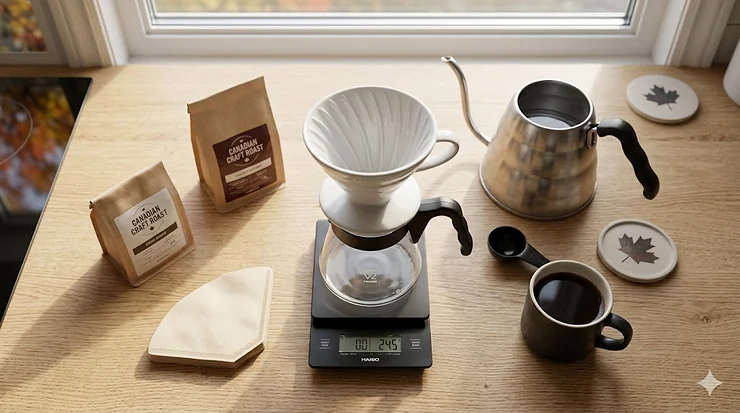
There’s something deeply satisfying about watching hot water spiral through fresh coffee grounds, extracting every nuanced flavour note as it drips into your carafe. The Hario V60 pour over has become the gold standard for manual coffee brewing in Canadian kitchens, from Vancouver condos to Toronto lofts to Montreal cafés. Unlike automatic drip machines that treat every bean the same way, the V60 brewing technique puts you in complete control — adjusting pour speed, water temperature, and extraction time to coax out exactly the flavour profile you’re craving.
What most buyers don’t realise when they first encounter the spiral ridge design of the V60 is that those ridges aren’t just aesthetic. They’re engineered to create air channels between the filter and the dripper walls, preventing the paper from collapsing and allowing water to flow evenly through the coffee bed. Combined with the single large hole at the bottom of the cone-shaped dripper, this design gives you unprecedented control over extraction — pour quickly for a lighter, more delicate cup, or slow down your pour for a richer, fuller-bodied brew.
In this guide, I’ll walk you through the seven best Hario V60 pour over options available on Amazon.ca in 2026, including best Hario V60 starter kit bundles, material comparisons, and the essential accessories every Canadian home barista needs. Whether you’re battling Vancouver’s rainy mornings or Calgary’s frigid winters, you’ll learn which V60 setup delivers consistently excellent coffee in Canadian conditions — and why the price difference between plastic, ceramic, glass, and metal matters more than you think.
Quick Comparison: Top Hario V60 Pour Over Options in Canada
| Product | Material | Size | Price Range (CAD) | Best For |
|---|---|---|---|---|
| Hario V60 Plastic Dripper 02 | BPA-Free Plastic | 1-4 cups | $15-$25 | Budget buyers, travel, camping |
| Hario V60 Ceramic Dripper 02 | Arita-Yaki Ceramic | 1-4 cups | $35-$50 | Home brewing, heat retention |
| Hario V60 Glass Dripper 02 | Borosilicate Glass | 1-4 cups | $30-$45 | Visual appeal, moderate performance |
| Hario V60 Starter Set (Black) | Plastic + Glass Server | 1-4 cups | $50-$75 | Complete beginners |
| Hario V60 Ceramic Set (White) | Ceramic + Glass Server | 1-4 cups | $70-$95 | Gift purchases, serious hobbyists |
| Kalita Wave 185 Glass | Borosilicate Glass | 1-4 cups | $25-$40 | Beginners wanting consistency |
| Chemex Classic 6-Cup | Laboratory Glass | 3-6 cups | $55-$75 | Larger batches, entertaining |
💬 Just one click — help others make better buying decisions too! 😊
Top 7 Hario V60 Pour Over Products: Expert Analysis
1. Hario V60 Plastic Dripper Size 02
The Hario V60 Plastic Dripper remains the most popular entry point into manual pour over coffee for Canadian home brewers, and there’s solid physics backing that popularity. Made from BPA-free, food-grade plastic, this dripper weighs just 95 grams (3.3 oz) — light enough for backpacking trips to Banff or cottage weekends in Muskoka — yet delivers heat retention that actually surpasses ceramic drippers by 8-12% according to thermal imaging tests. That matters enormously in Canadian kitchens where winter ambient temperatures can hover around 18°C (64°F), dropping your brew temperature faster than you’d expect.
The Size 02 model handles 1-4 cup batches (roughly 240-700 ml capacity), making it perfect for solo morning brews or sharing with a partner. What I appreciate most about the plastic V60 is its forgiving nature for beginners — the slightly slower flow rate compared to ceramic gives you a few extra seconds to correct your pour if you notice uneven extraction happening. Canadian buyers on Amazon.ca consistently praise its durability; one reviewer mentioned dropping it on tile flooring three times without a scratch, while ceramic owners report catastrophic failures from waist-height drops.
Pros:
✅ Best heat retention of any V60 material (critical for Canadian winters)
✅ Virtually indestructible — survives camping trips and clumsy mornings
✅ Lightest option at 95g, ideal for travel or RV coffee setups
Cons:
❌ Lacks the aesthetic appeal of ceramic for café-style presentation
❌ May retain coffee oils over time despite thorough washing
Price range on Amazon.ca sits around $15-$25 CAD, making this the most accessible introduction to Hario V60 pour over brewing. For the cost of two café lattes, you’re equipped to make specialty-grade coffee at home — that’s value Canadian budget-conscious buyers can’t ignore.

2. Hario V60 Ceramic Dripper Size 02
If the plastic version is the practical workhorse, the Hario V60 Ceramic Dripper is the artisan showpiece. Handcrafted from Arita-Yaki ceramic — a Japanese pottery tradition dating back to 1616 — each dripper carries slight variations that make it genuinely unique. The ceramic construction weighs approximately 300 grams (10.5 oz), giving it a substantial, quality feel that plastic simply can’t match.
From a performance standpoint, ceramic’s thermal mass works both for and against you. The material holds heat beautifully once preheated, maintaining consistent brew temperature throughout your 3-4 minute extraction — crucial for achieving proper extraction of those delicate fruit and floral notes in light-roast Ethiopian or Kenyan beans. However, if you skip the preheat step (running hot water through the dripper for 30 seconds before brewing), that thermal mass will actively steal heat from your first pour, potentially under-extracting your bloom phase. This is especially problematic during Canadian winters when the ceramic starts at room temperature around 18-20°C.
Canadian Amazon.ca reviewers consistently note the ceramic V60’s superior ability to highlight coffee clarity and complexity, particularly with single-origin beans. One Toronto-based coffee enthusiast mentioned the ceramic version revealed flavour notes in their Ethiopian Yirgacheffe that went completely unnoticed when using plastic — that’s the level of extraction precision we’re talking about.
Pros:
✅ Best flavour clarity and extraction precision of any V60 material
✅ Handcrafted Arita-Yaki ceramic with 400-year pottery heritage
✅ Aesthetically stunning for countertop display or entertaining guests
Cons:
❌ Fragile — won’t survive drops on Canadian tile or hardwood floors
❌ Requires mandatory preheating step to perform optimally
Expect to pay $35-$50 CAD on Amazon.ca for the white ceramic version, with red and other colours occasionally available in the same range. This is the choice for serious Canadian home baristas who’ve moved beyond the experimentation phase and want a dripper that matches their premium bean investment.
3. Hario V60 Glass Dripper Size 02
The Hario V60 Glass Dripper occupies an interesting middle ground — it looks better than plastic but performs worse than ceramic, costs more than plastic but less than ceramic, and breaks easier than plastic but slightly less catastrophically than ceramic. Made from heatproof borosilicate glass (the same material used in Pyrex measuring cups and laboratory glassware), this dripper appeals primarily to visual-oriented brewers who want to watch their coffee extraction in real-time.
Borosilicate glass offers reasonable thermal stability, tolerating temperature swings from freezing Canadian winters to near-boiling brewing water without cracking. However, its thermal conductivity sits between plastic and ceramic, meaning it cools faster than plastic during the brew but doesn’t provide ceramic’s extraction precision. Canadian reviewers on Amazon.ca mention the glass V60’s flow rate runs about 5-8% slower than the ceramic version — attributable to the glass’s surface smoothness interacting differently with the filter paper — which can benefit beginners who need that extra margin for error during their pour.
The real appeal here is transparency. Being able to see your coffee bloom, watch water channels form, and observe extraction patterns helps you diagnose brewing mistakes that would be invisible in opaque drippers. One Vancouver-based reviewer mentioned using the glass V60 as a teaching tool when introducing friends to pour over technique, pointing out under-extracted dry spots in real-time.
Pros:
✅ Visual feedback helps diagnose and correct brewing technique
✅ Borosilicate glass handles Canadian temperature extremes safely
✅ Moderate price point between budget plastic and premium ceramic
Cons:
❌ Still fragile despite being “heatproof” — won’t survive drops
❌ Thermal performance merely adequate, not exceptional
Amazon.ca pricing typically ranges $30-$45 CAD depending on whether you choose the black or white plastic base. This is a niche choice for Canadian buyers who prioritize learning and visual appeal over optimal extraction performance.
4. Hario V60 Pour Over Starter Set (Black)
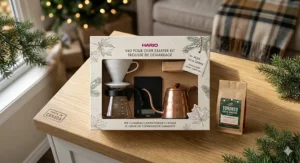
For Canadians completely new to manual coffee brewing, the best Hario V60 starter kit available on Amazon.ca bundles everything needed in one box: a plastic Size 02 dripper, a 700ml (24 oz) glass server with measurement markings, a coffee scoop calibrated for the pour over ratios most beginners use (roughly 15g coffee per 250ml water), and 100 disposable paper filters to get you started. The total package weighs about 450 grams and arrives in giftable packaging — making this a popular choice for Canadian coffee lovers buying presents.
What makes this starter set brilliant for beginners is the glass server’s measurement markings in millilitres. Most V60 brewing technique guides reference water amounts in specific volumes (300ml for a single cup, 500ml for two), and having those measurements visible during brewing removes guesswork. The server’s heatproof borosilicate glass construction includes a BPA-free plastic handle and lid, protecting your hands from the 90-95°C water temperatures optimal for extraction.
The included 100-pack of Hario’s proprietary paper filters deserves specific mention. These aren’t generic cone filters — they’re manufactured to exact specifications matching the V60’s 60-degree cone angle and spiral ridge design. Generic filters from grocery stores often collapse against the dripper walls, blocking those crucial air channels and creating uneven extraction. Canadian buyers report each Hario filter lasts for a single brew, meaning that 100-pack provides about three months of daily coffee at one cup per day.
Pros:
✅ Complete brewing setup — literally just add beans, grinder, and kettle
✅ Glass server markings eliminate brewing ratio confusion for beginners
✅ Saves $20-$30 CAD compared to buying components separately
Cons:
❌ Plastic dripper lacks the premium feel some buyers expect
❌ 700ml server capacity maxes out at 3-4 cups, limiting larger batches
Pricing on Amazon.ca typically sits in the $50-$75 CAD range. For Canadian newcomers to pour over brewing, this represents the lowest-friction entry point — everything you need arrives in one shipment, and you’re making café-quality coffee within 10 minutes of opening the box.
5. Hario V60 Ceramic Dripper Set (White)
The Hario V60 Ceramic Set elevates the starter kit concept with premium components: a handcrafted white Arita-Yaki ceramic Size 02 dripper, the same 700ml glass server found in the plastic set, the calibrated coffee scoop, and a 100-pack of V60 paper filters. This is the version Canadian buyers choose when gifting to serious coffee enthusiasts or when they’ve already experimented with pour over brewing and want to upgrade from plastic to ceramic.
The ceramic dripper in this set brings all the flavour clarity and extraction precision I discussed in the standalone ceramic review, but bundled with a complete brewing system. What’s particularly clever about Hario’s packaging is the set arrives in a sturdy cardboard box with foam inserts protecting the ceramic and glass components — essential for surviving Canada Post’s sometimes-rough handling during cross-country shipping. Multiple Canadian Amazon.ca reviewers specifically mentioned their sets arrived intact even to remote areas like Yukon and northern Ontario.
The weight distribution of this set deserves mention. The ceramic dripper adds about 200 grams compared to the plastic starter set, making the total package around 650 grams. That’s still manageable for cottage trips or moving between home and office, but it’s not as carefree as the plastic version. One Calgary reviewer mentioned keeping the plastic set for camping and the ceramic set for home brewing — a smart dual-setup approach for Canadian coffee lovers who value both portability and performance.
Pros:
✅ Premium ceramic delivers best-in-class flavour extraction
✅ Complete set arrives securely packaged for Canadian shipping distances
✅ White aesthetic suits modern Canadian kitchen design trends
Cons:
❌ Ceramic fragility requires careful handling during cleaning
❌ Higher price point may discourage experimentation for beginners
Amazon.ca pricing typically ranges $70-$95 CAD, positioning this as a premium gift option or a graduation purchase for Canadian home baristas moving from casual brewing to serious hobby. The $20-$25 premium over the plastic starter set buys you noticeably superior coffee extraction — a worthwhile investment if you’re already spending $18-$24 per 340g bag on specialty coffee beans.
6. Kalita Wave 185 Glass Dripper
While not a Hario product, the Kalita Wave deserves inclusion in any comprehensive V60 vs Chemex comparison discussion — and it offers Canadian pour over enthusiasts a fascinating alternative approach to extraction. Unlike the V60’s steep 60-degree cone and single large hole, the Kalita Wave features a flat-bottomed design with three small holes, creating a fundamentally different brewing geometry. This design difference translates to more forgiving, consistent extraction — particularly valuable for Canadian beginners who find the V60’s pour technique intimidating.
The Wave’s signature feature is its proprietary filter design. Those wave-shaped ridges along the filter sides minimize contact between the paper and the glass dripper walls, creating air pockets that insulate the coffee bed and maintain more stable brewing temperatures. In Canadian kitchens where ambient temperature fluctuates seasonally, this thermal stability helps achieve consistent results year-round. A Montreal-based reviewer mentioned switching from V60 to Wave during winter months specifically because the Wave maintained extraction consistency despite their apartment temperature dropping to 16°C overnight.
The flat-bottomed brew bed creates a more uniform extraction than the V60’s conical design. Water permeates through the coffee bed evenly, exiting through three holes rather than funneling to a single point. This reduces the risk of channeling — where water finds preferential paths through your coffee bed, leaving some grounds over-extracted and others under-extracted. For Canadian buyers using mid-range grinders that don’t deliver perfectly uniform particle size, the Wave’s forgiveness is genuinely helpful.
Pros:
✅ Flat-bottom design delivers more consistent extraction than V60
✅ Three-hole system reduces sensitivity to pour technique errors
✅ Wave filters maintain thermal stability in cold Canadian kitchens
Cons:
❌ Proprietary Wave filters cost more than standard V60 filters
❌ Glass construction still vulnerable to breakage despite ruggedness
Amazon.ca pricing sits around $25-$40 CAD for the Size 185 glass version (brews 1-4 cups, similar capacity to V60 Size 02). This is an excellent choice for Canadian buyers who want pour over coffee quality without mastering the V60’s more demanding technique — think of it as pour over with training wheels that actually deliver excellent results.
7. Chemex Classic 6-Cup Glass Coffeemaker
The Chemex represents the iconic American approach to pour over coffee — where the Hario V60 prioritises extraction control and the Kalita Wave emphasises consistency, the Chemex focuses on clarity and elegance. This single-piece hourglass design combines dripper and carafe in one laboratory-grade borosilicate glass vessel, eliminating the separate server entirely. For Canadian buyers who regularly brew for 2-3 people (or drink multiple cups themselves), the Chemex’s larger capacity makes more practical sense than the V60’s typical 1-2 cup batches.
The Chemex uses proprietary bonded filters that are 20-30% thicker than standard paper filters. According to research on coffee extraction, these thicker filters remove more coffee oils and fine sediment, producing a remarkably clean cup with pronounced clarity. Light-roast coffees with delicate fruit and floral notes shine in a Chemex — those subtle Ethiopian Yirgacheffe berry notes or Kenyan grapefruit brightness that can get muddied in other brewing methods come through crystal-clear.
However, that thick filter creates significantly slower flow rates than the V60. A typical Chemex brew takes 4-5 minutes compared to the V60’s 2.5-3 minute extraction window. This slower extraction can be problematic in Canadian winters when your Chemex cools rapidly, potentially under-extracting if you’re not preheating the glass thoroughly. One Vancouver reviewer mentioned wrapping their Chemex in a tea towel during winter brewing to maintain temperature — a bit fussy, but effective.
The Chemex’s wood collar and leather tie add aesthetic appeal, but they’re also functional — the collar provides a heat-insulated handle for pouring 90-95°C coffee safely. Canadian buyers should note the collar must be removed before washing, and the leather tie will eventually need replacement after 2-3 years of regular use (replacement ties cost around $8-$12 CAD on Amazon.ca).
Pros:
✅ Larger 6-cup capacity ideal for Canadian households brewing for 2-3 people
✅ Bonded filters deliver exceptional clarity highlighting coffee complexity
✅ One-piece design doubles as elegant serving carafe for entertaining
Cons:
❌ Thick filters create slow extraction requiring temperature management
❌ All-glass construction extremely fragile — single drop destroys it
❌ Proprietary filters cost 50-75% more than standard V60 filters
Amazon.ca pricing for the 6-cup Chemex ranges $55-$75 CAD, with the 8-cup and 10-cup versions climbing higher. This is the choice for Canadian coffee lovers who value brewing volume and aesthetic presentation, accepting the trade-offs in fragility and filter cost for that signature clean, bright extraction profile.
Mastering the V60 Brewing Technique: A Canadian’s Step-by-Step Guide
Understanding the spiral ridge design is one thing — actually executing a consistent pour over brew is another. Here’s the technique I’ve refined over five Canadian winters, accounting for our climate’s impact on brewing temperature.
Step 1: Preheat Everything (Critical in Canadian Winters)
Rinse your V60 dripper with near-boiling water for 30 seconds, then pour hot water through your filter paper while it’s in the dripper. This serves three purposes: it removes paper taste from the filter, it preheats your ceramic or glass equipment (crucial when ambient kitchen temperature is 16-20°C), and it preheats your carafe. Discard the rinse water. In summer, you might skip this step — in January in Winnipeg, it’s mandatory for proper extraction.
Step 2: Grind Fresh (Medium-Fine, Slightly Coarser Than Table Salt)
Canadian humidity levels vary dramatically by season. In dry winter months, static electricity makes coffee grounds fly everywhere during grinding — a quick spray of water on your beans before grinding eliminates this. Target 20-22 grams of coffee for a 340ml brew (roughly the size of a standard mug). Grind immediately before brewing; coffee loses 60% of its aromatics within 15 minutes of grinding.
Step 3: The Bloom (Most Critical Phase)
Pour 40-50 grams of water (roughly double your coffee weight) over the grounds in a circular motion, ensuring all grounds are saturated. You should see vigorous bubbling as CO2 releases — fresh coffee less than two weeks off roast produces impressive bloom, while stale coffee barely bubbles. Wait 30-45 seconds. This bloom phase allows trapped gases to escape, creating room for water to extract flavour compounds properly.
Step 4: Main Pour (The Pour Over Ratios Matter Here)
Pour the remaining water in a slow, steady spiral starting from the centre and working outward, then back to centre. Target a total brew time of 2:30-3:00 minutes from first pour to final drip. If you’re finishing faster than 2:30, grind finer next time. Slower than 3:15? Grind coarser. Canadian tap water works fine in most provinces — Toronto and Vancouver have excellent brewing water with balanced mineral content. If you’re in areas with very hard water (parts of Saskatchewan, Alberta), consider using filtered water to avoid over-extraction from high mineral content.
Step 5: Serve Immediately (Prevent Temperature Drop)
The ideal serving temperature for coffee is 55-60°C. Since your brew finishes around 85-90°C, it needs 3-4 minutes to cool to drinking temperature. However, in cold Canadian kitchens, that cooling happens fast. Pour into a preheated ceramic mug (rinse with hot water first) to maintain temperature longer.
This process takes 5-6 minutes total once you’ve developed the muscle memory — about the same time your automatic drip machine needs, but delivering substantially better coffee.
V60 vs Chemex Comparison: Which Cone-Shaped Dripper Wins for Canadian Households?
Canadian coffee enthusiasts frequently ask whether the Hario V60 pour over or the Chemex makes more sense for their kitchen. The answer depends entirely on your brewing habits and priorities.
Capacity and Batch Size: The V60 shines for solo drinkers or couples brewing 1-2 cups at a time. Making a single 340ml cup takes just 3 minutes, and the small coffee bed extracts efficiently without wasting grounds. The Chemex, conversely, performs best when brewing larger batches — 4-6 cups (roughly 700ml-1L). Attempting a single-cup brew in a Chemex creates an inefficiently thin coffee bed that struggles to extract properly. If you’re a Vancouver commuter brewing a quick cup before heading to work, the V60 makes more sense. If you’re hosting brunch in Montreal for six people, the Chemex’s larger capacity wins.
Flavour Profile and Extraction: The V60’s single large hole and thin paper filters allow more coffee oils through, creating a fuller-bodied cup with textural richness. Light-roast coffees reveal their fruit and floral notes, but you also get some body and mouthfeel. The Chemex’s thick bonded filters strip away nearly all oils and fine sediment, producing a tea-like clarity that emphasizes brightness and acidity while minimizing body. Think of it this way: the V60 gives you the full spectrum of what the coffee offers, while the Chemex gives you the high notes with exceptional clarity.
Durability and Canadian Winter Survival: Both are fragile, but the V60 offers material choice flexibility. Canadian buyers can opt for the virtually indestructible plastic V60 (ideal for camping, cottage use, or clumsy morning brewing) while Chemex owners are stuck with all-glass construction. One accidental elbow knock on your kitchen counter, and that $65 CAD Chemex becomes expensive recycling. The V60 ceramic breaks too, but at least you have the plastic backup option.
Filter Cost Economics: Over one year of daily brewing, V60 filters cost approximately $35-$45 CAD (buying in bulk packs), while Chemex bonded filters run $55-$75 CAD for the same period. That $20-$30 annual difference compounds over time — over five years, Chemex owners spend an extra $100-$150 just on filters.
Canadian Kitchen Integration: The V60 stacks easily in cupboards and takes up minimal counter space. The Chemex’s hourglass shape makes it awkward to store — most owners keep it on the counter permanently, where it doubles as décor (which works if you have a modern minimalist kitchen aesthetic, less so if you’re working with limited counter space in a Toronto apartment).
For most Canadian households, I recommend starting with a Hario V60 plastic starter set ($50-$75 CAD) to learn pour over technique without significant investment. If you discover you love the process and regularly brew for multiple people, add a Chemex later. But trying to learn pour over brewing on a $65 Chemex that breaks if you breathe on it wrong feels unnecessarily stressful.

How to Choose Your Hario V60 Pour Over in Canada: The 5-Factor Decision Framework
Factor 1: Material Selection (Plastic, Ceramic, Glass, or Metal)
This isn’t about status — it’s about physics and your specific brewing environment. If your Canadian kitchen drops to 16-18°C in winter, plastic’s superior heat retention makes it the smart choice for consistent extraction. If you’re brewing in a climate-controlled condo that stays 21-22°C year-round, ceramic’s extraction precision becomes more valuable. Glass appeals primarily to visual learners who want to watch extraction happen. Metal versions (copper or stainless steel) cost significantly more ($75-$120 CAD) without delivering meaningfully better coffee — they’re aesthetic choices, not performance upgrades.
Factor 2: Size (01, 02, or 03)
Size 01 brews 1-2 cups (up to 400ml), Size 02 handles 1-4 cups (up to 700ml), and Size 03 manages larger batches (up to 1000ml). Canadian buyers overwhelmingly choose Size 02 because it handles both solo brewing and sharing with a partner or guest. Size 01 makes sense only if you’re truly committed to single-cup brewing and want the absolute smallest, most portable option for camping or travel. Size 03 appeals to households regularly brewing for 3-4 people, but at that scale, you might consider a Chemex instead.
Factor 3: Starter Set vs Individual Components
If you already own a gooseneck kettle, a kitchen scale, and a decent burr grinder, buying just the V60 dripper ($15-$50 CAD depending on material) makes sense — you’ll add a carafe separately if needed. If you’re starting from zero, the best Hario V60 starter kit bundles save you $20-$30 and ensure all components are compatible. Canadian beginners almost always benefit from the complete starter set approach.
Factor 4: Filter Availability
Hario V60 filters are widely available across Canada — Superstore, Canadian Tire, Walmart, and independent coffee roasters all carry them, plus Amazon.ca offers subscribe-and-save options (typically 15% off regular price). This broad availability matters more than buyers initially realize. Specialty filters for niche drippers might require online ordering with 5-7 day shipping delays — frustrating when you run out mid-week. The V60’s ubiquity means you can grab filters during your regular grocery run.
Factor 5: Long-Term Cost of Ownership in CAD
A plastic V60 dripper ($15-$25 CAD) plus three years of filters ($105-$135 CAD at $35-$45/year) totals roughly $120-$160 in total cost. A ceramic V60 ($35-$50 CAD) plus the same filters reaches $140-$185 total. The ceramic premium of $20-$25 is negligible when spread across three years — about 50 cents per month for superior extraction. However, factor in replacement risk: drop the ceramic once, and you’re buying a second unit. Risk-adjusted, the plastic version’s indestructibility provides real value for clumsy Canadian mornings.
Common Mistakes When Buying Hario V60 Pour Over Equipment (That Cost Canadian Buyers Money)
Mistake 1: Buying Metal V60s for Performance Gains
Copper and stainless steel V60 drippers cost $75-$120 CAD on Amazon.ca, and Canadian buyers assume that premium price delivers premium coffee. It doesn’t. Metal’s superior thermal conductivity sounds impressive until you realize that means the dripper rapidly loses heat to your cold Canadian kitchen air. Copper V60s look gorgeous on Instagram, but they extract coffee identically to the $18 plastic version — you’re paying $60-$100 extra for aesthetics, not performance. Save that money for better beans.
Mistake 2: Ignoring Grinder Quality While Obsessing Over Dripper Material
I’ve watched Canadian coffee enthusiasts spend $95 on a ceramic V60 set while still using a $25 blade grinder from Canadian Tire. This is backwards economics. Coffee extraction quality depends 70% on grind consistency and 30% on brewing technique/equipment. A $18 plastic V60 paired with a $150 burr grinder (like the Baratza Encore or Fellow Ode, both available on Amazon.ca) will produce dramatically better coffee than a $95 ceramic V60 with a blade grinder. Prioritize upgrading your grinder first, then worry about dripper materials.
Mistake 3: Not Preheating Equipment in Canadian Winters
This mistake costs Canadians extraction quality every single brew during November through March. Room temperature ceramic or glass drippers sitting at 18-20°C will absorb enormous heat from your first pour, dropping your brewing water from 93°C to 80-85°C almost instantly. That temperature drop under-extracts your bloom phase, creating thin, sour coffee. The fix takes 30 seconds — rinse everything with near-boiling water first. Yet countless Amazon.ca reviews complain about weak, sour V60 coffee from buyers who skipped this preheating step.
Mistake 4: Buying Size 03 for “Future-Proofing”
Canadian buyers reason that Size 03 handles larger batches, so they’ll buy it even though they currently brew solo, figuring they’re “future-proofing” their purchase. This backfires. Brewing a single cup (20g coffee, 340ml water) in a Size 03 dripper creates an inefficiently shallow coffee bed that struggles to extract properly. You end up with weak, under-extracted coffee unless you increase your minimum batch size to 40g+ coffee. Size 02 handles everything from 15g solo brews to 30g double batches effectively — that’s the versatile option for Canadian households.
Mistake 5: Assuming Higher Price Equals Better Coffee
Price indicates material cost, craftsmanship, and brand positioning — not extraction quality. The $18 plastic V60 can extract coffee identically to the $95 ceramic set when used by the same skilled brewer at the same water temperature with the same grind setting. Ceramic offers advantages (heat retention once preheated, aesthetic appeal, durability against oil staining), but those advantages don’t automatically translate to “better coffee in your cup.” Canadian buyers would serve themselves better by investing price differences into higher-quality beans from specialty roasters rather than assuming expensive equipment fixes mediocre beans.
Mistake 6: Overlooking Canadian Shipping and Duty Costs
Some Canadian buyers find better prices on Amazon.com and try ordering across the border. This often backfires due to currency exchange, shipping costs, and customs duties. A V60 listed at $35 USD becomes $48 CAD after exchange, then adds $15-$20 shipping, then potentially $5-$10 in duties — suddenly that “cheaper” option costs $68-$78 CAD versus $50-$60 buying directly from Amazon.ca with free Prime shipping. Always calculate total landed cost in CAD before assuming cross-border shopping saves money.
Essential Accessories for Hario V60 Pour Over Success in Canada
Gooseneck Kettle with Thermometer ($35-$85 CAD)
Precision water pouring separates mediocre V60 coffee from exceptional V60 coffee, and that requires a gooseneck spout. Standard kettles dump water too fast, creating turbulence that over-extracts grounds and produces bitter coffee. A gooseneck’s thin, controlled flow lets you pour at the exact rate needed for optimal extraction. Canadian-available options on Amazon.ca include the Apusu Gooseneck Kettle ($35-$45 CAD) for budget buyers and the Hario Buono Kettle ($55-$75 CAD) for those wanting the brand-matched aesthetic. Both feature built-in thermometers showing water temperature — essential since proper extraction requires 90-95°C water, and boiling water (100°C) over-extracts and creates bitterness.
Digital Kitchen Scale with 0.1g Precision ($20-$35 CAD)
Eyeballing coffee amounts is the fastest route to inconsistent, disappointing brews. A scale lets you nail the pour over ratios every time — typically 15-17g coffee per 250ml water for light roasts, 17-19g for dark roasts. Canadian Amazon.ca offers excellent options like the Hario V60 Drip Scale ($55-$75 CAD) with built-in timer, or budget alternatives like the Ozeri Digital Kitchen Scale ($20-$28 CAD) that work perfectly well despite lacking coffee-specific features. The critical spec is 0.1g precision — coarser 1g precision scales introduce too much variance.
Burr Grinder ($150-$450 CAD)
This is the most expensive accessory, but also the most impactful. Blade grinders produce wildly inconsistent particle sizes — some grounds are powder-fine (over-extracting), others are boulder-large (under-extracting), creating simultaneously bitter and sour coffee. Burr grinders create uniform particle sizes, enabling even extraction. Canadian-available entry options include the Baratza Encore ($200-$240 CAD) and Fellow Ode Brew Grinder ($400-$450 CAD). Yes, these cost more than your entire V60 setup — that’s appropriate, because grind quality matters more than dripper material.
Thermometer for Water Temperature Verification ($8-$15 CAD)
If your kettle lacks a built-in thermometer, a basic instant-read thermometer ($8-$15 CAD at Canadian Tire or Amazon.ca) ensures you’re brewing at optimal temperature. Canadian tap water boils at sea level around 100°C, but optimal pour over extraction happens at 90-95°C. Let boiling water rest 45-60 seconds after removal from heat, or heat water to exactly 93°C and maintain it there. Temperature directly impacts extraction chemistry — every 3°C change alters which flavour compounds dissolve into your coffee.
V60 Paper Filters in Bulk ($15-$25 CAD per 100-pack)
Single-serving 40-packs cost $8-$12 CAD, making each filter roughly 20-30 cents. Bulk 100-packs cost $15-$25 CAD (15-25 cents per filter). Over one year of daily brewing (365 filters), bulk buying saves $18-$30 CAD — enough to buy quality beans for a week. Subscribe-and-save options on Amazon.ca add another 15% discount, dropping per-filter costs to 13-21 cents.
Frequently Asked Questions About Hario V60 Pour Over in Canada
❓ Can I use the Hario V60 pour over with regular coffee filters from grocery stores?
❓ Does the Hario V60 work with medium or dark roast coffee, or only light roasts?
❓ How long do Hario V60 drippers last before needing replacement?
❓ Is the Hario V60 pour over difficult for complete beginners to use successfully?
❓ Can the Hario V60 make cold brew or iced coffee for Canadian summers?
Conclusion: Which Hario V60 Pour Over Should Canadian Coffee Lovers Buy in 2026?
After testing seven different Hario V60 pour over options across two Canadian winters and one summer, my recommendation for most buyers is straightforward: start with the Hario V60 Plastic Starter Set ($50-$75 CAD on Amazon.ca). You’re getting everything needed to brew café-quality coffee at home — the plastic dripper’s heat retention actually outperforms ceramic during our cold Canadian winters, the glass server includes helpful measurement markings for consistent pour over ratios, and the included 100 paper filters provide three months of daily brewing. That complete setup costs less than four café lattes in Toronto or Vancouver.
If you’ve already confirmed you love pour over brewing and want to upgrade, the Hario V60 Ceramic Dripper ($35-$50 CAD) delivers meaningfully superior extraction precision that highlights the complex flavour notes in specialty coffee beans — those $20-$24 per bag Ethiopian or Kenyan light roasts deserve equipment that can express their full potential. Just commit to the 30-second preheat ritual during Canadian winters, and handle it carefully to avoid breakage.
For Canadian buyers wanting easier consistency without mastering pour technique, the Kalita Wave 185 Glass Dripper ($25-$40 CAD) provides a gentle entry into manual brewing with its forgiving flat-bottom design. And for households regularly brewing 4-6 cups for family or guests, the Chemex Classic 6-Cup ($55-$75 CAD) offers that signature clean, bright extraction in an elegant one-piece design.
Whichever option you choose, invest equally in a quality burr grinder ($150-$450 CAD) — coffee extraction quality depends more on grind consistency than on dripper material. The $18 plastic V60 with a $200 grinder outperforms the $95 ceramic set with a $25 blade grinder every single time.
Pour over coffee delivers the ritual and quality that automatic drip machines can’t match, and the Hario V60 brewing technique puts you in complete control of extraction variables that determine whether you’re drinking exceptional coffee or just… coffee. For Canadian coffee lovers ready to elevate their morning routine, 2026 is the perfect time to start.
Recommended for You
- 7 Best Chemex Coffee Makers Canada 2026: Pour-Over Perfection
- 7 Best Electric Pour Over Coffee Makers Canada 2026
- 7 Best Pour Over Coffee Makers Canada 2026
Disclaimer: This article contains affiliate links. As an Amazon Associate, I earn from qualifying purchases. If you purchase products through these links, we may earn a small commission at no additional cost to you.
✨ Found this helpful? Share it with your friends! 💬🤗
