In This Article
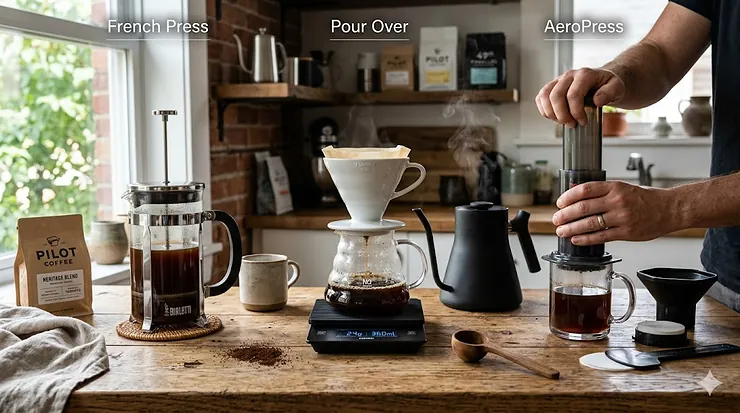
You’ve probably stood in a coffee aisle — or more likely, scrolled an Amazon.ca listing at 11 p.m. — wondering whether to commit to a French press, a pour over setup, or the cult-favourite AeroPress. The debate around french press vs pour over vs aeropress isn’t new, but choosing the right one for your Canadian kitchen, commute, or cabin weekend absolutely matters. These three methods produce dramatically different cups, reward different levels of patience, and suit very different lifestyles.
Here’s a quick orientation: the French press is your rich, full-bodied, low-fuss morning companion; the pour over is the deliberate artisan that extracts clarity and origin flavour from every bean; and the AeroPress is the agile, travel-ready workhorse that forgives almost every mistake and still delivers a spectacular cup in under two minutes. Each solves a different coffee problem — and none of them is the “wrong” answer.
What makes this comparison especially relevant for Canadian buyers in 2026 is the context: cold winters that demand a hot, substantial brew; remote work kitchens that deserve better than drip machine mediocrity; and an ever-growing Canadian specialty coffee scene (from Vancouver’s 49th Parallel to Toronto’s Pilot Coffee) that makes brewing at home a genuine pleasure. According to research published in Beverages journal (2025), the brewing method is a critical determinant of the final chemical, physical, and sensory attributes of coffee — meaning your hardware choice matters far more than most people realise.
This guide walks you through the seven best french press vs pour over vs aeropress products currently available on Amazon.ca, with honest expert commentary, CAD price ranges, and practical guidance tailored to Canadian brewers. All prices are in CAD; check Amazon.ca links for current pricing, as prices change frequently.
Quick Comparison: French Press vs Pour Over vs AeroPress at a Glance
| Feature | French Press | Pour Over | AeroPress |
|---|---|---|---|
| Brew Time | 4–5 minutes | 3–5 minutes | 1–2 minutes |
| Flavour Profile | Rich, full-bodied, bold | Clean, bright, origin-forward | Smooth, versatile, low-acidity |
| Skill Level | Beginner-friendly | Intermediate–Advanced | Beginner to Expert |
| Portability | Low | Low–Medium | High |
| Filter Type | Metal mesh (no paper needed) | Paper (usually) | Paper micro-filter |
| Best For | Morning routine, bold drinkers | Specialty single-origin, flavour chasers | Travel, versatility, speed |
| Average CAD Price Range | $30–$120 | $40–$200 | $45–$130 |
| Sediment in Cup | Yes (fine grounds) | No | No |
| Amazon.ca Availability | Excellent | Good | Excellent |
The table above tells an important story: no single method dominates across all dimensions. The AeroPress wins on speed and travel convenience but produces only one concentrated serving at a time — a real limitation if you’re hosting brunch at your cabin in Muskoka. The pour over wins on flavour transparency but demands a gooseneck kettle and a reliable grinder, adding $60–$150 CAD to your setup cost. The French press wins on simplicity and value for money but leaves fine sediment that sensitive palates find distracting.
💬 Just one click — help others make better buying decisions too! 😊
✨ Don’t Miss These Exclusive Deals!
🔍 Take your morning ritual to the next level with these carefully selected manual coffee brewers. Click on any highlighted item to check current pricing and availability on Amazon.ca. These tools will help you craft exceptional coffee your whole household will love!
Top 7 French Press, Pour Over & AeroPress Products: Expert Analysis
1. AeroPress Original Coffee Press
The AeroPress Original is the brewer that genuinely changed what manual coffee could be — and it remains the single most versatile piece of brewing equipment you can buy on Amazon.ca today. Compact at just 11.5 cm (4.5 in) tall, it weighs under 230 g (8 oz), yet delivers a smooth, full-flavoured cup in roughly 90 seconds.
The key to its performance is the combination of air pressure and micro-filtration. Unlike a French press — which leaves fine grounds swirling in your cup — the AeroPress paper filter eliminates grit almost entirely, producing a cleaner cup that still retains some of the oil character you’d expect from immersion brewing. The ability to control water temperature, steep time, and even inversion technique makes it infinitely hackable; the World AeroPress Championship (yes, this exists) has produced over 300 different winning recipes.
For most Canadian buyers, the practical advantage is its cold-weather resilience. The BPA-free, shatterproof polymer body doesn’t care whether you’re camping in Algonquin Park or warming up in a -20°C Edmonton apartment kitchen. It won’t crack like glass, and the sealed brewing chamber means your hot water loses virtually no heat during the short brew. Canadian reviewers consistently praise it as the “one brewer I’d never give up” — especially those who travel frequently for work.
Customer feedback on Amazon.ca is overwhelmingly positive, with buyers highlighting the forgiving learning curve and the ease of cleaning (literally a single push-out motion).
✅ Works brilliantly in cold environments — no glass to freeze or crack
✅ Easiest manual brewer to clean — done in 20 seconds
✅ Produces virtually zero bitterness, even with darker Canadian roasts
❌ Brews one concentrated serving at a time — not ideal for households of 3+
❌ Requires paper filters (ongoing cost, though reusable metal filters are available)
Price range: $45–$60 CAD — exceptional value for what it delivers; check Amazon.ca for current price.
2. AeroPress Go Portable Travel Coffee Maker
Think of the AeroPress Go as the AeroPress Original’s smarter, more travel-conscious sibling. The key difference: it ships with a compact silicone-lid mug that doubles as the storage vessel, meaning the entire kit nests into a package small enough for a carry-on side pocket.
The Go brews the same quality cup as the Original — pressure-assisted extraction, micro-filtered clarity, full coffee oil complexity — but its slightly smaller chamber (250 mL vs 350 mL) makes it purpose-built for solo travellers. For Canadians who commute by train between Toronto and Ottawa, fly for work, or spend time at remote fly-in fishing camps, the Go removes every excuse for bad hotel coffee. The included mug is rated microwave-safe, and the polypropylene construction handles luggage abuse without complaint.
Where most buyers underestimate the Go is as a daily home brewer, not just a travel item. If you live alone and your counter space is limited — say, a downtown Vancouver condo where every centimetre counts — the Go’s compact footprint earns it a permanent spot by the kettle. It’s the brewer I’d recommend to a first-year university student in a residence hall, or anyone setting up a home office that needs café-quality coffee without a full equipment spread.
✅ Complete self-contained kit — brewer + mug in one package
✅ Ideal for Canada’s outdoor culture — camping, cottage, ski lodge
✅ Same superior extraction as Original in a smaller, lighter form
❌ 250 mL capacity means smaller cups than the Original
❌ Mug is plastic — not everyone’s preference for hot beverages
Price range: $50–$65 CAD — worth every dollar if you’re away from home more than a few nights a month.
3. Bodum Chambord French Press 8-Cup (1 Litre)
The Bodum Chambord is arguably the most iconic French press ever made — the same design has been in continuous production since 1974, and for good reason. The 8-cup (1-litre) model is the sweet spot for Canadian households: enough to serve two generous mugs while still being manageable to plunge and pour.
What makes the Chambord enduringly relevant in 2026 is its borosilicate glass carafe, which handles the 95°C (203°F) water temperature required for optimal extraction without warping, and its stainless steel spiral frame that’s both elegant and protective. The three-part stainless steel plunger with mesh filter allows natural coffee oils to pass through fully, which is precisely why a French press produces that distinctive heavy, velvety mouthfeel. For dark roast enthusiasts — and many Canadians lean toward robust blends during the long winter months — the French press amplifies exactly the bold, chocolatey flavour notes that paper-filtered methods strip away.
What most Canadian buyers overlook about the Chambord is its sensitivity to grind size. A medium-coarse grind (think sea salt) is non-negotiable; too fine and you’ll push sediment through the mesh, producing a gritty cup that gives French press a bad reputation it doesn’t deserve. Pair it with a burr grinder and fresh-roasted beans from any Canadian specialty roaster, and the Chambord produces a café-quality result that costs roughly $0.30–$0.80 CAD per cup.
Canadian reviewers frequently mention the Chambord as a “best gift for coffee lovers” and note its dishwasher-safe components make cleanup genuinely effortless.
✅ Iconic design, 50+ year proven reliability
✅ Full oil extraction — best for bold, dark, and medium-dark roasts
✅ No filters required — long-term cost saving in CAD
❌ Glass carafe requires careful handling — not ideal for households with young children
❌ Fine sediment inevitable — not suited to those who prefer a grit-free cup
Price range: $35–$70 CAD depending on size — the 8-cup model offers the best value per litre.
4. Hario V60 Ceramic Coffee Dripper 02 (White)
The Hario V60 is where manual coffee brewing transitions from a morning task into a craft — and the ceramic 02 model (the size designed for 1–4 cups) is the most forgiving entry point into pour over territory. The V60’s conical design with its distinctive spiral ribs promotes even water flow from the edge to the single centre hole, creating the ideal conditions for even extraction.
Why ceramic over plastic or glass? In a Canadian context, this matters more than you’d think. Ceramic retains heat significantly better than plastic during the brew, which is critical when your kitchen is 18°C in January and your boiling water drops temperature the moment it hits the dripper. A quick pre-warm of the ceramic with a splash of hot water before brewing maintains the brew temperature in the 90–96°C (194–205°F) range that the Specialty Coffee Association recommends for optimal extraction. The V60 also pairs beautifully with light-to-medium roast single-origin beans — Ethiopian naturals, Kenyan washed, Colombian fruit-forward lots — because its filter removes oils and highlights flavour clarity that French press or AeroPress simply can’t replicate.
The learning curve is real and worth acknowledging honestly: getting a consistent pour over with the V60 requires a gooseneck kettle and some practice. Your first three brews may taste underwhelming. Your fourth or fifth, if you’ve dialled in grind size and pour rate, will taste like the best cup you’ve ever made at home.
✅ Best flavour clarity of any brewing method at this price
✅ Ceramic builds durability and heat retention in cold Canadian kitchens
✅ Widely used in Canadian specialty coffee shops — familiar to baristas
❌ Requires gooseneck kettle and burr grinder for best results — adds ~$80–$150 CAD to setup
❌ Single-cup focus — not efficient for hosting more than two people
Price range: $30–$50 CAD for the dripper alone — invest in the grinder first.
5. Chemex Classic Series Pour Over Glass Coffeemaker (6-Cup)
The Chemex Classic is simultaneously a coffee brewer and a piece of functional art — it’s the only coffee maker in the permanent collection of New York’s Museum of Modern Art, and it deserves a spot on any Canadian countertop that values both aesthetics and exceptional cups. The 6-cup (900 mL) model is the practical favourite for two-person households.
The Chemex’s core differentiator is its proprietary bonded paper filter, which is 20–30% thicker than standard pour over filters. This thickness removes virtually all coffee oils and fine particles, producing a cup of extraordinary clarity — bright, vibrant, and often described as almost tea-like in its cleanliness. For light roast origin coffees — a single-origin Ethiopia Yirgacheffe, for instance, from a Canadian specialty roaster like Montreal’s Café Union or Calgary’s Phil & Sebastian — the Chemex is probably the best brewing method money can buy.
The hourglass design doubles as the server, which is a practical advantage: brew directly into it, remove the filter stem, and serve. For Canadian winter mornings where the goal is minimal steps between bed and caffeine, this consolidation matters. The borosilicate glass body handles boiling water without complaint and is fully dishwasher-safe, though handwashing preserves the wooden collar longer.
Canadian buyers should note that Chemex-specific filters are sold separately and cost slightly more than standard pour over papers — factor in roughly $10–$15 CAD per 100-filter box when calculating total annual cost.
✅ The cleanest, most transparent cup of any manual brewer
✅ Beautiful enough to leave on the counter — doubles as kitchen décor
✅ Heat-resistant borosilicate glass — safe and durable in Canadian kitchens
❌ Proprietary filters are a recurring cost and not always in stock on Amazon.ca
❌ Glass body requires careful handling — not travel-compatible
Price range: $60–$90 CAD — justified by its dual function as brewer and carafe.
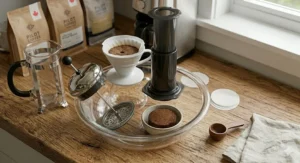
6. Bodum Brazil French Press 8-Cup (1 Litre)
If the Chambord is the designer suit of French presses, the Bodum Brazil is the smart-casual equivalent — same quality extraction, same reliable plunger mechanism, but housed in a heat-resistant plastic frame instead of stainless steel. The Brazil uses the identical three-layer mesh plunger as the Chambord, so the coffee quality in your cup is genuinely identical. What you’re paying less for is the exterior aesthetic.
For Canadian buyers, especially students, first-time apartment dwellers in cities like Halifax or Saskatoon, or anyone furnishing a home office on a budget, the Brazil delivers exceptional value. The plastic frame is also significantly more impact-resistant than the Chambord’s metal-and-glass combination — drop it on a tile floor and you’re far more likely to survive with the carafe intact. In shared households, busy morning routines, and households with curious toddlers, this durability advantage is not trivial.
The Brazil comes in a range of colours (black, red, white, and more), making it one of the few manual brewers where you can match your kitchen colour scheme without compromising brew quality. Canadian reviewers often describe it as the “workhorse” French press — unflashy, reliable, and worth replacing without guilt if it eventually breaks.
✅ Same extraction quality as premium French presses at a fraction of the price
✅ Durable, impact-resistant frame — ideal for busy households
✅ Wide colour selection — rare in manual coffee gear
❌ Plastic frame looks less premium — not a countertop showpiece
❌ Plastic components may absorb odours over time if not cleaned thoroughly
Price range: $25–$40 CAD — the best entry point for anyone new to French press brewing.
7. Kalita Wave 185 Stainless Steel Dripper
The Kalita Wave 185 is the pour over dripper that even people who “can’t get consistent results” with the Hario V60 tend to love — and that’s not an accident. Its flat-bottom design with three small drain holes (rather than the V60’s single large opening) slows the drawdown rate and makes the brew significantly less sensitive to pour rate variation. In practical terms, this means your cup tastes roughly as good on a rushed Tuesday as it does on a leisurely Sunday.
The stainless steel construction makes it the most durable pour over dripper on this list — no ceramic to chip, no plastic to discolour, and no concerns about thermal shock when you forget to pre-warm and pour boiling water directly in. The Wave’s proprietary wavy paper filters are designed to sit away from the dripper walls, which promotes even extraction by preventing the filter from flattening and blocking flow. Research on coffee extraction reproducibility (ScienceDirect, 2023) confirms that filter design significantly influences extraction consistency across different barista skill levels.
For Canadians who want pour over quality without the obsessive pour technique the V60 demands, the Kalita Wave 185 is the answer. It’s also the best option for camping trips where ceramic would be too fragile — the stainless body nests into any backpack without worry.
Wave filters are available on Amazon.ca and in most Canadian specialty coffee retailers; they’re slightly easier to find than Chemex-specific papers.
✅ Most forgiving pour over dripper for inconsistent pours — beginner-friendly
✅ Stainless steel — virtually indestructible, ideal for Canadian outdoor use
✅ Produces excellent clarity without V60’s steep learning curve
❌ Kalita Wave filters are less common than V60 papers in smaller Canadian towns
❌ Slightly slower than V60 — not ideal if you’re in a morning rush
Price range: $40–$65 CAD — worth the premium over plastic alternatives.
How to Choose the Right Brewing Method for Your Canadian Lifestyle
This is where most buying guides fail you — they list products but don’t help you match your actual daily life to a brewing method. Here’s a practical framework:
If you value simplicity and bold flavour above everything else, choose a French press. The Bodum Chambord or Brazil requires no paper filters, no expensive grinders (though a burr grinder always helps), and no technique beyond “add grounds, add water, wait, press.” It’s the best brewing method for dark roast enthusiasts and anyone who doesn’t want to think too hard before their first cup. It’s also genuinely the most cost-effective option over 12 months in CAD, since you never buy filters.
If you’re chasing the best possible cup quality and enjoy the ritual, go pour over — either the Hario V60 (if you’re patient and want full control) or the Kalita Wave 185 (if you want pour over quality with a more forgiving process). Budget an additional $80–$150 CAD for a gooseneck kettle and a quality burr grinder; they’re not optional if you want consistent results. Pair it with light-to-medium roast single-origin beans from a Canadian specialty roaster.
If you travel, commute, or want one brewer that does everything, the AeroPress Original or AeroPress Go is your answer. It handles every roast level, every grind size, and every brewing style from espresso-concentrate to cold brew — all in a format that fits in a jacket pocket. For Canadian road warriors, remote workers in cottage country, or anyone who spends time in climate zones where glass is a liability, the AeroPress is simply the most practical choice ever made.
If you’re buying a first brewer on a budget under $50 CAD, start with the Bodum Brazil French Press. It delivers café-quality coffee immediately, has zero learning curve, and if you decide you want to explore pour over or AeroPress later, you haven’t wasted significant money.
One underappreciated Canadian consideration: water quality. In many Canadian municipalities — Calgary, Winnipeg, and parts of Ontario in particular — tap water is notably hard. Hard water affects extraction differently across the three methods: French press tends to compensate well because the longer steep time extracts more flavour compounds even from mineral-heavy water; pour over, with its precise extraction, can taste flat or chalky if your water isn’t filtered. If your tap water tastes noticeably mineral-forward, consider a simple Brita or similar filter for your pour over setup — it makes a measurable difference in cup quality.
Canadian Buyer Profiles: Real-World Scenarios
These three Canadian scenarios illustrate how the french press vs pour over vs aeropress decision plays out in real life:
Sarah, 32 — Toronto Condo Dweller, Daily Commuter Sarah leaves her downtown condo by 7:15 a.m. and has roughly 10 minutes of kitchen time before she’s out the door. She takes the subway, works long days, and occasionally travels to Montreal for client meetings. She loves coffee but has zero patience for ritual on weekday mornings.
Best match: AeroPress Go. Two minutes, one serving, packs in her work bag for the return hotel stay. On weekends when she has more time, she can experiment with different recipes using the same device.
Marcus, 45 — Calgary Homeowner, Weekend Coffee Enthusiast Marcus has a proper morning routine on Saturdays and Sundays. He buys single-origin beans from Phil & Sebastian Coffee Roasters, owns a quality burr grinder, and genuinely enjoys the meditative process of making great coffee. He wants a brewer that rewards precision.
Best match: Chemex Classic 6-Cup. The brewing ritual is part of the pleasure; the clean, vibrant cups the Chemex produces with quality Calgary-roasted beans are unmatched for his purposes. He also hosts occasional Sunday brunches for 4–6 people, where the Chemex’s 900 mL capacity makes serving easy.
The Okafor Family — Ottawa Suburb, Household of Four Two adults, two teenagers who are starting to drink coffee. They want a reliable workhorse that makes 4+ cups at a time, is dishwasher-safe, and doesn’t require expertise to operate. Budget is a consideration.
Best match: Bodum Brazil French Press 8-Cup. It produces eight large cups per brew (using European 125 mL cup measurement), costs well under $40 CAD, requires zero accessories, and the whole family can use it without training. Cleanup is simple — the mesh filter rinses in seconds.
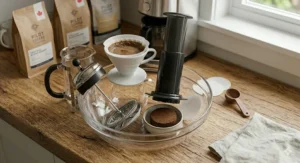
What to Expect: Real-World Performance in Canadian Winter Conditions
This is a topic almost every other buying guide ignores entirely — and it genuinely matters if you live in most of Canada.
French Press in Winter: The glass carafe loses heat faster in a cold kitchen than you might expect. If your thermostat drops to 18°C (64°F) overnight and you brew at 7 a.m. before the heat kicks up, your coffee will cool noticeably between plunging and pouring the second cup. The solution: pre-warm the carafe with boiling water for 30 seconds before brewing, and pour into a pre-warmed mug. Alternatively, the Frieling stainless steel French press (also available on Amazon.ca, priced higher) retains heat far better, though it’s not covered in this guide’s core seven.
Pour Over in Winter: Ceramic drippers like the Hario V60 perform better than plastic in cold kitchens because ceramic’s thermal mass resists rapid heat loss. Always pre-warm your dripper and server. The Chemex glass body, while beautiful, does lose heat during a slow pour in a cold kitchen — using a pre-warmed carafe and brewing slightly above the 93°C (200°F) recommended temperature (around 96°C / 205°F) compensates for this loss.
AeroPress in Winter: This is where the AeroPress genuinely shines over its competition. The sealed brewing chamber with its insulating polymer walls maintains brew temperature with remarkable efficiency. During winter camping trips in Ontario’s Algonquin or B.C.’s Whistler backcountry, the AeroPress is the only one of the three methods that doesn’t require special accommodation for cold ambient temperatures. It simply works.
Research published in the journal Foods (2023, PubMed) confirms that the AeroPress produces higher antioxidant retention than several other brewing methods due to its pressure-assisted rapid extraction — a pleasant bonus on a cold Canadian morning when you want your coffee working hard for you.
Common Mistakes When Buying a Manual Coffee Brewer in Canada
1. Buying a brewer before buying a grinder. This is the single most common and most expensive mistake. A $15 blade grinder produces inconsistent particles that make even a $100 pour over taste muddy. A decent hand burr grinder (Timemore C2 or C3, both available on Amazon.ca in the $60–$90 CAD range) transforms every brewing method’s results immediately. Budget for the grinder before you budget for the brewer.
2. Ignoring Amazon.ca availability vs. Amazon.com. Several specialty pour over drippers (certain Origami models, some Fellow products in specific colourways) appear on Amazon.com but don’t ship to Canada or arrive with $30–$50 CAD in customs and brokerage fees that aren’t disclosed upfront. All seven products in this guide are available directly on Amazon.ca. Prime members receive free shipping; non-Prime orders typically qualify for free shipping at $35+ CAD.
3. Choosing a brewer based on aesthetics alone. The Chemex is undeniably beautiful — but if you’re making one cup at 6:45 a.m. before a long commute, a full pour over ritual is the wrong choice for your lifestyle. Be honest about your morning pace before investing.
4. Underestimating the filter cost. French press: $0 ongoing (reusable mesh). AeroPress: roughly $8–$12 CAD per 350-filter pack (or one-time cost for a reusable metal filter). Chemex: $10–$15 CAD per 100-filter box. V60 and Kalita Wave: $7–$12 CAD per 100-filter pack. Over a year of daily use, this adds up — factor it into your total cost of ownership in CAD.
5. Not considering Canadian service and warranty support. Bodum products are widely distributed in Canada through major retailers and Amazon.ca, and warranty claims are handled domestically. AeroPress has Canadian distribution. Chemex has solid Amazon.ca availability but limited physical retail presence outside major cities. For products from smaller specialty brands, confirm Canadian warranty coverage before purchasing — cross-border warranty claims can involve significant shipping costs.
Flavour Profile Differences: What Each Method Actually Tastes Like
Understanding the flavor profile differences between these three methods is the heart of the french press vs pour over vs aeropress decision. The Specialty Coffee Association’s brewing standards define ideal extraction yield as 18–22% of the coffee’s soluble compounds — but the which compounds each method extracts differs dramatically.
French Press — The Bold, Oily Cup: Because metal mesh filters allow fine particles and coffee oils (specifically diterpenes like cafestol and kahweol) to pass into the cup, French press coffee is textually heavier and flavourally rounder than filtered methods. You taste the bean’s fat-soluble compounds directly. This is why dark roast and medium-dark coffees — chocolatey, nutty, smoky — taste exceptional in a French press; these flavour compounds are oil-carried. The downside: lighter, more delicate roasts can taste muddy and lack the floral clarity they’re capable of producing.
Pour Over — The Clear, Expressive Cup: Paper filters trap oils and micro-particles, producing a cup of notable clarity. This is the method that lets origin characteristics sing — the blueberry notes in Ethiopian natural process, the red fruit brightness in Kenyan washed, the jasmine florals in a Yemeni Haraaz. For the growing Canadian specialty coffee culture, pour over is the gold standard for exploring single-origin beans. The clean mouthfeel can feel thin to dark-roast drinkers transitioning from French press — give yourself three or four brews to adjust.
AeroPress — The Versatile Middle Ground: The AeroPress’s paper micro-filter removes grit and most oils, but the short brew time and pressure application extract a different spectrum of compounds than either French press or pour over. The result: a cup with French press-level body and pour over-level clarity — neither fully one nor the other, but with its own distinctive smooth, low-acidity character. Its greatest flavour advantage is consistency; even a mediocre technique produces a good cup, and a refined technique produces something exceptional.
How to Choose Your Brewing Method in Canada: Step-by-Step Framework
- Define your morning pace. Under 5 minutes available? → AeroPress. 10–15 minutes available and you enjoy ritual? → Pour over. Somewhere between with minimal mental load? → French press.
- Count your household’s daily cups. Solo drinker → AeroPress or single-cup V60. Household of 2–4 → Chemex 6-cup or Bodum French Press 8-cup. Group hosting → French press (multiple rounds) or Chemex 8-cup.
- Set a realistic total budget in CAD. Under $50 all-in → Bodum Brazil + your existing kettle. $100–$200 all-in → AeroPress + hand grinder. $200–$350+ all-in → Pour over setup with gooseneck kettle, burr grinder, and quality dripper.
- Assess your tolerance for technique. Zero tolerance → French press or AeroPress. Want to learn → Kalita Wave first, then V60. Love mastery → V60 or Chemex with full pour technique.
- Consider portability needs. Travel or outdoors regularly? → AeroPress Go wins every time. Stationary home setup only? → All three methods work equally well on a counter.
- Factor in water quality. Hard tap water in your city? → French press compensates best; consider a filter for pour over.
- Think about your roast preference. Love dark, bold roasts? → French press. Prefer light, fruity, floral notes from specialty beans? → Pour over. Want to drink everything without changing equipment? → AeroPress.
Long-Term Cost & Maintenance in Canada
Over a 24-month period of daily use, here’s how the three methods compare in total cost of ownership — a real analysis in CAD:
| Item | French Press | Pour Over | AeroPress |
|---|---|---|---|
| Brewer cost | $30–$70 CAD | $40–$90 CAD | $45–$65 CAD |
| Filter cost (2 yrs) | $0 (reusable mesh) | $40–$70 CAD | $15–$25 CAD (or $0 w/ metal filter) |
| Kettle required? | Basic kettle OK | Gooseneck kettle ($40–$90 CAD) | Basic kettle OK |
| Grinder impact | Medium | High | Medium |
| Replacement parts | New plunger seal ~$10 CAD | New dripper if broken | New rubber seal ~$8 CAD |
| 2-year total (brewer only) | $30–$70 | $80–$160 | $45–$90 |
The French press is the cheapest long-term if you already own a kettle. The AeroPress is competitive and essentially filter-cost-free with a $12–$15 CAD metal filter purchase. The pour over setup costs the most upfront due to the gooseneck kettle requirement but produces consistently the highest cup quality if you invest in good beans and a burr grinder.
One maintenance note every Canadian owner should know: French press plunger seals degrade over time — typically 12–18 months of daily use. When your plunger feels loose and grounds escape past the mesh, it’s time for a replacement seal or a new plunger assembly. These are available on Amazon.ca for well under $15 CAD, and they’re far more cost-effective to replace than buying an entirely new brewer. Clean your French press with hot water and a soft brush after every use, paying particular attention to the mesh filter — coffee oils that accumulate here turn rancid quickly and introduce bitterness into your next brew.
FAQ
❓ Which brewing method is best for Canadian specialty coffee beans?
❓ Does the AeroPress work well in cold Canadian winters or during camping?
❓ How does Amazon.ca pricing for these brewers compare to Amazon.com?
❓ What grinder should I buy in Canada alongside a pour over brewer?
❓ Is French press coffee safe to drink every day? Are there health concerns?
Conclusion
The french press vs pour over vs aeropress question doesn’t have one right answer — it has your right answer, and getting there requires being honest about how you actually live your coffee life, not how you imagine it. If bold flavour and no-fuss mornings define your routine, the Bodum Chambord or Brazil French Press delivers exceptional value in the $30–$70 CAD range with zero ongoing filter cost. If you’re chasing the best possible cup from quality Canadian-roasted beans and you enjoy the ritual of precision brewing, the Hario V60 Ceramic or Chemex Classic rewards your patience every single time. And if versatility, travel readiness, and speed matter most — the AeroPress Original or AeroPress Go is the most capable single piece of manual coffee equipment money can buy on Amazon.ca today.
For most Canadians landing on this page without a strong preference either way, I’d suggest starting with the AeroPress Original in the $45–$60 CAD range. It asks the least of your mornings, rewards curiosity when you have time to experiment, and survives everything from downtown Toronto kitchen chaos to northern Ontario winter camping. Once you know what you love about that cup, you’ll have a clearer sense of whether to evolve toward French press richness or pour over precision.
Whatever you choose, buy fresh beans, invest in even a basic burr grinder, and use water between 90–96°C (194–205°F). The brewer matters; the coffee and the care matter more.
✨ Don’t Miss These Exclusive Deals!
🔍 Ready to upgrade your morning ritual? Click on any highlighted product above to check current pricing and availability on Amazon.ca. Life’s too short for bad coffee — especially during a Canadian winter.
Recommended for You
- 7 Best Coffee and Tea Maker Combo in Canada 2026
- Best Ninja Coffee Bar in Canada 2026: 7 Top Models Reviewed
- Best All-in-One Coffee Station Canada 2026: 7 Top Picks
Disclaimer: This article contains affiliate links. As an Amazon Associate, I earn from qualifying purchases. If you purchase products through these links, we may earn a small commission at no additional cost to you.
✨ Found this helpful? Share it with your friends! 💬🤗
