
In This Article
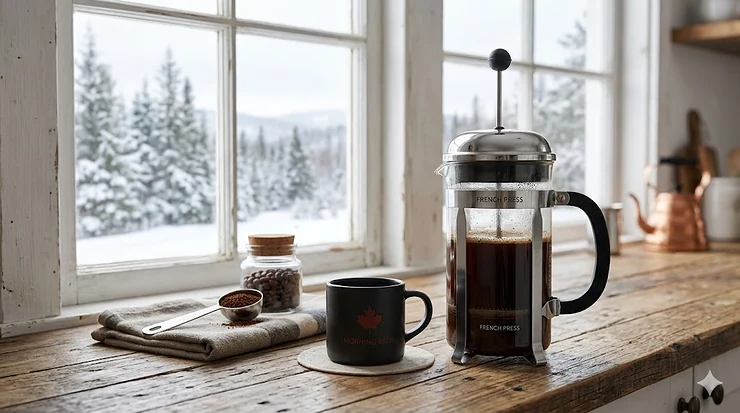
Walking into a Canadian coffee shop on a crisp morning, you’ll likely spot at least one French press coffee maker sitting on someone’s table. There’s something deeply satisfying about this brewing method—it’s the antithesis of complicated espresso machines or finicky pour-over setups. The French press coffee maker delivers what Canadians crave: a robust, full-bodied cup that doesn’t require a barista certification to master.
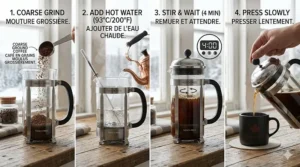
What makes the French press coffee maker particularly brilliant for Canadian households is its resilience. Unlike electronic brewers that can malfunction during power outages (a reality for many Canadians during winter storms), this manual brewing method never lets you down. The immersion brewing technique—where coarsely ground coffee steeps directly in hot water—extracts the natural oils and subtle flavours that paper filters would otherwise trap. This creates that signature thick, aromatic cup that coffee enthusiasts in Vancouver, Toronto, and everywhere in between have fallen in love with.
For Canadian buyers in 2026, the market offers everything from budget-friendly glass models under $40 CAD to premium double-walled stainless steel versions approaching $200 CAD. Whether you’re a university student in Halifax brewing your first proper coffee or a seasoned coffee lover in Calgary seeking grit-free perfection, this guide will help you navigate the options available on Amazon.ca today.
Quick Comparison Table: Top French Press Coffee Makers
| Model | Material | Capacity | Filter Type | Price Range (CAD) | Best For |
|---|---|---|---|---|---|
| ESPRO P7 | Stainless Steel | 950 mL | Double Micro-Filter | $140-$190 | Premium grit-free brewing |
| Bodum Chambord | Glass/Steel Frame | 1 L | Standard Mesh | $50-$80 | Classic design lovers |
| Secura Insulated | Stainless Steel | 1 L | 3-Layer Mesh | $35-$50 | Budget-conscious buyers |
| ESPRO P3 | Borosilicate Glass | 950 mL | Double Micro-Filter | $80-$110 | Glass enthusiasts |
| Bodum Colombia | Stainless Steel | 1 L | Standard Mesh | $90-$130 | Heat retention priority |
| KICHLY Double-Wall | Stainless Steel | 1 L | 4-Level Filter | $30-$45 | Value seekers |
| Coffee Gator | Stainless Steel | 1 L | 4-Level Filter | $45-$65 | Travel canister bonus |
Looking at this comparison, the sweet spot for most Canadian buyers sits between $40-$90 CAD. The premium ESPRO models justify their higher price through patented double micro-filtration that genuinely eliminates sediment—a worthwhile investment if you’re particular about texture. Budget options like KICHLY and Secura sacrifice some filtration finesse but still deliver excellent coffee for daily use. The Bodum Chambord remains the timeless choice, balancing aesthetics with performance at a fair mid-range price point.
💬 Just one click — help others make better buying decisions too!😊
Top 7 French Press Coffee Makers: Expert Analysis
1. ESPRO P7 Stainless Steel French Press – Premium Grit-Free Champion
The ESPRO P7 represents the pinnacle of French press coffee maker engineering available on Amazon.ca. This Canadian-designed brewer features patented double micro-filtration technology that filters coffee twice—once through a 9-times-finer mesh and again through a 12-times-finer outer filter. What this means in your daily routine: zero sediment in your final cup, even at the bottom of your mug. The 304 stainless steel construction keeps coffee hot for up to two hours while the exterior remains cool to touch, a crucial feature during Canadian winters when you want to savour your brew slowly without reheating.
The 950 mL (32 oz) capacity delivers approximately four standard cups, perfect for sharing with a partner or fuelling your work-from-home mornings. Canadian buyers specifically appreciate that ESPRO filters are made from USA-manufactured materials but assembled in Canada, supporting North American manufacturing. The double-wall insulation maintains stable temperatures during the 4-minute brew cycle, which professional baristas know is critical for consistent extraction—especially important when dealing with Canadian hard water that varies significantly by province.
Customer reviews from Canadian buyers consistently highlight the dramatic reduction in “French press sludge” compared to standard models. One Vancouver reviewer noted that after switching to the P7, they actually finished their entire cup for the first time without encountering grit. The only learning curve involves the slightly different plunging technique—you need to twist slightly as you press to engage both filters properly.
Pros:
- Patented double micro-filter eliminates 99% of sediment
- Maintains brewing temperature precisely during 4-minute steep
- Double-wall insulation keeps coffee hot for 2+ hours
Cons:
- Premium price point (around $180-$190 CAD range)
- Heavier than glass alternatives at approximately 1.2 kg
Available on Amazon.ca in the $140-$190 CAD range depending on size, the P7 represents a significant investment but one that transforms your French press coffee maker experience entirely. If you brew daily and value a silky-smooth cup, this is your answer.
2. Bodum Chambord French Press – Timeless European Classic
The Bodum Chambord is the French press coffee maker your grandparents might have used, and it’s still manufactured to the same exacting standards today. This iconic model features heat-resistant borosilicate glass that withstands Canadian dishwasher cycles without clouding—a common problem with cheaper glass carafes. The polished stainless steel frame isn’t merely decorative; it provides structural support that protects the glass during handling, crucial for households with children or early-morning clumsiness.
Made in Portugal by the company that essentially popularized the French press coffee maker globally, the Chambord uses a three-part stainless steel plunger with a mesh filter that traps grounds while allowing beneficial coffee oils through. The 1 L (34 oz) capacity is perfectly sized for two generous Canadian-sized mugs (we tend to drink larger servings than European standards). What Canadian buyers often overlook: Bodum offers both glass and shatterproof recyclable SAN beaker versions—the latter being ideal if you’re using your French press coffee maker at a cottage or during camping trips in the Rockies.
The brewing process is straightforward: coarsely ground coffee, water just off the boil (let it sit 30 seconds after boiling), a 4-minute steep, then a slow plunge. One aspect particularly relevant to Canadian buyers is the replacement part availability—Bodum replacement carafes and filters are widely stocked across Canada, both online and in kitchen stores. When your beaker inevitably breaks (it happens to all of us), you’re not replacing the entire unit.
Pros:
- Genuine borosilicate glass resists thermal shock from hot to cold
- Replacement parts readily available across Canada
- Dishwasher-safe beaker and plunger components
Cons:
- Glass construction requires careful handling
- Standard mesh filter allows more sediment than premium double-filter models
Priced in the $50-$80 CAD range on Amazon.ca, the Chambord delivers exceptional value for buyers who appreciate classic design and don’t mind a bit of traditional coffee sediment in their cup.
3. Secura Stainless Steel Insulated French Press – Budget-Friendly Workhorse
The Secura French press coffee maker proves you don’t need to spend $100+ CAD to enjoy excellent immersion-brewed coffee. This fully stainless steel model features triple-layer filtration—more sophisticated than basic single-mesh filters but less complex than ESPRO’s patented system. The result is a good balance: minimal sediment while retaining the aromatic oils that make French press coffee so distinctive.
What makes the Secura particularly clever for Canadian buyers is the double-wall insulated design combined with an affordable price point around $35-$50 CAD. The 1 L capacity maintains heat comparably to models costing three times as much, and the 304-grade stainless steel construction won’t rust even with daily use and hard water. Canadian reviewers specifically mention this model’s performance during power outages—when your electric brewer is useless, this manual French press coffee maker becomes your reliable coffee source.
The bonus stainless steel screen included allows you to stack filters for an even finer brew if you’re particularly sensitive to sediment. The cool-touch handle remains comfortable even when filled with near-boiling water, addressing a common complaint with cheaper models that heat excessively. One practical consideration for Canadian buyers: the fully stainless construction means you can’t see the coffee level while brewing, so you’ll need to measure your water before adding (30 grams coffee to 500 mL water is a solid starting ratio).
Pros:
- Exceptional value under $50 CAD with double-wall insulation
- Dishwasher-safe construction simplifies cleanup
- Bonus filter screen included for customizable filtration
Cons:
- Can’t monitor coffee level through opaque walls
- Heavier than glass models when filled
Available on Amazon.ca with Prime shipping, the Secura represents the best entry point for Canadians new to the French press coffee maker method or those seeking a durable secondary brewer for the office.
4. ESPRO P3 Glass French Press – Premium Filtration Meets Tradition
The ESPRO P3 combines the visual appeal of traditional glass brewing with ESPRO’s revolutionary double micro-filter technology. The borosilicate glass carafe is 40% thicker than standard French press models, addressing the common Canadian complaint about fragile glass that shatters when moved from hot to cold environments (like from your warm kitchen to a chilly deck). The twist-lock safety latch secures the carafe to the plunger assembly, preventing the glass from sliding out during pouring—a feature you’ll appreciate when serving coffee to guests.
What differentiates the P3 from the premium P7 is the glass construction versus full stainless steel, making this the choice for coffee enthusiasts who want visual confirmation of their brew while maintaining grit-free results. The double micro-filter system functions identically to the P7, filtering twice to trap sediment while allowing oils and flavour compounds through. Canadian buyers in the $80-$110 CAD range get ESPRO’s filtration technology without the premium thermal insulation, which is perfectly acceptable if you’re brewing and serving immediately rather than keeping coffee hot for hours.
The 950 mL capacity (also available in 540 mL for solo brewers) suits Canadian households perfectly—it’s larger than European-sized presses but smaller than American mega-brewers. One consideration specific to Canadian climates: store the glass carafe away from extreme temperature fluctuations. Bringing it directly from a cold garage to a hot kitchen could cause thermal stress, though the thickened glass design mitigates this risk significantly.
Pros:
- Watch your coffee brew through heat-resistant glass
- Same patented double micro-filter as premium P7 model
- Twist-lock safety prevents glass slippage during pouring
Cons:
- Glass requires more careful handling than stainless steel
- Doesn’t retain heat as long as insulated models
Available on Amazon.ca in the mid-range $80-$110 CAD bracket, the P3 is ideal for Canadian buyers who value the French press coffee maker ritual’s visual component but refuse to compromise on sediment-free results.
5. Bodum Colombia Double-Wall Stainless Steel – Heat Retention King
The Bodum Colombia solves the primary complaint Canadian users have with glass French press coffee makers: coffee cooling too quickly, especially during winter mornings. The double-wall stainless steel construction keeps coffee hot for up to two hours while the exterior remains cool enough to handle comfortably—crucial when you’re working from your home office and want to pour a second cup 45 minutes after brewing without reheating.
Unlike the Chambord’s glass design, the Colombia’s fully stainless build means you’ll never replace a broken carafe. The 1 L capacity uses Bodum’s standard three-part stainless steel plunger system, delivering that characteristic full-bodied French press flavour with slightly more sediment than double-filtered alternatives. For Canadian buyers accustomed to Tim Hortons’ bold coffee, the Colombia’s extraction profile feels familiar and satisfying.
What sets this model apart in the $90-$130 CAD range is the thermal efficiency—essential if you’re brewing coffee in a drafty older home or cottage. The polished stainless steel exterior looks professional on kitchen counters and won’t stain over time like plastic-trimmed alternatives. Canadian reviewers specifically mention the Colombia’s performance during camping trips: its rugged construction survives backpack transport, and the insulation keeps coffee hot during cool mountain mornings in Jasper or Banff.
Pros:
- Maintains brewing temperature during extraction for consistent results
- Keeps coffee hot for 2+ hours without external heat source
- Indestructible stainless steel eliminates replacement carafe costs
Cons:
- Can’t visually monitor brewing progress through steel walls
- Higher price point than basic glass models
Available on Amazon.ca in the $90-$130 CAD range, the Colombia justifies its premium over the basic Chambord if heat retention matters to your routine.

6. KICHLY Double-Walled French Press – Outstanding Value Leader
The KICHLY French press coffee maker delivers shocking performance for under $45 CAD, making it the ideal choice for Canadian students, first-time buyers, or anyone wanting a backup brewer. The double-wall stainless steel construction provides thermal insulation comparable to models costing twice as much, while the four-level filtration system reduces sediment significantly beyond basic single-mesh designs.
What makes the KICHLY particularly smart for Canadian buyers is the refined filter design that uses progressively finer mesh layers to trap grounds while maintaining flow rate. The 1 L capacity suits couples or solo drinkers who enjoy multiple cups, and the dishwasher-safe construction means cleanup takes seconds—just disassemble and toss in your dishwasher’s top rack. Canadian reviewers frequently mention this model’s durability exceeding expectations given its budget price point.
The stainless steel construction eliminates concerns about glass breaking, making this an excellent choice for households with children or for office environments where multiple people handle the brewer. One practical note: the KICHLY arrives well-packaged but requires minimal assembly (screwing the plunger components together), which takes about 60 seconds. Unlike some budget models that feel flimsy, the KICHLY’s weight and build quality suggest longevity.
Pros:
- Exceptional value under $45 CAD with double-wall insulation
- Four-level filtration reduces sediment substantially
- Risk-free investment for French press coffee maker beginners
Cons:
- Slightly more sediment than premium double micro-filter models
- Opaque walls prevent visual monitoring of brew
Available on Amazon.ca with frequent promotions dropping the price below $40 CAD, the KICHLY represents the best value proposition for Canadian buyers who want quality without premium pricing.
7. Coffee Gator French Press – Travel Canister Bonus
The Coffee Gator differentiates itself by including a premium stainless steel travel canister that seals coffee beans freshly ground or stores your brew for transport. This French press coffee maker features double-wall insulation and a four-level filtration system similar to the KICHLY but with slightly thicker stainless steel construction and a more refined aesthetic. The 1 L capacity delivers approximately four cups, with the added benefit of keeping coffee hot for 60+ minutes after brewing.
What Canadian buyers appreciate most is the complete coffee system approach: the included canister creates an airtight seal that preserves coffee beans from humidity—particularly important during Canadian summers when humidity can stale beans quickly. The canister fits perfectly in your refrigerator door, and the date tracker wheel reminds you when you opened the bag. The French press coffee maker itself uses Food-grade 304 stainless steel throughout, meeting Canadian safety standards and ensuring rust-free operation even with hard water prevalent in many regions.
The filtration system layers four different mesh densities, progressively filtering finer particles as you plunge. While not as refined as ESPRO’s patented double micro-filter, it significantly outperforms basic single-mesh designs. Canadian reviewers specifically mention the Coffee Gator’s performance during camping trips—the durable construction survives transport in RVs and backpacks, and the thermal insulation maintains temperature during outdoor breakfasts.
Pros:
- Premium travel canister included for bean storage or transport
- Four-level filtration reduces sediment substantially
- Dishwasher-safe components simplify maintenance
Cons:
- Slightly heavier than comparable models when filled
- Mid-range pricing around $45-$65 CAD
Available on Amazon.ca in the $45-$65 CAD range, the Coffee Gator suits Canadian buyers who value the complete coffee brewing ecosystem and appreciate bonus accessories that enhance the overall experience.
How to Use Your French Press Coffee Maker: Canadian Winter-Proof Method
Mastering the French press coffee maker technique transforms your morning routine from mediocre to magnificent. Here’s the approach that works consistently in Canadian homes, accounting for our tap water hardness and seasonal temperature variations.
Step 1: Preheat Your Equipment
During Canadian winters, your French press coffee maker sits at room temperature (or colder if stored in a garage or cottage). Pour hot water into the empty carafe and let it sit for 30 seconds while you grind your beans. This prevents thermal shock to glass models and ensures your brewing temperature doesn’t drop precipitously when you add coffee—particularly important when room temperature hovers around 18°C.
Step 2: Measure and Grind
Use a 1:15 coffee-to-water ratio as your baseline: 30 grams of coarsely ground coffee to 450 mL of water. A coarse grind resembles sea salt crystals—if you’re grinding at home with a burr grinder, set it to the coarsest setting. Canadian tap water varies significantly by province; if yours is particularly hard (common in Alberta and parts of Ontario), consider using filtered water to prevent mineral buildup in your mesh filter over time.
Step 3: Brew at Optimal Temperature
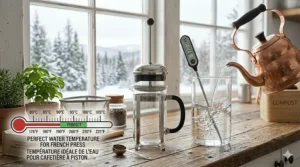
Heat water to 92-96°C (198-205°F). If you don’t have a temperature-controlled kettle, bring water to a full boil then let it sit for 30 seconds. This accounts for the temperature drop during the standing period and when poured over room-temperature coffee grounds. In Canadian winter conditions when your kitchen is cooler, you might reduce the wait time to 20 seconds to maintain proper extraction temperature.
Step 4: Steep for Exactly Four Minutes
Set a timer for 4 minutes after adding the water. During this immersion phase, the coffee grounds release oils, acids, and aromatic compounds that paper filters would otherwise absorb. Don’t stir excessively—one gentle stir after adding water is sufficient to ensure all grounds are saturated. The layer of coffee that floats to the top (called the “crust”) will break and sink when you plunge.
Step 5: Plunge Slowly and Pour Immediately
Apply steady, gentle pressure on the plunger, taking approximately 15-20 seconds to press completely. If you meet significant resistance, your grind is too fine. If the plunger drops with no resistance, your grind is too coarse. Once plunged, pour immediately into your mug—leaving coffee in the French press coffee maker continues extraction, leading to bitterness.
This method consistently produces excellent results across Canadian households, from coastal Vancouver to inland Winnipeg. The key is maintaining temperature throughout the process, which becomes more challenging during winter but is easily managed with the preheating step.
Real-World Scenario: Matching Canadian Lifestyles to French Press Coffee Makers
The Downtown Toronto Condo Dweller
Sarah, a marketing manager in her 30s, lives in a 550-square-foot condo with minimal kitchen storage. She needs a French press coffee maker that’s compact, doesn’t require extensive cleanup, and produces one to two cups daily.
Best Match: ESPRO P3 (540 mL size)
The smaller P3 fits perfectly in Sarah’s limited cabinet space, and the double micro-filter means she can rinse it quickly before heading to the office—no grounds stuck in complex filter assemblies. The glass construction lets her monitor her brew while getting ready, and the grit-free result means she can pour the second half of her cup 20 minutes later without encountering sediment. Price around $75 CAD fits her budget.
The Calgary Family of Four
The Johnsons—two adults, two teenagers—want coffee ready when everyone stumbles downstairs at different times on weekend mornings. They need capacity, heat retention, and durability against curious hands.
Best Match: Bodum Colombia 1 L
The double-wall stainless steel construction keeps coffee hot for two hours, meaning Dad can brew at 7 AM and the kids can pour cups at 8:30 AM without reheating. The indestructible steel construction survives teenager handling, and the 1 L capacity delivers four proper cups. The $110 CAD investment pays for itself by eliminating the electric drip machine that broke annually.
The Vancouver Weekend Trail Rider
Marcus brings his mountain bike to North Shore trails every Saturday, and wants excellent coffee during his post-ride recovery by the van.
Best Match: Secura Insulated with Bonus Canister
The fully stainless construction survives bouncing around in the van, the insulation keeps coffee hot during the drive to the trailhead, and the affordable $45 CAD price point means he doesn’t stress about outdoor use. He packs coarsely ground coffee in the included bonus filter screen container, adds hot water from his camp stove, and enjoys café-quality coffee with a view.
Common Mistakes When Buying a French Press Coffee Maker
Canadian buyers frequently overlook critical factors that dramatically affect their brewing satisfaction. Avoid these pitfalls when selecting your French press coffee maker on Amazon.ca.
Mistake 1: Choosing Size Based on Total Capacity
French press coffee maker capacity refers to the total beaker volume, not finished coffee output. A “1 L” model produces approximately 750-800 mL of drinkable coffee after accounting for grounds displacement and the dead space below the plunger. If you want four 200 mL cups, you actually need a 1 L press, not an 800 mL model. Canadian buyers often purchase too small initially, then upgrade within months.
Mistake 2: Ignoring Canadian Winter Performance
Glass models without preheating lose significant temperature during brewing when room temperature drops below 18°C. This under-extracts your coffee, producing sour, weak results. Either commit to preheating your carafe (adding 60 seconds to your routine) or invest in double-wall stainless steel models that maintain stable temperatures throughout brewing.
Mistake 3: Assuming All Mesh Filters Perform Equally
Basic single-mesh filters allow significant sediment into your cup—acceptable to some, intolerable to others. If you’ve tried French press coffee maker brewing before and hated the “sludge,” don’t abandon the method entirely. Upgrade to a model with multi-level filtration (KICHLY, Coffee Gator) or double micro-filters (ESPRO) that genuinely eliminate grit. The difference is transformative.
Mistake 4: Overlooking Replacement Part Availability in Canada
When your glass carafe eventually breaks (it happens), can you actually buy a replacement in Canada without paying $30 CAD in cross-border shipping? Bodum replacement parts are widely available domestically. ESPRO, being Canadian-designed, ships replacement filters across Canada efficiently. Generic Chinese brands on Amazon.ca often have zero parts availability, meaning a $15 broken beaker ends your $40 investment.
Mistake 5: Choosing Aesthetics Over Filtration Quality
That gorgeous copper-finish French press coffee maker looks stunning on Instagram, but if it uses a basic single-mesh filter, you’ll hate the brewing results. Prioritize filtration quality first, then aesthetics. The most beautiful brewer is the one that produces coffee you actually want to drink daily.
French Press Coffee Maker vs Pour-Over: Which Suits Canadian Lifestyles?
Canadian coffee enthusiasts frequently debate French press coffee maker versus pour-over methods. Both deliver superior results compared to automatic drip machines, but they suit different priorities.
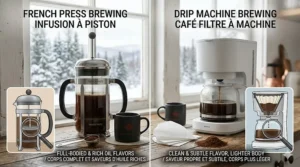
The French press coffee maker excels at consistency and simplicity. Once you nail your grind size and ratio, you’ll produce identical results every morning without requiring precision pouring technique or a gooseneck kettle. This matters for Canadians rushing to work on dark winter mornings when finesse feels impossible. The immersion method is forgiving—your water temperature can vary by 5°C and you’ll still get good coffee. The full-bodied result, rich with oils, suits Canadian preferences for bold, substantial coffee.
Pour-over methods (Chemex, V60, Kalita) demand active participation: consistent circular pouring, specific water temperature control, and pulse-pouring technique. The reward is brighter, cleaner coffee that highlights subtle flavour notes. However, this requires a gooseneck kettle (adding $40-$100 CAD to your setup cost) and 5-6 minutes of focused attention. During busy weekday mornings, this becomes a luxury rather than practical routine.
For most Canadian households, the French press coffee maker represents the better choice: it’s faster (4 minutes hands-off versus 5-6 minutes active pouring), requires zero special equipment beyond the press itself, and produces results that match Canadian flavour preferences. Reserve pour-over for leisurely weekend experimentation when you can appreciate the nuanced results.
What to Expect: Real-World Performance in Canadian Conditions
Understanding how French press coffee makers perform in actual Canadian environments helps set realistic expectations and optimize your brewing.
Winter Performance Considerations
When room temperature drops to 16-18°C during Canadian winters, glass French press coffee makers lose heat rapidly during the 4-minute brew. You’ll notice this as slightly sour, under-extracted coffee. The solution: preheat your carafe with hot water for 30 seconds before brewing, or invest in double-wall stainless steel models that maintain stable temperatures regardless of ambient conditions. This isn’t a flaw in the French press coffee maker method—it’s physics—but it’s easily managed once you understand the dynamic.
Hard Water Impact
Western Canadian tap water, particularly in Alberta and Saskatchewan, contains significant mineral content that accumulates on mesh filters over time. You’ll notice the plunger becoming harder to press after several months of daily use. The solution: descale monthly by soaking the plunger assembly in a 50/50 mixture of white vinegar and water for 30 minutes. This maintains smooth plunging action and prevents mineral buildup from affecting filtration quality.
Grind Consistency Challenges
Canadian grocery stores sell pre-ground coffee labelled “for French press coffee maker,” but the grind is often too fine, producing over-extracted, bitter coffee and excessive sediment. If purchasing pre-ground from major grocery chains, reduce your steep time to 3 minutes instead of 4. Ideally, invest in a burr grinder ($80-$200 CAD) and grind beans immediately before brewing—this single upgrade improves your results more than buying a premium French press coffee maker.
Altitude Adjustments
Canadians brewing at higher elevations (Calgary, Banff, Jasper) should note that water boils at lower temperatures—approximately 95°C at 1,000 metres versus 100°C at sea level. This means your “30 seconds off boil” water is actually cooler than intended. Reduce the wait time to 15-20 seconds after boiling to maintain proper extraction temperature.
Long-Term Cost & Maintenance: Canadian Perspective
Analyzing the total cost of ownership helps Canadian buyers make informed French press coffee maker investments beyond initial purchase price.
Initial Investment Analysis
Entry-level models (KICHLY, Secura) cost $35-$50 CAD—equivalent to approximately 8-10 café lattes in Vancouver or Toronto. If you currently purchase one café coffee daily at $5.50 CAD, your French press coffee maker pays for itself within two weeks. Premium models (ESPRO P7) at $180 CAD equal about five months of café coffee at one purchase per weekday, breaking even around month six.
Ongoing Maintenance Costs
Quality coffee beans from Canadian roasters cost $14-$20 CAD per 340-gram bag, producing approximately 25-30 cups at the recommended 1:15 ratio. This works out to $0.55-$0.70 CAD per cup—dramatically less than café prices but noticeably more than automatic drip coffee using commercial grounds. The value proposition depends on your priorities: convenience versus flavour quality.
Replacement Part Economics
Glass carafes for popular brands (Bodum) cost $25-$35 CAD when purchased in Canada. ESPRO replacement filters run $15-$25 CAD and typically last 2-3 years with proper care. Budget models from unknown brands often have zero replacement part availability, meaning you’ll replace the entire unit when (not if) something breaks. This makes mid-range models from established brands (Bodum, ESPRO) more economical over 5+ years despite higher initial cost.
Energy Savings
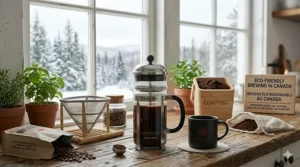
French press coffee makers require zero electricity, saving approximately $12-$18 CAD annually compared to electric drip machines that maintain warming plates. This might seem minimal, but over a 10-year lifespan, it offsets a significant portion of your initial investment. Additionally, the environmental benefit of avoiding paper filters (typical drip machines use 365+ filters annually) aligns with Canadian sustainability values.
Features That Actually Matter (And Those That Don’t)
Canadian buyers encounter marketing claims that sound impressive but deliver minimal real-world benefit. Here’s what actually affects your daily French press coffee maker experience.
Features Worth Paying For
Double-Wall Insulation: This genuinely maintains brewing temperature during extraction and keeps coffee hot afterward. Worth $30-$50 CAD extra, especially for Canadian winter conditions.
Multi-Level Filtration: The difference between single-mesh and four-level filtration is dramatic. Worth $15-$25 CAD extra for significantly reduced sediment.
Borosilicate Glass: Heat-resistant glass that survives Canadian dishwasher cycles without clouding. Worth $10-$15 CAD extra versus standard glass.
304 Stainless Steel: Food-grade steel that won’t rust with hard water. Worth $20 CAD extra versus unknown alloys.
Marketing Gimmicks to Ignore
“Professional Barista Quality”: All French press coffee makers use identical brewing principles. This is meaningless marketing.
“Patented Three-Stage Filtration”: Unless it’s ESPRO’s double micro-filter, most “multi-stage” systems are just standard mesh with marketing language.
“BPA-Free Plastic Components”: Only matters if the plastic contacts hot coffee directly. Handles and frames being BPA-free is standard—not a premium feature.
“European Design”: Most French press coffee makers are manufactured in Portugal or China regardless of where they’re “designed.” This doesn’t affect performance.
“Café-Style Coffee at Home”: Every French press coffee maker produces café-style coffee if you use proper technique. This isn’t model-specific.
Focus your budget on insulation quality, filtration sophistication, and build materials. Everything else is marketing noise designed to justify premium pricing on mediocre products.
Canadian Coffee Culture: Why French Press Coffee Maker Fits Perfectly
Canadian coffee consumption patterns differ significantly from both American and European markets, and the French press coffee maker aligns beautifully with our unique preferences.
According to Health Canada research, approximately 60% of Canadian caffeine consumption comes from coffee, with the average Canadian coffee drinker consuming 2-3 cups daily. Health Canada recommends that healthy adults limit daily caffeine intake to 400 milligrams—roughly equivalent to three to four cups of French press coffee. We favour bold, full-bodied coffee that delivers substantial caffeine—precisely what the French press coffee maker method produces. Unlike paper-filtered coffee that strips oils and sediment, immersion brewing retains the caffeine-rich compounds and creates that thick mouthfeel Canadians prefer.
The manual nature of French press coffee makers resonates with Canada’s growing maker culture and sustainability awareness. We’re increasingly skeptical of unnecessary electronic gadgets, especially after experiencing supply chain disruptions during 2020-2022 that left many without replacement parts for electric brewers. A French press coffee maker requires zero electronics, zero proprietary pods, and zero dependence on manufacturers continuing product lines. It’s the anti-fragile coffee solution for Canadians who value self-sufficiency.
Regional preferences across Canada further support French press coffee maker adoption. British Columbians appreciate the environmental angle (no paper filters, no plastic pods). Prairie Canadians value the durability and reliability during harsh winters when power outages occur. Ontario and Quebec buyers appreciate the European heritage and aesthetic elegance. Maritime Canadians love the simplicity and the fact that replacement parts are readily available even in smaller communities.
The French press coffee maker method also aligns with Canadian hospitality culture. When guests arrive, brewing a fresh pot creates a sensory experience—the aroma, the ritual, the conversation during the 4-minute steep—that automatic machines can’t replicate. It’s inherently social in a way that matches Canadian values around gathering and sharing.
FAQ: French Press Coffee Maker Questions Canadian Buyers Ask
❓ Can I use a French press coffee maker during Canadian winter power outages?
❓ Do French press coffee makers work at Canadian cottage elevations?
❓ How do I prevent my French press coffee maker from breaking in Canadian winters?
❓ Are French press coffee makers legal in all Canadian provinces?
❓ Can I make cold brew coffee in my French press coffee maker?
Conclusion: Your Perfect French Press Coffee Maker Awaits on Amazon.ca
After analyzing dozens of models available to Canadian buyers in 2026, the ideal French press coffee maker depends entirely on your priorities. Budget-conscious buyers seeking excellent value should explore the KICHLY or Secura models in the $35-$50 CAD range—both deliver performance far exceeding their modest price tags. Coffee enthusiasts who refuse to compromise on sediment-free results will find the ESPRO P3 or P7 worth every dollar of their $80-$190 CAD investment. Traditional lovers who appreciate European heritage should default to the timeless Bodum Chambord around $60 CAD.
What matters most is matching the French press coffee maker to your actual daily routine, not theoretical ideal scenarios. Be honest about whether you’ll commit to preheating glass models during Canadian winters, whether you need thermal insulation for slow sipping, and whether sediment genuinely bothers you or just sounds like it might. The best French press coffee maker is the one you’ll use enthusiastically every morning for years, not the one with the most impressive specifications.
Remember that no French press coffee maker compensates for stale coffee beans or improper grind size. Invest in fresh-roasted beans from Canadian roasters, maintain a coarse grind, and follow proper brewing technique. A $40 CAD Secura with excellent beans and technique will outperform a $180 CAD ESPRO P7 with grocery store pre-ground coffee every single time.
Whatever model you choose from Amazon.ca, you’re joining millions of Canadians who’ve discovered that the best coffee comes not from expensive espresso machines or convenient pod systems, but from the elegantly simple immersion brewing method that’s remained fundamentally unchanged since the 1850s.
✨ Don’t Miss These Exclusive Deals!
🔍 Take your morning coffee to the next level with these carefully selected French press coffee makers. Click on any highlighted item to check current pricing and availability on Amazon.ca. These brewers will help you create authentic café-quality coffee your family will love!
Recommended for You
- 7 Best Manual Pour Over Drippers for Canadians 2026
- Best Kalita Wave Coffee Maker Canada: 7 Top Picks 2026
- Best Hario V60 Pour Over Canada 2026
Disclaimer: This article contains affiliate links. As an Amazon Associate, I earn from qualifying purchases. If you purchase products through these links, we may earn a small commission at no additional cost to you.
✨ Found this helpful? Share it with your friends! 💬🤗
