
In This Article
Picture this: You’ve brewed the perfect pot of coffee at 7 a.m., but by 9 a.m., that second cup tastes burnt and bitter. Sound familiar? The culprit isn’t your beans or brewing technique—it’s your carafe. The thermal vs glass carafe coffee maker debate isn’t just about aesthetics; it’s about preserving that rich, aromatic flavour Canadians crave on chilly mornings. According to Wikipedia’s detailed overview of coffee preparation, temperature management is one of the most critical factors in coffee quality.
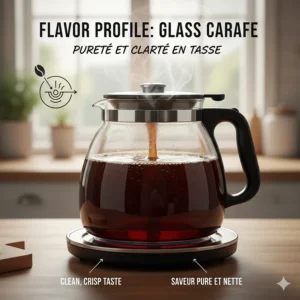
A thermal vs glass carafe coffee maker decision impacts everything from your coffee’s temperature retention to its taste quality over time. Glass carafes on hotplates can vary coffee temperature by about 2.5°F in either direction after one hour, while thermal carafes lose about 4°F after an hour. That’s according to Consumer Reports’ rigorous testing, and it explains why your glass carafe coffee might taste “cooked” by mid-morning.
Whether you’re a Toronto commuter grabbing quick cups between meetings or a Vancouver remote worker savouring slow sips throughout the day, understanding the nuances between thermal and glass options helps you make the right choice. In this comprehensive guide, we’ll explore seven real coffee makers available on Amazon.ca, compare their heat retention capabilities, and help you decide which carafe type suits your Canadian lifestyle best.
Quick Comparison: Thermal vs Glass Carafe Coffee Maker at a Glance
| Feature | Thermal Carafe | Glass Carafe |
|---|---|---|
| Heat Retention | 4-12 hours without external heat | 1-2 hours with hotplate |
| Temperature Stability | Loses ~4°F per hour | Varies ±2.5°F with hotplate cycling |
| Flavour Preservation | Excellent – no “burnt” taste | Can develop bitter flavours from prolonged heat |
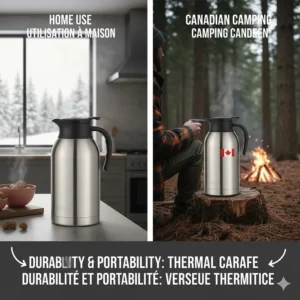
| Durability | High – stainless steel construction | Fragile – prone to breakage |
| Price Range (CAD) | $80-$400+ | $40-$300+ |
| Weight | Heavier (harder to pour when full) | Lighter (easier handling) |
| Visibility | Opaque – can’t see coffee level | Transparent – easy level monitoring |
| Cleaning Difficulty | Moderate – narrower opening | Easy – wide opening, dishwasher safe |
💬 Just one click – help others make better buying decisions too! 😊
Top 7 Thermal vs Glass Carafe Coffee Makers: Expert Analysis
1. Cuisinart DCC-1170BK 10-Cup Thermal Classic
The Cuisinart DCC-1170BK stands as one of Canada’s most beloved thermal carafe options, combining affordability with reliable performance. This 10-cup programmable brewer features a double-wall stainless steel carafe that keeps coffee hot for hours without a hotplate.
Key Specifications:
- 10-cup (1.4L) thermal carafe capacity
- 24-hour programmability with auto-shutoff
- Brew Pause™ feature for mid-cycle pouring
- Gold-tone and charcoal water filters included
Price: $115-$145 CAD on Amazon.ca
Canadian Customer Feedback: Toronto buyers consistently praise its heat retention, with many noting coffee stays enjoyably warm for 3-4 hours. Some Montreal users mention the carafe’s drip-free spout occasionally requires careful angling.
✅ Pros: Excellent value, reliable programming, good heat retention, dual filtration system
❌ Cons: Carafe can be heavy when full, LCD display lacks backlighting
2. Hamilton Beach 46899R Programmable 10-Cup Thermal
The Hamilton Beach 46899R delivers surprising quality at a budget-friendly price point for Canadian households. Its cone-shaped filter basket promotes optimal extraction, while three brew strength settings let you customize intensity.
Key Specifications:
- 10-cup thermal carafe with thumb-activated lid
- Cone filter design for enhanced extraction
- Regular, Bold, and Robust brew options
- Includes starter pack of #4 cone filters
Price: $85-$110 CAD on Amazon.ca
Canadian Customer Feedback: Calgary buyers appreciate the cone filter’s superior extraction compared to flat-bottom baskets. Vancouver customers note the thermal carafe maintains temperature well for 2-3 hours.
✅ Pros: Budget-friendly, cone filter extraction, three brew strengths, easy-pour thumb lid
❌ Cons: Build quality feels lighter than premium models, shorter heat retention than higher-end thermal carafes
3. Hamilton Beach 46899R Programmable 10-Cup Thermal
The BLACK+DECKER CM2046S stands out with its innovative Vortex Technology that evenly saturates grounds for optimal flavour extraction. The four-layer vacuum-sealed carafe is engineered to maintain temperature for up to 2 hours.
Key Specifications:
- 12-cup (1.7L) four-layer vacuum thermal carafe
- Vortex Technology for even saturation
- Programmable with brew strength selector
- Digital controls with freshness timer
Price: $75-$95 CAD on Amazon.ca
Canadian Customer Feedback: Ottawa residents praise the freshness timer that shows elapsed time since brewing. Some Halifax users wish the heat retention lasted beyond the 2-hour mark for all-day sipping.
✅ Pros: Excellent value, Vortex saturation technology, brew strength control, freshness timer display
❌ Cons: Heat retention shorter than competitors, plastic components feel less premium
4. Mr. Coffee BVMC-PSTX91 10-Cup Thermal Programmable
The Mr. Coffee BVMC-PSTX91 combines thermal efficiency with programmable convenience at a mid-range price. Its stainless steel exterior adds durability while the double-wall construction preserves temperature and flavour.
Key Specifications:
- 10-cup stainless steel thermal carafe
- Brew strength selector (Regular/Bold)
- Grab-A-Cup Auto Pause for mid-brew pouring
- 24-hour advance brew programming
Price: $95-$125 CAD on Amazon.ca
Canadian Customer Feedback: Winnipeg buyers appreciate the faster brewing speed compared to standard models. Edmonton customers note the thermal carafe keeps coffee noticeably warmer than their previous glass carafe machines.
✅ Pros: Fast brewing time, brew strength options, reliable brand, good heat retention
❌ Cons: Carafe lid can be tricky to align properly, programming interface could be more intuitive
5. Technivorm Moccamaster KBT 10-Cup Thermal (Premium Option)
For coffee purists, the Dutch-made Technivorm Moccamaster KBT represents the gold standard. This SCA-certified brewer meets the Specialty Coffee Association’s Golden Cup Standard, ensuring optimal extraction every time. While pricier, it’s handmade in the Netherlands with a 5-year warranty.
Key Specifications:
- 10-cup (1.25L) glass-lined thermal carafe
- SCA Golden Cup Certified
- Manual-adjust drip-stop brew basket
- Brews full pot in 4-6 minutes
Price: $380-$420 CAD on Amazon.ca
Canadian Customer Feedback: Toronto coffee enthusiasts rave about the noticeably superior flavour compared to budget models. The SCA’s Golden Cup standard requires 18%-22% total dissolved solids and proper water temperature between 196-205°F, which the Moccamaster achieves consistently.
✅ Pros: SCA-certified excellence, handmade quality, exceptional flavour, 5-year warranty
❌ Cons: Premium price point, no programmable timer, requires manual operation
6. Cuisinart DCC-3200NAS 14-Cup Programmable Glass Carafe
Representing the glass carafe category, the Cuisinart DCC-3200NAS offers generous capacity with PerfecTemp technology. The glass carafe sits on a hotplate that maintains serving temperature, though prolonged heating can affect flavour.
Key Specifications:
- 14-cup (2L) glass carafe with ergonomic handle
- Brew strength control (Regular/Bold)
- Adjustable keep-warm temperature
- 1-4 cup setting for smaller batches
Price: $105-$140 CAD on Amazon.ca
Canadian Customer Feedback: Montreal families appreciate the large 14-cup capacity for entertaining. Saskatchewan users note the glass carafe’s transparency helps monitor coffee levels easily, though some experience the “burnt” taste after 2+ hours on the hotplate.
✅ Pros: Large capacity, transparent viewing, adjustable hotplate temperature, more affordable than comparable thermal models
❌ Cons: Flavour degradation after extended hotplate time, glass breakage risk, higher energy consumption
7. Bonavita BV1900TS 8-Cup SCA-Certified with Thermal Carafe
The Bonavita BV1900TS brings SCA certification to a more accessible price point than Moccamaster. Its powerful 1500W heater reaches optimal brewing temperature quickly, while the optional pre-infusion mode allows grounds to “bloom” for enhanced flavour.
Key Specifications:
- 8-cup (1.2L) stainless steel thermal carafe
- SCA Golden Cup Certified
- Optional pre-infusion (bloom) cycle
- Showerhead design for even saturation
Price: $180-$220 CAD on Amazon.ca
Canadian Customer Feedback: Vancouver specialty coffee drinkers praise the bloom function for bringing out subtle flavour notes. Québec City buyers appreciate that it’s one of the most affordable SCA-certified options available in Canada.
✅ Pros: SCA-certified quality, pre-infusion capability, powerful heating element, excellent extraction
❌ Cons: Smaller 8-cup capacity, basic design aesthetics, no programmable timer
Understanding Heat Retention: The Science Behind Coffee Temperature Maintenance
Temperature isn’t just about keeping your coffee hot—it’s about preserving those delicate aromatic compounds that make specialty coffee special. According to research from the National Coffee Association, coffee drinkers prefer to consume their black coffee at 58-66°C (136.4-150.8°F), while the NCA recommends holding brewed coffee at 180-185°F.
How Thermal Carafes Work
Thermal carafes employ double-wall vacuum insulation, similar to a thermos bottle. This design creates an airless barrier between the inner and outer walls, dramatically reducing heat transfer through conduction and convection. The vacuum essentially “traps” the heat inside, allowing coffee to maintain temperature for 4-12 hours depending on carafe quality and volume.
Double-walled stainless steel carafes can keep coffee hot for up to 12 hours, with the double-walled design providing insulation that reduces heat transfer. However, preheating your thermal carafe by rinsing it with hot water before brewing can extend heat retention by warming the steel walls, giving your coffee a temperature advantage from the start.
Glass Carafe Temperature Dynamics
Glass carafes rely on external heating plates to maintain temperature. These hotplates cycle power on and off, causing coffee temperature to vary by about 2.5°F in either direction after 1 hour. This cycling creates temperature fluctuations that can affect flavour extraction from the brewed coffee—essentially “cooking” it further and releasing bitter compounds.
The continuous heating also evaporates aromatic volatiles, which is why glass carafe coffee often loses its fresh aroma within 30-60 minutes. For Canadians who brew a pot and sip throughout the morning, this flavour degradation becomes increasingly noticeable.
Carafe Material Pros and Cons: Making the Right Choice
Thermal Carafe Advantages
Superior Heat Retention Without External Power
Thermal carafes are the clear winner for extended heat retention. They maintain coffee temperature for 4-6 hours minimum, with premium models holding warmth for 8-12 hours. This makes them ideal for Canadian home offices, where you might brew once in the morning and pour cups throughout your workday.
Preserves Authentic Coffee Flavour
Without continuous reheating, thermal carafes prevent the bitter, “burnt” taste that develops when coffee sits on a hotplate. The coffee you pour at 11 a.m. tastes remarkably similar to your 8 a.m. cup—maintaining the flavour profile your beans were meant to deliver.
Energy Efficiency
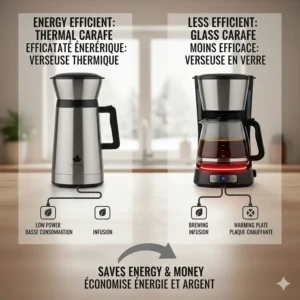
Thermal carafe coffee makers typically auto-shutoff after brewing, eliminating the energy draw of a constantly running hotplate. For environmentally conscious Canadians, this translates to lower electricity bills and reduced environmental impact.
Enhanced Safety
With no hotplate, there’s zero risk of burns from accidentally touching the heating element. The exterior of thermal carafes stays cool to touch, making them safer for households with children or pets.
Thermal Carafe Disadvantages
Higher Initial Cost
Quality thermal carafes command premium prices, typically $30-$80 CAD more than comparable glass models. The investment pays off in longevity, but budget-conscious buyers might hesitate.
Heavier Weight
Stainless steel construction makes thermal carafes noticeably heavier, especially when full. Pouring 10-12 cups requires more strength, which can be challenging for some users.
Limited Visibility
You can’t see how much coffee remains without opening the lid (which releases heat). Some newer models include level indicators, but they’re not as intuitive as glancing at a transparent glass carafe.
Cleaning Challenges
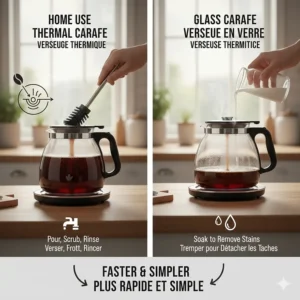
Thermal carafes often have narrower openings and can’t be immersed in water due to vacuum seal concerns. Hand-washing with bottle brushes becomes necessary, and coffee oils can accumulate if not cleaned properly.
Glass Carafe Advantages
Transparent Design
You always know exactly how much coffee remains, making it easy to gauge when to brew a fresh pot. This visibility is particularly helpful when serving guests or managing office coffee stations.
Lighter Weight
Glass carafes are significantly lighter, making them easier to pour even when full. This accessibility benefits users with limited hand strength or mobility concerns.
Simpler Cleaning
Most glass carafes are dishwasher-safe with wide openings that accommodate standard kitchen sponges. Coffee stains rinse away more easily than from stainless steel interiors.
Lower Price Point
Budget models start around $40-$60 CAD, making quality coffee makers accessible to students, first-time homeowners, and anyone prioritizing affordability.
Glass Carafe Disadvantages
Poor Heat Retention
Without the hotplate running, glass carafes lose heat rapidly—often cooling to room temperature within 20-30 minutes. Even with the hotplate, temperature fluctuations affect flavour quality.
Flavour Degradation
Prolonged hotplate exposure creates that characteristic “diner coffee” taste—overly bitter with burnt notes. The continuous heat literally cooks your coffee, breaking down desirable flavour compounds while extracting unpleasant ones.
Fragility Risk
Glass carafes shatter easily if dropped or subjected to rapid temperature changes. Canadians ordering replacement carafes report frustration when exact matches are discontinued or unavailable.
Burn Hazard
Hotplates reach temperatures that can cause serious burns. Accidentally touching the heating element or grabbing a hot glass carafe without the handle poses real safety risks.
Coffee Temperature Maintenance: Best Practices for Both Carafe Types
Maximizing Thermal Carafe Performance
Preheat Before Brewing
Fill your thermal carafe with hot water from the kettle and let it sit for 2-3 minutes while your coffee brews. This simple step warms the stainless steel walls, giving your coffee a significant temperature boost. Empty the preheating water just before brewing begins.
Brew Full Batches When Possible
Thermal mass principles mean a full carafe retains heat longer than a half carafe, as partial volumes lose temperature more quickly. If you’re only brewing 4-5 cups, consider using a smaller thermal carafe to optimize heat retention.
Clean Regularly to Maintain Vacuum Seal
Coffee oils can compromise the vacuum seal over time. Clean your thermal carafe weekly with a mixture of hot water and baking soda, or use specialized coffee carafe cleaning tablets available at Canadian Tire.
Store with Lid Off Between Uses
Allowing air circulation prevents moisture buildup and odour accumulation. Never store a thermal carafe with the lid sealed, as trapped moisture creates an environment for mould growth.
Optimizing Glass Carafe Longevity
Adjust Hotplate Temperature
If your coffee maker has adjustable heat settings, experiment with lower temperatures. You might sacrifice a few degrees of warmth but gain better flavour preservation—a worthwhile trade-off for quality-focused drinkers.
Brew Smaller, More Frequent Batches
Instead of keeping one pot warm for hours, brew fresh 4-6 cup batches every 90-120 minutes. The coffee stays fresher, and you avoid the burnt flavours that develop with extended heating.
Transfer to Thermal Server
Consider pouring brewed coffee from your glass carafe into a separate thermal server for longer-term storage. This hybrid approach gives you the transparent brewing visibility of glass with the heat retention of thermal insulation.
Avoid Temperature Shock
Never pour cold water into a hot glass carafe or place a hot carafe on a cold surface. These rapid temperature changes create stress fractures that lead to catastrophic breakage. Let carafes cool gradually at room temperature.
Best Carafe Type for Coffee: Matching Your Lifestyle
Choose Thermal If You:
Work from Home
Remote workers benefit tremendously from thermal carafes. Brew once at 7 a.m., and your 11 a.m. coffee break still delivers hot, fresh-tasting java without rebrewing. For Canadians spending full days at home offices, the convenience is unmatched.
Prefer Slow, Leisurely Drinking
If you’re the type who savours coffee over conversation, reading, or morning tasks, thermal carafes accommodate your pace. No rush to finish before it cools or develops off-flavours.
Prioritize Flavour Quality
Coffee enthusiasts who invest in specialty beans from Canadian roasters like Phil & Sebastian or 49th Parallel deserve equipment that preserves those carefully developed flavour profiles. Thermal carafes protect your investment.
Have Safety Concerns
Households with young children or elderly family members benefit from eliminating hotplate burn risks. The cool-to-touch exterior provides peace of mind.
Value Energy Efficiency
Eco-conscious Canadians appreciate that thermal carafes eliminate hours of daily hotplate operation. The energy savings, while modest per use, accumulate significantly over a coffee maker’s lifespan.
Choose Glass If You:
Brew and Serve Immediately
If your household drains the pot within 30-60 minutes, glass carafes work perfectly fine. Office settings where coffee disappears quickly don’t need extended heat retention.
Prefer Visual Feedback
Some people simply like seeing their coffee level at a glance. The transparency helps you decide whether to brew more or if there’s enough for one more cup.
Have Budget Constraints
Students, recent grads, or anyone furnishing their first apartment can access quality brewing without the premium thermal carafe price tag. The $40-$80 CAD savings matters when budgets are tight.
Already Own Quality Equipment
If you have a favourite glass carafe machine that’s still functioning well, there’s no need to replace it. Consider adding a separate thermal server for longer-term storage instead.
Entertain Frequently
The larger capacity options (14-16 cups) are more common in glass carafe models. For Canadians who regularly host brunch or dinner parties, capacity might trump heat retention as a priority.
Coffee Maker Carafe Buying Guide: Essential Considerations
Capacity Needs
Small Households (1-2 People): 5-8 Cups
Compact models prevent waste and optimize freshness. Both thermal and glass options exist in this range, typically priced $60-$150 CAD on Amazon.ca.
Medium Households (2-4 People): 10-12 Cups
The sweet spot for most Canadian families. This capacity accommodates morning routines plus afternoon cups without excessive leftovers. Expect to invest $80-$250 CAD for quality options.
Large Households or Entertaining (14+ Cups)
Glass carafes dominate this category, with fewer thermal options available. Prices range $100-$180 CAD for mainstream brands.
Brewing Features
Programmability
Wake-up-ready coffee requires 24-hour advance programming. Nearly all modern coffee makers include this feature, but verify the programming interface is intuitive. Canadian buyers report frustration with overly complicated button sequences.
Brew Strength Control
Regular vs. Bold settings adjust brewing time and water flow to extract more or less from grounds. Coffee aficionados appreciate this customization, while casual drinkers may never use it.
Pause & Pour
Also called “sneak-a-cup,” this feature temporarily halts brewing so you can pour mid-cycle. Essential for impatient early risers who can’t wait for the full pot.
Auto-Shutoff
Safety and energy savings combine in this feature. Thermal carafe models typically shut off immediately after brewing, while glass carafe machines might stay on 2-4 hours to maintain hotplate heat.
Build Quality Indicators
Carafe Lid Design
Quality thermal carafes have well-engineered lids that seal tightly (preserving heat) yet pour smoothly without dripping. Test reviews on Amazon.ca frequently mention lid quality—read them carefully.
Brew Basket Type
Cone filters generally provide better extraction than flat-bottom baskets, according to coffee science. However, flat-bottom baskets are more common and easier to find replacement filters for in Canadian stores.
Water Reservoir Access
Front-fill or removable reservoirs simplify the filling process, especially in kitchens where the coffee maker sits under cabinets. Side or rear-fill designs can be awkward.
Warranty Length
Premium brands like Technivorm offer 5-year warranties, reflecting confidence in longevity. Budget brands typically provide 1-2 years. Consider extended coverage from retailers like Canadian Tire or Amazon.ca for protection beyond manufacturer terms.
Price vs. Value Assessment
Budget Tier ($40-$90 CAD)
Models like BLACK+DECKER and basic Hamilton Beach units deliver functional brewing at entry-level prices. Expect decent performance but limited longevity (2-4 years typical lifespan).
Mid-Range ($90-$200 CAD)
Cuisinart and Mr. Coffee thermal models occupy this space, offering good build quality, reliable features, and 4-6 year lifespans with proper care. Best value for most Canadian households.
Premium ($200-$450 CAD)
Technivorm, Breville, and Bonavita SCA-certified brewers justify higher prices with superior flavour extraction, exceptional durability (8-10+ years), and warranty backing. Ideal for coffee enthusiasts willing to invest in quality.
Heat Retention Comparison: Real-World Performance Data
Temperature Testing Results
Independent testing by organizations like Consumer Reports provides objective data on heat retention. Here’s how different carafe types perform over time:
Thermal Carafe Temperature Decline:
- Hour 1: ~4°F drop (from 185°F to 181°F)
- Hour 2: Additional 3-4°F drop (177-178°F)
- Hour 4: 170-175°F (still within drinking preference range)
- Hour 6: 165-170°F (warm but cooling noticeably)
- Hour 8: 155-165°F (lukewarm for most preferences)
Glass Carafe with Hotplate:
- Hour 1: ±2.5°F fluctuation (cycling between 182.5-187.5°F)
- Hour 2: Similar fluctuation, but flavour degradation becomes noticeable
- Hour 3: Temperature maintained but bitter, burnt flavours intensify
- Hour 4: Many users describe coffee as undrinkable due to flavour issues
Glass Carafe Without Hotplate:
- 30 Minutes: Drop to ~140-150°F
- Hour 1: ~120-130°F (too cool for most preferences)
- Hour 2: Approaching room temperature
Factors Affecting Heat Retention
Initial Brew Temperature
Coffee makers that brew at higher temperatures (195-205°F) give thermal carafes more “heat energy” to retain. SCA-certified brewers must maintain water temperature between 196-205°F during brewing to achieve optimal extraction.
Carafe Fill Level
A full carafe maintains temperature significantly longer than a half-full one. The larger volume of liquid has greater thermal mass, resisting cooling more effectively.
Ambient Temperature
Canadians notice dramatic differences between summer and winter heat retention. A thermal carafe in a frigid February kitchen loses heat faster than the same carafe in a warm July environment. Counter this by preheating more thoroughly in cold months.
Lid Seal Quality
Heat escapes primarily through the lid opening, making seal quality critical. Premium thermal carafes invest in multi-layer lid insulation and precision gaskets that maintain tight seals for years.
Glass Carafe vs Thermal Comparison: Head-to-Head Evaluation
| Category | Glass Carafe | Thermal Carafe | Winner |
|---|---|---|---|
| Heat Retention | 30-60 min without hotplate; fluctuating with hotplate | 4-12 hours without external heat | Thermal |
| Flavour Preservation | Degrades after 90-120 min on hotplate | Maintains quality for 3-4+ hours | Thermal |
| Initial Cost | $40-$150 CAD typical | $80-$250 CAD typical | Glass |
| Long-Term Value | Replacement every 2-3 years common | Lasts 5-10 years with care | Thermal |
| Ease of Use | Light weight, easy pouring | Heavier, requires more strength | Glass |
| Visibility | Transparent – see coffee level | Opaque – must estimate level | Glass |
| Cleaning | Dishwasher safe, wide opening | Hand-wash recommended, narrow neck | Glass |
| Durability | Fragile, breaks easily | Dent-resistant stainless steel | Thermal |
| Safety | Hotplate burn risk | Cool-to-touch exterior | Thermal |
| Energy Use | Continuous hotplate power draw | No ongoing energy after brewing | Thermal |
| Capacity Options | Up to 14-16 cups widely available | Typically max 10-12 cups | Glass |
✨ Don’t Miss These Exclusive Deals!
🔍 Take your coffee experience to the next level with these carefully selected products available in Canada. Click on any highlighted item to check current pricing and availability on Amazon.ca. These brewers will help you create authentic café-quality coffee your family will love!
Specialty Coffee Association Standards: Why Certification Matters
For serious coffee enthusiasts, SCA certification represents the pinnacle of home brewing quality. The Specialty Coffee Association’s rigorous testing program evaluates coffee makers against objective criteria developed by coffee scientists and professional tasters.
The Golden Cup Standard
The SCA’s Golden Cup standard requires coffee to contain 18%-22% total dissolved solids (TDS), measured through precise extraction testing. This range produces coffee that’s neither under-extracted (weak, sour) nor over-extracted (bitter, harsh)—achieving the balanced sweetness and complexity that specialty coffee should deliver.
Beyond TDS, certified brewers must:
- Maintain water temperature between 196-205°F throughout brewing
- Keep coffee in contact with grounds for 4-8 minutes
- Produce less than 75mg of sediment per 100mL of coffee
- Hold brewed coffee at 176-185°F for at least 30 minutes without active reheating
SCA-Certified Models Available in Canada
Technivorm Moccamaster Series (thermal and glass options)
The gold standard for automatic drip brewing, handmade in the Netherlands with a 5-year warranty. Prices range $380-$450 CAD on Amazon.ca.
Bonavita BV1900TS (thermal)
More affordable SCA certification at $180-$220 CAD. Includes optional pre-infusion for enhanced flavour extraction.
Breville Luxe Brewer (thermal and glass options)
Combines SCA certification with versatile brewing modes including cold brew. Available for $280-$350 CAD.
Café Specialty Coffee Makers (thermal and glass)
WiFi-enabled SCA certification with smart home integration. Premium pricing at $350-$400 CAD but offers advanced features.
Canadian coffee lovers purchasing SCA-certified brewers report noticeable flavour improvements compared to standard machines—particularly when using specialty beans from local roasters. The certification provides confidence that your equipment won’t sabotage the quality your beans deserve.
❓ Frequently Asked Questions
❓ How long does a thermal carafe keep coffee hot in Canada?
❓ Is thermal or glass carafe better for coffee flavour?
❓ What's the price difference between thermal and glass carafe coffee makers in Canada?
❓ Can you replace a glass carafe with a thermal carafe?
❓ Do thermal carafe coffee makers use less electricity than glass carafe models?
Conclusion: Making Your Thermal vs Glass Carafe Coffee Maker Decision
The thermal vs glass carafe coffee maker debate ultimately hinges on your daily coffee rituals, flavour priorities, and budget considerations. For Canadians who brew once and sip throughout the morning, thermal carafes deliver superior heat retention, better flavour preservation, and energy efficiency that justifies the higher initial investment. Your 10 a.m. cup tastes as fresh as your 7 a.m. pour—something glass carafes with hotplates simply can’t achieve.
However, glass carafes remain perfectly valid for households that consume coffee quickly, value transparent visibility, and prioritize lower upfront costs. If your family drains the pot within an hour, the heat retention advantages of thermal technology become largely irrelevant.
Consider these final decision points:
Choose Thermal If: You work from home, savour coffee slowly, prioritize authentic flavour, have safety concerns about hotplates, or want to reduce electricity consumption.
Choose Glass If: You brew and serve immediately, prefer seeing coffee levels at a glance, have strict budget limitations, or need larger 14+ cup capacity for entertaining.
Both options available on Amazon.ca in 2026 deliver quality brewing when matched appropriately to your lifestyle. The “best” choice isn’t universal—it’s the one that aligns with how you actually drink coffee every day. Read Canadian customer reviews, compare specifications, and invest in the carafe type that genuinely serves your morning routine. Your perfect cup awaits!
Recommended for You
- 7 Best 5 Cup Drip Coffee Makers Canada 2026: Compact Perfection
- 7 Best Premium Drip Coffee Makers Canada 2026
- Best 10 Cup Drip Coffee Maker Canada 2026: Top 7 Reviews
Disclaimer: This article contains affiliate links to Amazon.ca. If you purchase products through these links, we may earn a small commission at no additional cost to you.
✨ Found this helpful? Share it with your friends! 💬🤗
