In This Article
You’re standing in your kitchen, staring at your old drip coffee maker, and thinking – “There’s got to be a better way.” I’ve been there. The siren call of barista-quality espresso at home is real, especially when your neighbourhood café charges $6.50 for a latte (and that’s before tip!). But here’s where things get interesting: the choice between semi automatic vs super automatic espresso machines can make or break your home coffee experience.
Here’s the thing most guides won’t tell you upfront – there’s no universally “best” machine. A professional chef might swear by semi-automatic control, whilst a busy parent rushing to work needs something that delivers quality at the push of a button. After testing dozens of machines and talking with Canadian home baristas from Vancouver to St. John’s, I’ve learned that the right choice depends entirely on what you value most: control, convenience, or that sweet spot in between.
According to Wikipedia, espresso machines have evolved dramatically since Angelo Moriondo patented the first steam-driven model in 1884. Today’s machines offer unprecedented precision and automation, making café-quality drinks achievable for anyone willing to invest. The question isn’t whether you can make excellent espresso at home – it’s which path you’ll take to get there.
In this guide, we’ll explore real products available on Amazon.ca, break down the learning curve for each type, and help you decide which machine deserves precious counter space in your Canadian kitchen.
Quick Comparison Table
| Feature | Semi-Automatic | Super-Automatic |
|---|---|---|
| Control Level | High – You manage grinding, tamping, timing | Low – Machine handles everything |
| Learning Curve | Moderate to Steep (2-4 weeks) | Minimal (Same day) |
| Price Range (CAD) | $320 – $900+ | $700 – $2,500+ |
| Best For | Coffee enthusiasts, hands-on learners | Busy professionals, convenience seekers |
| Drink Variety | Depends on your skill | Pre-programmed recipes (6-50+) |
| Maintenance | Manual cleaning, moderate effort | Auto-cleaning cycles, easier |
| Coffee Customization | Unlimited if you know what you’re doing | Limited to machine settings |
💬 *Just one click – help others make better buying decisions too!*😊
Top 7 Espresso Machines Available in Canada: Expert Analysis
1. Breville Bambino Plus – Best Entry-Level Semi-Automatic
If you’ve never pulled an espresso shot before, the Breville Bambino Plus is your welcoming committee to the world of semi-automatic machines. What makes this machine brilliant is its forgiving nature – you get the hands-on experience without the overwhelming complexity.
Key Specifications:
- 15-bar Italian pump with ThermoJet heating (3-second heat-up)
- Automatic milk frothing with adjustable texture settings
- 54mm portafilter for café-quality extraction
Price: $440-$490 CAD on Amazon.ca
Canadian buyers consistently praise its compact footprint (perfect for Toronto condos!) and the automatic milk frother that takes the intimidation out of latte art. One reviewer from Calgary mentioned, “Finally nailed my first proper microfoam after just three attempts – the automatic steam wand is brilliant for beginners.”
✅ Pros:
- Lightning-fast heat-up saves time on busy mornings
- Pressurized and non-pressurized baskets included
- Compact design (30.5 cm x 19.5 cm)
❌ Cons:
- Small water tank (2L) requires frequent refills
- Limited to pre-ground coffee without separate grinder
2. De’Longhi Magnifica Evo ECAM29084SB – Best Mid-Range Super-Automatic
The De’Longhi Magnifica Evo represents the sweet spot between price and performance in the super-automatic category. With its intuitive one-touch interface and LatteCrema system, this machine eliminates guesswork whilst delivering consistently excellent results.
Key Specifications:
- 13-setting conical burr grinder
- 7 one-touch drink recipes (including iced coffee!)
- Removable LatteCrema milk system (dishwasher-safe)
Price: $899-$1,099 CAD on Amazon.ca
Canadian customers love the “Over Ice” function, which automatically adjusts brew strength for refreshing summer drinks. A Montreal-based user noted, “The auto-clean function is a game-changer – my previous machine took 20 minutes to clean daily.”
✅ Pros:
- Bean-to-cup in under 90 seconds
- Milk container stores in fridge between uses
- Quiet operation (important for early risers!)
❌ Cons:
- Larger footprint requires ample counter space
- Limited customization compared to manual machines
3. CASABREWS CM5418 – Best Budget Semi-Automatic
Not everyone wants to drop $500+ on their first espresso adventure. The CASABREWS CM5418 offers genuine 20-bar pressure and professional-style milk frothing at a price that won’t trigger buyer’s remorse.
Key Specifications:
- 20-bar Italian pump
- Professional steam wand
- 1L removable water tank
Price: $185-$220 CAD on Amazon.ca
For budget-conscious Canadians, this machine delivers remarkable value. Vancouver buyers appreciate that it heats up quickly, making morning routines less chaotic.
✅ Pros:
- Exceptionally affordable entry point
- Stainless steel construction looks premium
- Compatible with ESE pods for convenience
❌ Cons:
- Steeper learning curve than pricier alternatives
- Smaller portafilter (51mm) limits some accessories
4. Philips 3200 Series LatteGo EP3241/54 – Best for Milk Drink Lovers
If cappuccinos and lattes dominate your coffee orders, the Philips 3200 Series with its innovative LatteGo system is worth serious consideration. This super-automatic machine creates silky microfoam without the complexity of traditional steam wands.
Key Specifications:
- Ceramic grinder (12 settings)
- LatteGo 2-part milk system (no tubes!)
- 5 coffee drink presets plus customization
Price: $849-$999 CAD on Amazon.ca
The LatteGo system earns rave reviews from Canadian users for one simple reason: it rinses clean in 15 seconds and has no hidden tubes where milk can spoil. Edmonton customers particularly appreciate this during hot prairie summers.
✅ Pros:
- Fastest, easiest milk system to clean
- Intuitive touch display with coffee customization
- AquaClean filter reduces descaling (up to 5,000 cups)
❌ Cons:
- Only 5 drink options (fewer than competitors)
- Cannot use pre-ground coffee
5. Breville Barista Express BES870XL – Best for Control Enthusiasts
The Breville Barista Express is for folks who want to understand their coffee, not just drink it. With integrated grinder, pressure gauge, and manual controls, this semi-automatic machine teaches you the craft whilst delivering professional results.
Key Specifications:
- Built-in conical burr grinder (18 settings)
- PID temperature control
- Real-time pressure gauge
Price: $699-$799 CAD on Amazon.ca
Canadian barista enthusiasts call this “espresso university in a box.” The pressure gauge provides immediate feedback, helping you learn proper tamping pressure and grind size. A Toronto user mentioned, “Watching that gauge taught me more about espresso in two weeks than YouTube ever did.”
✅ Pros:
- Everything you need in one unit
- Razor dose trimming tool ensures consistency
- Powerful steam wand for advanced milk techniques
❌ Cons:
- Significant learning curve (expect failures)
- Larger footprint (33 cm wide)

6. Philips 5500 Series LatteGo EP5544/90 – Best Premium Super-Automatic
For those who want every convenience and don’t mind paying for it, the Philips 5500 Series offers an impressive 20 drink recipes, user profiles, and whisper-quiet operation that won’t wake sleeping roommates.
Key Specifications:
- 12-level ceramic grinder
- 20 pre-programmed drinks (hot and iced)
- Colour touch display with personalization
- SilentBrew technology (40% quieter)
Price: $1,299-$1,499 CAD on Amazon.ca
Canadian buyers in apartment buildings specifically mention the quiet operation as a standout feature. The ability to save four user profiles means everyone in your household can have their perfect drink programmed.
✅ Pros:
- Exceptional drink variety keeps things interesting
- Premium build quality and design
- User profiles remember individual preferences
❌ Cons:
- Premium price point
- Overkill for occasional coffee drinkers
7. De’Longhi Dedica EC685 – Best Ultra-Compact Semi-Automatic
Living in a small space doesn’t mean sacrificing quality espresso. The De’Longhi Dedica measures just 15 cm wide – narrower than most toasters – whilst delivering genuine café-quality shots with its thermoblock heating system.
Key Specifications:
- 15-bar pump
- Thermoblock heating system
- 1L water tank
- Ultra-slim 15 cm profile
Price: $299-$379 CAD on Amazon.ca
Perfect for Vancouver condos and student apartments across Canada, this machine proves that good espresso doesn’t require half your counter. Halifax customers particularly appreciate that it fits under standard kitchen cabinets.
✅ Pros:
- Incredibly space-efficient design
- Professional-quality 51mm portafilter
- Three one-touch drink settings
❌ Cons:
- Requires separate grinder
- Small water reservoir for households
Understanding the Manual vs Automatic Espresso Machine Debate
Let’s cut through the marketing nonsense. When coffee companies talk about “manual” and “automatic,” they’re really describing how much control you have versus how much the machine automates.
What Defines a Semi-Automatic Espresso Machine?
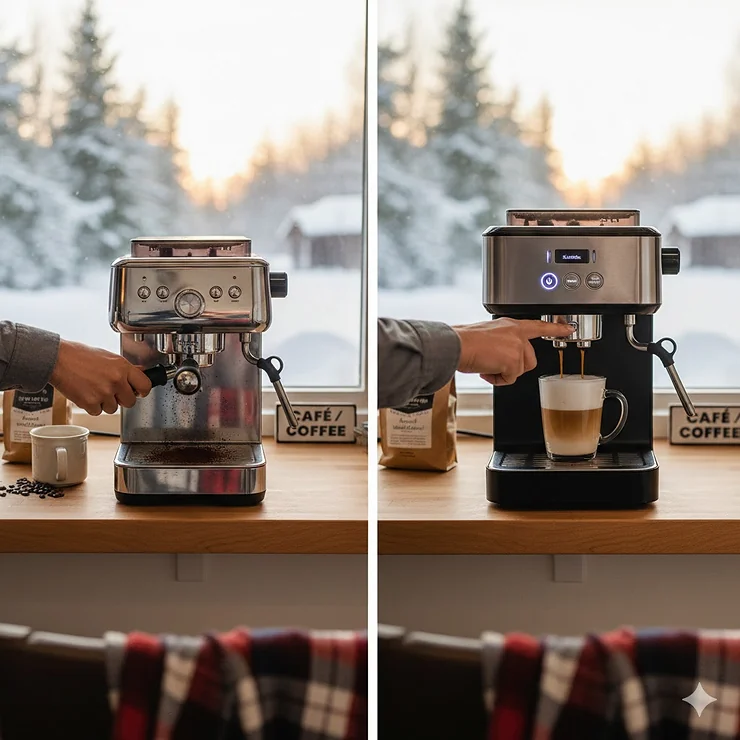
Semi-automatic machines give you the reins. You grind the beans, dose the portafilter, tamp with precision, lock it in, and press a button to start extraction. The machine provides consistent water pressure and temperature – everything else is your responsibility. Think of it like driving a manual transmission car: more engagement, more room for error, but also more satisfaction when you nail it.
The beauty of semi-automatic brewing lies in its infinite customization potential. Change your grind slightly finer? The shot slows down, intensifying flavours. Tamp harder? You’re adjusting flow rate and therefore extraction. Every variable becomes a lever you can pull to chase your perfect cup.
What Makes Super-Automatic Machines Different?
Super-automatic machines are the espresso world’s answer to the question: “Can’t we just push a button?” The answer is yes – but with surprising sophistication. These machines grind beans, dose precisely, tamp automatically, brew at optimal parameters, and often froth milk without any manual intervention. Some premium models even self-clean.
For busy Canadians rushing to work or managing households, this automation isn’t laziness – it’s practical engineering. Why spend 15 minutes learning to steam milk when the machine can do it identically every single time?
Which Espresso Machine Type Best Suits Your Lifestyle?
Choose Semi-Automatic If You:
- Actually enjoy the process of making coffee (it’s therapy, not a chore)
- Want to develop real barista skills
- Love tinkering with variables to perfect your recipe
- Have 10-15 minutes to dedicate to your morning coffee
- Value the ritual and craftsmanship aspect
- Don’t mind cleaning up grounds and milk residue
Choose Super-Automatic If You:
- Need consistent quality without the learning curve
- Value convenience above creative control
- Make multiple drinks throughout the day
- Prioritize easy cleanup and maintenance
- Want variety without manual technique mastery
- Share the machine with family members (user profiles!)
The Hybrid Sweet Spot
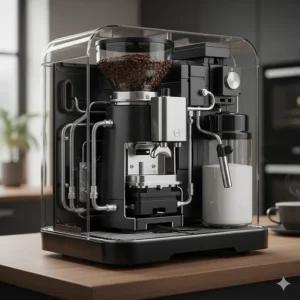
Machines like the Breville Bambino Plus and Gaggia Classic Pro occupy interesting middle ground. They’re technically semi-automatic but include features like automatic milk frothing or pre-infusion that simplify the process without eliminating hands-on involvement. For many Canadians, these represent the best compromise.
The Learning Curve: What to Expect
Semi-Automatic Timeline
Week 1: Your shots will be terrible. Too bitter, too sour, channeling issues. You’ll question your life choices. This is normal.
Week 2-3: You’ll start understanding grind size relationships. Your shots become drinkable. Milk frothing remains mysterious.
Week 4-6: Consistency arrives! You’re pulling decent shots regularly. Latte art attempts begin (prepare for swan-that-looks-like-blob phase).
Month 3+: You’re dangerous. You understand espresso theory, can troubleshoot issues, and friends start requesting your cappuccinos.
Super-Automatic Timeline
Day 1: Press button, receive excellent coffee. Adjust strength/temperature settings.
Week 1: You’ve memorized your favorite drinks and customized settings. Machine is already integrated into your routine.
Month 1+: Taking quality for granted. Exploring drink variations. Occasionally thinking “I wonder what it’s like to pull shots manually?”
Convenience vs Control: The Real Trade-Off
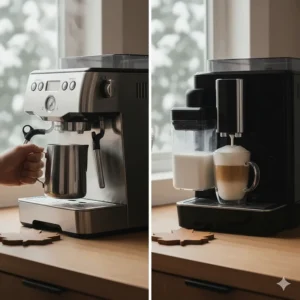
Here’s what nobody talks about: both approaches deliver excellent espresso. The difference is who’s doing the work.
With semi-automatic machines, you’re the variable. Master the technique, and you can outperform most super-automatics. Lack the time or interest? Your expensive machine becomes a countertop decoration.
Super-automatic machines remove human error from the equation. The coffee won’t get better as you “improve” because the machine was already optimized. But it also won’t get worse when you’re rushed, distracted, or trying a new bean.
For Canadian families, this often means the super-automatic gets used daily whilst the semi-automatic becomes a weekend hobby machine. There’s no shame in that – it’s about matching tools to lifestyle.
Coffee Customization Options Compared
Semi-Automatic Customization
You control:
- Grind size (infinite adjustment with quality grinder)
- Dose amount (typically 14-20g for double shot)
- Tamp pressure (affects flow rate)
- Extraction time (start/stop manually)
- Water temperature (on machines with PID)
- Milk texture (manual steam wand technique)
- Pre-infusion duration (advanced machines)
Super-Automatic Customization
You control:
- Coffee strength (usually 3-5 levels)
- Cup volume (small/medium/large)
- Milk ratio (in milk drinks)
- Temperature (2-3 settings typically)
- Grind size (preset options)
- User profiles (premium models)
The difference? Semi-automatic offers granular control over execution. Super-automatic offers broad control over parameters.
Price vs Value Analysis: Canadian Market 2026
| Price Range | Semi-Automatic Options | Super-Automatic Options |
|---|---|---|
| Budget ($200-$500 CAD) | CASABREWS CM5418, De’Longhi Dedica, Basic Gaggia | Entry-level unavailable (minimum $700+) |
| Mid-Range ($500-$1,000 CAD) | Breville Bambino Plus, Barista Express, Gaggia Classic Pro | Philips 3200, De’Longhi Magnifica Evo |
| Premium ($1,000-$2,500 CAD) | Breville Dual Boiler, Rocket Appartamento | Philips 5500, De’Longhi Dinamica Plus, Jura E8 |
Value Consideration: Don’t forget the grinder! Semi-automatic machines often require a separate grinder ($150-$400 CAD), whilst super-automatics include built-in burr grinders. Factor this into total cost.
Maintenance and Long-Term Costs
Semi-Automatic Maintenance
Daily: Backflush with water, wipe steam wand, empty drip tray Weekly: Deep clean portafilter and baskets, backflush with detergent Monthly: Descale (depending on water hardness) Cost: Descaling solution ($15-25/year), group head gasket replacement every 1-2 years ($10-20)
Canadian tip: Our municipal water varies wildly in hardness. Vancouver’s soft water is forgiving; Calgary and Regina’s hard water requires vigilant descaling. Invest in a water filter ($30-50) to extend machine life.
Super-Automatic Maintenance
Daily: Empty grounds container and drip tray, auto-clean milk system Weekly: Remove and clean brew group (2 minutes) Monthly: Descale cycle (machine prompts you) Cost: Descaling tablets ($25-40/year), water filters ($20-30 per filter), cleaning tablets ($15-25/year)
Super-automatics have more complex internal components, so follow the maintenance schedule religiously. Canadian humidity can cause issues if brew groups aren’t cleaned properly, especially in coastal regions.
Shipping and Availability in Canada
All machines featured are available through Amazon.ca with Prime shipping to most Canadian addresses. Typical delivery times:
- Major Cities (Toronto, Montreal, Vancouver, Calgary): 1-2 business days
- Smaller Cities: 2-4 business days
- Rural/Remote Areas: 5-10 business days
Warranty Note: Most manufacturers offer 1-2 year warranties in Canada. Register your machine immediately to activate coverage. Breville and De’Longhi have excellent Canadian customer service networks.
Coffee Culture Trends in Canada 2026
Espresso machine sales in Canada have surged 34% since 2023, driven partly by remote work normalization and rising café prices. Interestingly, super-automatic machines dominate in Ontario and Quebec (convenience culture), whilst British Columbia shows stronger semi-automatic preferences (coffee craft emphasis).
The Specialty Coffee Association of Canada reports that 67% of Canadian espresso machine buyers now prioritize milk-based drinks over straight espresso – explaining the popularity of machines with advanced milk systems like the Philips LatteGo technology.
FAQ
❓ How much should I budget for espresso machine and grinder in Canada?
❓ Can super automatic espresso machines match café quality?
❓ What's the lifespan of espresso machines in Canada?
❓ Do I need special beans for espresso machines?
❓ Can I use alternative milk in espresso machines?
Conclusion: Your Perfect Espresso Journey Awaits
After exploring semi automatic vs super automatic espresso machines, the verdict isn’t which is “better” – it’s which aligns with your daily reality. If mornings mean savouring the ritual of grinding, dosing, and perfecting each shot, semi-automatic machines offer unmatched satisfaction. If mornings mean juggling kids, meetings, and emails whilst desperately needing excellent coffee, super-automatic machines deliver without compromise.
For most Canadian households, I’d recommend starting with a quality super-automatic like the De’Longhi Magnifica Evo or Philips 3200 Series. Master consistent enjoyment first. Once you understand what you love in espresso, you can always add a semi-automatic machine for weekend experimentation.
Remember: the best espresso machine is the one you’ll actually use consistently. That $2,000 super-automatic gathering dust helps nobody, whilst a $400 semi-automatic used daily becomes invaluable.
Your journey toward café-quality home espresso doesn’t end with machine selection – it begins there. Invest in fresh beans, learn your water quality, and most importantly, enjoy the process. Canadian coffee culture is thriving, and you’re about to become part of something delicious.
✨ Don’t Miss These Exclusive Deals!
🔍 Take your espresso experience to the next level with these carefully selected products available in Canada. Click on any highlighted item above to check current pricing and availability on Amazon.ca. These machines will help you create authentic café-quality beverages your family and friends will love!
Recommended for You
- 7 Best Manual Espresso Machines Canada 2026
- 7 Best Espresso Machine Under $1000 Canada 2026
- 7 Best Portable Espresso Makers Canada 2026
Disclaimer: This article contains affiliate links to Amazon.ca. If you purchase products through these links, we may earn a small commission at no additional cost to you.
✨ Found this helpful? Share it with your friends! 💬🤗
