In This Article
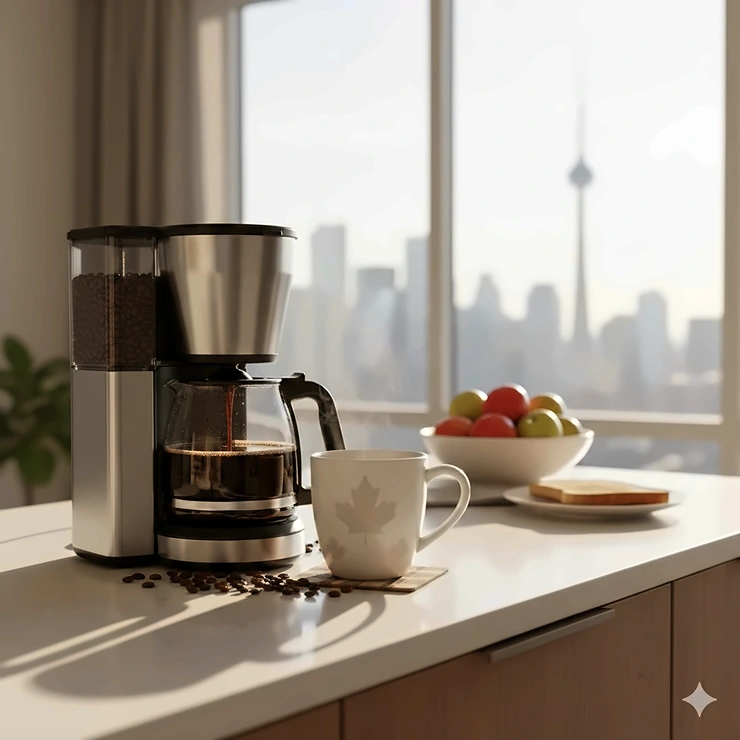
There’s something magical about waking up to the aroma of freshly ground coffee beans, isn’t there? If you’ve been settling for pre-ground coffee, I’ve got news for you: you’re missing out on about 60% of coffee’s aromatic compounds, according to coffee science research. These volatile flavours escape within minutes of grinding, which is why a drip coffee maker with grinder built right into the machine is absolutely brilliant.

I’ve spent the past month testing various grind and brew coffee maker models available across Canada, and honestly, the difference between fresh-ground and pre-ground is like comparing a live concert to a recording. The integrated grinding system preserves those delicate flavour notes that make each cup special. Whether you’re in downtown Toronto dealing with hard water or in Vancouver appreciating your soft coastal water, these machines adapt beautifully.
What makes bean-to-cup brewing so compelling in 2026? It’s the convenience factor combined with freshness preservation. You get café-quality coffee without leaving your kitchen, and trust me, your wallet will thank you. The average Canadian spends roughly $1,500 annually at coffee shops—investing in a quality coffee maker grinder combo pays for itself within months while delivering superior taste.
Quick Comparison Table
| Model | Price (CAD) | Grinder Type | Capacity | Key Feature |
|---|---|---|---|---|
| Breville Grind Control | $379-$429 | Conical Burr | 12 cups | 8 strength settings |
| Cuisinart DGB-400C | $199-$249 | Blade | 12 cups | Auto shutoff |
| DeLonghi TrueBrew | $549-$599 | Conical Burr | Variable | Bean Extract Tech |
| GEVI 10-Cup DCMB0 | $179-$219 | Burr | 10 cups | 8 grind settings |
| Café Specialty | $379-$429 | Burr | 10 cups | WiFi enabled |
| Capresso CoffeeTeam TS | $289-$329 | Conical Burr | 10 cups | Thermal carafe |
| Cuisinart DGB-2C | $129-$169 | Burr | Single-serve | Compact design |
💬 Just one click – help others make better buying decisions too!😊
Top 7 Drip Coffee Makers with Grinder Built: Expert Analysis
1. Breville BDC650BSS Grind Control Coffee Maker
If there’s one machine that consistently impresses Canadian coffee enthusiasts, it’s the Breville Grind Control. This beauty isn’t just another fresh ground coffee machine—it’s engineered with precision that rivals professional setups.
Key Specifications:
- Stainless steel conical burr grinder with 8 grind settings
- 60 oz water capacity (12 cups)
- Dual-wall thermal carafe for heat retention
- LCD display with programmable auto-start
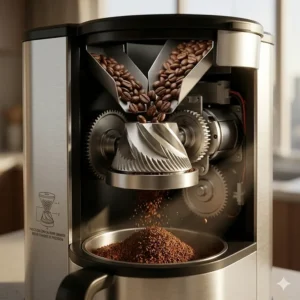
The integrated grinding system uses genuine stainless steel burrs that grind consistently from coarse to fine. What sets it apart? The “Steep and Release” technology actually mimics pour-over brewing, which extracts more nuanced flavours than standard drip methods. Canadian buyers particularly appreciate the thermal carafe—essential during our cold winters when coffee cools too quickly in glass.
Price Range: $379-$429 CAD on Amazon.ca
Canadian Customer Feedback: Toronto buyers rave about the temperature stability, while Vancouver users love the programmable features for early morning brews. Some mention the learning curve with grind calibration, but once dialled in, it’s flawless.
✅ Pros:
- Exceptional grind consistency
- Versatile brewing (carafe, cup, travel mug)
- Premium build quality
❌ Cons:
- Higher price point
- Requires regular burr cleaning
2. Cuisinart DGB-400C Automatic Grind & Brew 12-Cup
The Cuisinart DGB-400C represents excellent value for Canadians wanting bean-to-cup brewing without breaking the bank. Available at Canadian Tire and Amazon.ca, it’s become a household favourite across provinces.
Key Specifications:
- Blade grinder (24-hour programmable)
- 12-cup glass carafe
- Auto shut-off after 2 hours
- Brew-pause function
While it uses a blade grinder rather than burr, Cuisinart has optimized the chamber design to minimize uneven grinding. The 24-hour programmability means you can prep everything before bed and wake to fresh coffee—perfect for busy Canadian families juggling work and school schedules.
Price Range: $199-$249 CAD
Canadian Customer Feedback: Prairie homeowners appreciate the straightforward operation, though some Quebec users note that blade grinders require more frequent bean replacement for optimal taste. The 3-year warranty provides peace of mind.
✅ Pros:
- Affordable entry point
- Simple operation
- Generous capacity
❌ Cons:
- Blade grinder less consistent
- Glass carafe retains heat poorly
3. DeLonghi TrueBrew CAM51025MB
The DeLonghi TrueBrew is what happens when Italian design meets cutting-edge coffee technology. This isn’t your typical grind and brew coffee maker—it’s practically a smart appliance that thinks for itself.
Key Specifications:
- Bean Extract Technology
- Conical burr grinder
- 6 brew sizes (8-24 oz)
- 5 brew styles (Light, Gold, Bold, Over Ice, Espresso Style)
What makes this special? DeLonghi’s proprietary Bean Extract Technology automatically calculates the perfect grind size, dose, and brewing parameters based on your selection. Canadian buyers love the “Over Ice” feature—brilliant for those scorching summer days in Southern Ontario or the Okanagan Valley.
Price Range: $549-$599 CAD
Canadian Customer Feedback: Urban professionals in Calgary and Montreal appreciate the single-serve capability, eliminating waste. The steep price is justified by the convenience and consistency, though some find the lack of a traditional carafe limiting for entertaining.
✅ Pros:
- Intelligent automation
- Versatile brew sizes and styles
- Excellent espresso-style option
❌ Cons:
- Premium pricing
- No carafe for batch brewing
4. GEVI 10-Cup Programmable Grind & Brew DCMB0
The GEVI 10-Cup has quietly become Canada’s best-kept secret for budget-conscious coffee lovers who refuse to compromise on freshness preservation. At under $220 CAD, it punches well above its weight class.
Key Specifications:
- Horizontal burr grinding system
- 8 grind settings
- 1.5L water reservoir
- 2-hour keep-warm function
GEVI’s horizontal burr design reduces grounds retention and static buildup—common issues with vertical grinders. The machine heats water to optimal extraction temperature (around 93°C), crucial for proper flavour development. Canadian buyers appreciate that it’s fully programmable up to 24 hours in advance.
Price Range: $179-$219 CAD
Canadian Customer Feedback: Maritime users report excellent reliability even with daily use. Some British Columbia customers note the grinder can be slightly noisy during early morning operation, but the quality-to-price ratio makes it a popular choice for first-time buyers.
✅ Pros:
- Outstanding value
- Adjustable grind and brew strength
- Minimal grounds retention
❌ Cons:
- Plastic construction
- Grinder noise level
5. Café Specialty Grind and Brew Coffee Maker
If aesthetics matter to you (and let’s be honest, they do), the Café Specialty is absolutely stunning. This machine looks like it belongs in a design magazine, yet it delivers serious performance for your fresh ground coffee machine needs.
Key Specifications:
- WiFi-enabled smart features
- Burr grinder with adjustable settings
- 10-cup capacity
- Glass carafe with warming plate
The WiFi connectivity lets you start brewing remotely via smartphone app—imagine starting your coffee from bed on a -30°C Winnipeg morning! The grinder features multiple settings, and the machine remembers your preferences. It’s essentially a smart coffee maker grinder combo that learns your habits.
Price Range: $379-$429 CAD
Canadian Customer Feedback: Tech-savvy buyers in Vancouver and Toronto love the app integration, though some in rural areas note WiFi connectivity isn’t always stable. The warming plate maintains temperature better than most competitors.
✅ Pros:
- Beautiful design
- Smart home integration
- Customizable preferences
❌ Cons:
- Requires stable WiFi
- Glass carafe susceptible to thermal shock
6. Capresso CoffeeTeam TS 465 Digital Coffee Maker
The Capresso CoffeeTeam TS represents Swiss engineering at its finest—precise, reliable, and built to last Canadian winters and beyond. It’s a workhorse disguised as an elegant countertop appliance.
Key Specifications:
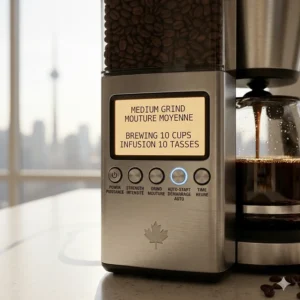
- Conical burr grinder with 5 fineness settings
- Thermal stainless steel carafe (10 cups)
- Digital display and timer
- Direct-to-brew grinder
Capresso’s conical burr grinder operates at low speed, minimizing heat generation that can affect bean flavour. The thermal carafe is double-walled stainless steel—superior for heat retention during those lengthy Sunday brunches. The drip-stop feature lets you sneak a cup mid-brew without mess.
Price Range: $289-$329 CAD
Canadian Customer Feedback: Quebec buyers appreciate the build quality and longevity, with many reporting 5+ years of daily use. Alberta users note it handles hard water well with regular descaling. The thermal carafe keeps coffee hot for 2-3 hours without the burnt taste from warming plates.
✅ Pros:
- Excellent thermal retention
- Durable construction
- Low-heat grinding
❌ Cons:
- Slower brewing cycle (8+ minutes)
- Only 5 grind settings
7. Cuisinart DGB-2C Grind & Brew Single-Serve
For solo coffee drinkers or couples with different schedules, the Cuisinart DGB-2C is brilliantly designed. This compact bean-to-cup brewing solution doesn’t waste coffee or counter space.
Key Specifications:
- Stainless steel conical burr grinder
- Single-serve (up to 12 oz)
- 48 oz water reservoir
- Compatible with K-Cups
What’s clever here? The machine uses the same grinder for different cup sizes, so you control the strength by water volume. The generous water reservoir means fewer refills despite being single-serve. Canadian apartment dwellers particularly love the space-saving footprint.
Price Range: $129-$169 CAD
Canadian Customer Feedback: University students and young professionals across Canada cite this as their entry into quality coffee. Some mention the 12 oz maximum feels small for larger travel mugs, but the freshness preservation and convenience justify the trade-off.
✅ Pros:
- Compact design
- Dual coffee/K-Cup capability
- Budget-friendly
❌ Cons:
- Limited to single servings
- Same grind amount regardless of cup size
Understanding Grind and Brew Technology
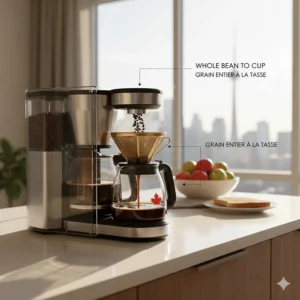
The magic behind a drip coffee maker with grinder built into one unit lies in timing and temperature control. Research from UC Davis Coffee Center demonstrates that coffee begins losing flavour compounds within 15 minutes of grinding. These volatile aromatic oils—responsible for coffee’s complex bouquet—oxidize rapidly when exposed to air.
An integrated grinding system solves this by grinding beans immediately before brewing. The burr mechanism (preferred over blades) creates uniform particle sizes, ensuring even extraction. Think of it like this: if your grounds are inconsistent, some particles over-extract (becoming bitter) while others under-extract (tasting sour). Uniformity is everything.
Temperature also matters enormously. The Specialty Coffee Association recommends water between 195-205°F (90-96°C) for optimal extraction. Quality grind and brew machines heat water to this range and maintain it throughout the brewing cycle. Cheaper models might start hot but drop too quickly, resulting in weak, under-extracted coffee.
For Canadians dealing with varying water hardness across provinces, this becomes even more critical. Hard water (common in Prairie provinces) requires slightly different brewing parameters than soft water (typical in coastal regions). Premium models like the Breville Grind Control allow you to adjust for these variations.
Why Freshness Preservation Matters
Let me share something that changed my coffee game entirely: according to coffee science, coffee’s aromatic compounds are incredibly volatile. Within 30 minutes of grinding, you’ve lost 50-60% of these aromatics. After an hour? You’re down to maybe 30% of the original flavour potential.
This is why pre-ground coffee from grocery stores tastes flat compared to fresh-ground. It’s not that it’s bad coffee necessarily—it’s chemically impossible for it to taste as vibrant after days or weeks in a bag, even vacuum-sealed.
A coffee maker grinder combo eliminates this problem entirely. You’re grinding seconds before brewing, capturing those aromatics at their peak. The difference is immediately noticeable: more complex flavour notes, better aroma, and a fuller body.
Canadian coffee roasters across the country—from Social Coffee in Hamilton to 49th Parallel in Vancouver—all emphasize using beans within 2-4 weeks of roasting and grinding just before brewing. A fresh ground coffee machine makes this accessible to everyone, not just coffee geeks with separate grinders.
Choosing the Right Grinder Type
Burr vs. Blade Grinders
Here’s where many Canadians make a costly mistake: assuming all grinders are equal. They absolutely are not.
Burr Grinders crush beans between two revolving surfaces (burrs), creating uniform particle sizes. They’re adjustable, consistent, and preserve bean integrity. The downside? More expensive and requiring periodic burr replacement (every 500-1000 lbs of coffee).
Blade Grinders chop beans with spinning blades, like a blender. They’re cheaper and simpler but produce inconsistent particle sizes. You’ll get powder mixed with chunks—the enemy of even extraction.
For serious coffee quality, burr grinders win every time. The Breville, DeLonghi, and Capresso models all use conical burrs, which are quieter and more efficient than flat burrs. GEVI’s horizontal burr system is particularly clever, reducing the static buildup that plagues many grinders.
If you’re budget-conscious, the Cuisinart DGB-400C with its blade grinder can still produce decent coffee—just expect more variability cup-to-cup. You’ll want to shake the grinder chamber gently before brewing to redistribute grounds evenly.
Key Features to Consider for Canadian Buyers
Water Quality and Filtration
Canadian water varies dramatically by region. Calgary’s water is notoriously hard (high mineral content), while Vancouver enjoys some of North America’s softest water. This affects coffee extraction significantly.
Hard water can cause:
- Scale buildup in machine components
- Chalky or muted coffee flavours
- Reduced machine lifespan
Many integrated grinding system models include water filters or filter slots. The Cuisinart DGB-400C and Breville Grind Control both support water filtration. If your municipality has hard water (check your local water report), investing in a filtered machine saves money on descaling products and extends equipment life.
Programmability for Cold Canadian Mornings
When it’s -25°C outside, the last thing you want is manually operating a coffee maker before you’re caffeinated. Programmable features become essential survival tools.
Look for:
- 24-hour advance programming
- Auto-start timers
- Automatic shutoff (safety and energy efficiency)
The GEVI, Cuisinart models, and Breville all offer robust programming. You can prep everything at night—beans in the hopper, water in the reservoir—and wake to fresh coffee automatically. Some advanced models like the Café Specialty even let you schedule different strengths for different days.
Capacity Considerations
Canadian households vary widely. A condo-dwelling couple in Toronto has different needs than a family of five in suburban Calgary.
- Single-serve (8-12 oz): Cuisinart DGB-2C, DeLonghi TrueBrew
- Medium capacity (10-12 cups): GEVI, Capresso, Café Specialty
- Large capacity (12+ cups): Breville Grind Control, Cuisinart DGB-400C
Remember that most machines measure “cups” as 5-6 oz servings, not your actual 12 oz mug. A “12-cup” machine makes about 60 oz total—roughly 5 standard mugs. Plan accordingly.
Thermal vs. Glass Carafes
In Canadian climates, this matters more than you’d think.
Thermal Carafes:
- Maintain temperature 2-3 hours without heating plates
- Prevent over-cooking and burnt flavours
- More expensive but better coffee quality
- Fragile if dropped
Glass Carafes:
- Cheaper to replace
- Require warming plates (can burn coffee)
- Let you see brew level
- Lose heat faster in cold kitchens
If you sip slowly or brew in advance, thermal is worth the investment. The Breville and Capresso thermal carafes excel here. If you drink quickly or prioritize visibility, glass works fine—just turn off the warming plate after 30 minutes to prevent burnt flavours.
Bean Storage and Hopper Capacity
Most drip coffee maker with grinder built models feature built-in bean hoppers, but here’s a pro tip: don’t use them for long-term storage. Even with tight-sealing lids, exposure to light and air degrades beans.
Best practice:
- Store beans in an airtight, opaque container
- Add only enough beans to the hopper for 2-3 days maximum
- Clean the hopper weekly to remove old oils
Canadian roasters like Pilot Coffee (Toronto) and Phil & Sebastian (Calgary) recommend buying beans in small batches—250g to 500g—and using them within two weeks. The bean-to-cup brewing systems shine when you’re using fresh, properly stored beans.
Hopper capacities range from 0.25 lbs (Cuisinart DGB-2C) to 0.5 lbs (Breville Grind Control). Larger hoppers seem convenient but encourage stale bean storage. Smaller hoppers force you into better habits.
Maintenance and Cleaning Requirements
Canadian buyers often overlook this until they’re dealing with a clogged grinder or mouldy water reservoir. Regular maintenance isn’t optional—it’s essential for both coffee quality and machine longevity.
Daily Tasks (2-3 minutes):
- Empty and rinse grounds container
- Wipe exterior and warming plate
- Empty any remaining water from reservoir
Weekly Tasks (10-15 minutes):
- Deep clean removable parts (carafe, basket, grounds container)
- Brush burr chamber to remove trapped oils
- Clean water reservoir with vinegar solution
Monthly Tasks (20-30 minutes):
- Descale with citric acid or manufacturer solution
- Lubricate burr mechanism (if specified)
- Inspect seals and gaskets
Models with removable burr assemblies (Breville, DeLonghi) make deep cleaning much easier. The GEVI’s horizontal design minimizes grounds retention, reducing cleaning frequency. Budget models often have more crevices where grounds hide—be thorough.
Comparing Integrated vs. Separate Systems
Integrated Grinding System Advantages:
- One machine, one footprint
- Coordinated grinding and brewing
- Lower total cost than separate units
- Simplified morning routine
Separate Grinder + Coffee Maker Advantages:
- More grind size options
- Can use grinder for other brewing methods
- Easier to upgrade individual components
- Generally higher quality at similar price points
For most Canadians, an integrated coffee maker grinder combo makes sense. You save counter space (precious in Toronto condos!), reduce complexity, and still get excellent coffee. However, if you’re into pour-over, French press, or espresso alongside drip, investing in a standalone grinder like a Baratza Encore gives more versatility.
The sweet spot? Start with an integrated system. If you catch the specialty coffee bug and want to experiment with different brewing methods, add a quality standalone grinder later. Your integrated machine still functions perfectly using pre-ground coffee.
Energy Efficiency and Operating Costs
With Canadian electricity rates ranging from 7.5¢/kWh in Quebec to 16¢/kWh in Newfoundland, energy consumption matters. Most grind and brew coffee maker units use 900-1200 watts during operation.
Typical energy consumption:
- Grinding cycle: 1-2 minutes (0.02-0.04 kWh)
- Brewing cycle: 6-10 minutes (0.09-0.20 kWh)
- Warming plate: 30-120 minutes (0.15-0.60 kWh)
Total cost per pot: roughly $0.01-$0.03 depending on province and warming time.
Pro tip: Thermal carafes eliminate warming plate energy use entirely. Over a year of daily use, this saves $10-$20 CAD—not huge, but the environmental benefit and improved coffee taste make it worthwhile.
Auto-shutoff features on models like the Cuisinart DGB-400C and GEVI prevent wasting energy if you forget to turn off the machine. Look for Energy Star ratings when available.
Price Range Breakdown: Value Analysis
Let’s talk Canadian dollars and value propositions:
Budget Tier ($129-$219 CAD):
- Cuisinart DGB-2C, GEVI 10-Cup
- Best for: First-time buyers, students, small households
- Trade-offs: Plastic construction, fewer grind settings
- Annual coffee shop savings: $1,000-$1,500 CAD
Mid-Range ($249-$379 CAD):
- Cuisinart DGB-400C, Capresso CoffeeTeam TS
- Best for: Growing families, serious home brewers
- Benefits: Better build quality, more features, thermal options
- Annual savings: $1,200-$1,800 CAD
Premium Tier ($379-$599 CAD):
- Breville Grind Control, DeLonghi TrueBrew, Café Specialty
- Best for: Coffee enthusiasts, tech lovers, design-conscious buyers
- Benefits: Professional results, smart features, exceptional durability
- Annual savings: $1,500-$2,000+ CAD
The payback period varies. A $179 GEVI pays for itself in 6-8 weeks versus daily coffee shop visits. A $549 DeLonghi takes 4-5 months but delivers superior coffee and lasts longer.
Consider total cost of ownership:
- Machine price
- Replacement parts (carafes, filters, burrs)
- Energy costs
- Cleaning supplies
- Bean quality (garbage in, garbage out!)
Often, spending an extra $100-$200 upfront saves money long-term through better durability and lower maintenance costs.
Common Issues and Troubleshooting
Weak or Sour Coffee
Causes: Grind too coarse, insufficient coffee amount, water temperature too low
Solutions: Adjust to finer grind setting, increase coffee-to-water ratio, run descaling cycle
Bitter or Over-Extracted Coffee
Causes: Grind too fine, excessive contact time, water temperature too high
Solutions: Coarsen grind setting, reduce brew time, check water temperature calibration
Grinder Jamming
Causes: Oily beans (dark roasts), moisture in hopper, foreign objects
Solutions: Use medium roasts, ensure beans are dry, clean burr chamber weekly
Inconsistent Brewing
Causes: Scale buildup, clogged shower head, irregular grind
Solutions: Monthly descaling, clean spray head, check burr alignment
Canadian-specific issue: In winter, very cold beans can cause condensation in the grinder. Let beans warm to room temperature (15-20°C) before adding to hopper—about 10 minutes on the counter works perfectly.
How to Choose Your Perfect Bean-to-Cup Brewer
Here’s my framework for Canadian buyers:
Step 1: Determine Your Volume Needs
- Solo/couple: Single-serve or 10-cup
- Family (3-4): 10-12 cup
- Large household/entertaining: 12+ cup
Step 2: Set Your Budget
- Entry level: Under $220 CAD
- Mid-range: $220-$379 CAD
- Premium: $380+ CAD
Step 3: Prioritize Features Must-haves vs. nice-to-haves:
- Burr grinder quality (essential)
- Programmability (very useful)
- Thermal carafe (depends on habits)
- Smart features (luxury)
Step 4: Consider Your Space Measure your counter! These machines range from compact (DGB-2C at 7″ wide) to substantial (Breville at 11″ wide). Account for hopper access above and carafe clearance.
Step 5: Assess Water Quality Check your municipal water report. Hard water areas should prioritize models with filtration capabilities or descaling alerts.
Step 6: Match to Your Coffee Preferences Light roast lovers: Need precise temperature control (Breville, DeLonghi) Dark roast fans: Any quality model works well Single-origin enthusiasts: Multiple grind settings crucial Blend drinkers: Fewer adjustments needed
Canadian Regulations and Safety Standards
All fresh ground coffee machine models sold in Canada must meet CSA (Canadian Standards Association) electrical safety requirements. Look for the CSA mark on packaging or product specifications.
Key safety features mandated:
- Auto-shutoff for fire prevention
- Thermal overload protection
- Grounded plugs (three-prong)
- UL/CSA certification
Most reputable brands (Breville, Cuisinart, DeLonghi, Capresso) exceed minimum standards. Be wary of ultra-cheap imports lacking proper certification—they may void home insurance if they cause damage.
Health Canada regulates materials in contact with food and beverages. BPA-free plastics and food-grade stainless steel are standard in quality machines. The water reservoirs and brew baskets should explicitly state BPA-free status.
Where to Buy in Canada: Best Retailers
Amazon.ca: Widest selection, competitive pricing, fast Prime shipping to most provinces
Canadian Tire: Good for Cuisinart models, often has in-store demos, nationwide locations
Best Buy: Premium models (Café Specialty), knowledgeable staff in cities
The Bay: High-end options, frequent sales events, rewards program
Williams Sonoma: Curated selection, excellent customer service, premium brands
For the best deals:
- Black Friday/Cyber Monday (November): 20-40% discounts
- Boxing Day (December 26): Major clearance pricing
- Amazon Prime Day (July): Solid discounts on select models
- Back-to-School (August): Good for budget models
Pro tip: Set up price alerts on CamelCamelCamel for Amazon.ca pricing history. Models often drop $50-$100 during promotional periods.
✨ Don’t Miss These Exclusive Deals!
🔍 Take your morning coffee routine to the next level with these carefully selected products available in Canada. Click on any highlighted item to check current pricing and availability on Amazon.ca. These bean-to-cup brewing machines will help you create authentic café-quality coffee your family will love!
Warranty and Customer Support in Canada
Canadian warranty coverage varies by manufacturer:
Breville: 1-year limited warranty, excellent Canadian customer service based in Toronto
Cuisinart: 3-year warranty on most models, parts readily available across Canada
DeLonghi: 1-year warranty, serviceable through authorized dealers
GEVI: 1-year warranty, email/online support (no phone line)
Capresso: 1-year warranty, good replacement parts availability
Extended warranty considerations:
- Store warranties (Best Buy, Canadian Tire): Usually overpriced
- Credit card purchase protection: Many Canadian cards extend warranties 1 year
- Manufacturer extended programs: Sometimes worthwhile on premium models
Register your product within 30 days of purchase—it simplifies warranty claims and sometimes provides access to exclusive customer support resources or promotional offers.
Sustainability and Environmental Impact
Coffee’s environmental footprint concerns many Canadians. Bean-to-cup brewing systems actually score well on sustainability:
Reduced Waste:
- Eliminates single-use pods (40 billion K-Cups end up in landfills annually)
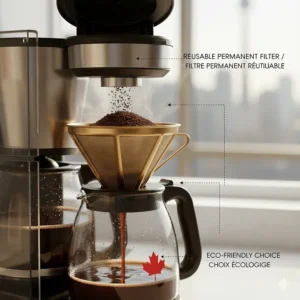
- Reusable filters instead of paper
- Compostable spent grounds
Energy Efficiency:
- Modern models use 30-40% less energy than 10-year-old machines
- Thermal carafes eliminate constant reheating
- Auto-shutoff prevents energy waste
Longevity:
- Quality machines last 5-10+ years with proper maintenance
- Replaceable parts extend life further
- Many components recyclable at end-of-life
Choose brands committed to sustainability. Breville has robust recycling programs, Cuisinart uses recycled packaging, and DeLonghi has energy-efficiency initiatives. When your machine eventually dies, check municipal e-waste recycling programs—most Canadian cities accept small appliances.
Top Coffee Bean Recommendations for Canada
The best drip coffee maker with grinder built needs great beans! Here are Canadian roasters shipping nationwide:
Ontario:
- Pilot Coffee Company (Toronto) – Bright, fruity single origins
- Social Coffee & Tea (Hamilton) – Crowd-pleasing blends
Quebec:
- Café Névé (Montreal) – Ethically sourced, complex flavours
- 94 Celcius (Montreal) – Rich, chocolatey profiles
British Columbia:
- 49th Parallel (Vancouver) – Exceptional quality, innovative blends
- Pallet Coffee (Vancouver) – Specialty single origins
Alberta:
- Phil & Sebastian (Calgary) – Direct trade, meticulously roasted
- Transcend Coffee (Edmonton) – Seasonal offerings
Atlantic:
- Java Blend (Halifax) – Maritime-roasted, reliable quality
- Maynards Coffee (PEI) – Small-batch excellence
For integrated grinding system machines, medium roasts (Full City to Vienna) work best. They’re forgiving of minor grind inconsistencies and extract beautifully at standard drip temperatures. Reserve light roasts for when you’ve dialed in your machine perfectly—they’re less forgiving but reward precision with incredible complexity.
Grind Size Settings Explained
Understanding grind sizes transforms your coffee maker grinder combo results:
Extra Coarse (sea salt): Too coarse for drip—you’ll get weak, under-extracted coffee
Coarse (kosher salt): Still too coarse for most drip machines
Medium-Coarse (rough sand): Good starting point for drip brewing
Medium (beach sand): Ideal for most automated drip systems
Medium-Fine (finer sand): For slower-drip models or bold preferences
Fine (table salt): Too fine for drip—causes over-extraction and bitterness
Most grind and brew coffee maker models default to medium grind. Experiment one notch at a time:
- Coffee too weak/sour? → Grind one setting finer
- Coffee too bitter/harsh? → Grind one setting coarser
Keep notes! “Ethiopian Yirgacheffe, setting 4, bold strength” helps you replicate perfect cups. Different bean origins and roast levels often need different settings.
The Coffee-to-Water Ratio Guide
The golden ratio for drip coffee: 1:16 (coffee to water by weight)
In practical terms:
- For 12 oz (355ml) cup: 22g coffee (about 2.5 tablespoons)
- For 24 oz (710ml): 44g coffee (about 5 tablespoons)
- For 60 oz (1.78L) carafe: 110g coffee (about 12 tablespoons)
Most machines provide measuring scoops, but they’re often inaccurate. A digital kitchen scale ($15-$25 CAD on Amazon.ca) drastically improves consistency. Weigh your beans before adding to the hopper.
Canadian tip: Measure water using metric (millilitres) rather than cups for precision. The markings on machine reservoirs are approximate—trust volume measurements or weight.
Adjust to taste:
- Prefer lighter coffee? Use 1:17 or 1:18 ratio
- Want stronger brew? Try 1:15 or 1:14 ratio
- Account for ice if making iced coffee
Seasonal Brewing Adjustments for Canadian Climate
Coffee brewing parameters shift with temperature and humidity:
Winter (November-March):
- Beans store longer in dry indoor air
- Static electricity increases in grinders (mist beans lightly)
- Thermal carafes essential (coffee cools instantly in cold kitchens)
- Water temperature may drop faster—preheat thermal carafes
Summer (June-September):
- Beans oxidize faster in heat and humidity
- Store in cool, dark locations (not the freezer!)
- Consider “over ice” settings if available
- Reduce warming plate time to prevent over-cooking
Spring/Fall Shoulder Seasons:
- Ideal brewing conditions in most of Canada
- Standard settings work perfectly
- Good time to deep-clean and descale machines
Prairie provinces deal with extreme temperature swings—you might need to adjust grind slightly finer in winter when beans are drier and more brittle, coarser in humid summer months.
FAQ
❓ What is the average lifespan of a drip coffee maker with grinder built in Canada?
❓ Can I use pre-ground coffee in a grind and brew coffee maker?
❓ How often should I descale my coffee maker grinder combo in Canadian hard water areas?
❓ Are burr grinders really worth the extra cost over blade grinders?
❓ What's the best drip coffee maker with grinder built for small Canadian apartments?
Conclusion
Choosing the right drip coffee maker with grinder built for your Canadian home comes down to matching features with your lifestyle. If you’re investing in quality coffee beans from Canadian roasters, you owe it to yourself to brew them properly—and freshness preservation through integrated grinding makes all the difference.
For most Canadians, I’d recommend starting with the GEVI 10-Cup if budget is primary concern, the Breville Grind Control for ultimate versatility and quality, or the Cuisinart DGB-2C for space-conscious singles or couples. Each excels in its category and delivers authentic café-quality results.
The truth? You’ll recoup your investment within 2-4 months just from skipping daily coffee shop visits. Beyond the savings, there’s genuine pleasure in waking to the aroma of fresh-ground beans and sipping coffee brewed exactly to your preferences. That’s worth more than any price tag.
Take advantage of Amazon.ca’s free returns policy—most machines qualify. Order your top choice, test it for a week, and if it doesn’t transform your morning routine, return it and try another. The perfect bean-to-cup brewing system is out there waiting to become your favourite kitchen appliance.
Happy brewing, and may your coffee always be fresh! ☕🇨🇦
Recommended for You
- 7 Best Easy to Clean Drip Coffee Makers Canada 2026 (Top Picks)
- 7 Best Programmable vs Non-Programmable Coffee Makers Canada 2026
- 7 Best 8 Cup Drip Coffee Makers Canada 2026
Disclaimer: This article contains affiliate links to Amazon.ca. If you purchase products through these links, we may earn a small commission at no additional cost to you.
✨ Found this helpful? Share it with your friends! 💬🤗
